NKN: Paving a New Network for Web 3.0

The following report was written by Messari Hub Analyst(s) and commissioned by NKN, a member of Messari Hub. For additional information, please see the disclaimers following the article
Long before Google, before Amazon, before Wikipedia or the other essential services we use in our day-to-day life, there was merely an experiment. And on an otherwise unassuming February morning in 1995, Newsweek declared the experiment a failure. In a piece titled “Why the Web Won’t Be Nirvana,” one of the news magazine’s writers outlines several flaws to the world’s most successful network: too expensive, too slow, too complicated – all criticisms those building in blockchain recognize today.
Of course, two and a half decades later, the Internet got cheaper, got faster, and became accessible for even the most technologically challenged among us. Some call the progress made in those 26 years the advancement from a static web to a social web, or the paradigm shift from Web 1.0 to Web 2.0. Creations like search algorithms and the invention of web-purposed languages like Javascript enabled developers to build interactive platforms for users, greatly enhancing the usability of the Internet.
Yet while much is improved, lingering challenges still remain. Politicians threatening to repeal net neutrality laws, inefficiencies across bandwidth usage, Internet censorship, and limited privacy protections are a few of the hurdles remaining today. Thus, continued efforts to build upon Web 2.0 have led to the recent emergence of what pioneers are calling Web 3.0.

Source: “Silicon Valley” TV Series
Setting the Stage for Web 3.0
Web 3.0 can be best characterized by its purpose: To build a more autonomous, intelligent, and open network for all. Given the focus on building a free network, one of the key goals of this network is to move away from central servers. Gone are the days of managed repositories storing data; replacing them are the decentralized protocols familiar to those in the crypto space.
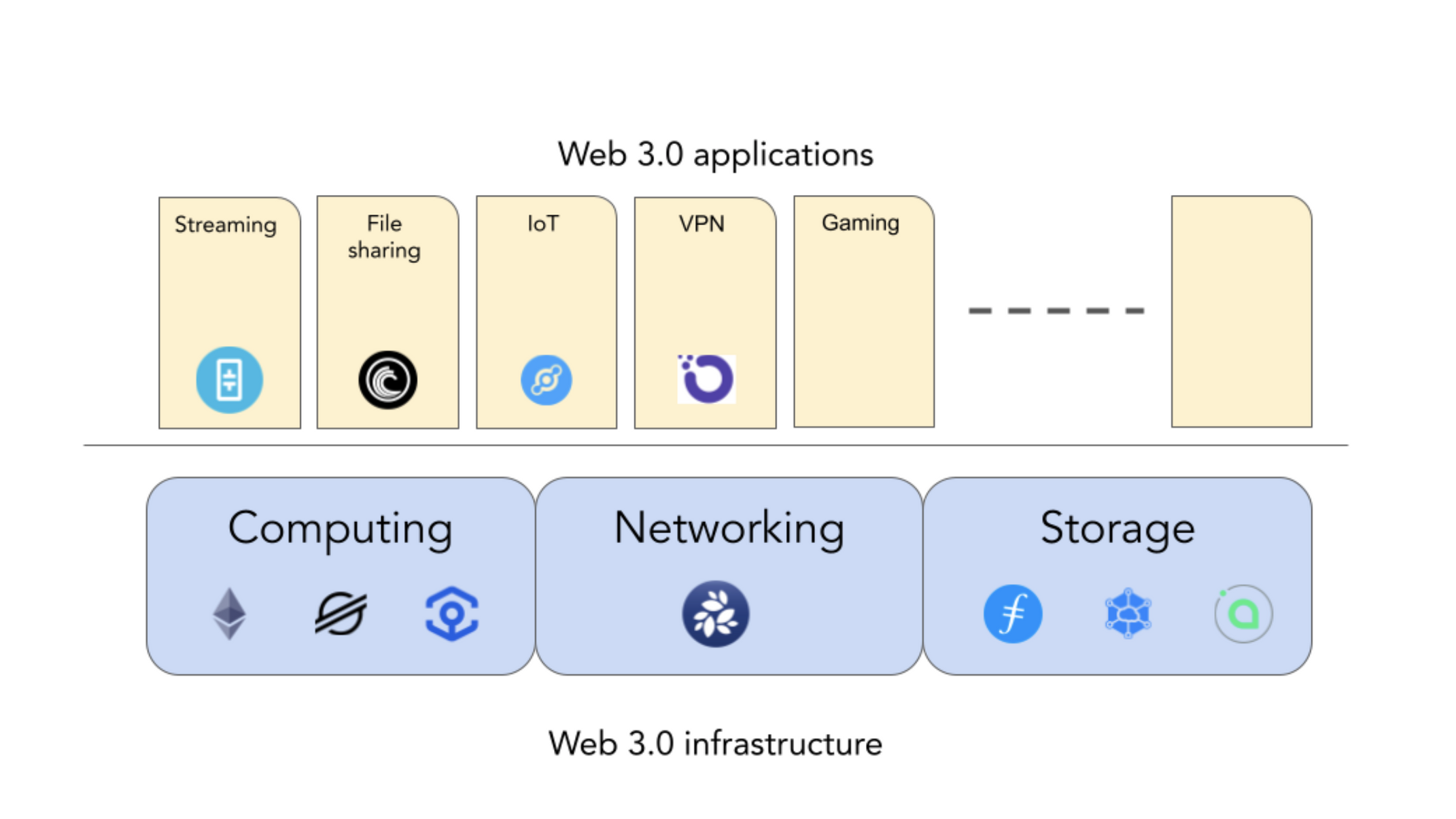
One way to think about the infrastructure for such a blockchain-based Web 3 is to imagine three pillars: Computing, storage, and networking. Ethereum and other smart contract platforms handle the first component; Filecoin, IPFS, Arweave, and Sia are prominent solutions for storage; what remains is a new networking layer.
Source: NKN/Binance AMA
New Kind of Network, or NKN, describes itself as the third pillar. Created in 2018, the vision for a new networking layer was spurred by three co-founders based on their decades of telecoms experience. Both co-CEOs, Yanbo Li and Bruce Li, worked at major telecom companies like Google, Nokia, and Baidu prior to starting NKN. Yanbo Li also built OnChain, the enterprise version of the NEO blockchain. The team’s CTO, Yilun Zhang, holds a PhD in Physics with a focus on a subset of computation theory called cellular automata, used by the team for its blockchain consensus algorithm. It is noteworthy to mention Stephen Wolfram (creator of the popular computational engine, Wolfram Alpha) and Whitfield Diffie (inventor of public key cryptography) are advisors to the trio of co-founders, rounding out a group of credentialed individuals.
A New Network
The premise of NKN is a blockchain-based P2P network connectivity protocol designed to upgrade the modern client-server Internet infrastructure. NKN’s network sits on top of the current Internet stack and allows users to participate through their own Internet-enabled devices. Linking devices together overlays a new network layer above what exists today, bringing the privacy and censorship-resistant features notable from decentralization.
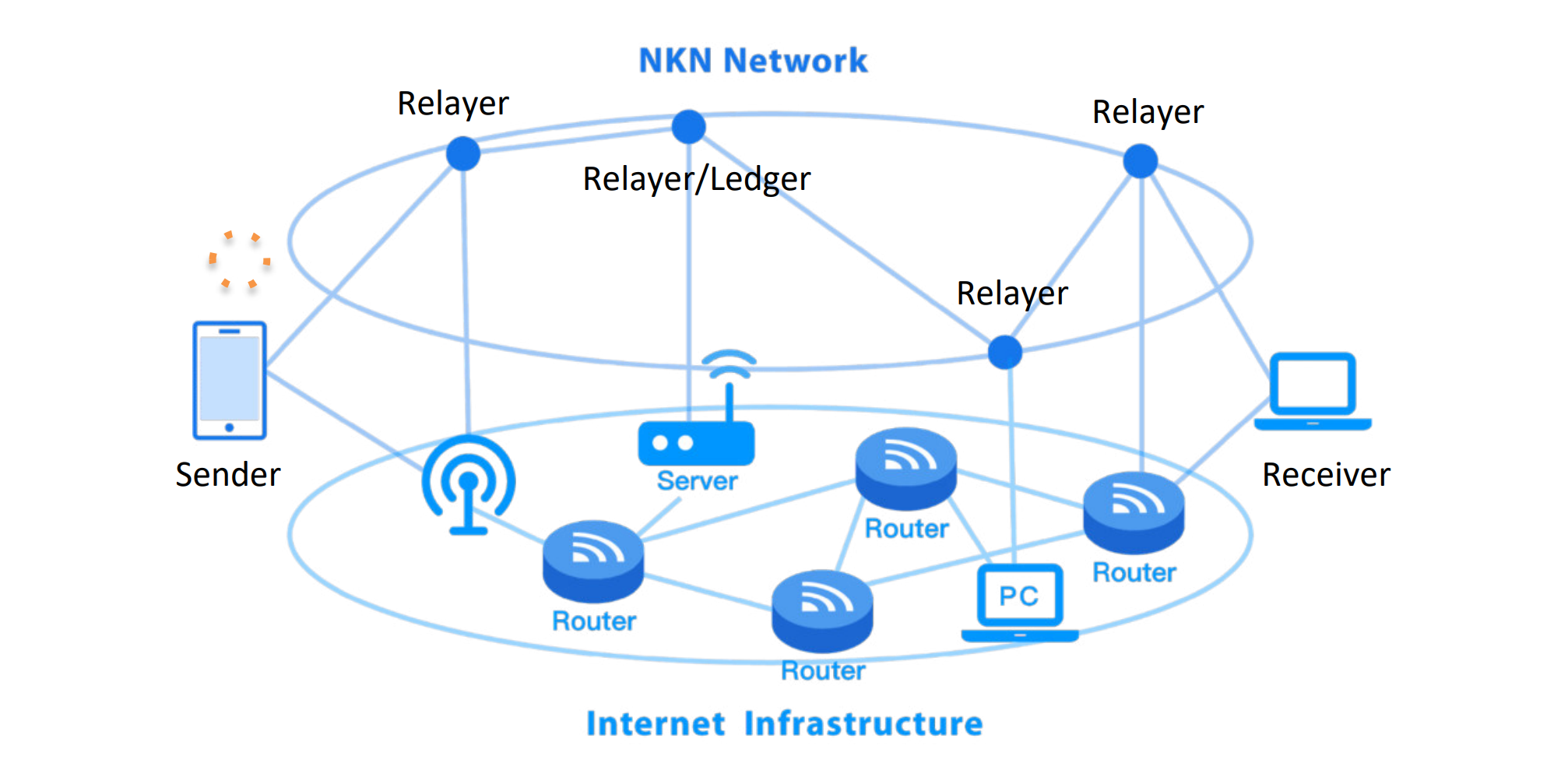
Let’s reiterate here NKN isn’t attempting to create a new Internet, at least for now. Instead, NKN hopes to leverage unused Internet bandwidth in a manner which reduces the risk of centralized points of server failure. A visual of the NKN network is displayed below. Which begs the question: How does this network work?
Source: NKN November 2020 Overview Pitch Deck
To start, every device connected to the NKN network can be placed into two categories: (1) nodes and (2) clients. Nodes are full participants. They send and receive data, but most importantly, transfer data to neighbor nodes. Those operating nodes, called miners, strengthen the network and are given monetary rewards in $NKN for their contribution. Meanwhile, client devices can do everything except pass along data in the network. Think of them as the end users. In the diagram above, the nodes are labeled relayers. Clients can send data to another through a path of relayers in a manner easily verifiable on the blockchain.
Nodes also help the network achieve consensus through an algorithm called Majority Voting Cellular Automata, or MOCA. In simple terms, MOCA requires nodes to only communicate, or transfer data, with neighbor nodes instead of the whole network. This process is operated through a proof of work algorithm called Proof of Relay (PoR). Designed to be verifiable and untamperable, PoR is crucial to NKN’s network as the consensus algorithm that calculates each node’s mining rewards. Nodes constantly running on the network pass along more data and earn higher rewards. With MOCA and PoR, global consensus is achieved quicker due to reduced communication burdens. This allows for the scaling of the network.
Once a client or node has accessed the NKN network, anonymized NKN network-specific addresses are assigned at random. These serve as replacements to IP addresses in the traditional TCP/IP architecture, ensuring no Internet IP address needs to be exposed when clients communicate with each other.
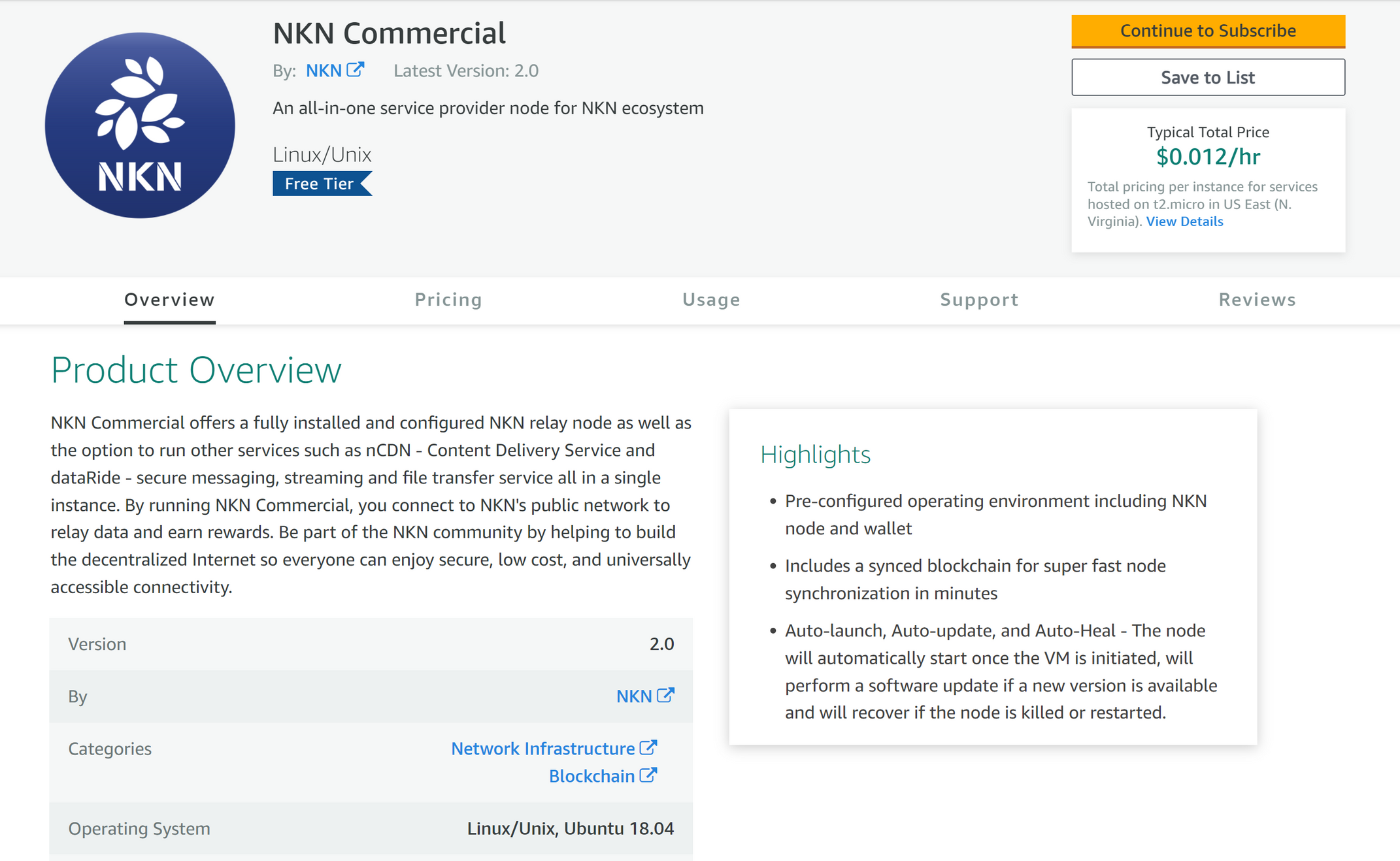
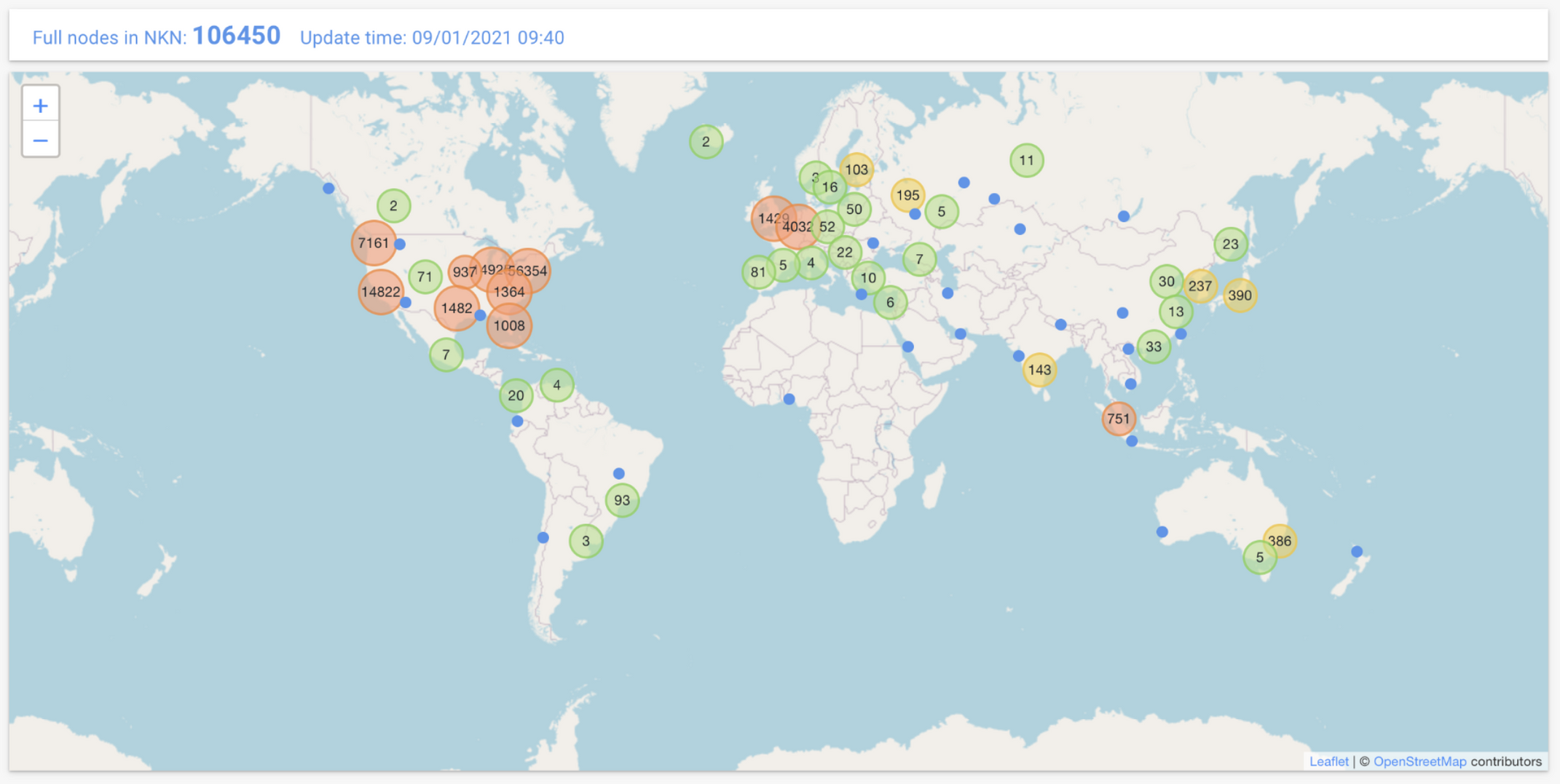
Due to the ubiquity of Internet-connected devices, the number of nodes in the network is vast. As of September 2021, NKN boasts over 106,000 full consensus nodes on its mainnet, one of the highest node counts of any blockchain network. However, it is worth mentioning many of these are operated through NKN’s partnerships with AWS and Digital Ocean, which allow for one-click deployments of nodes. As NKN nodes on AWS fall under the cloud provider’s free-tier list, users can operate a node for 750 hours without any cost, followed by a low fee of $0.012 per hour. Similarly, Digital Ocean allows users to operate relay nodes for free for multiple months. This introduces a higher degree of reliance on third-party service providers. Using this system, NKN makes the tradeoff between new infrastructure for the convenience of bootstrapping a network of relayers.The same isn’t the case for Bitcoin and Ethereum, rendering direct comparisons of node counts between the various blockchains an apples to oranges situation.
Source: AWS Marketplace
That said, a high number of nodes is, of course, desirable in any blockchain system, but it’s especially important for NKN. Since NKN is a utility blockchain, more nodes correlate with increased network capacity and speed. This means the NKN network can deliver high-quality content, such as 4K UHD video streams, to millions of clients. As the network scales, its capability to serve the entire planet grows.
Most of NKN’s 106,000+ nodes today are currently located in the United States, Europe, and other regions where Internet infrastructure is strong. Not surprisingly, there is also a strong correlation between where node clusters occur and where known cloud servers are located. But NKN’s technology is well-suited for those in developing countries and places without robust infrastructure. Regions like Africa and South America are relatively underutilized. Moving forward, growing in these markets is a challenge with huge payoffs for NKN.
Source: NKN Monthly Report - August 2021
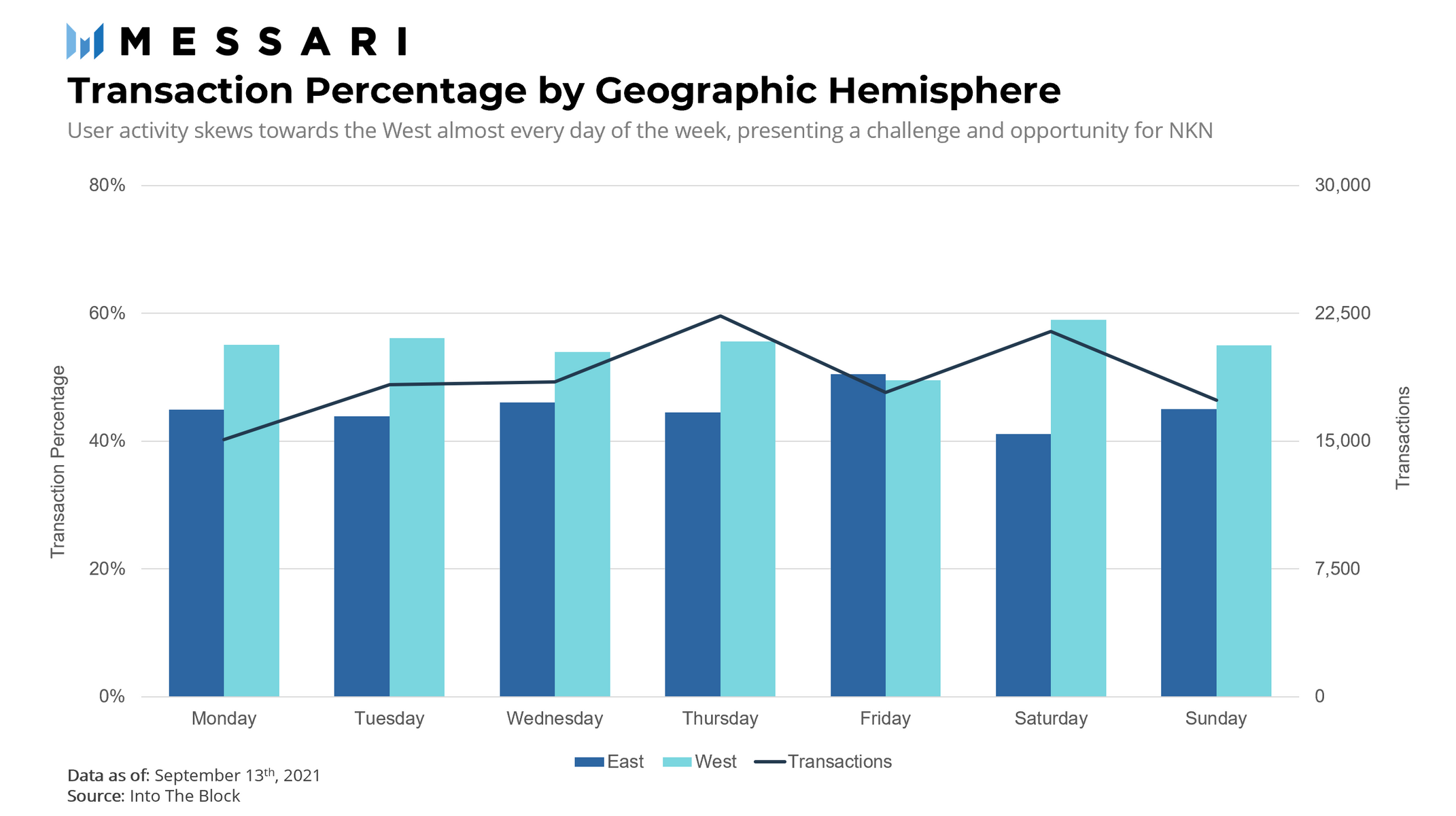
Current activity on the network skews towards occurring between 10AM – 10PM UTC compared to 10PM – 10AM UTC. In other words, most activity occurs in the Western hemisphere.
NKN Infrastructure and Applications
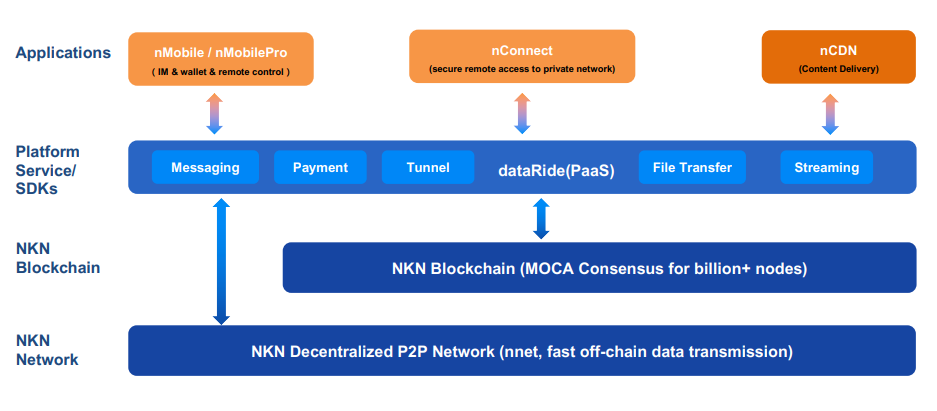
NKN’s network mainnet officially launched in June 2019. It was subsequently supplanted by NKN 2.0 a year later. NKN 2.0 is home to dataRide, the foundation of NKN’s product vision.
dataRide
dataRide is an umbrella platform for network-based services and applications. Current and future use cases for dataRide include chat/instant messaging, file transfer, and more across human-to-human, human-to-machine, and machine-to-machine interaction.
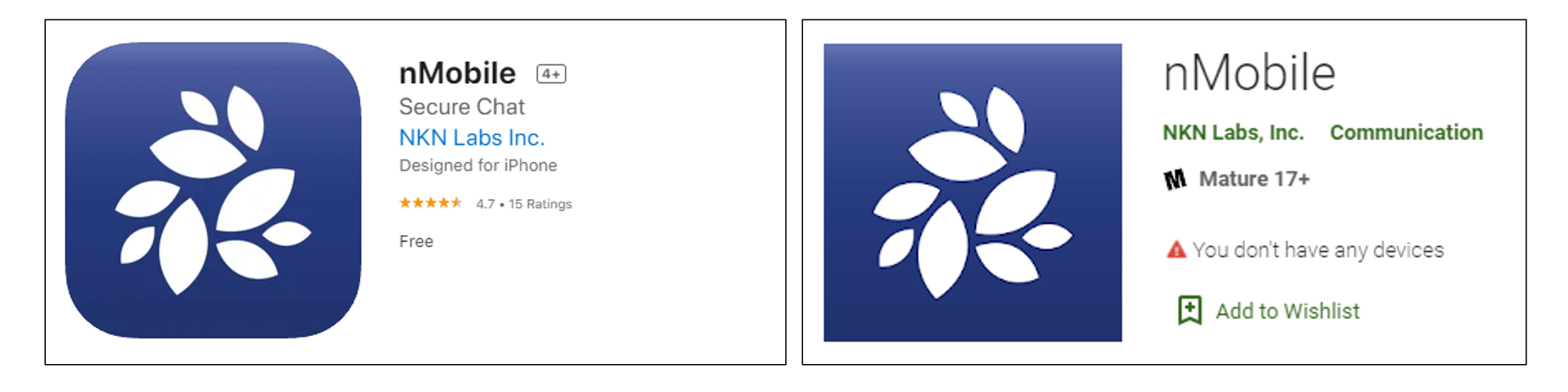
An existing dataRide application is nMobile, a mobile app available on iOS and Google Play. nMobile is similar to the popular encrypted messaging platform, Signal, but the application uses NKN’s P2P network instead of centralized servers. Beyond acting as a messaging platform, nMobile also serves as a crypto wallet with built-in token transfer ability. Users of nMobile can send NKN mainnet and ERC-20 tokens to each other directly through the app.
Source: nMobile (Google Play, App Store)
Another dataRide application is nConnect. nConnect provides remote access to files and apps from anywhere in the world to any user’s devices, such as personal devices like Macs and Windows computers, enterprise devices behind a firewall, or network attached storage (NAS) servers. NAS servers are servers on particular networks designed for file storage that can be accessed from anywhere in the world. Think of them as isolated Google Drives for users of the network. NKN has partnered with Synology, QNAP, and ASUSTOR, three NAS providers, to offer storage of client files accessible only on the NKN network. Using nConnect on a personal or enterprise level can help resolve the tradeoff faced by limited storage on local devices and the reliance on centralized cloud services such as Google Drive, Dropbox, and Microsoft OneDrive.

Source: nConnect (via Synology)
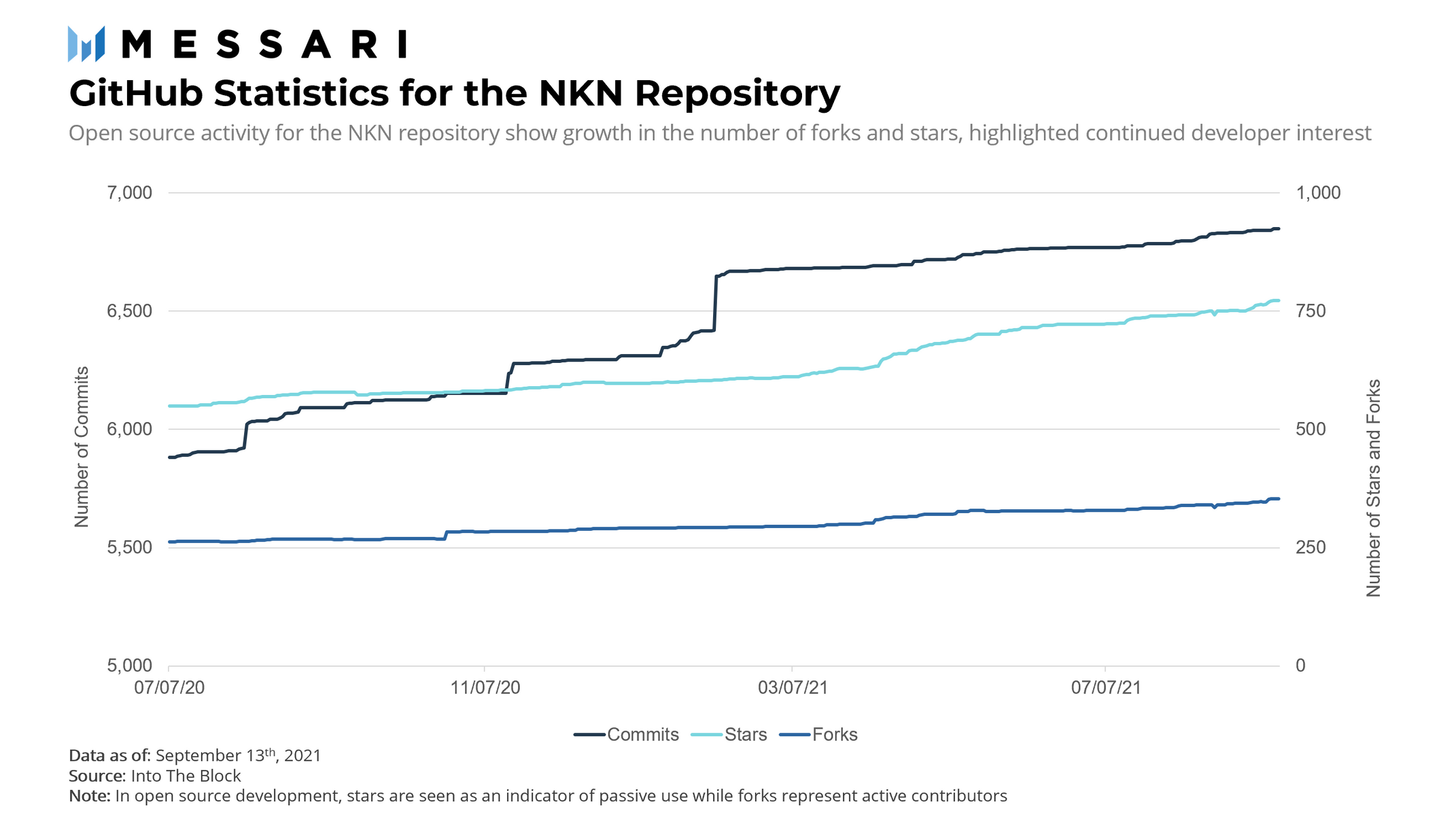
All source code is open source, meaning outside developers are able to access and build their own applications for the network. Over time, NKN envisions developers leveraging the code base to create new services or businesses, much like the Internet today. As displayed in the graph below, over the last year, the NKN team committed 17% of all code changes to the public Github repository while the number of repository stars (or “favorites”) and forks increased roughly 50%.
The $NKN Token
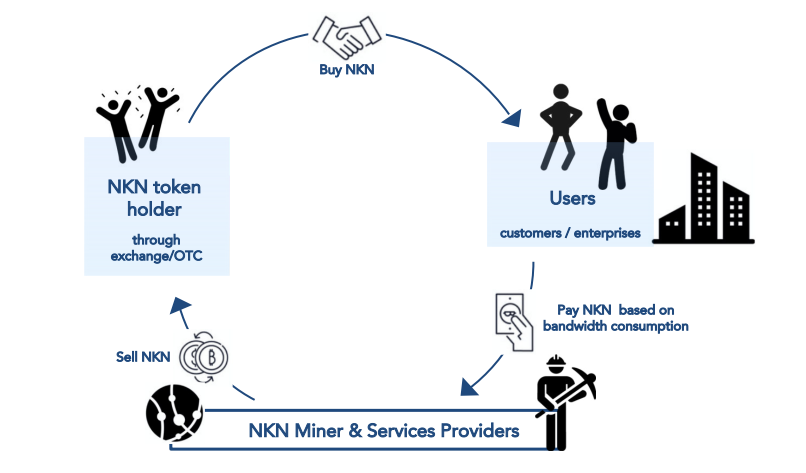
To create a mechanism for transactions on the network, the team developed a native token using a dual structure supporting interchangability between the NKN mainnet and ERC-20 standard. The easiest way to earn the token is for a miner to serve as a node in the network. This creates an economic incentive for devices to share bandwidth and to keep the node running 24/7 with a stable connection. Running a node using a local device starts only at a few dollars a month. The $NKN token can also be used to transact within the network. As mentioned above, NKN’s network allows for applications such as the aforementioned nConnect, content delivery, group chat, and many other services that can be paid for through the token. Miners who host value-added services on their node – referring to applications such as nConnect and nMobile – for the network can earn additional $NKN tokens. A flywheel effect, represented below, is created over time as miners who earn $NKN sell to others or pay for services run on the network.
Source: NKN November 2020 Overview Pitch Deck
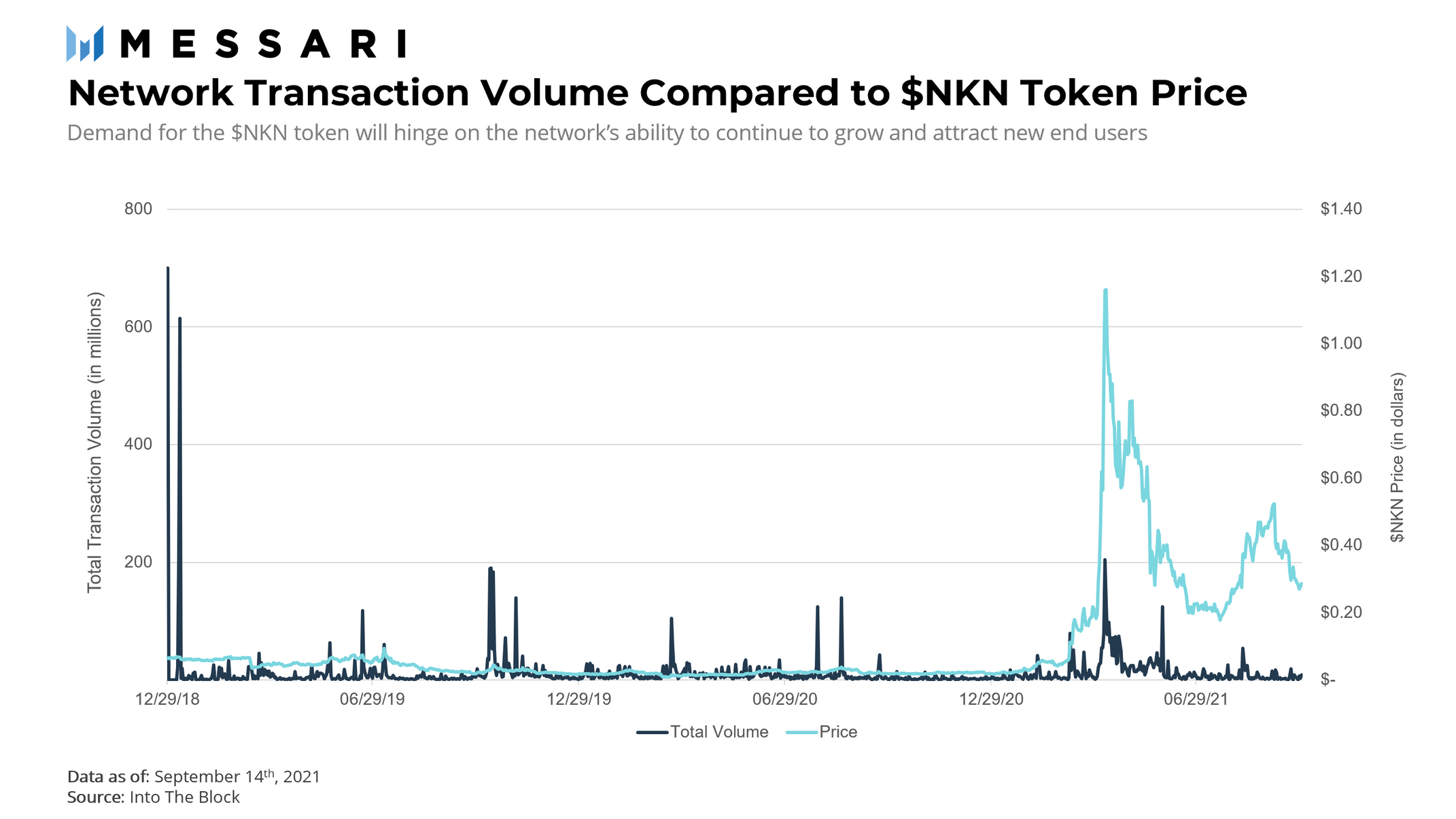
Long-term, sustainable price action will rely on demand for the token – and demand for the token will depend on the success, usability, and scale of NKN’s underlying network.
Token Distribution
Initial funding for the project was achieved through a series of sales in the first half of 2018. Between February and April, three separate rounds of funding were conducted raising a total of ~$27M:
- Private Sale: From February through April 2018, 250M $NKN tokens were sold at a per token price between $0.06 and $0.09. Funds were raised in both $ETH and $NEO.
- Early Bird Sale: Between April 2nd and 8th, 50M $NKN tokens were sold at a per token price of $0.084. This time, the capital raised was denominated in $ETH only.
- Public Sale: On April 19th, another 50M $NKN were sold at a token price of $0.126. Received funds were denominated in $ETH.
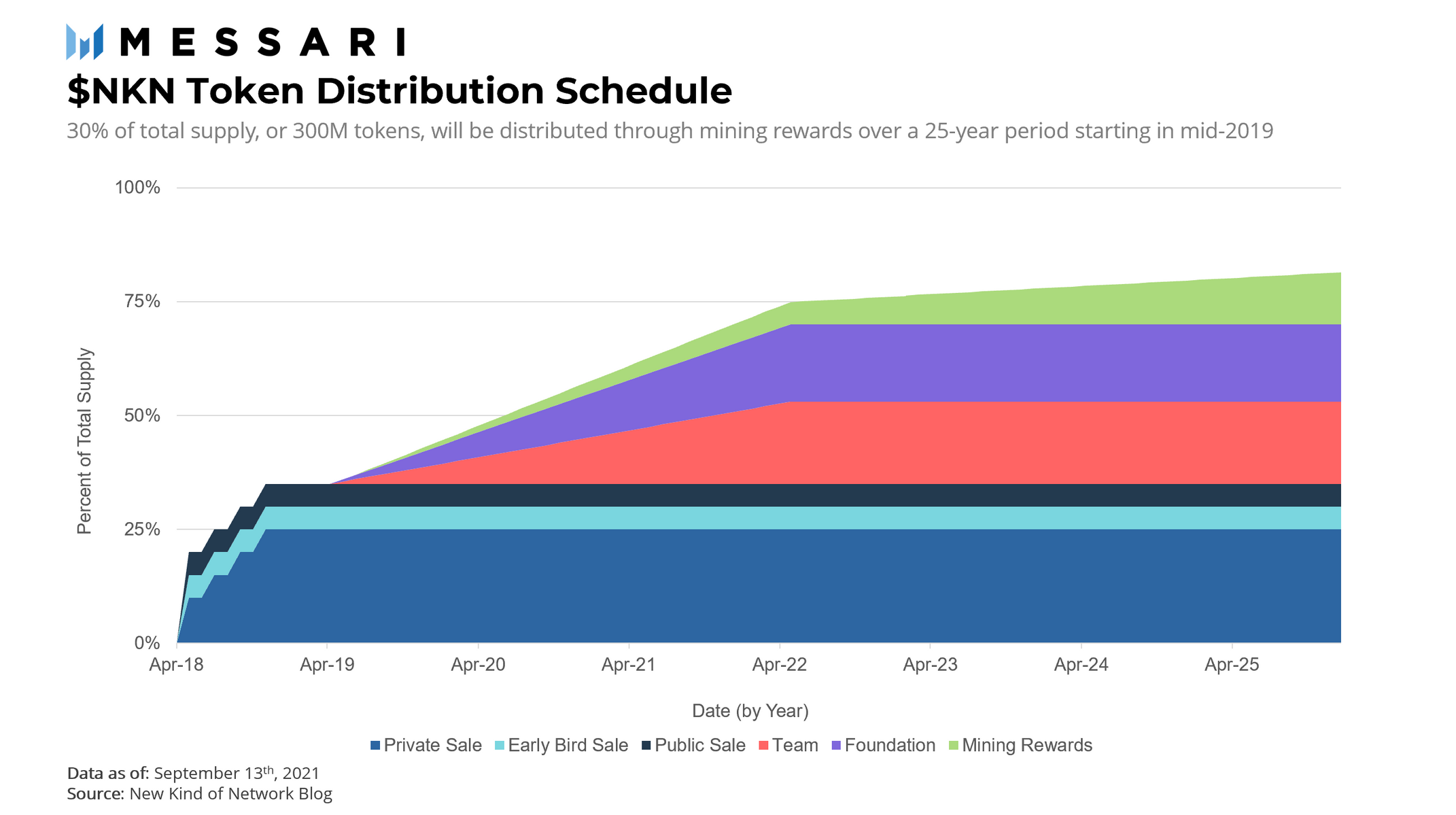
Of the 1 billion total tokens, 35% was allocated to the three token sales at the beginning of the project. The remaining 65% are allocated across the project’s team, foundation, and for mining rewards.
- The founding team and community developers received 18% of the supply
- 17% is allocated to the NKN Foundation and project treasury
- 30% is reserved for mining rewards; these rewards will vest over an estimated 25 year period
All of the NKN tokens from the initial funding rounds are fully vested and both the NKN Foundation and founding team will be fully vested by April 2022:
Future of NKN and Networking
NKN recognizes the project cannot rest on its laurels. The leadership team has devoted significant resources to growth across technological and commercial implementations.
On the technology front, NKN has announced work on increased features aligned to help developers and users alike. One feature is to allow for multiple programming languages, opening up the number of developers able to build on the NKN platform. Another is the reduction of limitations to a single IP address per node. Eliminating the limitation lets miners potentially run a single node using multiple devices. In addition to changes with singular IP addresses, NKN is building compatibility with IPv6, the newest Internet Protocol. The upgrade will allow newer devices using IPv6 to connect to the NKN network as the current generation protocol, IPv4, runs out of unique IP addresses.
Commercially, NKN aims to drive adoption of nMobile and its other product lines. One key method of growth is to sponsor community development of major applications for its ecosystem as a means to showcase what NKN can do. Additional growth can be explored through increased corporate partnerships. ASUSTOR, Synology, and several major cloud providers have already engaged in contracts with NKN and NKN is committed to obtaining partnerships internationally to better position NKN as a key player in the future of networking. Along similar lines, NKN claims it is focused on increasing the number of exchanges trading its $NKN token to better facilitate onboarding of applications which require the use of the token. Finally, the growth of satellite Internet via Starlink and other competitors is a unique opportunity for coverage. Satellite Internet can provide a global network not bound by a single country or region. The team is ramping up efforts on NKN-powered satellite services, including setting aside $20,000 for a NKN satellite miner.
If Web 3.0 is the future of our global network, NKN is well-positioned to capture a much-needed component of infrastructure. And while Web 3.0 may still have skeptics, one need only read articles from decades ago to remember how far we’ve come. Do investors really want to bet against a more global, transparent, and decentralized network?

Jerry joined Messari as a Research Analyst after working in management consulting. He graduated with a B.S. in finance and a minor in computer science from Indiana University's Kelley School of Business.