On March 24, 2025, Nillion launched its alpha mainnet and Token Generation Event (TGE), introducing the NIL token. The NIL token debuted on exchanges such as Binance, Gate.io, Bitget, MEXC, Kraken, and Bithumb.
Nillion conducted a 7.5% NIL community airdrop, rewarding high-impact contributors across development, community, and verification, while filtering out sybil and extractive activity.
Nillion argues that the current internet is fundamentally inadequate for next-generation applications and proposes the “Internet for Intelligence” as a new infrastructure designed to embed privacy and control at its core.
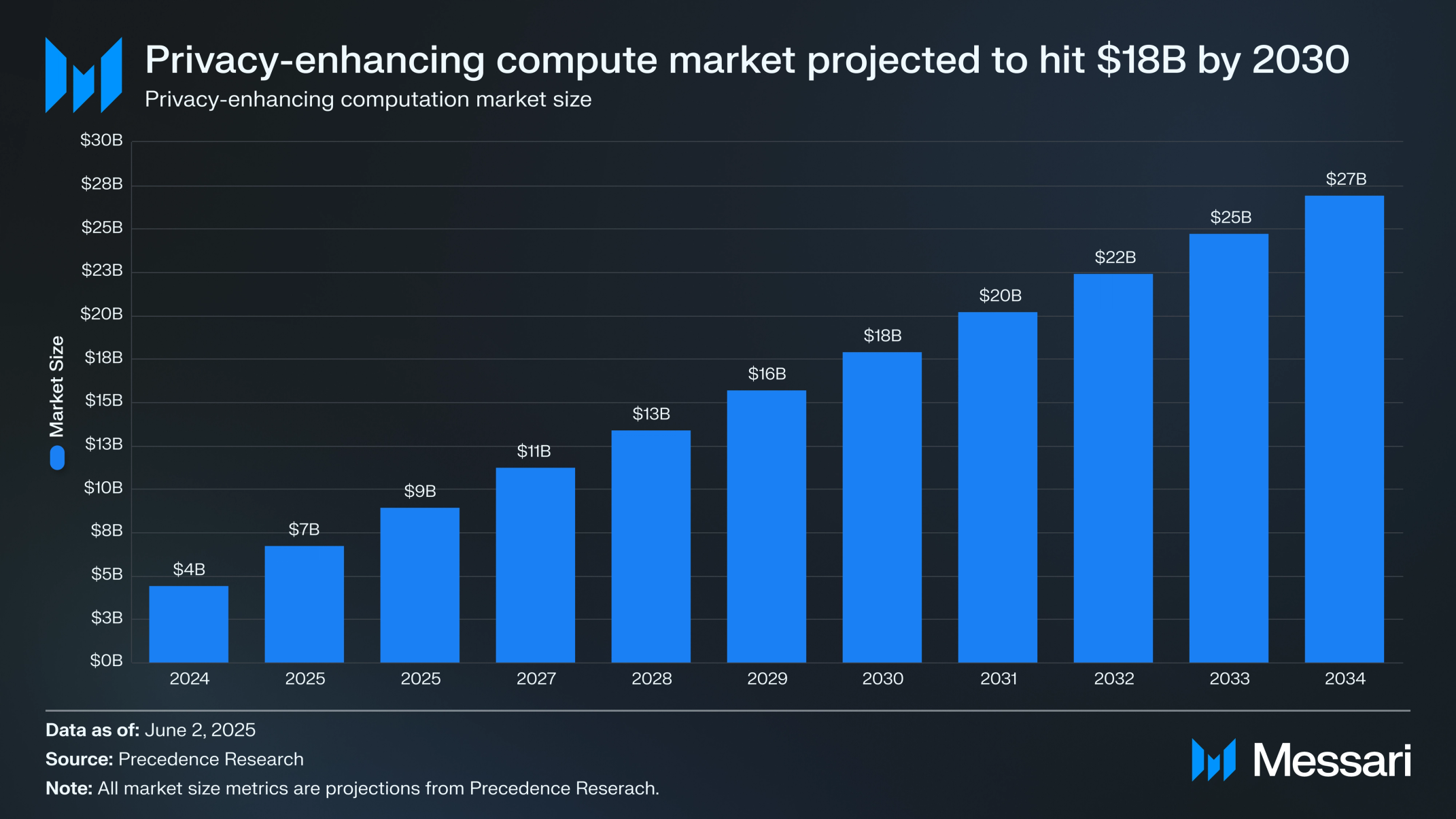
The privacy-enhancing computation market size is projected to reach $17.9 billion by 2030, with adoption accelerating across industries that demand both compliance and confidentiality.
The Nillion ecosystem has expanded rapidly, with over 60 projects building on its infrastructure and more than 75 native applications live or in development.
Primer
Nillion is a decentralized, privacy-preserving computation network founded in 2021 to address a critical gap in digital infrastructure: how to handle, store, and process sensitive data securely in distributed systems. Nillion leverages Privacy-Enhancing Technologies (PETs) such as Multi-Party Computation (MPC), Fully Homomorphic Encryption (FHE), and Trusted Execution Environments (TEEs) to enable the ability to conduct computations on encrypted data without exposing the data to any party. This ability is called Blind Compute, and it fundamentally alters the trust assumptions inherent in digital systems, offering a new paradigm for privacy and data security.
The Nillion network is built upon a dual-layer architecture. The coordination and governance layer, nilChain, ensures node integrity through staking, slashing, and community-driven upgrades, while the orchestration layer, Petnet, handles privacy-preserving computation and data storage. This separation helps ensure scalability and security. A suite of application frameworks supports this infrastructure, including nilCC (private computation on sensitive inputs), nilDB (encrypted distributed database), and nilAI (private AI tooling), enabling developers to build a broad spectrum of privacy-first applications.
Nillion describes the current internet as fundamentally inadequate for the next generation of applications. While today’s internet facilitates data transfer between parties, it lacks mechanisms for ensuring privacy, data ownership, or enforcing user intent. This shortcoming is increasingly problematic as AI systems become embedded in everyday life and enterprise operations. Sensitive user data is now routinely used to train, prompt, and guide AI agents, often without the user’s explicit awareness or consent.
In response, Nillion introduced the concept of the “Internet for Intelligence,” a reimagined infrastructure that prioritizes privacy and control. Rather than sending data to centralized servers for processing, this model enables encrypted data to be computed on without ever exposing it. Users and applications can extract value from their data without giving up control.
This approach is based on three core principles:
Data sovereignty: People and systems should control how their data is processed, not just where it’s stored.
Blind computation: Computation should happen without revealing the inputs.
Modular privacy: Developers should be able to choose the right balance between performance, decentralization, and anonymity.
These principles are already being put into practice across domains: In healthcare, blind compute allows researchers to collaborate on sensitive medical datasets without violating patient privacy (e.g., Welshare Health). In AI, it enables inference on proprietary or personal data without sharing it with model providers (e.g., Mighty Network). In finance, it enables encrypted reputation systems or co-signing agents to act on private context without revealing it (e.g., Choose K). The Internet for Intelligence treats privacy as a foundational design principle, something that must be embedded into the infrastructure itself, rather than added as an afterthought.
Mainnet and Token Generation Event
On March 24, 2025, Nillion launched its alpha mainnet, enabling developers to deploy privacy-preserving applications using blind computation. This launch marked the transition from testnet to a live environment, allowing real-world usage of the network's decentralized infrastructure.
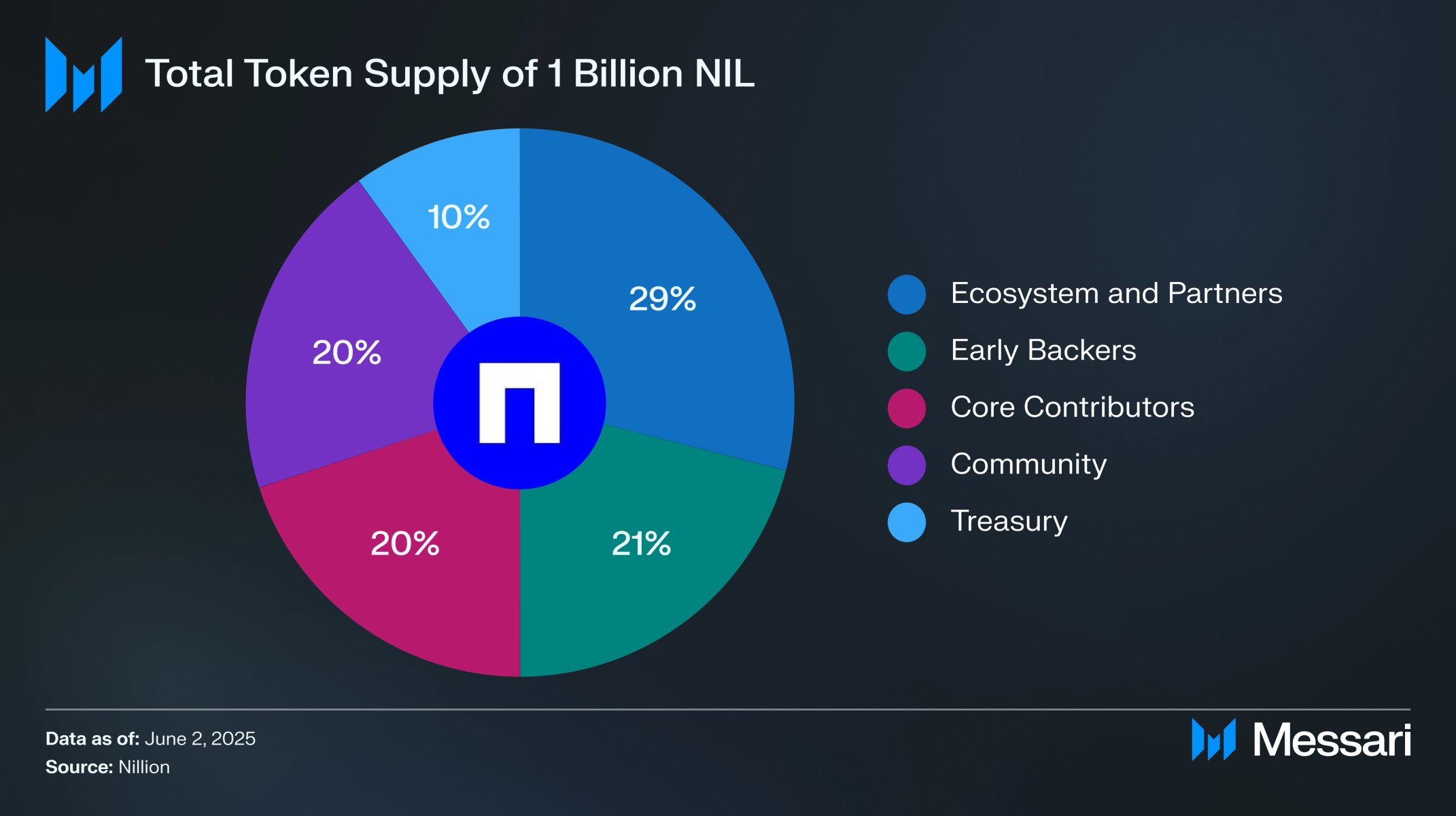
The same day, Nillion held its Token Generation Event (TGE), introducing the NIL token. NIL has a maximum token supply of 1.00 billion, and 195.15 million NIL tokens (19.52%) were released at launch.
In parallel, Nillion executed a community airdrop of 7.5% of the total NIL supply, prioritizing high-impact contributions across development, community engagement, and verifier participation, while actively filtering out sybil activity and extractive behavior. The team framed this as a new standard for value-driven distribution, aimed at aligning token rewards with long-term commitment rather than opportunism.
NIL Token Functions
The NIL token serves several functions within the network, including:
Paying for computational services, data storage, AI inference, and transaction fees. Developers use it to access Nillion’s privacy-preserving infrastructure, including Blind Modules and other PET-based tooling.
Staking to support network security and earn rewards:
Validators bond NIL to validate transactions and computations, securing the nilChain.
Petnet node clusters stake NIL to increase their cluster’s security and attract developers and applications.
Participating in onchain governance. This includes proposing and voting on protocol upgrades, funding allocations (e.g., grants, incentive programs), and adjustments to network parameters such as staking thresholds or fee models.
Tokenomics
The pie chart above depicts the NIL token allocation (a visual representation of its vesting schedule can be found here):
Blockchain’s founding ethos centered on removing centralized gatekeepers by enabling open, permissionless systems. But this openness, embodied in transparent ledgers, comes with trade-offs: every balance, trade, or interaction is permanently visible to anyone running an archive node. As other digital systems, especially AI models, begin to rely heavily on behavioral data, the tension between openness and privacy becomes even more pronounced, just as global data protection regimes (e.g., the EU’s GDPR, California’s CCPA, Brazil’s LGPD, India’s DPDP Act) grow stricter. Privacy has shifted from a “nice-to-have” to a prerequisite for compliance, competitive advantage, and basic civil liberty. Organizations that cannot protect inputs, models, and outputs increasingly find themselves locked out of high-value data partnerships, especially in healthcare, finance, and AI training. That urgency underpins the fast-growing market for privacy-enhancing computation, projected to expand from $6.7 billion in 2025 to $17.9 billion by 2030.
Fragmented Privacy Layers
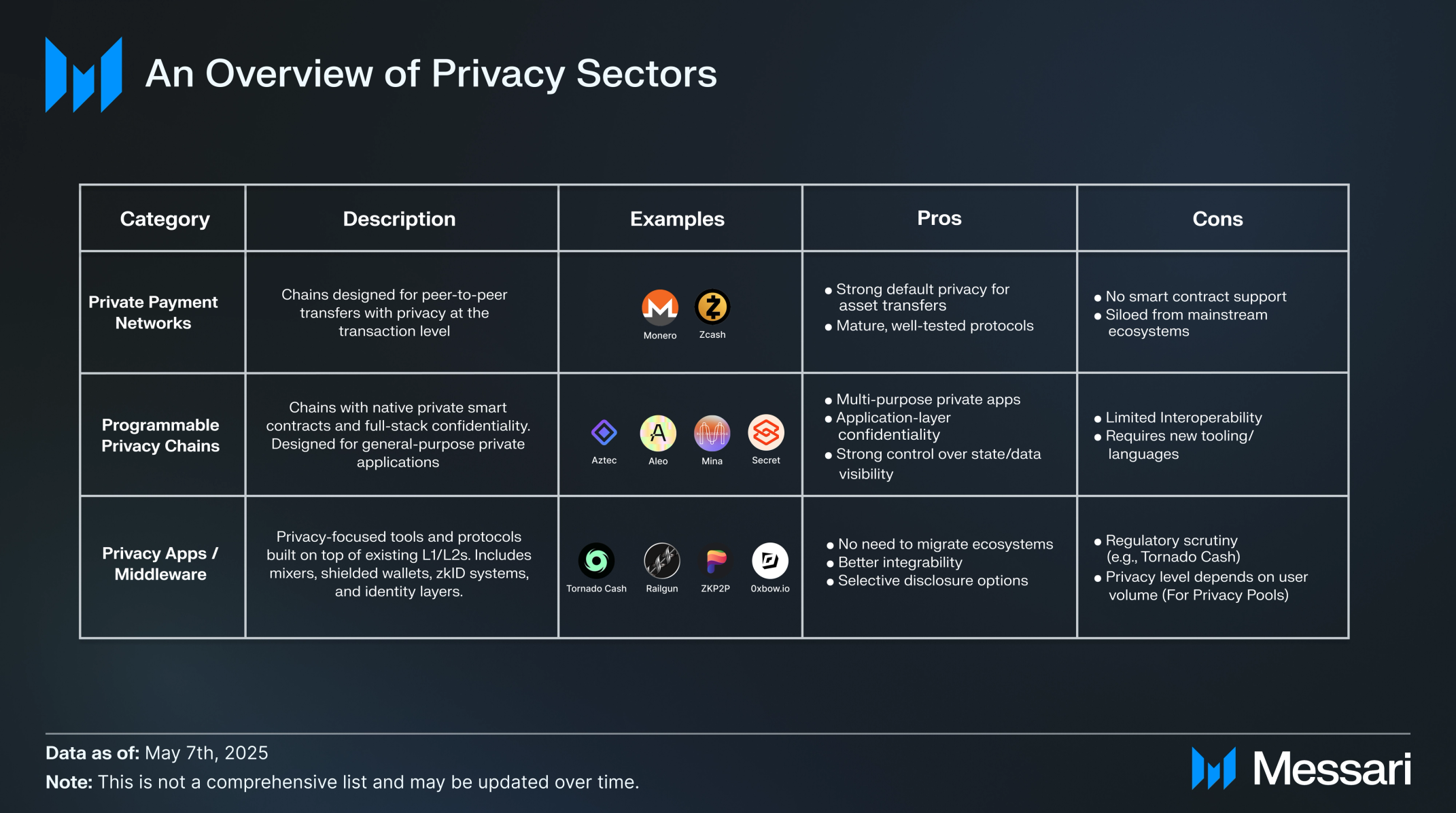
As detailed in Messari’s Decoding Onchain Privacy report, the Web3 privacy ecosystem can be split into three main categories: Private Payment Networks, Programmable Privacy Chains, and Privacy Applications/Middleware. Each category reflects distinct design priorities and architectural tradeoffs, targeting different layers of the stack, from end user asset transfers to developer infrastructure for building privacy-native applications.
Diverse threat models: Retail users prioritize private balances and transaction metadata; enterprises demand confidential compute over proprietary datasets.
Technology tradeoffs: ZK circuits optimize for proof-of-computation; MPC and FHE enable joint analytics but incur higher computational overhead.
Regulatory variance: Some jurisdictions permit shielded transactions; others require auditability or selective disclosure to meet compliance standards.
No single architecture accommodates all constraints. Instead, the privacy stack has fragmented into composable layers, each optimized for a specific trust, performance, or compliance boundary.
Nillion’s Approach
Nillion shifts the focus from hiding who sent what to enabling secure computation on encrypted data:
Complementary to private payments: Ingests shielded UTXOs as encrypted inputs, enabling secure offchain computation without decryption.
Parallel to programmable privacy chains: Offloads heavy MPC/FHE workloads to Petnet while anchoring succinct proofs to ZK chains like Aleo or Aztec.
Enabling privacy middleware: Supports identity tools, DePIN protocols, and ZK-frontends by allowing sensitive inputs to be computed offchain via Blind Modules.
Nillion functions as a confidential compute layer that links otherwise isolated systems, bringing composability and data privacy to the upper layers of the stack.
Nillion Ecosystem
The Nillion ecosystem has expanded rapidly, with over 60 projects building on its infrastructure and more than 75 native applications live or in development. Its modular framework supports a diverse range of use cases, from AI and decentralized science (DeSci) to DePIN (Decentralized Physical Infrastructure Networks) and beyond. Nillion’s Nucleus builder program and extensive developer tooling, including nilAI for private AI inference, nilDB for encrypted database management, and nilCC for privacy-preserving computation, have catalyzed this growth.
Key Sectors
Key sectors that highlight the variety of benefits Nillion provides include:
Artificial Intelligence: Nillion processes data and performs inference without exposing sensitive information, bridging the gap between secure local AI processing and the scalability of centralized non-private AI systems.
Personalized Agents: AI agents can store, compute, and handle private data.
Private Model Inference: AI models can process private data securely, minimizing the risk of exposure to third parties and enabling private LLMs.
Private Knowledge Bases and Search: Data can be stored in encrypted form while still enabling search functions for AI agents and other AI use cases.
Data Ownership: Nillion’s cryptographic infrastructure supports secure data marketplaces by allowing users to control and sell their data to buyers.
Blockchains: Nillion allows blockchain applications to send blind storage and compute requests to the Nillion network, complementing blockchains' public data features. It also supports onchain settlement by allowing applications to decrypt relevant data on the blockchain.
DePIN: Integrating with Nillion, DePIN projects can securely store and process sensitive operational data.
DeSci: Nillion supports privacy-preserving analysis of scientific data (e.g., clinical trials, genomic research, and pharmaceutical development) without exposing it to unauthorized parties.
Key projects that highlight the variety of benefits Nillion provides include:
Stadium Science: A decentralized platform that crowdsources health and science data, such as sleep metrics, using token incentives, prediction markets, and research challenges to drive large-scale discovery while preserving user privacy.
Aptos/NEAR/Arbitrum/Sei/Monad: L1 and L2 blockchains that integrated blind data storage and computation to enhance data handling within smart contracts.
Fulcra: A unified platform that aggregates personal health, fitness, sleep, and location data to help users identify patterns and gain insights across their daily activities, with full control over their data.
Healthblocks: A fitness application that uses Nillion to maintain user ownership and control of data while allowing third-party insights without exposing individual details.
MonadicDNA: A genomics platform that uses Nillion to keep data encrypted throughout its lifecycle, providing an alternative to centralized providers (e.g., 23andMe).
Soarchain: A DePIN project enabling vehicles to securely share data, powering smarter transportation systems, predictive maintenance, and optimized routes.
DataHive: A platform that enables individuals to aggregate, control, and monetize their personal data across apps and services using decentralized infrastructure.
Pindora: A hyper-personalized assistant that learns from conversations, health metrics, and personal files to provide tailored insights and recommendations, leveraging Nillion to ensure all user data remains local and private.
PIN AI: A decentralized platform that empowers users to own their data and customize AI interactions, using Nillion to safeguard sensitive information throughout the AI experience.
Mighty Network: A data infrastructure company providing secure, compliant access to private data for AI agents through its Sidekick SDK, a trust layer that enforces fine-grained access policies and integrates Nillion’s privacy-preserving compute capabilities at scale.
Key Native Applications
Key native applications built during various hackathons that highlight the variety of benefits Nillion provides include:
WalletSheets: An application that transforms Google Sheets into a crypto command center by enabling users to manage their entire Web3 experience, directly within a familiar spreadsheet interface.
Colosseum: A gaming platform where users can bet on AI agent competitions.
AgentNet: A decentralized protocol for inter-agent communication, enabling agents to autonomously discover, interact, and transact onchain.
TEE Shield: A decentralized security solution that protects users from frontend tampering using onchain hashes
AIkin-Codeguard: A command-line tool designed for AI-powered security auditing and code review.
Roadmap
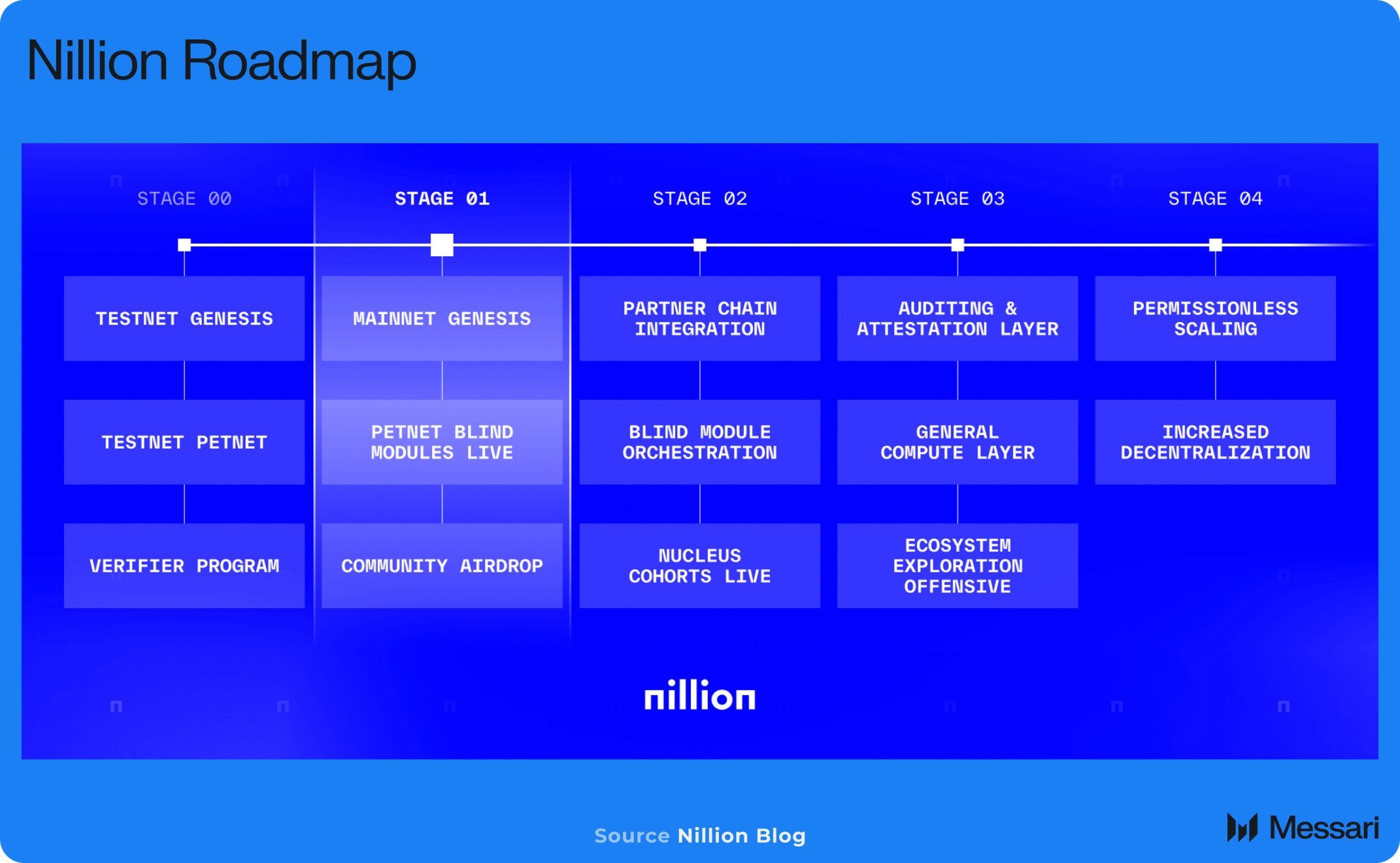
Nillion is rolling out its network infrastructure in structured stages, progressing through a clearly defined sequence of deployments and ecosystem initiatives. The roadmap outlines five main stages, each focused on incremental technical, operational, and community expansion milestones.
Looking ahead, Nillion aims to enhance interoperability by integrating with partner chains and enabling its privacy-preserving compute modules to operate across diverse blockchain environments. It is also enhancing orchestration between Blind Modules to support more efficient and complex computation, while continuing toward greater decentralization. Concurrently, Nillion is expanding ecosystem development through the Nucleus builder program. This includes initiatives that incentivize user exploration of new decentralized applications within the ecosystem.
Closing Summary
Nillion is establishing foundational infrastructure for privacy-preserving computation through the launch of its alpha mainnet and the introduction of the NIL token. The March 2025 mainnet activation marked a critical milestone in transitioning from testnet to real-world deployment, enabling developers to build and scale privacy-first applications. Nillion’s architectural model is rooted in the idea of an “Internet for Intelligence,” a reimagined internet where encrypted data can be computed on without ever being exposed. This vision addresses structural limitations in today’s digital infrastructure by embedding privacy, data sovereignty, and user control into the computational layer itself.
Positioned within a rapidly maturing privacy ecosystem, Nillion complements advances in zero-knowledge proofs, homomorphic encryption, and network-layer obfuscation, offering a modular platform for applications spanning AI, healthcare, finance, and beyond. With over 60 projects integrating Nillion’s infrastructure and more than 75 native applications live or in development, the ecosystem is gaining meaningful traction. Key sectors include private AI inference, encrypted data marketplaces, and privacy-preserving scientific research. Supported by programs like Nucleus and adoption across multiple L1s and L2s, Nillion is helping define the future of decentralized privacy infrastructure. As demand for confidential computation accelerates, Nillion is well-positioned to serve as a foundational layer in the privacy-centric internet stack.
This report was commissioned by the Nillion Association. All content was produced independently by the author(s) and does not necessarily reflect the opinions of Messari, Inc. or the organization that requested the report. The commissioning organization may have input on the content of the report, but Messari maintains editorial control over the final report to retain data accuracy and objectivity. Author(s) may hold cryptocurrencies named in this report. This report is meant for informational purposes only. It is not meant to serve as investment advice. You should conduct your own research and consult an independent financial, tax, or legal advisor before making any investment decisions. Past performance of any asset is not indicative of future results. Please see our Terms of Service for more information.
No part of this report may be (a) copied, photocopied, duplicated in any form by any means or (b) redistributed without the prior written consent of Messari®.
Jake is a Research Analyst on the Protocol Research team. He previously worked as an Investment Analyst at an AI-driven crypto research platform and as a Venture Analyst at a digital assets venture fund. He advised multiple RWA tokenization projects on tokenomics. Jake graduated from the University of Southern California, where he studied Philosophy and Finance.
Jake is a Research Analyst on the Protocol Research team. He previously worked as an Investment Analyst at an AI-driven crypto research platform and as a Venture Analyst at a digital assets venture fund. He advised multiple RWA tokenization projects on tokenomics. Jake graduated from the University of Southern California, where he studied Philosophy and Finance.