NFT Marketplaces: Valuing The eBay and Shutterstock’s of NFTs


By Mira Christanto and Mason Nystrom
NFT Marketplace Landscape
The NFT landscape has evolved dramatically throughout the past year. A year ago, Rarible didn’t exist and OpenSea’s monthly volumes hovered around $1 million. Today there is a robust NFT application stack that powers billions in monthly activity. The growth has been incredible.
Within the NFT stack, marketplaces and NFT issuance protocols are key platforms that are built on top of Layer 1’s like Ethereum, Flow, and Wax. At the top of the stack are the interfaces – wallets and exchanges – as well as aggregators like OpenSea that enable consumers to purchase NFTs from any given platform.
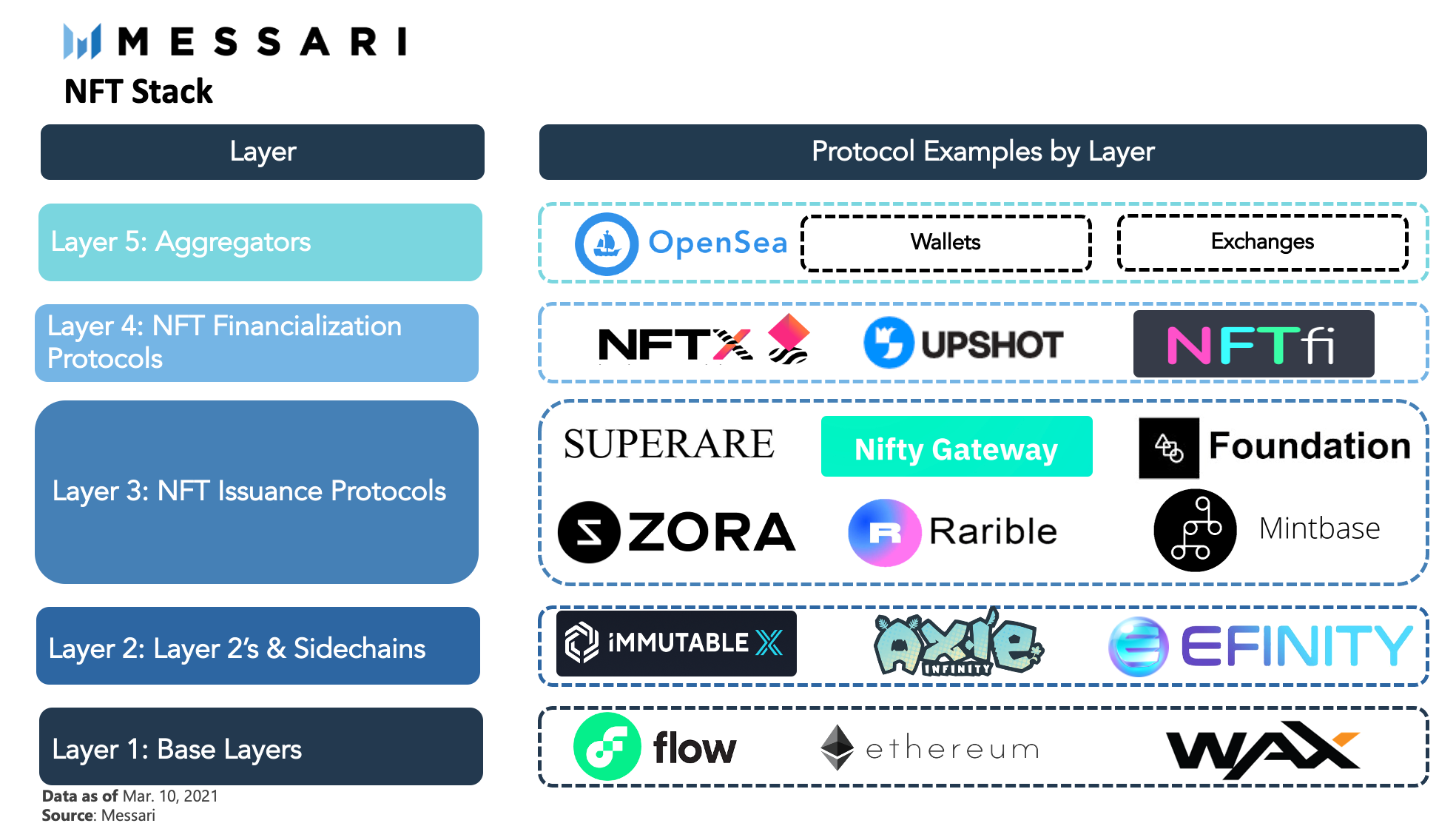
NFT issuance platforms and marketplaces currently make up one of the largest categories of NFT protocols (beyond NFT projects themselves), and are one of the more obvious market opportunities given the business model. For an investor, it might be difficult to pinpoint which NFT may outperform so issuance platforms might be a better way to express a constructive point of view on the NFT sector.
As a testament to this, platforms have been among the most successful at fundraising this year, nearly matching full year 2020’s fundraising within the first two months:

Mira was a Senior Research Analyst at Messari. Prior to joining Messari, Mira was a Senior Portfolio Manager for a US$6 billion Asia Pacific equities fund at APG Asset Management. Mira received a BA in Economics and Mathematical Methods in the Social Sciences from Northwestern University.

Mason was a Senior Research Analyst at Messari focused on Web3 protocols and cryptoassets. Before Messari, Mason worked at ConsenSys as a Content Marketer focused on marketing strategy. Mason obtained his Master’s in Business Management at Hong Kong Baptist University.