New Asset Launches: Breaking down the launch strategies of Kadena vs. Nervos Network

At a high level, our previous research reports mentioned the wide range of new assets set to launch in the coming months. As these networks begin to go live, we would like to take a closer look at the various dynamics of each project.
In this first series, we’re dissecting the different approaches employed by Kadena and Nervos Network to bootstrap their respective mining communities. All Proof-of-Work (PoW) blockchains rely on a robust group of miners to ensure network security. But PoW networks need to offer a clear competitive advantage (often financial) to entice miners to join in the first place.
Nervos opted to host a mining competition on its testnet, where the top participants received real financial rewards in Nervos’ native CKB token upon mainnet launch (Nov. 15). This method helped familiarize miners with the nuances of Nervos’ blockchain and mining client design while facilitating token distribution. You can learn more about Nervos Network’s mining competition and the benefits of testnet events in our Pro research report on Incentivizing Testnet Participation.
On the flip side, Kadena quietly launched its mainnet only for CPU mining activity (token transfers won’t unlock until Dec. 17, and smart contract functionality won't launch until Jan. 2020). The release enabled early miners to earn KDA tokens at a minimal expense. Kadena simultaneously held a public token sale, pricing KDAs at $1 per unit. The stark difference in acquisition cost between mining and purchasing created an enticing arbitrage opportunity for miners, which Mohamed Fouda at Token Daily covers in greater detail. The prospect of acquiring cheap KDA tokens ignited a frenzy among miners to join the network and develop more advanced mining tools.
With each chain now live, does the data point to one approach being better than the other? Below is a comparison of the growth experienced by each network since its mainnet launch.
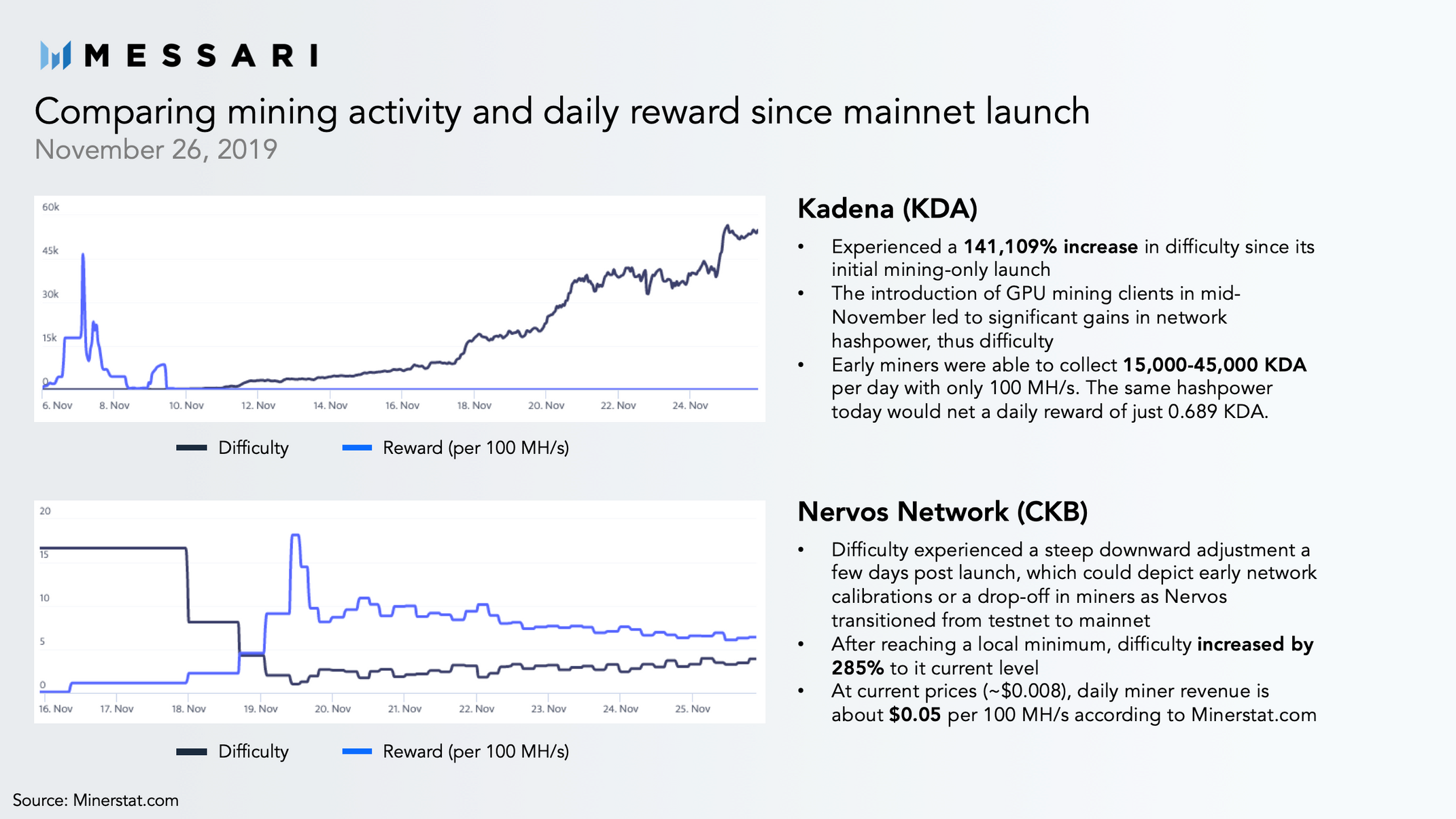
Kadena’s effort had a profound effect on miner adoption. The opportunity for oversized financial gains early on (think of it as a pre-sale for miners) helped bootstrap a miner base. Notably, miners continue to dedicate resources to the network even though the arbitrage opportunity has long since closed. The network buy-in is strong at the moment since token transfers remain disabled.
But the comparison to Nervos Network is deceiving at first. Despite the more gradual growth pattern (following its first few difficulty adjustments), Nervos’ hash rate and difficulty level are orders of magnitude greater than Kadena’s security metrics. Nervos is a premier example of how testnet competitions can recruit an active community of miners leading up to a mainnet launch.
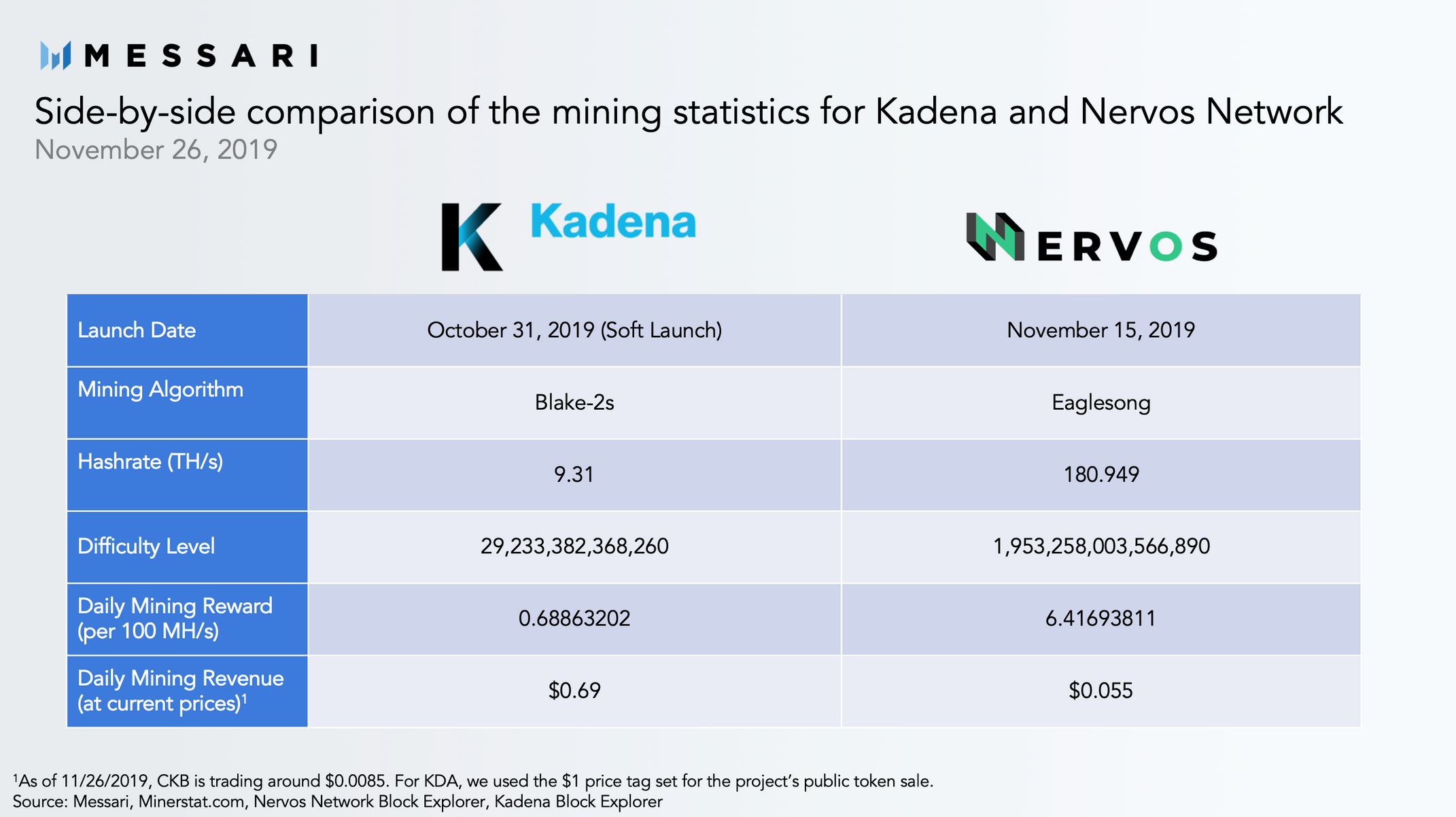
We should also note that no cross-network comparison is perfect. Kadena and Nervos have different mining algorithms, mining hardware/software requirements, and difficulty adjustment mechanisms. And if the algorithm itself is insecure, then the amount of hash power dedicated to the network is irrelevant. With that said, hash rate is generally an accepted measurement for evaluating the level of security between different chains.
Check our asset profiles on Kadena and Nervos Network to learn more about each project. For future breakdowns on new assets, we’ll be keeping a close eye on the upcoming launches of Orchid and Polkadot.