Near 2023 Recap: Inside the Blockchain Operating System

Since our last report in September 2022, the Near ecosystem has continued to fall further out of the spotlight. DeFi usage has come to a standstill, likely because the same primitives available on Near can be found on other L1s and L2s without the burden of switching chains. Near’s token continues to trade lower in trend with other alt L1 tokens and the broader crypto market, down 95% from its all-time high achieved in early 2022.
Despite this decline, Near has continued its push towards technological innovation across many frontiers, including the protocol’s recent evolution into the Blockchain Operating System (BoS), as well as partnerships to introduce novel consumer-facing dApps. The BoS enables the network to support multichain experiences while significantly enhancing the user and developer experience. Further, Near’s core development team has pushed out several protocol improvements that enhance the developer experience. While other networks prioritize sponsorships, financialization, and fast money growth objectives, Near remains focused on growing a large user base and integrating with incumbent Web2 companies.
2023 Recap
The Near team pushed several updates throughout Q1 and Q2 that greatly reduced friction for developers and users. Meta transaction support is a new feature that can most similarly be compared to account abstraction on Ethereum. The Near team actually shipped meta transactions nearly half a year before account abstraction was supported on Ethereum and deems the proper term to be “account extension.” Meta transactions enable third parties to pay for transaction costs of any account, meaning that users can use Near without having to first purchase tokens for transaction fees. In line with this, Near now supports zero-balance accounts, which enables the creation of accounts with zero token balances so that dApps and wallets can create accounts on behalf of new users. Prior to zero balance accounts, users had to create wallet accounts and request NEAR from a faucet. This was easily exploited by bots, who mass created accounts specifically to drain the NEAR faucet.
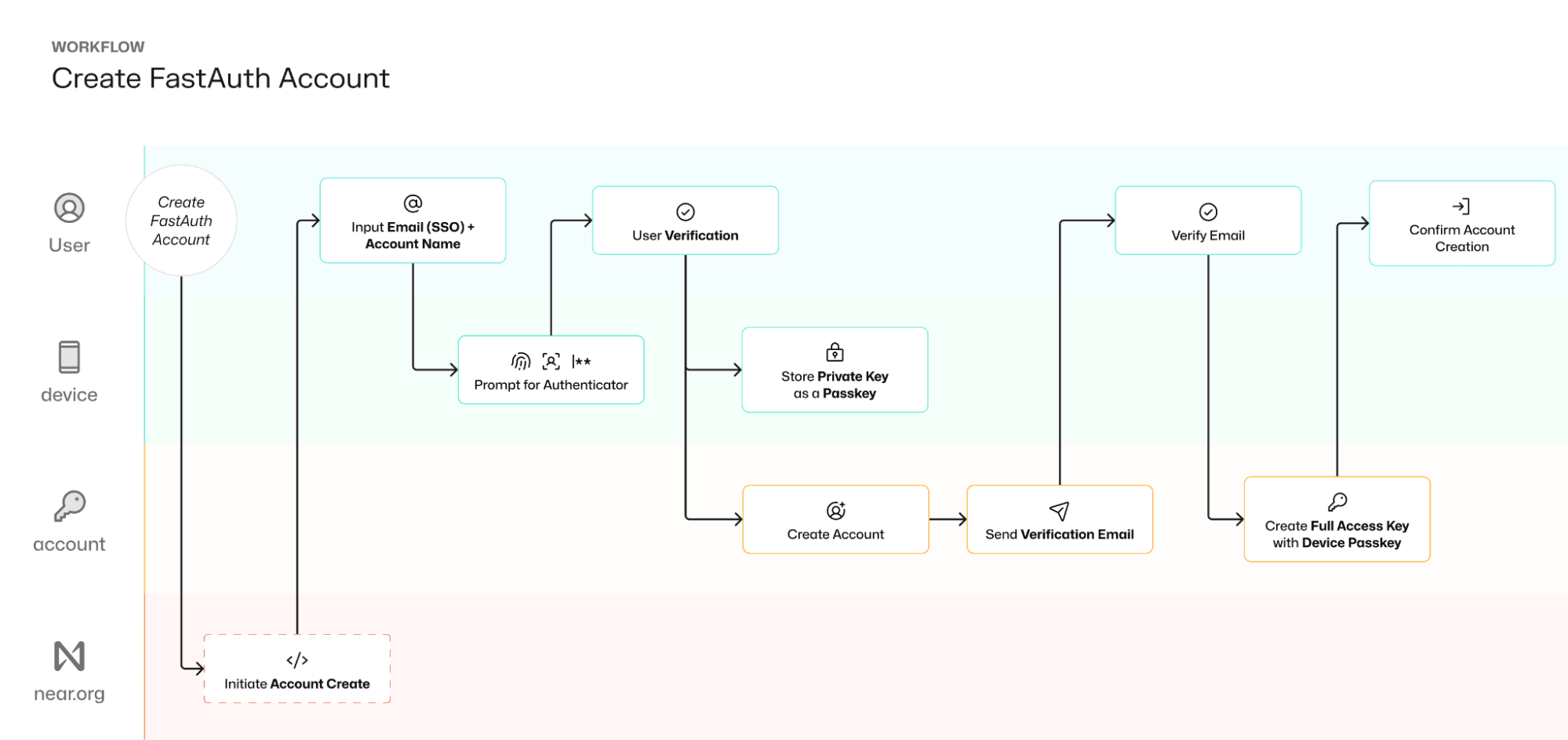
Another major upgrade for Near is FastAuth, a new onboarding mechanism where prospective users can set up a wallet by using their email and phone prompts, such as iPhone’s Face ID or passcode. This completely abstracts the need to manage seed phrases or long strings of numbers away from the user while also strengthening authentication security, given Face ID’s facial recognition and machine learning features that leverage the iPhone’s internal Secure Enclave to encrypt and protect valuable user keys. Logging into a wallet is now as easy as unlocking one’s phone. FastAuth provides a similar experience to single-sign-on providers, such as a Google account. It also eliminates the need to download a specific browser or wallet app because all dApps work directly from any browser on a desktop or mobile device. FastAuth employs a decentralized recovery methodology that utilizes multi-party-computation (MPC) to securely sign and relay transactions, as well as recover accounts. Meta transactions, zero balance accounts, and FastAuth are crucial updates that assist developers in onboarding users to Near, and these functions can be seen in real time in helping popular dApps, like Sweatcoin and Kaching, entice users onchain.
On the deeper technical side, Near is currently focused on preparing the network for Sharding Phase 2, which is slated for release by the end of 2023. In Phase 2, block producers will no longer have to track every shard like they currently do in Phase 1. After Phase 2 is achieved, both state and processing will be completely sharded, greatly reducing the requirements to run a validator on the network. For a more in-depth look at Near’s sharding mechanism and roadmap, read our previous report on Near’s upgrade to Phase 1.

Pibblez leads coverage on emerging L1s, infrastructure, and stablecoins. Previously worked as a Research Analyst at Kraken.