Namada is an upcoming Layer-1 (L1) developed by Heliax aiming to provide a single privacy pool shared across all assets and networks.
Namada’s technical innovations include the Multi-Asset Shielded Pool (MASP) and the Convert Circuit (CC). The MASP offers a unified, asset-agnostic privacy set and the Convert Circuit enables programmable asset conversions (e.g., distributing yield).
At launch, Namada will be interoperable with IBC networks and Ethereum. There are plans to extend to other ecosystems, such as Zcash, in the future.
Namada views privacy as a public good. Contributors to the shielded set are rewarded with NAM, which will also be distributed toward retroactive and proactive public goods funding.
Namada's internal programmability through the CC is limited, but shielded actions will enable multichain programmability. Users will be able to interact with existing external dapps on connected networks without exiting the shielded pool.
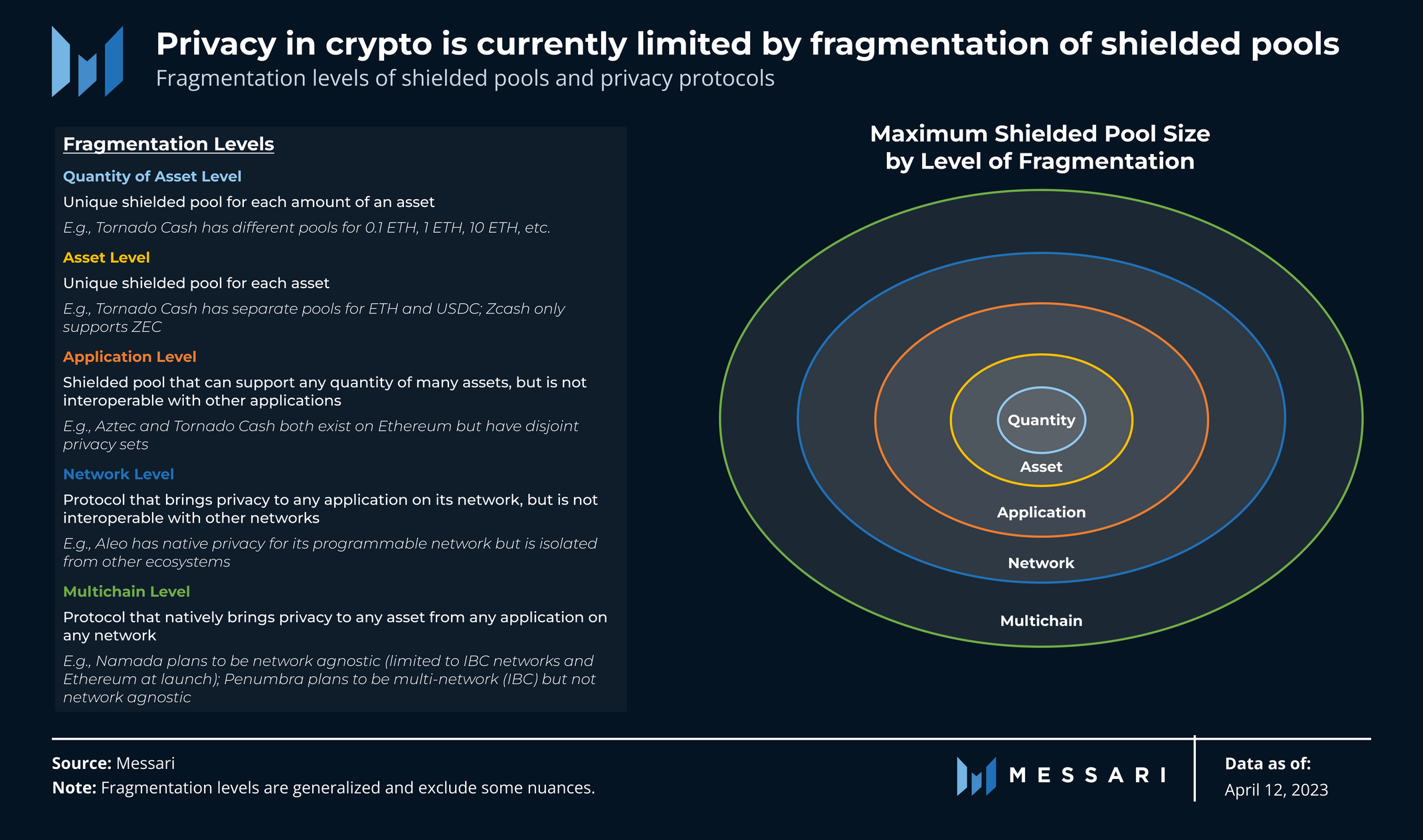
Most crypto protocols are merely pseudonymous, where transactions can often be de-anonymized by firms like Chainalysis or on-chain sleuthers. There are many protocols focused on bringing more privacy to crypto; however, the general privacy landscape is limited by fragmentation. Fragmentation levels include:
Asset level (e.g., Tornado Cash has separate shielded pools for ETH and DAI; can only gain privacy through Zcash by using ZEC)
Application level (e.g., Aztec and Tornado Cash both exist on Ethereum but have disjoint privacy sets)
Network level (e.g., Aleo has native privacy built in for the entire programmable network but is isolated from other ecosystems)
The privacy strength of a shielded pool is proportional to its size. In the current landscape, privacy protocols are directly competing with each other for assets.
Namada is an upcoming Layer-1 blockchain that aims to offer a single, unified shielded pool for any asset type (fungible or non-fungible) created on any platform. Namada is IBC-compatible and plans to build bridges to many ecosystems, beginning with Ethereum. The bridges will at first be transparent but will later be privacy-preserving. Namada considers privacy to be a public good and will incentivize liquidity to grow and sustain its privacy set. If successful, Namada will bring greater privacy to crypto through its multichain, asset-agnostic shielded pool.
Background
Namada is the first fractal instance of Anoma, an intent-centric, privacy-preserving protocol for decentralized counterparty discovery, solving, and multichain atomic settlement. Namada focuses on bringing the best privacy to the immediate multichain user, while Anoma’s architecture will enable privacy-preserving applications that cannot be built on existing architectures. The development of Namada, Anoma, and other self-sovereign technologies is led by Heliax, a software development company with a focus on privacy and public goods.
Heliax was founded by Adrian Brink, Awa Sun Yin, and Christopher Goes in 2021. Prior to Heliax, Goes led the development of the Inter-Blockchain Communication protocol (IBC) at Tendermint, Sun was a data scientist at Chainalysis and later a researcher at Tendermint, and Brink was a core developer and later head of partnerships at Tendermint. Aside from their work together on the Cosmos stack at Tendermint, the trio also founded Cryptium Labs and Metastate and are board members of the Swiss non-profit Anoma Foundation.
Namada launched its first public testnet on Dec. 20, 2022. A day after, it completed its trusted setup to generate parameters for Namada’s shielded pool with over 2,500 participants. Mainnet launch for the open-source network is planned for Q2 2023.
Technology
Overview
Namada’s technical architecture is aligned with Cosmos technologies in both consensus and interoperability. As far as privacy goes, Namada offers multi-asset functionality via a novel Multi-Asset Shielded Pool (MASP) and programmable asset conversions via the Convert Circuit (CC). The technology section of this report covers features that will be live upon mainnet launch. For future upgrades, see the roadmap section further below.
Consensus
Mechanism
Namada uses a unique Bonded Proof-of-Stake (BPoS) variant called Cubic PoS together with Tendermint BFT for consensus.
Like with Cosmos BPoS chains, validators are selected proportional to their stake (self-staked and delegated) to produce and sign blocks. Stake is bonded to increase security: validators and delegators must wait 21 epochs (1 epoch = ~1 day) after their un-stake request before they can receive their tokens.
Namada plans to launch with around 257 validators.
Rewards and Penalties
Most of the novel features of Namada’s consensus revolve around its rewards and penalties systems.
Namada’s rewards mechanism is an upgraded variant of the F1 fee distribution mechanism developed by Tendermint. Validators receive block rewards proportional to their amount of stake. Validators set a commission rate, which is the percentage of rewards they keep for themselves, before passing on the rest to their delegators proportional to stake. However, Namada’s variant automatically compounds all rewards, removing the need for validators and delegators to withdraw rewards and re-stake them.
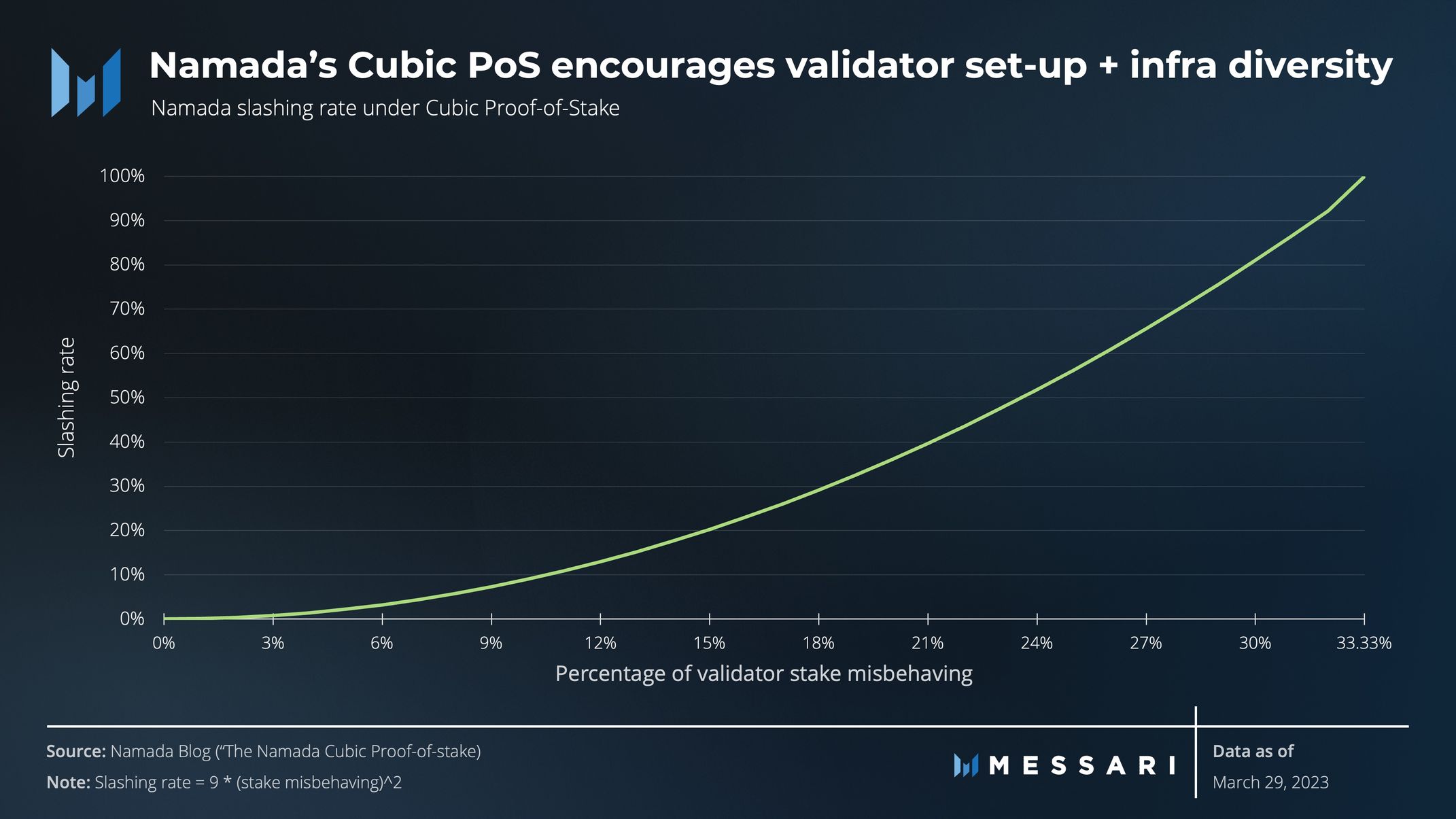
Cubic PoS gets its name from Namada’s penalties mechanism. Instead of slashing validators linearly, Namada is implementing cubic slashing. The percentage of stake slashed is proportional to the cube of total stake (whether from one or many validators) that misbehaved at the same time. Once 33% of stake misbehaves, 100% of that stake is slashed.
Cubic slashing encourages diversity within validator configurations and infrastructure architecture by pricing into the incentive mechanism the risk to protocol security of correlated faults.
Cryptography
Multi-Asset Shielded Pool (MASP)
The MASP is an extension of Sapling, a circuit developed by Electric Coin Company for Zcash. It also has added support for arbitrary assets. The MASP handles the minting and burning of shielded assets, known as notes, as they move between shielded and transparent Namada accounts.
As is denoted by the name, Namada has one shielded pool for all assets (fungible and non-fungible) rather than separate ones for each asset. This increases privacy, especially for unique or low-volume assets, which could easily be de-anonymized by monitoring entries and exits if they had their own privacy pools.
Within the MASP, all transactions are indistinguishable from one another. The creation of notes is visible, but senders, recipients, asset type, and amount are all obfuscated. Outside of the MASP, everything is visible in transparent accounts, as it is on other chains such as Ethereum.
A note in the MASP is minted by a zero-knowledge proof (ZKP) with three values:
Asset type: the type of asset (e.g., ETH, NAM, or an NFT)
Amount: the number of units of the asset
Address: the owner of the asset(s) and note
The notes exist in a UTXO-like model as they record values of assets. Unlike UTXOs however, the notes are not part of the public chain state. This status is only possible because notes are represented on-chain by two Merkle trees: a commitment and a nullifier tree.
A note is spent by:
Proving inclusion that it exists in the commitment tree. This step confirms that the note exists, the user spending it controls it, and that the transaction balance is preserved (no assets were created or destroyed in the transfer).
Revealing a nullifier which does not already exist in the nullifier tree. This step ensures each note can only be spent once, avoiding double-spend.
Convert Circuit (CC)
The CC is a separate circuit that works in tandem with the MASP circuit. It enables programmable asset conversions, which are facilitated through a predefined conversion table through a mint and burn mechanism. Conversions allow for added functionality that would otherwise require assets to first be withdrawn from the MASP (“internal programmability”).
The CC’s primary purpose is to privately reward MASP depositors with NAM.When an asset is deposited into the MASP, it is tagged with that epoch. When a user wants to reclaim their asset, the asset with the old epoch is converted to the asset with the new epoch. This system can then determine how long an asset was held in the pool and abstract everything away from the user. Users receive NAM rewards depending on the asset, amount, and duration they hold or use it in the pool. Unlike the bonded consensus mechanism used with NAM for the overall network, assets in the shielded pool are liquid and can be freely moved while still receiving shielded set rewards.
Other applications of the CC include voting, prediction markets, and shielded borrowing and lending.
Interoperability
Namada is integrated with IBC, granting trustless interoperability with Cosmos and IBC chains.
Additionally, Namada is building a native light client-based bridge to Ethereum. The bridge is run by Namada validators as part of the core protocol. Namada validators will run Ethereum full nodes and monitor Ethereum bridge contracts to know when assets are transferred to Namada.
For transferring back to Ethereum, the design is a little more complex because Ethereum does not yet support efficient light clients. Bridge requests are compiled into a sort of “mempool,” which stores them as a Merkle tree. Anyone can then relay any subset of the requests in the pool to Ethereum. By pooling bridge transactions, instead of sending and verifying them individually, gas costs can be reduced. Pooling is similar in practice to a sequencer batching transactions for a Layer-2 (L2) network. It differs by allowing anyone to initiate the verification of pooled transactions rather than the process being owned by a centralized sequencer, as it is with most L2s.
Tokenomics
Namada will have a native token, NAM, that will be used for:
Security (validator staking),
Shielded pool incentives,
Governance, and
Public goods funding.
Genesis Distribution
Genesis allocation details have not been announced.
However, the team has committed to distributing at least 20% of the initial supply toward retroactive public goods funding. The team wants to give back to developers, contributors, educators, and others who contributed to parts of Namada’s underlying tech stack and mission of privacy.
The team is still deciding on the exact mechanism and list of contributors. They accepted public nominations to help surface worthy contributors on their forum from January to March 2023. Recently, the Anoma Foundation proposed a strategic alliance between Namada and Zcash, which includes a NAM airdrop to ZEC holders and a grants pool funded by NAM dedicated to the Zcash ecosystem.
Inflation Mechanism
Inflationary tokens will be minted for three purposes: PoS (validator and delegator) rewards, shielded pool rewards, and public goods funding. The team will announce the exact inflation parameters for each bucket before mainnet.
PoS rewards: NAM will be distributed to validators in a mechanism generally modeled after Cosmos-bonded PoS. Tokens will be minted at a variable rate to target a set percentage of supply staked figure.
Shielded pool rewards: In order to grow the privacy set, NAM will be distributed to users who keep assets in the shielded pool. Rewards will depend on the asset, amount, and duration they’re held in the pool.
Public goods funding (PGF): NAM will be distributed as part of both proactive and retroactive PGF. Eligible categories include technical research; engineering; social research, art, and philosophy; and other areas like independent journalism, carbon sequestration, legal advocacy, and more. The funding will be conducted by the PGF Council, whose members are elected bi-annually by governance. The members can allocate the fund via a multisig up within the spending cap. The PGF Council will also receive a small portion of yearly inflation as income for their duties.
Governance
NAM tokens will also be used for on-chain stake-weighted governance. There will also be an off-chain governance protocol to reach general consensus before a governance vote or hard fork, or in case the network cannot produce blocks anymore.
Roadmap
Despite focusing on launching mainnet, Heliax outlined potential future protocol upgrades. After mainnet, any update will need to pass through on-chain governance.
At launch, Namada will be compatible with Cosmos chains (through IBC) and Ethereum (through its native bridge). Future upgrades will seek to add interoperability to other ecosystems to realize Namada’s mission of a unified privacy set. Heliax has begun working on an architecture for a Zcash <> Namada bridge, which it posted on Zcash’s forum.
Even if Namada is connected to every ecosystem, its privacy set will not be truly unified with those ecosystems as long as the bridges are transparent. With transparent bridges, users still lose privacy when moving between Namada and other private chains. Thus, the longer-term goal is to deploy privacy-preserving bridges, allowing all connected chains to share a privacy set.
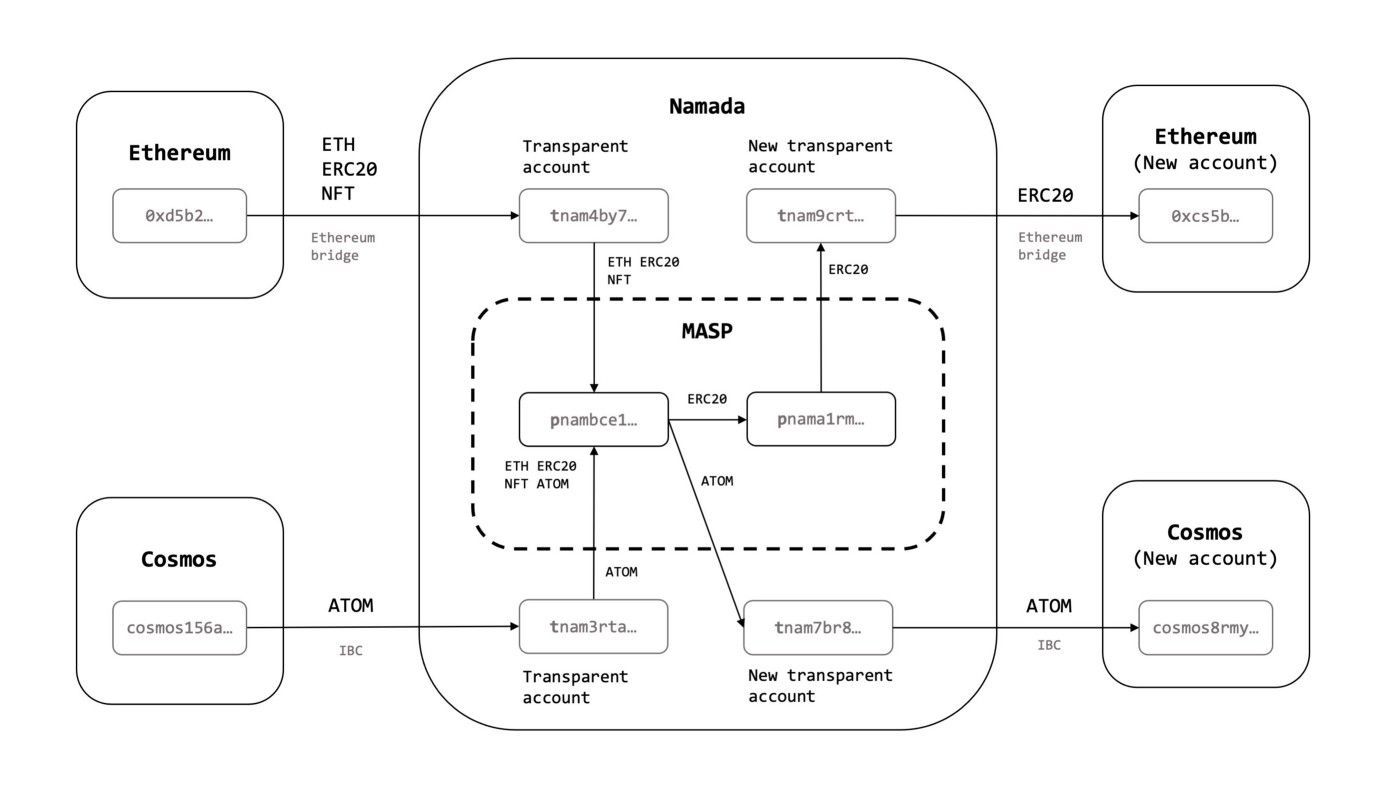
At launch, Namada will offer shielded transfers to users. Added internal programmability can be achieved through the CC, but generally, internal programmability is limited. Furthermore, if users want to use Namada for complex, multichain actions (for example, making a trade on Osmosis), they must do so manually. This manual process would include creating an account on Namada, bridging tokens to it, transferring the tokens within the shielded set, bridging back to Osmosis and swapping there, and finally bridging the tokens to a new Namada account. This process is clearly not the best user experience, and, if not done correctly, users could unintentionally doxx themselves.
Thus, Heliax is building shielded actions, which it plans to propose as an upgrade to Namada. Shielded actions will essentially combine the above steps into one simple front end. Shielded actions bring multichain programmability, allowing users to interact with any connected chain and their dapps. Other examples of potential shielded actions beyond DEX swaps include trading NFTs or staking ETH.
Lastly, Heliax plans to propose upgrades to aspects of Namada’s cryptography stack. For example, it hopes to upgrade Namada to a Halo2 circuit (developed by Electric Coin Company for Zcash), which will remove the need for trusted setups.
Competitive Landscape
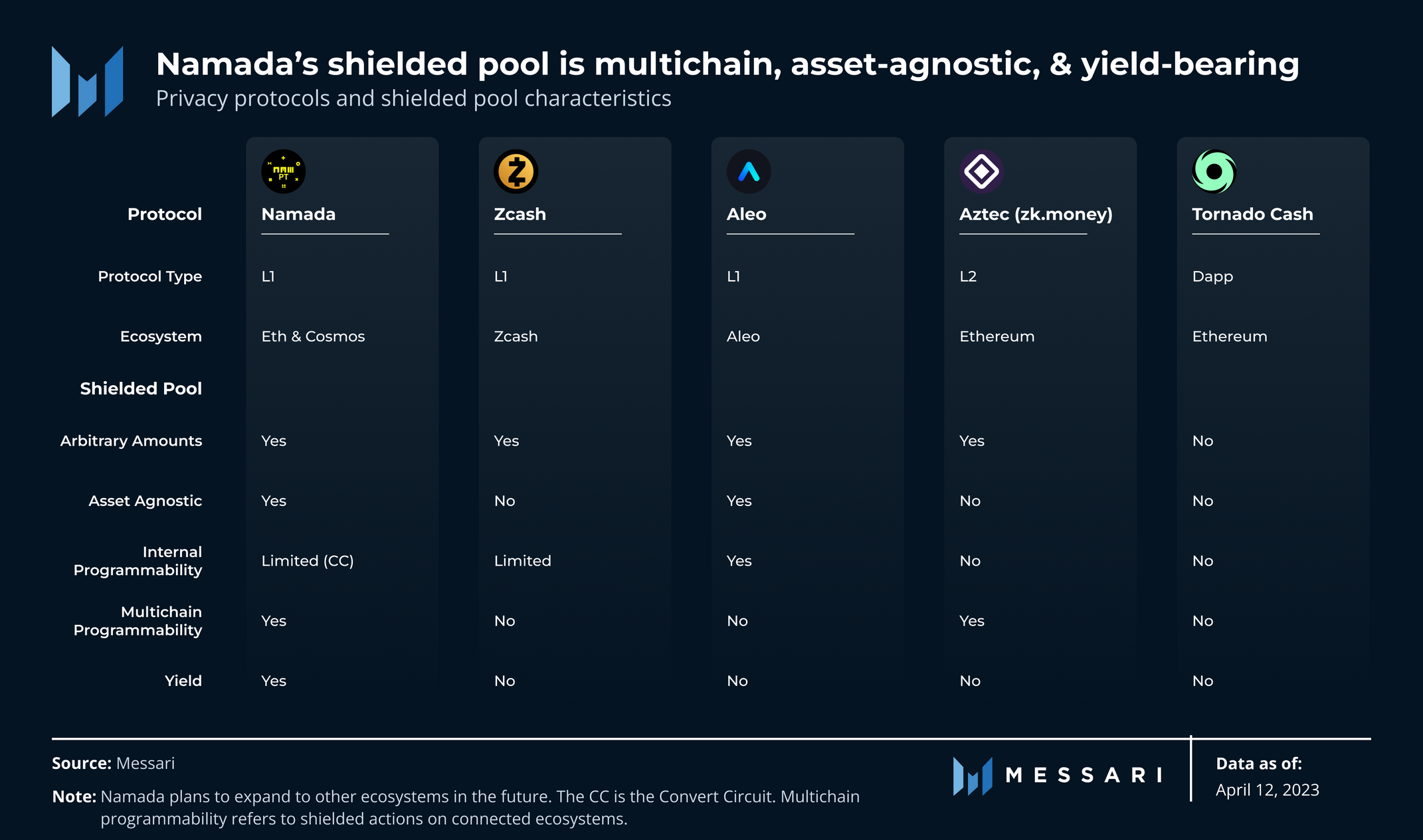
Privacy is heavily fragmented among pools on different protocols. Namada’s main advantages over its “competitors” in the privacy sector are that it supports multiple assets from multiple chains and incentivizes contributors to the privacy set. As a result, Namada is more of a complementary service to other shielded pools than it is a competition.
Privacy protocols exist in many forms across many networks:
Scriptable settlement L1s, such as Zcash and Monero, offer privacy within their networks. Because they are not programmable, they are limited in use case. These protocols are often fragmented both at the asset level, because usage of their privacy is generally restricted to a single native asset, and at the network level, because their limited interoperability.
Decentralized applications (dapps), such as Tornado Cash and Privacy Pools, are fragmented at the application level. Their privacy sets are disjoint from each other even if they’re built on the same network. While dapps can be unified at the asset level, many are not. Tornado cash for example is fragmented at both the asset level and quantity of asset level. It has different pools for different assets (e.g., ETH and USDC), and within those asset categories, it has different pools for different quantities (e.g., 0.1 ETH, 1 ETH, and 10 ETH). Some privacy dapps, such as RAILGUN, offer shielded actions to interact with other applications, but their pools are still isolated.
Programmable settlement L1s, such as Aleo and Secret Network, offer privacy and arbitrary computation within their ecosystems. This offering allows for DeFi, governance, and other applications to benefit from privacy, so long as they’re built on that network. Once Namada adds shielded actions, users will similarly be able to participate in various applications privately. However, they will be able to participate in applications in any connected ecosystem, rather than only the native ecosystem.
Programmable settlement L2s, such as Aztec (zk.money), enable shielded actions to interact with the existing ecosystem on L1. Unlike the protocols listed above, L2s don’t need to bootstrap their own ecosystem of applications and instead offer familiarity to their users. These protocols are still fragmented at the network level and also at the application level because they are not native to the core network (underlying L1).
As far as multichain solutions go, such as THORChain and Axelar, Namada separates itself with its offering of native privacy. Penumbra, a private L1 and shielded DEX on Cosmos, is multichain, but is only natively connected to chains within the Cosmos ecosystem. Penumbra’s services of shielded transactions and swaps would be complementary to Namada.
Generally, Namada differentiates itself by being the only cross-chain privacy solution with a unified, asset-agnostic privacy set. It uniquely offers yield to users in return for adding to the anonymity set. If it can achieve its endgame, Namada’s MASP will be unified at all levels.
Summary
Namada is an upcoming privacy-centric L1 driven by Heliax’s core values. It believes that privacy is a public good whose usage should be additive, not rivalrous. Namada’s core technological innovations include the MASP, which offers a unified, asset-agnostic privacy set, and the incentivization of usage of the MASP via the Convert Circuit. Namada will launch with IBC compatibility and a native Ethereum bridge, with plans to connect to more ecosystems in the future, at first through transparent and then privacy-preserving bridges. If Namada is successful, it will be able to enhance, rather than compete with, existing privacy protocols.
This report was commissioned by the Anoma Foundation. All content was produced independently by the author(s) and does not necessarily reflect the opinions of Messari, Inc. or the organization that requested the report. The commissioning organization may have input on the content of the report, but Messari maintains editorial control over the final report to retain data accuracy and objectivity. Author(s) may hold cryptocurrencies named in this report. This report is meant for informational purposes only. It is not meant to serve as investment advice. You should conduct your own research and consult an independent financial, tax, or legal advisor before making any investment decisions. Past performance of any asset is not indicative of future results. Please see our Terms of Service for more information.
No part of this report may be (a) copied, photocopied, duplicated in any form by any means or (b) redistributed without the prior written consent of Messari®.
Looking to dive deeper? Subscribe to Messari Pro. Messari Pro memberships provide access to daily crypto news and insights, exclusive long-form daily research, advanced screener, charting & watchlist features, and access to curated sets of charts and metrics. Learn more at messari.io/pro.
Red is a researcher, educator, and developer in the web3 space. Red's background is in electrical and software engineering. His main interest is privacy technology, through zero-knowledge proofs and general cryptography.
Peter is a Research Analyst in Protocol Services focused on Layer-1s. He recently graduated from Boston College where he studied economics and computer science and led the school's blockchain club.
Red is a researcher, educator, and developer in the web3 space. Red's background is in electrical and software engineering. His main interest is privacy technology, through zero-knowledge proofs and general cryptography.
Peter is a Research Analyst in Protocol Services focused on Layer-1s. He recently graduated from Boston College where he studied economics and computer science and led the school's blockchain club.