MEV in PoS Ethereum: Flashbots and Manifold

One area of blockchain research that has gained immense traction over the past few years is the concept of Maximum Extractable Value (MEV). Put simply, it is a measure of the amount of profit that a privileged entity can generate by including, excluding, or reordering transactions from the blocks they produce. This entity on Ethereum has traditionally been the miner, but in proof of stake consensus, this is now the validator. Given the change in consensus protocol, MEV design has been structured differently, and after a month since the change we can finally assess how the MEV landscape has evolved and how various actors have performed since the Merge.
Flashbots: MEV Supply Chain
Prior to 2019, MEV was a largely unexplored phenomenon that existed for sophisticated miners and bot operators in inefficient forms but was generally unknown to most Ethereum users. Then, Phil Daian and other notable smart contract researchers published Flash Boys 2.0, a research report that first defined MEV and highlighted the arbitrage opportunities that were available as a result of DEXs. This opened up many more research explorations into the many possible extractable opportunities that blockchains presented. At that time, MEV seemed like a looming threat to Ethereum’s security.
Flashbots was created in 2020 as an entity looking to research and develop ways to mitigate the negative externalities of MEV, such as centralization and bot spamming, through bringing transparency to MEV activity, democratizing access to MEV rewards, and ultimately figuring out the most sustainable way to distribute MEV.
Prior to Ethereum’s upgrade to Proof of Stake, Flashbots created what is known as MEV-Geth, a version of the Go Ethereum client that enabled a sealed-id block space auction. This meant that rather than a transaction going directly to the mempool and being picked up by a miner, there was now the ability for the transaction to be routed through a network of intermediaries who could compete to create blocks with the highest value capture. This competition meant less network congestion, as bot operators weren’t spamming the network to get their transactions included at the front of a block, less centralization that could lead to censorship or price gouging, and greater average rewards for miners of over 100% APR. Before the Merge, 80-90% of miners were running this client. This MEV supply chain consisted of different specialized operators who competed for their specific construction to be included in a block.
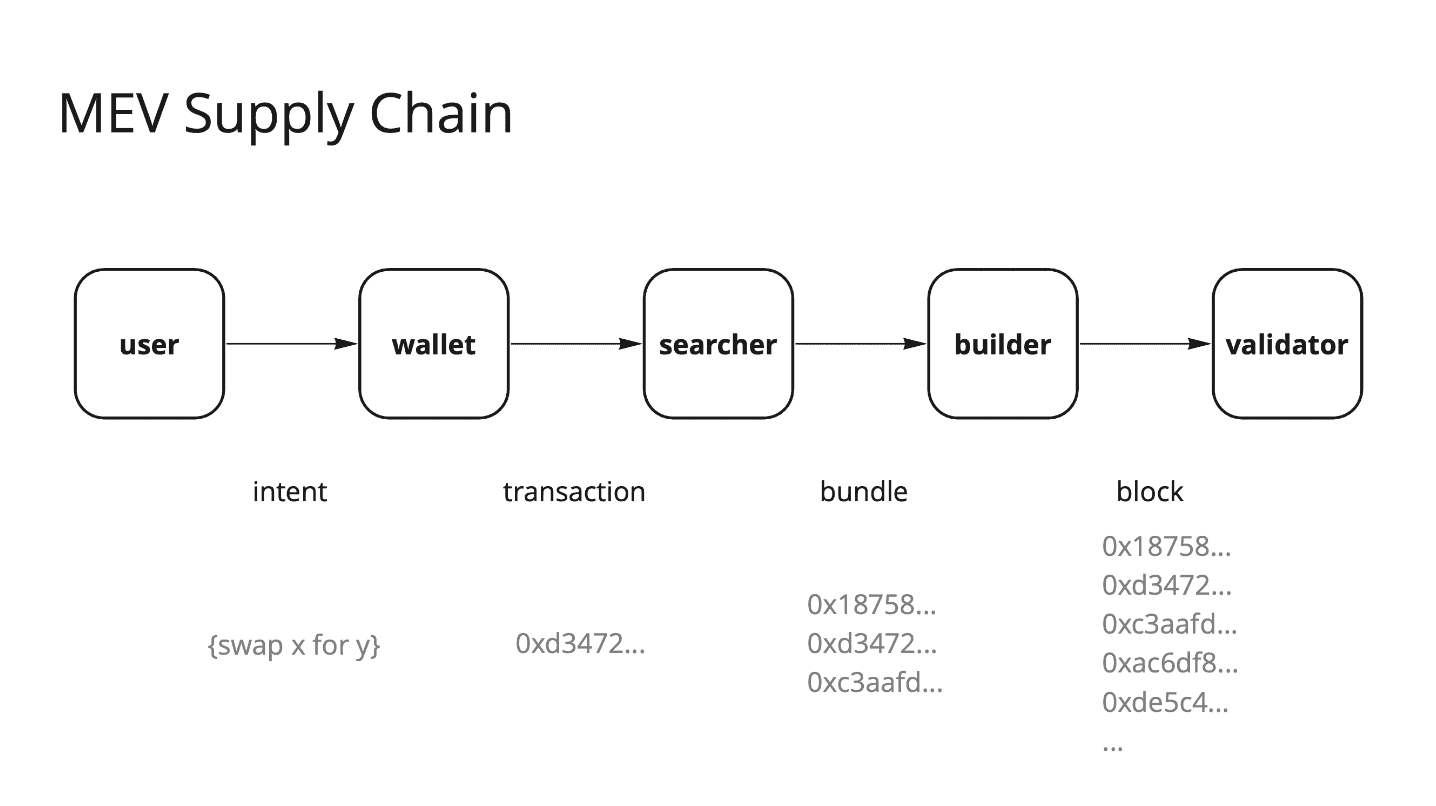
Source: Stephane Gosslein - Flashbots

Westie leads coverage on Ethereum, L2s, and Synthetix. Previously he worked in public sector technology Consulting at Guidehouse.