Messari Daily Brief Jan. 21, 2021 - Aavelanche of Loans

Flash loans as a concept didn’t exist 12 months ago. Today Aave alone has been responsible for $1.7 billion of flash loan issuances to date, and accelerating. Aave issued $25 million in loans in the first half of 2020, $500 million in Q3, and nearly $1 billion in Q4, including $450 million in December.
Flash loans are one of DeFi’s most exciting "zero to one” innovations, a primitive that allows users to borrow an asset, deploy the asset in a transaction, and repay the loan as part of a single-block multistep transaction. They can be used for arbitrage (programmatically exploiting price inefficiencies between various DEX’s within single blocks), collateral swaps (replace collateral in underlying loans without repaying the loan), and “self-liquidations” (can be thought of as DeFi refinancings without triggering taxable events), plus myriad potential future applications, and generally make DeFi more liquid and antifragile. Finematics has a new explainer on what the Aave community has been up to recently and it’s exciting.
In full disclosure, I own AAVE tokens, and those have performed well (along with crypto portfolios in general) in recent months. Aave is also a Messari partner. Still, Aave’s eyepopping stats only caught my attention yesterday because of their clean and reliable weekly KPI updates, which you can subscribe to here.
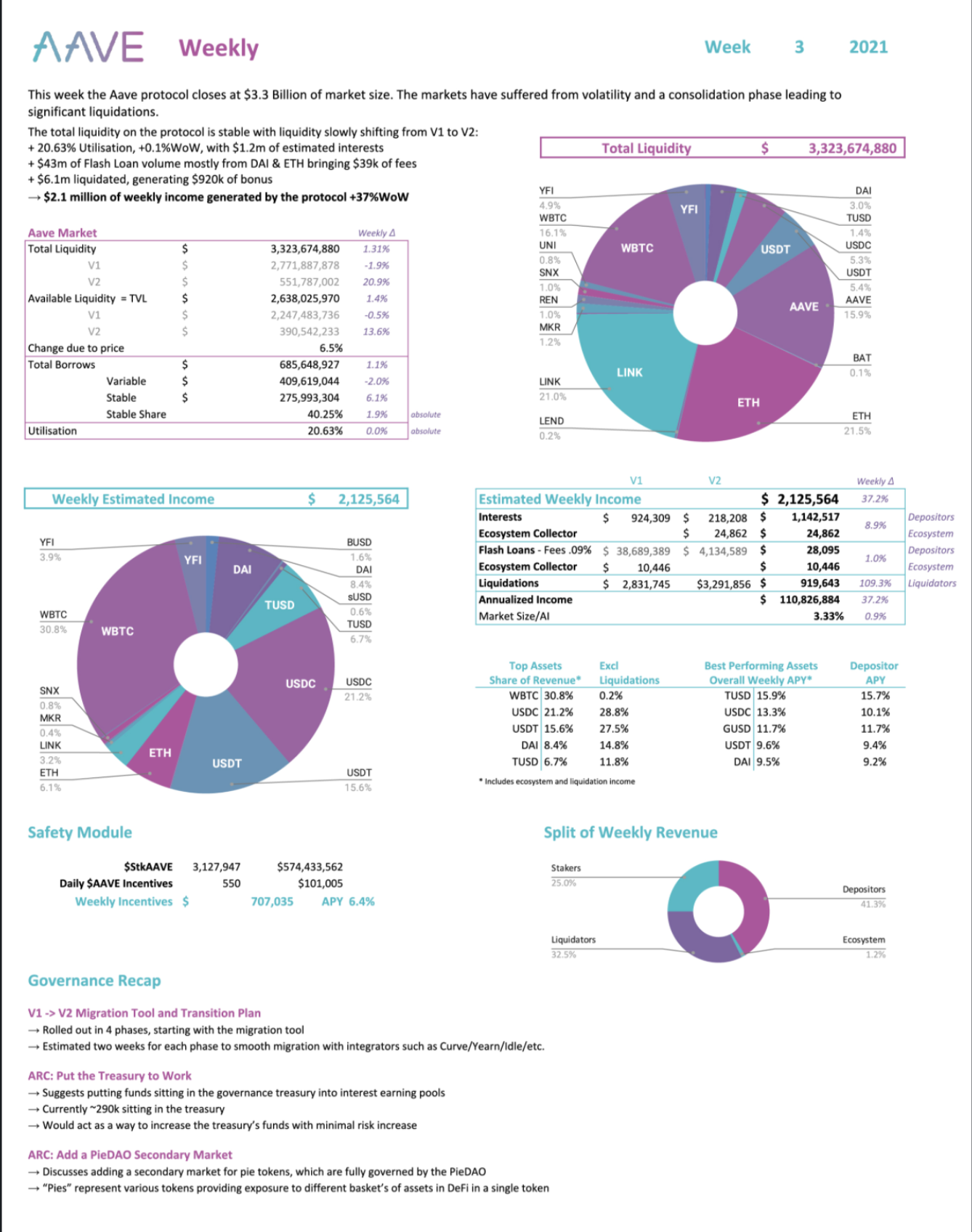
Every serious project and community should follow Aave’s lead. One page tl;dr’s that track tl;dr updates, governance proposals, and critical KPIs. It’s a work of art, it’s phenomenal stakeholder communications in a noisy market, and it's something we’ll be promoting heavily (and trying to automate) at Messari in the quarters ahead.
Headlines that matter:
- INTEL: Kyber 3.0 (sick); PowerPool PowerIndex v2; UMA collateral adds; Maker governance; Tezos, Cosmos, Polkadot software release updates
- An Excellent Year-in-Review of Ethereum (Evan & Josh)
- Celo prepping a digital Euro (The Block)
- BlockFi adds OTC trading desk (Decrypt)
- Blackrock greenlights two funds buying BTC futures (CoinDesk)
- STO platform iSTOX closes $50 million Series A (TechCrunch)
- DeFi will eat corporate (not yet, but good piece) (Bankless)
- Former Ripple advisor to take over OCC (The Block)
- Life After Trump, a series from geopolitical expert Peter Zeihan
- Daily Shade: Happy Melania.

Prior to founding Messari, Ryan was an entrepreneur-in-residence at ConsenSys, and on the founding teams of Digital Currency Group, where he managed the firm’s seed investing activity, and CoinDesk, where he led the company’s restructuring & annual Consensus conferences. He has been an investor & prolific writer in the crypto industry since 2013.