Maple Finance: Bringing Undercollateralized Lending to DeFi

“Credit is probably the most important part of the economy and probably the least understood” (Ray Dalio)
Debt is leverage and leverage is good. Okay, so it may be more nuanced than that but many of us have been taught that debt is inherently bad. Student loans are bad, credit card debts are bad. However, that doesn’t have to be the case.
Like many financial instruments, if used responsibly debt is a vital tool which enables us to grow personal wealth and, in aggregate, grow economic wealth. Afterall, an economy is simply the sum of the transactions within that market, i.e. money + credit exchanged for goods and services. You will notice that if we were to remove credit from the above equation, we would greatly hamper economic growth. Credit allows the borrower to pull forward their spending and it is spending that drives the economy.
In our effort to build a fairer, better financial system, the role of credit is no less vital. Looking back on the origins of DeFi, it is no surprise that protocols like Maker, Aave and Compound were some of the first lending use cases that now form the backbone of this industry. However, in a developing financial system without trusted intermediaries, the notion of undercollateralized lending was a tougher problem to solve. DeFi users are pseudonymous identities without reputations or credit scores. It’s why we have seen the overcollateralized model flourish where borrowers are able to source liquidity from aggregated pools without requiring recourse beyond collateral provided. Given the jumpstart effect on DeFi from these early pioneering money market protocols, we can only begin to imagine how transformative an on-chain credit market will be for DeFi zero-to-one growth - one where users don’t need capital to access capital.
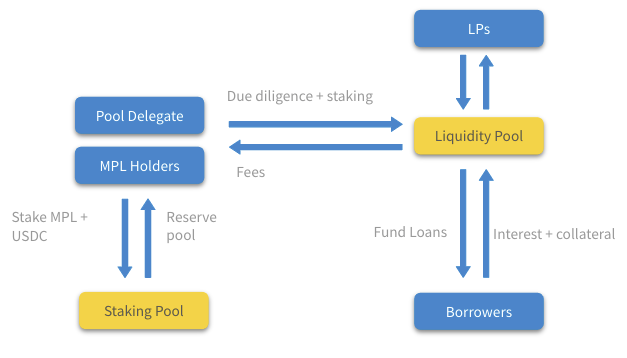
Enter Maple. Maple is a decentralized corporate credit market enabling institutions to borrow on an undercollateralized basis. For the first time, this enables users to access credit at a fixed rate to reinvest in their businesses in a capital efficient manner. Whether you are a crypto miner looking to fund hardware, a market neutral fund seeking to borrow to deploy basis trades or a market maker seeking to boost liquidity in trading pairs, institutional corporate credit is a vital cog in the crypto puzzle. In this thread from Ross Middleton at DeversiFi, he explains how Maple solves a vital pain point in a capital-intensive part of their business. As Ross describes, DeversiFi runs market making services to aggregate liquidity trustlessly into their L2 DEX while funding withdrawal pools that allow traders to instantly move from L2 to L1 meaning they need to keep millions of dollars of tokens in various parts of their protocol which if using the usual overcollateralized borrow methods would simply be infeasible.
How does it work?