Manta Labs is shifting from infrastructure to applications. The move recognizes that Layer-2 networks face diminishing differentiation at the infrastructure level, making application-driven demand the more durable path to growth.
Thema marks the beginning of Manta’s enterprise DeFi growth strategy. Through Omnichain Meta-Tokens, Thema creates arbitrage opportunities on tokenized indexes, enabling high-frequency rebalancing.
Junk.Fun saw 15k users and a $5.5M annualized revenue run rate on its first day. By burning worthless tokens and NFTs, users turn rugs into another chance to win.
SUPERFORTUNE ranked among the top four AI apps on BNB Chain at the end of October 2025. During this period, SUPERFORTUNE reached 12.2k daily active users.
Application revenues will flow back to MANTA holders. MANTA will benefit from its utility as an infrastructure token and activity across institutional and consumer markets.
Primer
Since Manta Pacific’slaunch in 2023, the network has positioned itself as a modular Ethereum Layer-2 (L2) designed to deliver low-cost, high-throughput execution while inheriting Ethereum’s security guarantees. Its development reflected the broader Ethereum scaling roadmap, which shifted most activity off mainnet and into L2 environments. Manta Pacific entered this market as one of many rollups competing to capture liquidity, developers, and users.
The Ethereum L2 sector has expanded quickly, but growth has introduced structural challenges. Liquidity has fragmented across dozens of chains, often leaving shallow markets on individual rollups. This fragmentation has also reduced Ethereum mainnet revenues, creating questions about the sustainability of rollup economics. At the same time, performance metrics such as transaction speed and cost have converged across most L2s, limiting opportunities for differentiation at the infrastructure level. Base has scaled rapidly through Coinbase’s distribution, but many other rollups have struggled to achieve product-market fit or sustain adoption without ongoing incentive programs.
Manta’s strategic transition is a response to these realities. After establishing the Manta Pacific Ethereum L2, the project is shifting focus toward applications as the primary growth engine. On the institutional side, Manta Labs is developing Thema, a tokenized index protocol that packages baskets of assets into onchain products and creates arbitrage opportunities between the index and its components. The design aims to provide compliant exposure to diversified tokens while generating liquidity through arbitrage flows. In parallel, Manta is targeting retail adoption with SUPERFORTUNE, a GameFi application that blends AI with cultural engagement mechanics and token incentives to encourage sustained participation and Junk.Fun, a memecoin burning lottery system on Solana. These applications are Manta Labs’ starting point for repositioning the project from an infrastructure-first rollup to an application-driven ecosystem.
Ethereum L2 networks have become the primary scaling path for the ecosystem, offering lower fees and faster throughput than the Ethereum mainnet. Their growth was driven by Ethereum’s rollup-centric roadmap, which shifted activity away from the base layer and into offchain execution environments. As rollups proliferated, they promised developers and users a more accessible environment while still inheriting Ethereum’s security guarantees.
This expansion has revealed structural challenges. Infrastructure performance has largely converged across L2s, with most networks delivering similar transaction speeds and costs. With few technical distinctions, it has been difficult for individual rollups to stand out. Many have leaned heavily on incentive programs to attract activity, but these efforts often fail to sustain engagement once rewards taper off. As a result, only a handful of rollups have managed to build meaningful ecosystems, while many continue to struggle with product-market fit and long-term user retention.
These dynamics suggest that the future of L2 competition will be shaped less by infrastructure and more by applications. Networks with distribution advantages, such as Base through its integration with Coinbase, have demonstrated how external pipelines of users can be decisive. For others, the path to relevance will depend on creating or supporting applications that capture demand directly and generate real liquidity. This is the strategic backdrop for Manta’s decision to pivot from being an infrastructure-first rollup toward an application-focused ecosystem.
Even as it transitions toward applications, Manta continues to strengthen its infrastructure layer. The network recently launched MANTA staking in partnership with Symbiotic, enabling MANTA holders to delegate to Symbiotic Finality Providers (SFPs) that secure Manta Pacific and deliver fast finality. Delegators and operators earn MANTA rewards every three days for submitting finality proofs, with customizable commission rates. This model decentralizes finality, shortens confirmation times from days to minutes, and aligns network security with tokenholder participation.
Manta’s Strategic Pivot
Manta’s latest strategy is a deliberate response to the limitations of infrastructure-driven growth. The team has recognized that sustaining adoption requires applications that create direct user demand rather than relying on chain-level performance or incentives to attract activity. To execute on this shift, Manta Labs is incubating a portfolio of applications across both institutional and consumer markets. Thema, its institutional initiative, is a tokenized index protocol developing an omnichain exchange-traded product platform with arbitrage-aware mechanics designed to align prices with value while generating additional yield. On the consumer side, Manta Labs is incubating SUPERFORTUNE, a GameFi application that integrates tokenized rewards to drive engagement and Junk.Fun, a protocol that enables users to access SOL rent associated with active token accounts on Solana by burning their worthless memecoins and entering a lottery system for rewards. Together, these efforts reposition Manta from an infrastructure-first rollup to an application-focused ecosystem, with all activity designed to reinforce value capture for MANTA holders.
Manta’s Enterprise DeFi Expansion
Thema
Thema is the cornerstone of Manta Labs’ enterprise DeFi application strategy. It is being developed as a tokenized index protocol with a first product centered on omnichain exchange-traded products (ETPs). At the core of this design are Omnichain Meta-Tokens (OMTs), a new class of assets that represent baskets of underlying tokens while maintaining interoperability across multiple networks. OMTs allow Thema to mint and redeem index products across ecosystems, ensuring accurate tracking of components while preserving portability in a fragmented market.
The use of OMTs also introduces arbitrage-aware mechanics. OMTs can be minted and redeemed across multiple chains, giving traders several pathways to profit when the token’s market price diverges from the value of its underlying basket of assets. If an OMT trades at a premium, arbitrageurs can mint new tokens from the components and sell them into the market. If it trades at a discount, arbitrageurs can redeem OMTs for the underlying assets. This feature keeps valuations aligned and encourages professional market makers to provide liquidity. By embedding arbitrage into the structure, Thema reduces index tracking error, defined as the divergence between a product’s market price and the net asset value of its underlying basket, and addresses the shallow liquidity that has challenged earlier single-chain DeFi index protocols.
Another central feature is high-frequency rebalancing. Manta Labs is developing an in-house system to adjust Thema’s index compositions dynamically in real time, keeping prices close to net asset value and reducing tracking error. This capability, combined with omnichain functionality, positions Thema to avoid the inefficiencies that plagued earlier single-chain index experiments. By maintaining tight tracking and cross-chain accessibility, OMT-based products are designed to scale more effectively across liquidity venues.
Thema applies the framework of structured products to an onchain environment aimed at bridging traditional and decentralized markets. Traditional financial institutions are increasingly exploring tokenized products, but they require familiar structures and dependable liquidity to allocate capital at scale. By structuring indices as ETPs with built-in arbitrage and cross-venue portability, Thema seeks to make onchain exposure operationally familiar for capital markets desks. It could provide Manta Labs with a durable institutional anchor, generating sustained liquidity and trading flows that complement the more volatile dynamics of consumer-facing applications.
Consumer Applications
SUPERFORTUNE
Alongside its institutional push, Manta is incubating a portfolio of consumer-facing applications to drive broad user adoption. The first consumer application is SUPERFORTUNE, an AI-powered InfoFi platform that blends Chinese metaphysics, including Feng Shui principles, with blockchain to generate fortune-based insights. Users can perform daily fortune readings, analyze tokens or contract addresses, and test compatibility between social accounts, with each interaction rewarding Fortune Points. This gamified loop leverages cultural motifs, AI, and crypto mechanics to encourage repeat engagement.
SUPERFORTUNE has quickly become one of the fastest-growing AI applications on BNB Chain. As of Oct. 29, 2025, the app ranked as the #1 AI dApp by daily active users, with 12,220 DAUs and 14,930k transactions over the 24-hour period, according to DappBay. During the final week of October, it placed fourth among all AI applications on BNB Chain, exceeding 14,130 users. The majority of users engage with the platform as a supplementary analytics tool for trading activities, reflecting growing demand for products that merge AI-driven insight with interactive experiences.
As part of Manta Labs’ multichain strategy, SUPERFORTUNE has been deployed on BNB Chain and Solana to reach users across established ecosystems. The approach recognizes that activity is already distributed across networks and that limiting adoption to a single chain would constrain growth. By operating in multiple environments, SUPERFORTUNE is positioned to capture engagement where it already exists rather than requiring users to migrate to a new venue.
SUPERFORTUNE’s Game Mechanics
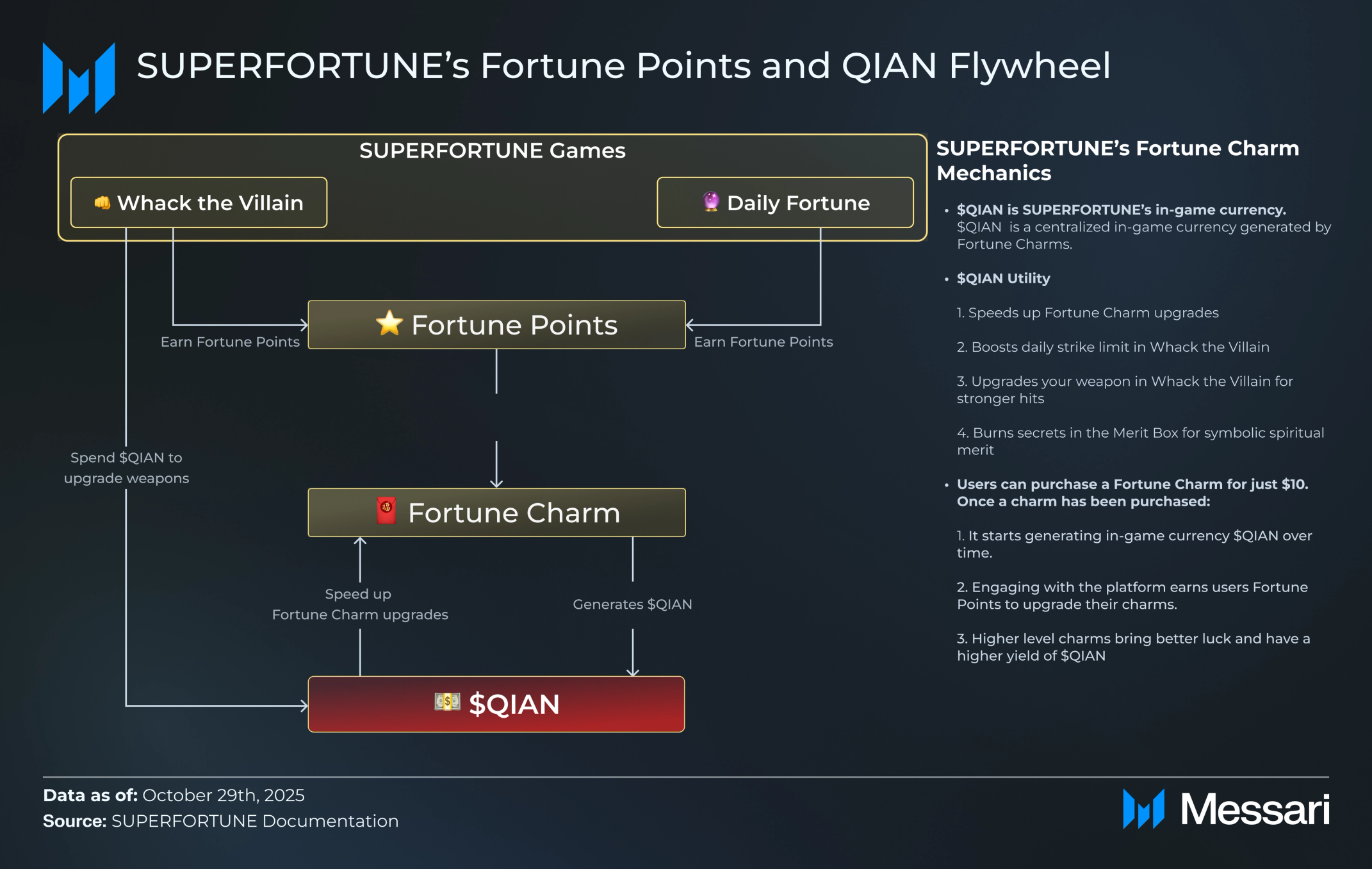
SUPERFORTUNE’s monetization and progression mechanics center on Fortune Charms, which combine cultural symbolism with tokenized incentives. Purchased for $10 and modeled after Daoist talismans, charms unlock the full platform, including referral rewards and access to the “Whack the Villain” minigame. Fortune Charms generate QIAN, a centralized, non-tradable in-game currency used exclusively within the platform for upgrades, boosts, and gameplay. Fortune Charms can be upgraded across eight levels using Fortune Points, with higher levels producing faster yields. Whack the Villain extends this loop by rewarding points through a ritual-inspired click-based game, where weapons can be upgraded with QIAN and daily strike limits expanded. These mechanics function as a closed progression loop that balances participation, rewards, and upgrades within the application’s economy.
SUPERFORTUNE employs a dual-currency model that distinguishes closed in-game rewards from onchain utility. QIAN is centralized and non-tradeable. By keeping QIAN closed, SUPERFORTUNE avoids the inflationary dynamics that undermined many play-to-earn projects.
SUPERFORTUNE’s official token, GUA, carries a fixed supply of 1.00 billion tokens and is reserved for advanced utilities such as NFT purchases, feature unlocks, and buyback-and-burn mechanisms. This structure supports sustainability by tying GUA’s utility to platform growth while containing reward issuance within a closed system.
Junk.Fun
The next addition to Manta Labs’ consumer portfolio is Junk.Fun. Junk.Fun turns wallet clutter into something crypto culture can’t resist: another roll of the dice, another pull of the lever, another flip of the coin, one last lottery ticket and a dream. What began as a cleanup tool has become a gamified recycling center for the blockchain’s forgotten experiments, giving holders of worthless tokens and NFTs one more chance to make it.
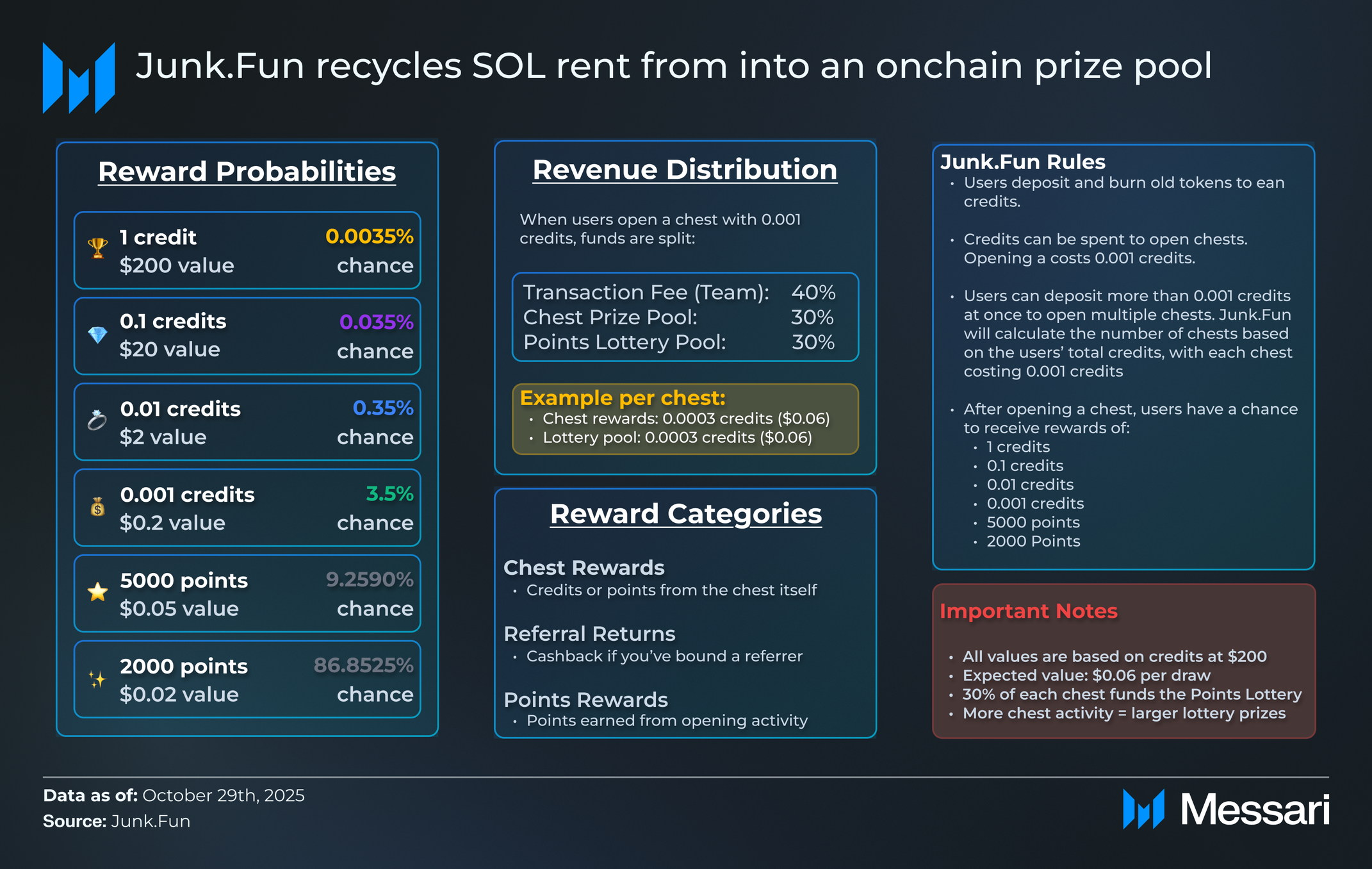
Powered by Bonk and built on Solana, Junk.Fun rewards users for burning “junk” assets, typically memecoins or NFTs that have gone to zero. Participants, playfully known as Trash Bandits or Junkies, can deposit these assets to permanently burn them, reclaim SOL rent from the closed accounts, and earn points that unlock prize-based mechanics like Treasure Chests and lottery points. Opening Treasure Chests costs 0.001 SOL and grants randomized rewards, while the Points Lottery runs on a fifteen-day cycle, allowing users to invest their accumulated points for a chance at larger SOL prize pools.
Rewards
Rewards span eight tiers, ranging from common point payouts to rare SOL prizes. Most chests yield 2,000 to 5,000 points, while higher-value credit rewards range from 0.001 to 1 credit, with the top prize worth the equivalent of 1 SOL. The odds scale steeply; players have a 0.0035% chance of winning the jackpot and an 86.8% chance of landing the smallest reward. Each chest opening splits proceeds across three pools: 40% to the team as a transaction fee, 30% to the Chest Prize Pool, and 30% to the Points Lottery Pool, which funds seasonal prize distributions.
Referrals
Participation in Junk.Fun is social by design. Every user must join through a referral, creating a viral loop that rewards community-led growth. Players receive unique invite codes and earn bonus points whenever their invitees junk tokens or open treasure chests. Referral rewards accumulate automatically and can be claimed at any time, turning social reach into another form of onchain yield. Active participants are encouraged to share their codes early to maximize passive points and climb the leaderboard of top Trash Bandits.
Part Cleanup, Part Casino
Originally conceived as a lighthearted way to clear out dead tokens, Junk.Fun is part cleanup, part casino, part collective coping mechanism. Every burn is a bet, every chest a pull of the lever, every lottery entry a reminder that even the trash might still have one last run left in it. Junk.Fun doesn’t just dispose of the past; it recycles it into one more chance to win big.
Manta Labs’ Consumer Application Strategy
SUPERFORTUNE and Junk.fun are the first applications in a planned series of consumer-facing launches. Manta has outlined a pipeline of three to five applications over the next year, spanning enterprise DeFi and consumer applications. The portfolio approach is intended to diversify adoption pathways and reduce reliance on a single breakout product. While consumer-facing applications represent a higher-variance strategy than enterprise products, they provide an important channel for user acquisition and brand visibility within Web3.
Implications for MANTA Holders
Manta has indicated that revenues generated from its consumer and enterprise applications will be directed back to MANTA holders. This model aligns tokenholder interests with ecosystem expansion across retail and institutional markets. The extent to which this framework creates durable value will depend on execution, particularly the sustainability of consumer-facing applications and the regulatory clarity surrounding institutional adoption.
Closing Summary
Manta has shifted from an infrastructure-first orientation to a strategy centered on applications as the primary driver of adoption. The change follows structural challenges in the Ethereum L2 sector, where performance has converged, liquidity has fragmented, and many networks have struggled to sustain usage once incentives decline. Manta Labs is incubating enterprise DeFi and consumer applications to address these pressures. Thema, a tokenized index protocol that leverages Omnichain Meta-Tokens for arbitrage-aware, cross-chain products, anchors the institutional side, while consumer applications such as SUPERFORTUNE and Junk.Fun merge cultural engagement, gamified mechanics, and tokenized incentives to attract new audiences. By incubating enterprise DeFi and consumer applications, Manta aims to diversify adoption channels and direct revenues from each back to MANTA holders, repositioning the network as an application-led ecosystem rather than competing on infrastructure performance alone.
This report was commissioned by Manta Network. All content was produced independently by the author(s) and does not necessarily reflect the opinions of Messari, Inc. or the organization that requested the report. The commissioning organization may have input on the content of the report, but Messari maintains editorial control over the final report to retain data accuracy and objectivity. Author(s) may hold cryptocurrencies named in this report. This report is meant for informational purposes only. It is not meant to serve as investment advice. You should conduct your own research and consult an independent financial, tax, or legal advisor before making any investment decisions. Past performance of any asset is not indicative of future results. Please see our Terms of Service for more information.
No part of this report may be (a) copied, photocopied, duplicated in any form by any means or (b) redistributed without the prior written consent of Messari®.
Hayden is a Research Analyst specializing in the intersection of crypto-economic incentive mechanisms and their role in DeFi, DePIN, and AI ecosystems. Prior to joining Messari, Hayden worked as a Research Analyst at The Block and as a Venture Associate at a crypto-native venture capital fund.
Hayden is a Research Analyst specializing in the intersection of crypto-economic incentive mechanisms and their role in DeFi, DePIN, and AI ecosystems. Prior to joining Messari, Hayden worked as a Research Analyst at The Block and as a Venture Associate at a crypto-native venture capital fund.