MakerDAO: Organic Demand Doesn’t Grow on Trees

To summarize, the DAI supply has shrunk notably in the short term as users are moving to more volatile assets, and the stablecoin has seemingly been used to perform leverage and carry trades as a result of low stability fees in comparison to the rest of the market. This has put downward pressure on DAI and forced MakerDAO to strengthen its liquidity profile by, e.g., withdrawing all of its funds from the Coinbase Custody vault to the USDC PSM.
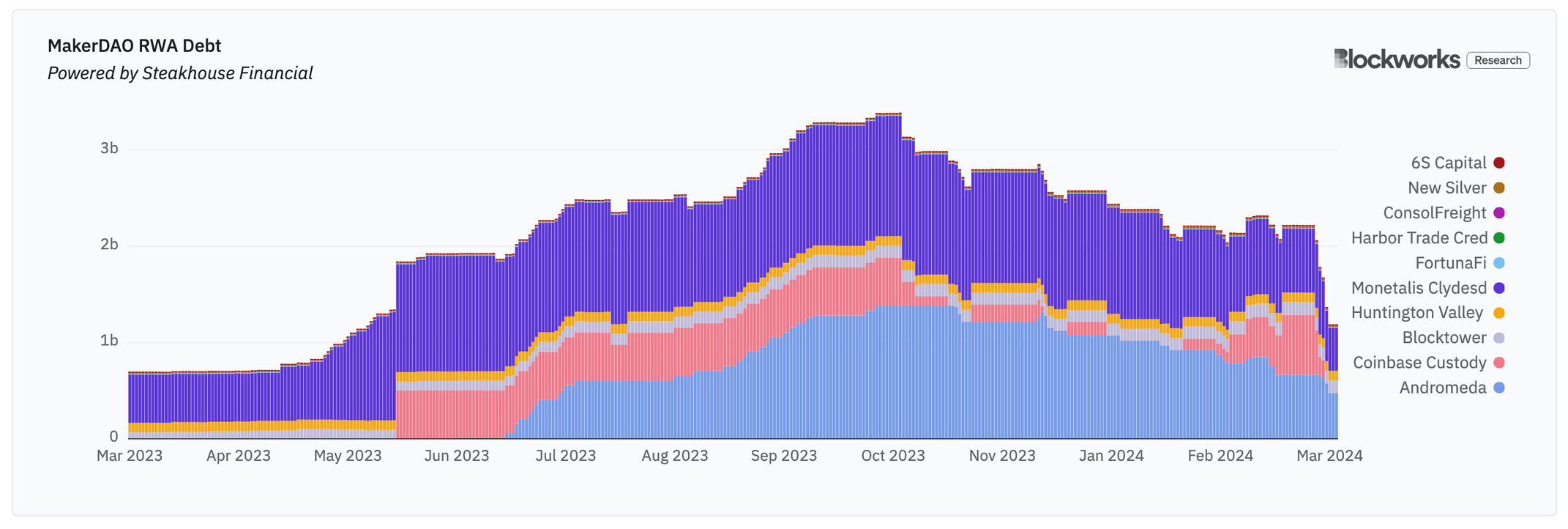
The protocol is well capitalized, with the two largest T-Bill vaults, BlockTower Andromeda and Monetalis Clydesdale, controlling ~$920M worth of capital. However, both have shrunk notably in recent times in tandem with the Coinbase Custody vault. Although crypto-backed loan and Spark interest revenues have been growing, this has led to a ~$30M decrease in annualized revenue from this year’s high.
By increasing stability fees across the board, MakerDAO is trying to close any major DAI carry trade opportunities, bringing interest rates more in line with the rest of the significant stablecoins in the onchain market. This could lead to further DAI supply shrinkage if users aren’t willing to pay the higher interest rates. However, the probability of a liquidity crunch and DAI depeg is decreased because users would have to return DAI to the protocol to close their positions. Furthermore, through an increase in the DSR, MakerDAO hopes to incentivize more users to hold DAI passively, curbing sell pressure and supply shrinkage. This has had an immediate impact, with the DAI supply having reverted to growth, up ~150M since the rate changes were implemented, and the DSR saw an inflow of ~95M DAI on March 10.
Higher stability fees will also ensure that the larger DSR is sustainable, regardless of the DAI in the DSR as a percentage of the total DAI. These changes seem to have primarily been implemented due to the volatile USDC PSM and recent idiosyncratic shocks, where DAI outflows have been driven by a few large wallets that have now sold most of their holdings.
There is an argument to be made that these changes can increase MakerDAO’s revenue and, more importantly, profit. For the sake of the argument, making the simplistic and improbable assumptions that the remaining DAI borrowers are completely insensitive to the interest rate increases and that no new capital enters the DSR because there is a vast amount of other high-yield passive opportunities on the market, results in ~$198M annualized crypto interest revenue (~$76M in February), ~$194M in annualized D3M (Spark) revenue (~$55M in February), and ~$192M in annualized DSR expenses (~$55M in February). In other words, all else equal, annualized revenue would increase by ~$261M and annualized profit by ~$123M.
MakerDAO sends its profits to the Surplus Buffer, and once the buffer reaches 50M DAI, the Smart Burn Engine uses the excess to acquire MKR and pairs it with DAI in a Uniswap V2 pool. Naturally, some DAI is likely to be redeemed, the DSR increase could induce large inflows similar to when the yield was set at 8% in August 2023 (DAI in the DSR has grown by ~12% since the recent rate increase), and the current onchain rate environment likely isn’t sustainable.

Brick leads coverage on Aevo, Chainlink, and MakerDAO. Previously he worked in investment banking as a sector-agnostic M&A and ECM advisor.