MakerDAO: Cash Flow Machine


RWAs enable the billions of dollars in idle stablecoins to generate yield that is generally inversely correlated to the demand for leverage in crypto. Looking at Maker’s Income Statement, it’s clear that RWA Vaults generate a significant amount of revenue. In November 2023, RWA Vaults earned $16.3M of revenue (~$194M annualized), accounting for 64% of total revenue.
Our latest MakerDAO Dashboard provides insights into the protocol’s income statement, balance sheet, RWA Vaults, and more. Many of our financial metrics leverage the transaction-level accounting ledger built by Steakhouse, the old Strategic Finance Core Unit for MakerDAO.
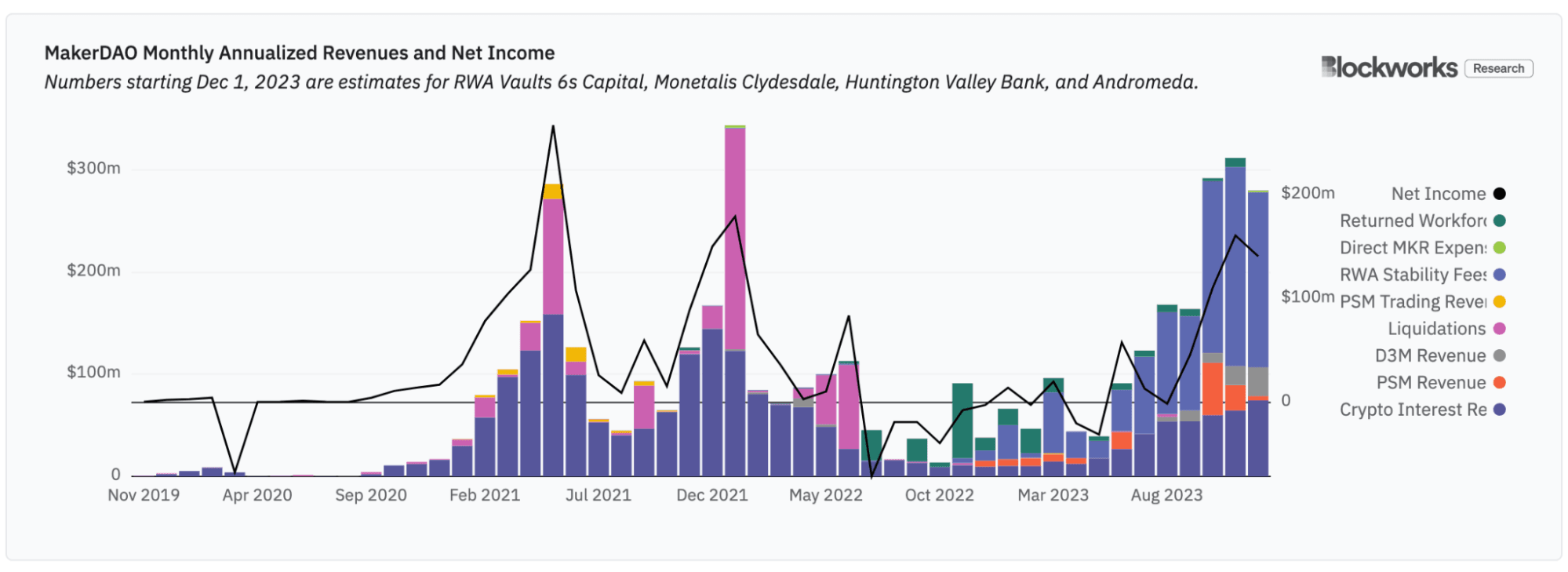
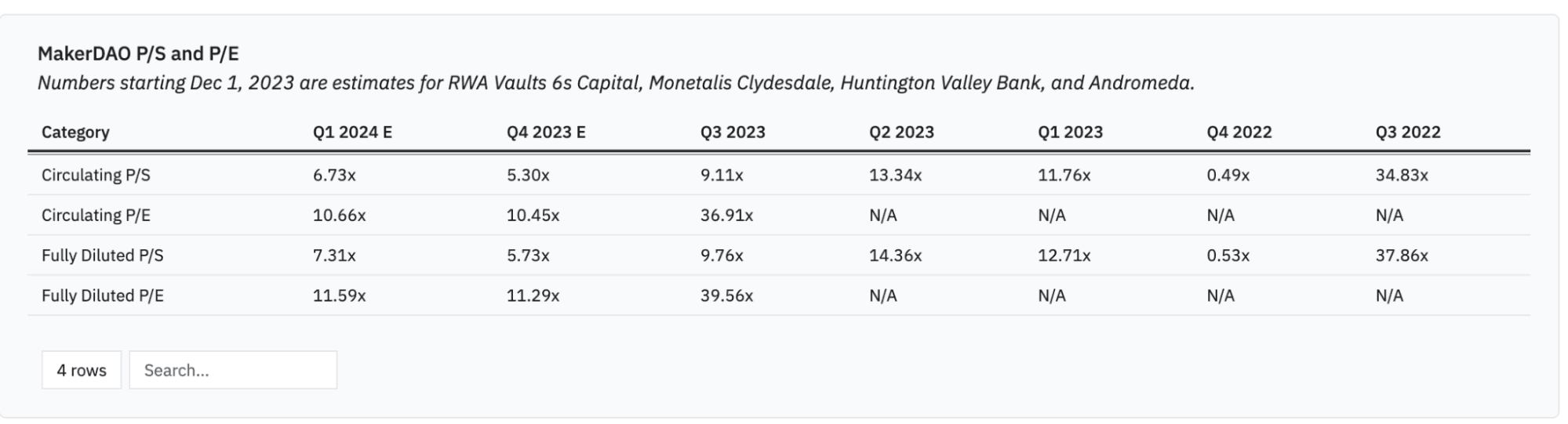
This RWA revenue, alongside $5.4M in Crypto Interest Revenue ($64.5M annualized), is the main driver for significant protocol revenue. The magnitude of these numbers has yet to be seen anywhere in DeFi and has led to favorable P/S and P/E multiples. In Q4 2023, the P/S ratio was as low as 5.3x.
However, the problem with the reliance on RWAs is not apparent until you dig deeper into the mechanics. RWA vaults are managed by third parties, some of which are more forthcoming with information while others are not, which means a very slow process of gathering data. This is in contrast to onchain financial activity, which is gathered in real-time on a block-by-block basis. In addition, some of the commercial credit extended by these third parties have proven to be questionable.
Tracking revenue data for RWA-003 (ConsolFreight) and RWA-004 (Harbor Trade Credit) highlights some of MakerDAO’s reporting inefficiencies. Each of these vaults has multiple assets representing loans to various parties. RWA-003 has 2 assets in default, which make up 12% of the current portfolio, and RWA-004 has all three of its assets in default. While ConsolFreight and Harbor Trade Credit work behind the scenes for recourse, the onchain vault continues to accrue stability fees used in the RWA revenue calculation. It is unclear how much Maker will recover, whether that be the entire principal and the stability fees or only a small portion of the overall value. While these vaults only represent a minority of RWA stability fees, it goes to show how these numbers could misrepresent revenue collected by Maker.

Westie leads coverage on Ethereum, L2s, and Synthetix. Previously he worked in public sector technology Consulting at Guidehouse.

Brick leads coverage on Aevo, Chainlink, and MakerDAO. Previously he worked in investment banking as a sector-agnostic M&A and ECM advisor.