Lyra: Cash Collateralized Options Market-Making Vaults

Lyra is an on-chain options AMM live on Optimism and Arbitrum with options available for BTC & ETH. Lyra allows users to both buy and sell options from and to a liquidity pool.
Options IV & Skew
Like any other options AMM, the key thing to figure out is how to price implied volatility (IV). The other variables within the commonly used Black-Scholes formula are given.
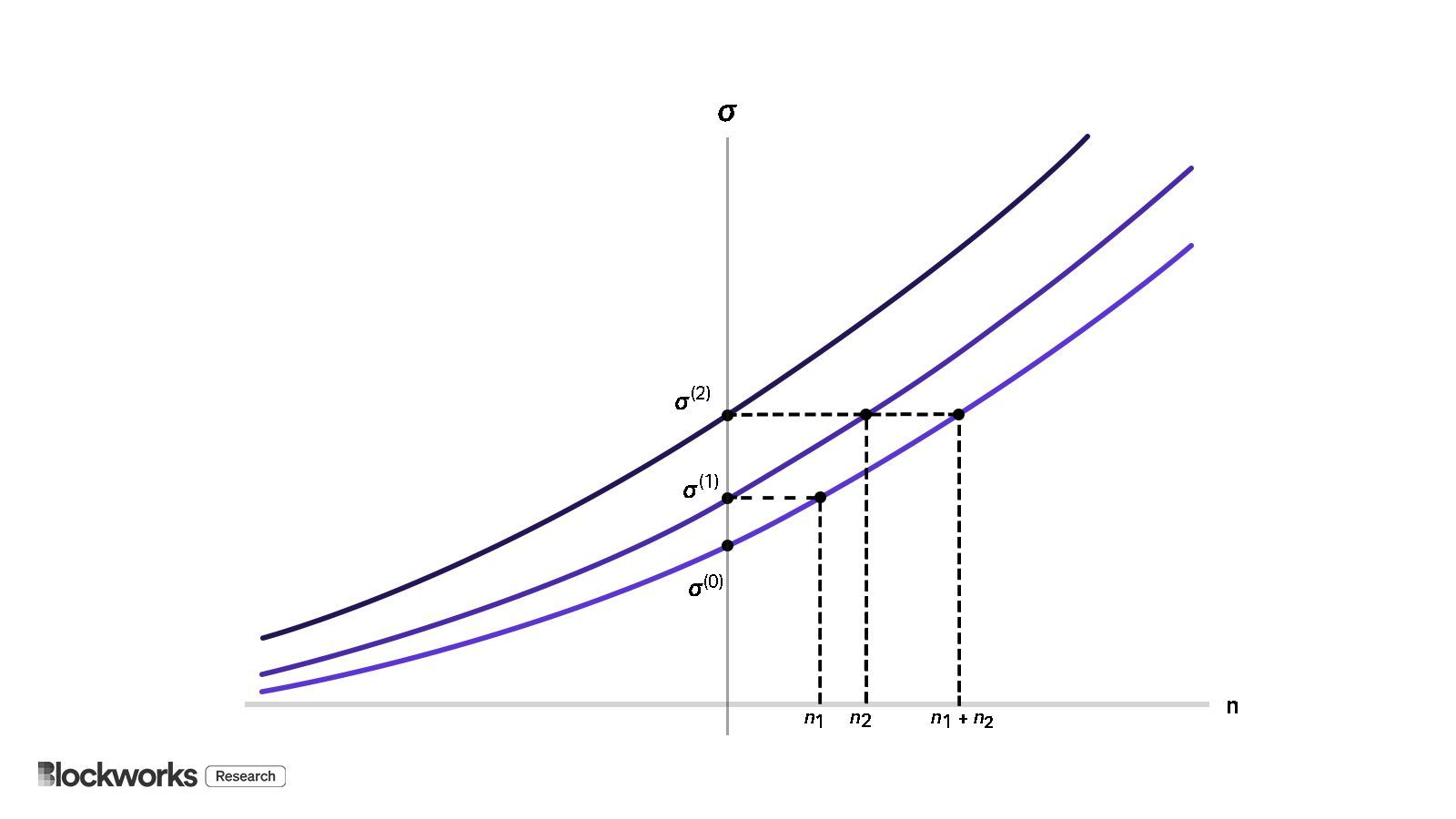
Once an options expiry is listed, a baseline IV is initialized using market data from Deribit. After initialization, the baseline IV will fluctuate based on supply and demand for the various options within that expiry. Lyra increases or decreases the baseline IV for a given expiry by a fixed 1% for every standard-size trade. The standard-size is a protocol-defined metric that determines trade impact per options contract. Currently, it is updated manually, and in the future will be updatable by the DAO when Lyra moves to a token holder governance structure. A smaller standard-size would result in a more sensitive IV. As a point of reference, the standard-size for the Arbitrum ETH pool, which has around $11M in TVL, is currently 60 options contracts. So a trader buying 60 option contracts would result in the baseline IV increasing from 102% to 103%.
Another aspect that Lyra has to take into account is the volatility smile, which states that for a given expiry, options with different strikes will have different IVs. This generally results in an increased IV the further away a strike is from the ATM strike, hence the classic smile pattern. Lyra accounts for the volatility smile using a skew ratio. The skew ratio is increased or decreased every time a user buys or sells a standard-size trade for a specific strike. Currently, that constant increase or decrease is set to 0.0075. For example, if a user bought 1 standard-size of options contracts for ETH at a strike of $1400, that skew ratio would increase from 1 to 1.0075. Then, for every 1.0% that the baseline IV increases for that expiry, the IV for that specific strike will increase by 1.0075%.
The combined impact of the baseline IV and volatility skew on the volatility curve is quadratic. This stems from the fact that as more traders buy options, both the baseline IV and the skew of an option and its expiry increase, which when multiplied together results in an exponential-shaped curve. Note that the volatility curves are not vertical shifts of each other. Fundamentally, as the AMM sells options, the volatility curve is shifted up, meaning that options become more expensive to buy ceteris paribus all else being constant; if the AMM is buying options, the volatility curve is shifted down, which means that options become cheaper to buy all else being constant.

Ren leads coverage on Options, Structured Products, Money Markets, and AMMs. Previously worked at a crypto hedge fund managing DeFi strategies.