Loopscale: Scaling Net New Assets in DeFi

The Evolution of Money Markets
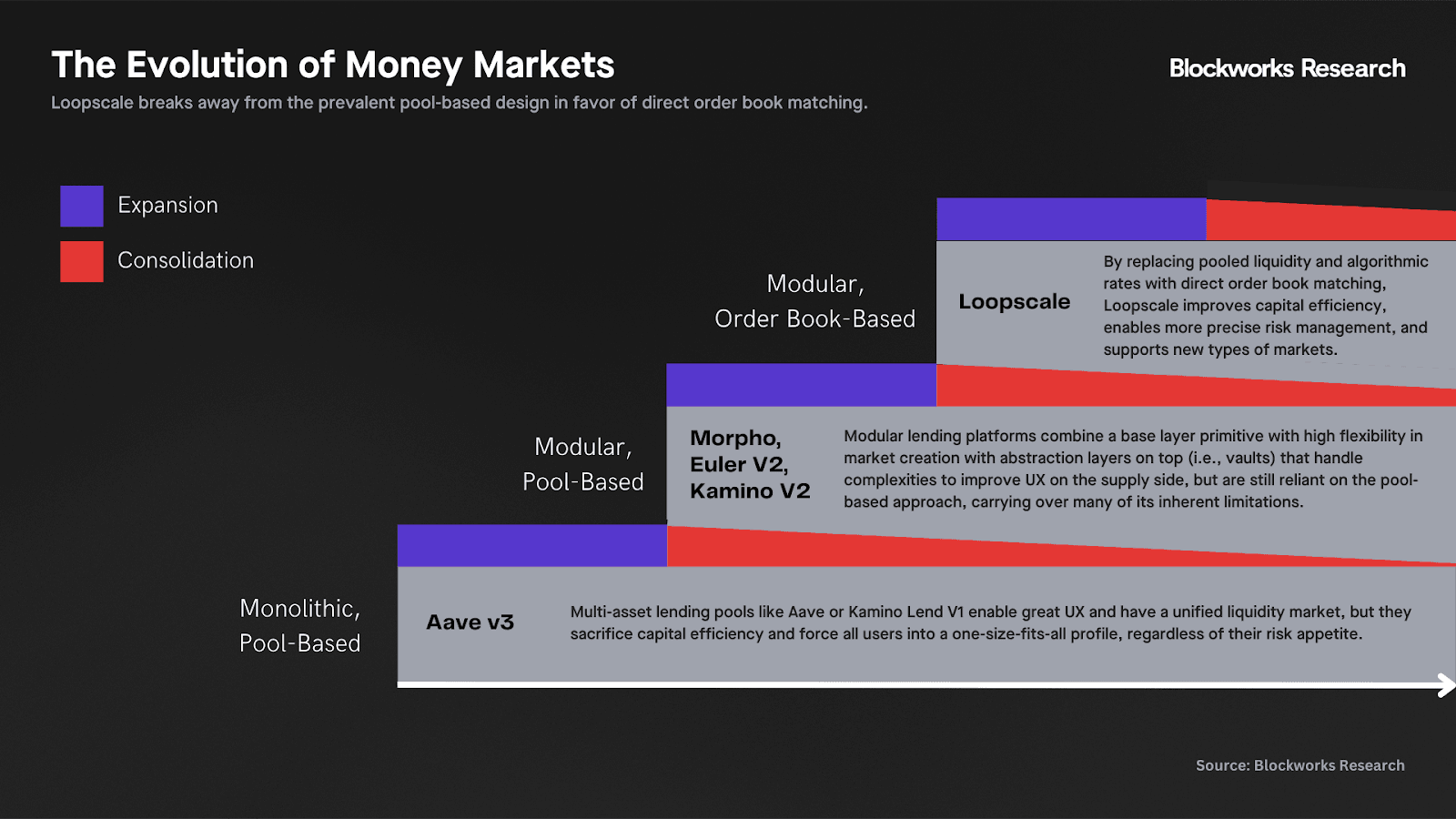
DeFi has given rise to four foundational primitives: DEXs, perps, tokenization (stablecoins), and money markets. While the first three have undergone extensive experimentation, money markets have remained architecturally stagnant, still primarily anchored to the pool-based model popularized by Compound back in 2018.
In this model, lenders and borrowers interact through a shared liquidity pool, with interest rates set algorithmically based on pool utilization. Protocols like Morpho, Euler, and Kamino v2 have introduced modularity through permissionless market creation and abstraction layers on top (i.e., vaults), which aggregate liquidity and improve the user experience, primarily on the supply side. However, this approach still builds upon the pool-based design, carrying over many of its inherent limitations.
Built on Solana, Loopscale uses an order book-based architecture to combine the efficiency of direct market matching with the flexibility and user experience of modular lending protocols. This innovation coincides with the maturation of market infrastructure and borrower demands. We believe that Loopscale can help scale net new assets (NNAs) in DeFi and serve as their foundational credit layer.
This report explores the design and mechanics of Loopscale (still pre-TGE), highlighting its traction and outlook. We also delve into specific stablecoin loops and farming strategies for other pre-TGE Solana ecosystem projects via Loopscale, highlighting Hylo and OnRe amongst the cohort.
Protocol Overview

Carlos leads coverage on Solana and spends his time on DeFi applications. Previously held a research role at 21Shares.
- The Evolution of Money Markets
- Protocol Overview
- Orderbook vs. Pool-Based Model
- Team and Fundraising
- Competitive Advantage: Fixed Rates & Listing Velocity
- Market Growth: Deposits & Loans
- Farming Opportunities & Risk Premiums
- Hylo
- OnRe
- Exponent and RateX PTs
- LP Tokens
- Growth Levers
- Revenue
- Risks
- Conclusion