Loopring: Better than CEX?

Retail and professional financial traders in markets all over the world tend to favor traditional order book exchanges such as the National Association of Securities Dealers Automated Quotation (NASDAQ) exchange. On such an order book exchange, bids and offers by “makers'' accumulate at prices around the market level, to be hit or lifted by “takers”.
The most popular centralized exchanges such as Binance, Coinbase Pro and Kraken are structured much like the NASDAQ, where all of the outstanding limit orders can be viewed on the same page as the price tick chart. Yet many cryptoasset traders eschew the KYC requirements and the centralized nature of exchanges (“not your keys, not your coins”).
Decentralized exchanges (DEXs) have been severely limited in their functionality by Ethereum gas costs: keeping track of orders on the Ethereum blockchain would be prohibitively expensive. DEXs are therefore forced to offer passive liquidity in an automated market maker (AMM) such as Uniswap or Curve, or a slightly more active market maker such as Uniswap v3. AMMs can not directly provide the same look, feel and options as an order book exchange, however.
AMMs provide “take it or leave it” market price swap functionality, generally at par for highly correlated tokens (e..g stablecoin-to-stablecoin in Curve) or at the current ratio between the two tokens in the liquidity pool (for most other DEXs). These AMMs also require active arbitrage to keep prices in line with the rest of the market. Aggregators such as 1inch do offer some order book features as limit orders, but do not offer the full order book experience.
Enter Loopring
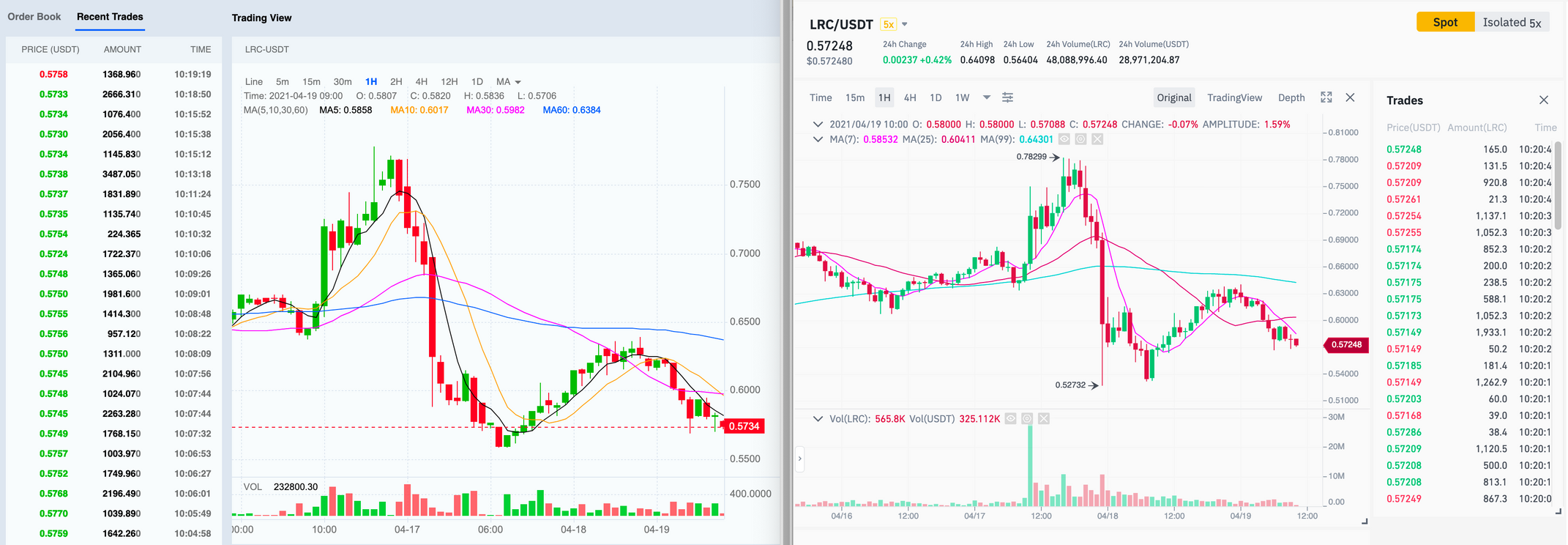
Loopring was the first DEX to implement its own “layer-2” solution to operate an order book exchange without the high gas costs required on Ethereum layer-1. Loopring offers the look, feel and operational benefits of a centralized exchange (CEX) such as Binance or Kraken, but is non-custodial and benefits from Ethereum’s security. Loopring’s UX is almost identical to those of the CEXs, as can be seen below.