Loom Network to cap off troublesome quarter with a network upgrade

Loom Network, a layer-2 scaling solution for Ethereum and a few other chains, has seen its fair share of departures over the last few months. Former CEO Matthew Campbell stepped down from his position towards the end of Feb. In the following weeks, several validators in the chain's DPoS system, such as Chorus One, Stake Capital, and StakeWith.Us, announced plans to drop support for Loom, with most citing the project's recent change in management and uncertain future direction as reasons for leaving. Around the same time, a handful of Loom-based games, including the chain's most popular app in Axie Infinity, left the network in search of an alternative solution.
What are the implications for Loom's validator support with multiple staking providers opting out? The project will still have 14 active validators once Stake Capital officially leaves. But the consequence is that Binance now controls over 50% of the staked token supply. While Loom caps on-chain voting power for every validator at 28%, DPoS systems are not immune to stakeholders colluding to undermine network votes. The sheer size of Binance's stake could still give it undue influence over future governance decisions if the exchange continues to support the project.
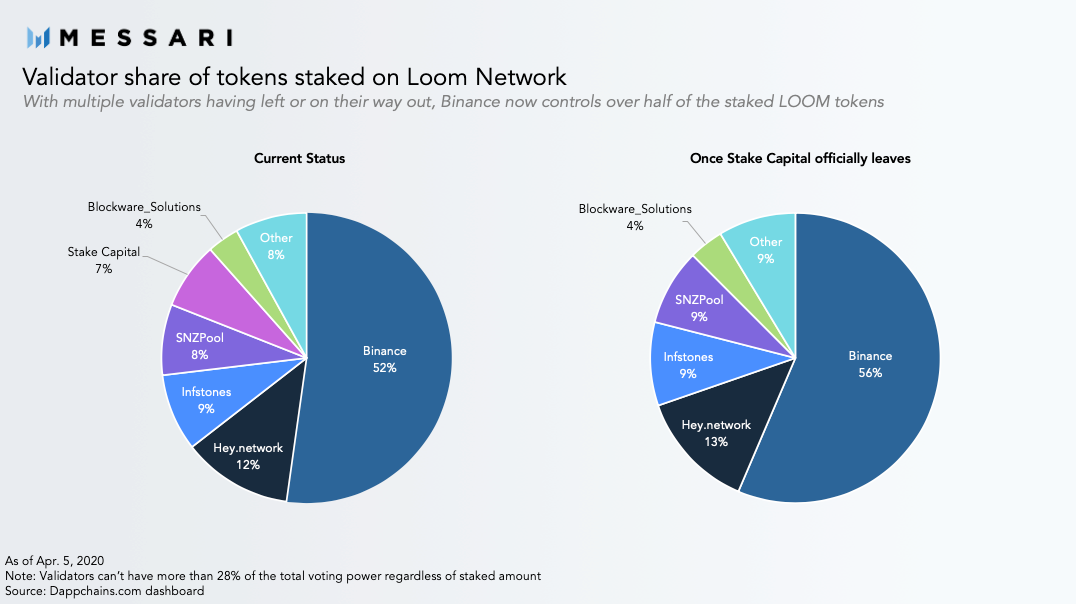
Loom has remained relatively quiet amidst the exodus, leaving users and investors to rely more on the disconcerting comments made by companies on their way out. Despite the seemingly chaotic situation, the team is planning to complete the next stage of its Basechain upgrade on Apr. 6, which will reportedly include fixes to the DPoS system and other performance improvements.
Why it matters:
- Loom appears to be in the midst of a substantial project overhaul, a change foreshadowed by its plan to hand over maintenance responsibilities of CryptoZombies to another project. But this pivot could have some negative short term implications, as the comments from exiting companies are somewhat ominous. Chorus One left said it left because "the project is not developing as we initially believed it would." Stake Capital was more blunt, going as far as to say that the "Loom project is dead."
- While the team has not revealed where the project might be heading, many Loom-based games reportedly left because Loom intends to shift focus towards integrating with enterprise clients rather than end-user applications. If true, it's a curious decision as enterprise adoption of blockchain use cases has been somewhat slow even on application-specific private solutions like Corda and Hyperledger. But the move could suggest that non-financial blockchain apps are not seeing an adequate amount of user demand, which would not be entirely surprising as growth in some similar use cases slowed last year.

Wilson Withiam was a Senior Research Analyst at Messari. Previously, he worked at Circle Research where he conducted research on cryptoassets. He graduated with a B.Sc. in Kinesiology and Exercise Science before studying computer science and economics at UConn.