LayerZero is an interoperability protocol that enables cross-chain messaging and token transfers, including stablecoins issued using the Omnichain Fungible Token (OFT) Standard. OFT enables burn-and-mint transfers across Ethereum, Solana, Tron, and 129 other blockchains, realizing a unified supply across chains without relying on third-party bridges.
As of May 31, 25.4% (14 out of 55) of major stablecoin issuers (over $50 million in market cap) issue tokens using the OFT Standard, including USDT0 (Tether), USDe (Ethena), PYUSD (PayPal), Ondo (USDY), and Frax (FRAX).
As of May 31, 61.2% ($150.0 billion) of issued stablecoins were supported by LayerZero, either through USDT0’s Legacy Mesh or issued using the OFT Standard. Of this total, 56.6% ($138.6 billion) were USDT tokens integrated across Ethereum, Tron, and TON, and 4.6% ($11.4 billion) were native OFTs.
The number of major stablecoin issuers (over $50 million in market cap) increased 90% over the past year, from 29 in June 2024 to 55 in May 2025. To grow adoption and ensure accessibility, issuers are increasingly focused on offering unified liquidity across networks.
The total market cap of stablecoins increased by 53% in the past year, rising from $160 billion in June 2024 to $245 billion in May 2025. Monthly stablecoin transfer volumegrew153% over the past year from $1.4 trillion in June 2024 to $3.7 trillion in May 2025. The rise highlights the role of stablecoins in onchain value transfer rather than passive holding, reinforcing the need for infrastructure that efficiently supports cross-chain movement.
Primer
LayerZero (ZRO) is an interoperability protocol that enables secure communication across blockchains through immutable onchain endpoints and a modular security stack. Message verification and execution are handled by a permissionless set of decentralized verifier networks (DVNs) and executors. DVNs validate cross-chain messages, then executors carry out message instructions on the destination chain.
The protocol’s Omnichain Application (OApp) standard defines a generalized cross-chain messaging interface, allowing developers to build applications that send and receive arbitrary data across multiple networks. Each OApp can be configured to have its own set of DVNs and executors, enabling each developer to tailor the cost and security tradeoff for their use case.
LayerZero’s OFT Standard provides a framework for cross-chain token issuance and transfers. OFT transfers use a burn-and-mint model that avoids price impact and slippage by moving tokens between chains without trading against a liquidity pool, requiring only source chain gas fees. Each OFT can be configured to have its own set of DVNs and executors, enabling token issuers to tailor the tradeoff between cost and security for their specific assets. In many cases, stablecoin issuers like USDT0, Ondo, and PayPal USD run their own DVN. While LayerZero can transmit any type of data, asset transfer remains the most common use case. Additional applications include cross-chain governance, gaming, identity protocols, restaking, and enterprise products.
LayerZero launched in 2022, and V2 launched in January 2024, introducing a standardized messaging system and common security properties to streamline cross-chain development. The protocol’s native token, ZRO, launched in June 2024. In April 2025, a16z crypto purchased $55 million worth of ZRO tokens with a three-year lockup. Development continues to be led by LayerZero Labs, which initially built the protocol.
This report analyzes the impact of stablecoin expansion amidst DeFi’s fragmented liquidity landscape across siloed blockchains. The total market cap of stablecoins increased by 53% in the past year, rising from $160 billion in June 2024 to $245 billion in May 2025. Over the same time frame, the number of major stablecoin issuers (over $50 million in market cap) grew 90% YoY from 29 to 55 issuers. To support this growth across an increasingly multichain environment, issuers are integrating LayerZero’s OFT Standard to eliminate reliance on wrapped assets through native cross-chain issuance and transfers.
Stablecoins are digital assets designed to maintain a stable value relative to a reference asset, typically a fiat currency like the U.S. dollar. The main types include fiat-collateralized, crypto-collateralized, commodity-backed, and algorithmic stablecoins.
For users on the demand side, stablecoins serve several key functions. They act as a store of value, offering crypto participants a stable, low-volatility asset to rotate into during market downturns without converting their digital assets into fiat. They also offer digital access to U.S. dollar–denominated value in regions in regions with unstable currencies or limited banking access.
In DeFi, stablecoins are used as collateral for borrowing, base pairs for trading, and liquidity provision for DEXs, and more. In payments, stablecoins enable cross-border transfers and remittances by reducing reliance on traditional banking rails and lowering transaction costs.
For issuers on the supply side, stablecoin issuance provides a way to monetize high-interest-rate environments. Issuers create dollar-pegged tokens backed by reserve assets, such as cash or short-term U.S. Treasuries, earning yield on the collateral while maintaining a 1:1 peg. As demand for stablecoins in DeFi and payments has grown, more issuers are entering the market to capture differentiated opportunities.
Stablecoin Issuance
The number of major stablecoin issuers (over $50 million in market cap) increased 90% YoY from 29 in June 2024 to 55 in May 2025. Of those 55 issuers, nine have individual market caps over $1 billion. A notable example is USDe, a stablecoin issued by Ethena Labs that launched in February 2024 and has already grown to become the third-largest stablecoin by market cap, with a $5.3 billion market cap as of May 31.
This growth reflects a shift in the market, where new issuers are actively competing across specific product attributes, such as offering native onchain yield through a delta-neutral hedging strategy (USDe), providing tokenized exposure to U.S. Treasuries, generating yield from short-term Treasury bills and bank deposits (USDY), or integrating with consumer fintech for payments and remittances (PYUSD). The result is a more competitive and segmented stablecoin landscape, with issuers targeting distinct use cases beyond general-purpose payments or trading.
Market Cap
Over the past year, the total stablecoin market cap increased 53% ($85 billion) from June 2024 to May 2025. This growth signals increased adoption of stablecoins, driven by both new users and emerging use cases from new stablecoin issuers. This expansion was also likely caused by greater institutional and regulatory clarity, including the rollout of the EU’s MiCA framework and anticipated U.S. legislation progress. Adoption also accelerated in inflationary or underbanked regions, where stablecoins offer access to a U.S. dollar–denominated alternative to local currencies.
Stablecoin Distribution
Despite the increase in stablecoin issuers, the stablecoin landscape by market cap is still dominated by Tether’s USDT and Circle’s USDC. USDT and USDC have a duopoly, accounting for 89% of the stablecoin market cap ($217 billion) combined. USDT is the largest with 64% ($156 billion) of stablecoin market share, down from 70% on June 1, 2024, while USDC is the second-largest with 25% ($60 billion), up from 20% on June 1, 2024. These two fiat-backed tokens are the primary liquidity underpinning most crypto trading pairs and DeFi protocols. USDT is backed by a mix of assets, including cash, cash equivalents, and other assets, with Tether providing regular disclosure reports on its reserve composition. USDC is backed by cash and short-term U.S. Treasuries, with monthly public attestations conducted by Deloitte.
Transfer Volume
Monthly transfer volumes on stablecoins also increased by 153% over the past year from $1.4 trillion to $3.7 trillion. Notably, the onchain transaction volume of stablecoins was $20.9 trillion in 2024, more than Visa’s 2024 total transaction volume of $15.7 trillion. The rise highlights the role of stablecoins in onchain value transfer rather than passive holding, reinforcing the need for infrastructure that efficiently supports cross-chain movement.
Active Addresses
The average number of weekly active addresses interacting with stablecoins increased by 49% (3.8 million) in the past year, rising from 7.8 million in June 2024 to 11.7 million in May 2025. This growth likely stems from increased DeFi trading activity, greater cross-chain bridging of stablecoins, and expanded use of stablecoins in lending and payment applications.
The Problem: Stablecoin Liquidity Fragmentation
As new stablecoins are created and new blockchains continue to emerge, the value of interoperability protocols like LayerZero for cross-chain transfers becomes more apparent. On May 31, 2025, nine blockchains had more than $1 billion in stablecoins. Ethereum had the most with $126.9 billion (52% of circulating stablecoins). Solana stablecoin market cap increased the most, growing 285% from $3.0 billion in June 2024 to $11.6 billion in May 2025. Over the same time frame, BNB Chain rose the second-most, growing 90% from $5.4 billion to $10.2 billion. Tron held its position as the second-largest chain by stablecoin market cap ($78.4 billion), but grew more modestly relative to the other top-six chains, increasing 38% over the past year from $56.9 billion to $78.4 billion.
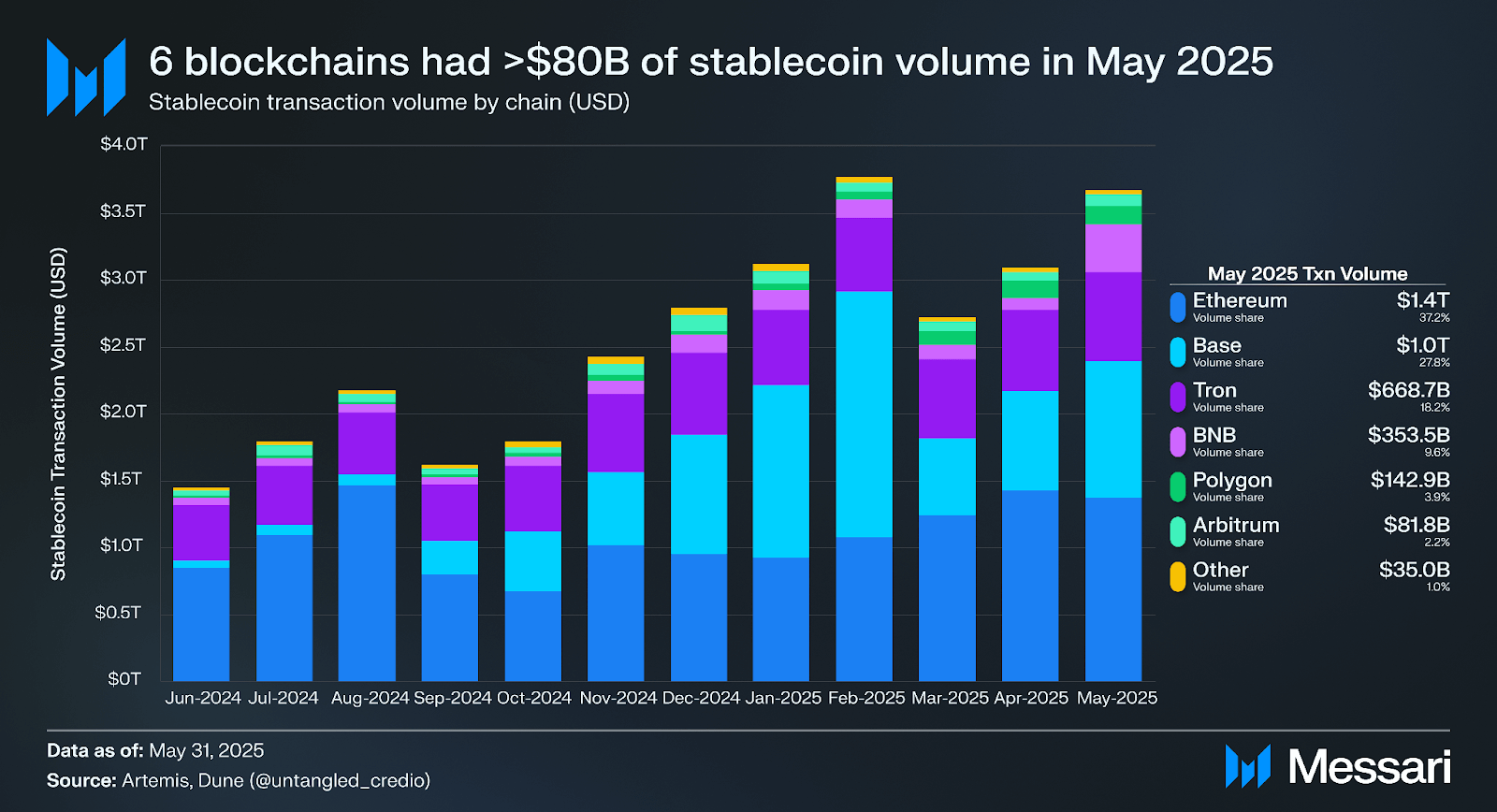
As of May 31, 2025, there were over 230 L1s and over 90 L2s. In May 2025, six blockchains had over $80 billion in stablecoin transaction volume. Stablecoin transaction volume has become increasingly fragmented, as the combined share of the top two blockchains in June 2024, Ethereum and Tron, fell from 88% to 55% in May 2025. Specifically, Ethereum’s market share of stablecoin transaction volume declined from 59% ($855.7 billion) in June 2024 to 37% ($1.4 trillion) in May 2025. Over the same time frame, Tron’s market share decreased from 28% ($404.3 billion) to 18% ($668.7 billion).
Despite the increase in total USD value of stablecoin transaction volume on Ethereum and Tron, their market share declined due to growing competition from other blockchains offering different advantages, like lower transaction costs for stablecoin transfers. For example, Base’s share of transaction volume rose from 1% ($21.0 billion) in June 2024 to 28% ($1.0 trillion) in May 2025. This growth suggests stablecoins will continue expanding beyond the initial liquidity hubs of Ethereum and Tron.
Stablecoins were originally deployed on single networks, but now span multiple blockchains to meet liquidity demands across increasingly fragmented blockchain ecosystems. For example, USDT launched on the Bitcoin blockchain via the Omni Layer protocol in 2014, while USDC launched on Ethereum in 2018. As stablecoins expand across chains, liquidity becomes fragmented, making DeFi actions like cross-chain trading more complex for users. For instance, USDC is natively issued on 20 blockchains, but wrapped versions exist on more than 80 others through third-party bridges. Fragmentation also creates challenges for stablecoin issuers like Circle, as reliance on these third-party bridges introduces security risks because issuers do not control the bridged tokens. Issuers also lose both revenue and oversight when stablecoins are bridged externally. They forfeit transfer fees and gain no visibility into cross-chain flows.
Each wrapped version of USDC, often labeled with a similar ticker such as USDC.e, is a separate token minted on a destination blockchain after a user locks their original USDC on the source chain via a specific bridge. When the same stablecoin, like USDC, exists across different blockchains, its liquidity becomes siloed on each chain. As a result, users can't directly access USDC liquidity from another chain unless they “unbridge” their wrapped token or use an exchange, which introduces additional costs and time delays. This fragmentation can lead to higher slippage, reducing execution quality for large trades, and increasing the necessity for arbitrage to maintain price consistency across networks. Additionally, it adds complexity for developers, who must integrate multiple token contracts when building protocols.
Users also face trust risks when stablecoins are bridged through third parties. Custody and redemption are managed by the bridge operator, not the issuer, which introduces counterparty risk undermining the stablecoin’s original 1:1 guarantee.
While the lock-and-mint model has been widely adopted for cross-chain stablecoin transfers, newer approaches now offer issuers greater control over security and design. LayerZero’s OFT Standard supports native cross-chain issuance and transfers, allowing stablecoin issuers to deploy assets across 130+ chains and configure their own decentralized verifier networks (DVNs) to verify transactions.
For example, in November 2024, Ondo adopted the OFT Standard to launch a bridging solution for USDY, a tokenized product backed by U.S. Treasuries and bank deposits. As part of its implementation, Ondo deployed a bespoke security stack composed of third-party DVNs such as Polyhedra and Axelar, with Ondo serving as the final verifier for each cross-chain message. This structure reduces reliance on external parties and ensures that the security model for USDY transfers is aligned with the trust users already place in Ondo as an issuer. By allowing issuers to serve as the final verifier, OFT-based models minimize additional trust assumptions and offer a customizable framework for cross-chain interoperability.
The Solution: Interoperability with Canonical Tokens
Achieving a cross-chain stablecoin standard that preserves a single total supply across chains and allows liquidity to flow freely is a key step for the next phase of stablecoin growth.
LayerZero’s OFT Standard
LayerZero addresses stablecoin token issuance across a multi-blockchain industry with its Omnichain Fungible Token (OFT) standard. Rather than creating new bridges, LayerZero provides a messaging protocol that allows a stablecoin issuer’s own smart contracts on different chains to communicate directly.
LayerZero allows token issuers to select independent DVNs and Executors to validate and execute cross-chain messages. DVNs are independent networks that verify the integrity of cross-chain messages. Each application using LayerZero can configure its preferred set of DVNs, which can even include third-party bridges or oracle providers for additional security. Executors are permissionless actors that are chosen by applications to trigger smart contract execution on the destination chain once DVNs have confirmed validity.
When a user transfers tokens from Chain A to Chain B using the OFT Standard, the tokens are burned on the source chain and are minted on the destination chain, preserving a unified supply across all supported chains and avoiding wrapped assets. This eliminates third-party custodial risk as the stablecoin issuer's own contracts manage the process rather than external vaults controlled by a third party.
PayPal’s developers have described their OFT-based PYUSD setup as a “bridge-less” model. For example, PYUSD can be sent from Ethereum to Solana without involving third-party bridges or centralized exchanges. Transfers using LayerZero's protocol are typically finalized in under a minute. Additionally, since there are no wrapped tokens or floating pools, slippage and price inconsistency between chains are avoided, maintaining its peg across all supported networks.
Issuers also retain operational control of their stablecoins as their smart contracts govern mint/burn logic and can define transfer and fee policies per chain, allowing them to capture transfer fees that would otherwise be captured by bridge operators. In the case of PayPal’s stablecoin, the team integrated a custom set of verifiers, such as Paxos and Google Cloud, to approve each PYUSD cross-chain transfer, a degree of control and flexibility that generic bridges do not allow.
As of May 31, 25.4% (14 out of 55) of major stablecoin issuers (over $50 million in market cap) issue tokens as native OFTs that leverage LayerZero’s burn-and-mint mechanism. This reflects how, amid the 90% growth in major stablecoin issuers over the past year, an increasing share are prioritizing native interoperability to enable consistent token supply across chains and reduce reliance on third-party bridges.
As of May 31, 61.2% ($150.0 billion) of issued stablecoins were supported by LayerZero. This includes tokens integrated through USDT0’s Legacy Mesh and stablecoins issued as native OFTs that use the burn-and-mint mechanism.
Of that total, 56.6% ($138.6 billion) of issued stablecoins were USDT tokens integrated via the Legacy Mesh across Ethereum, Tron, and TON, which represented 90.8% of USDT’s market cap as of May 31.
The Legacy Mesh has two core functions. First, it enables USDT transfers between Ethereum, Tron, and TON using a lock-and-mint mechanism. Second, it uses a lock-and-mint pool to convert native USDT on Tron or TON into USDT0 on Arbitrum. Once USDT0 is minted on Arbitrum, it can be transferred across supported chains using LayerZero’s messaging protocol, which burns USDT0 on the source chain and mints it on the destination chain. This structure avoids third-party bridges and ensures that USDT0 remains fully backed by locked USDT on the origin chain. USDT on Ethereum can be converted into USDT0 on any USDT0-supported chain, not just Arbitrum.
Users can redeem USDT0 for USDT on Ethereum by burning USDT0 on any supported chain. To redeem USDT0 for USDT on Tron or TON, users must burn it on Arbitrum. Once the redemption is verified, the equivalent amount of USDT is unlocked on the origin chain.
As of May 31, the remaining 4.6% ($11.4 billion) of LayerZero-supported stablecoins are native OFTs that leverage LayerZero’s burn-and-mint mechanism. The largest partners by market cap include USDe ($5.3 billion), USDtb ($1.4 billion), USDT0 ($1.3 billion), PYUSD ($1.0 billion), and USDY ($600 million).
Major Stablecoin Partnerships and Integrations
Over recent months, several major stablecoin issuers and ecosystems have adopted LayerZero’s Omnichain Fungible Token (OFT) standard to address fragmentation and improve cross-chain liquidity.
USDT0 (Tether)
Launched in January 2025, USDT0 is an omnichain representation of USDT built using LayerZero’s OFT Standard. To mint USDT0, Ethereum-based USDT must be locked in a smart contract, and an equivalent amount of USDT0 is minted on a supported destination chain such as Berachain or HyperCore. In February 2025, USDT0 launched a solution called the Legacy Mesh for Tron and TON, which do not support native USDT0 issuance. The Legacy Mesh enables USDT transfers between Ethereum, Tron, and TON, accounting for 90.8% of USDT market cap as of May 31. Second, it uses a lock-and-mint pool to convert native USDT on Tron or TON into USDT0 on Arbitrum.
USDe/USDtb (Ethena)
Ethena adopted the OFT Standard in August 2024 to expand USDe to Solana and has since deployed across more than ten blockchains. As of May 31, 2025, USDe’s supply reached $5.3 billion, and the asset now circulates across Ethereum, Arbitrum, Base, Solana, and other networks. Ethena's USDtb, backed by short duration treasury assets including BlackRock's BUIDL, is also on the OFT Standard. LayerZero’s protocol allowed Ethena to manage cross-chain issuance without building custom infrastructure, ensuring consistent peg mechanics while reaching DeFi platforms at scale. Weekly cross-chain volume for USDe has averaged approximately $50 million in 2025 through May.
PYUSD (PayPal)
Paxos issues PYUSD, which PayPal uses as its stablecoin. The token launched on Ethereum and expanded to Solana in November 2024 through a LayerZero OFT integration. PayPal and Paxos directly select the validators responsible for verifying each PYUSD transfer, enabling them to maintain control over compliance and security. The integration reflects how traditional financial institutions are adopting OFT-based interoperability frameworks to scale stablecoin usage across multiple networks.
frxUSD (Frax Finance)
In February 2025, Frax integrated LayerZero to enable cross-chain transfers of frxUSD. The rollout introduced omnichain functionality across Ethereum, Arbitrum, Avalanche, Optimism, BNB Smart Chain, and other networks. Fraxtal acts as the central hub in this model, allowing users to burn and mint frxUSD between chains at a 1:1 ratio while preserving a unified supply. To support usability, Frax launched the Frax Universal Interface (FUI), a tool for bridging, staking, and managing frxUSD positions across chains. The integration positions frxUSD as a fully interoperable stablecoin for DeFi, extending its reach while maintaining Frax’s focus on protocol-level control and capital efficiency.
USDY (Ondo Finance)
In November 2024, Ondo launched a cross-chain bridging solution for USDY, its tokenized product backed by U.S. Treasuries and bank deposits, using LayerZero’s OFT Standard. The bridge uses a Multi-Messaging Aggregation (MMA) framework that verifies messages through a custom set of DVNs operated by Polyhedra, Axelar, LayerZero, and Ondo itself. Ondo designed its DVN to act as the final verifier in the DVN stack, reducing reliance on external parties and aligning trust assumptions with the issuer. The bridge initially supported Ethereum, Arbitrum, and Mantle, and in May 2025, Solana was added. The expansion marked USDY’s availability across both EVM and non-EVM ecosystems, enabling native transfers without wrapping or third-party bridge reliance.
Conclusion
Stablecoins have continued to gain adoption as essential infrastructure for onchain activity. They serve as a store of value, a tool for accessing dollar-denominated liquidity in underbanked regions, and a foundational asset in DeFi applications like DEXs and liquidity provision.
From June 2024 to May 2025, the total market cap of stablecoins increased by 53%, active addresses rose by 49%, and monthly transfer volume grew by 153%. This growth has accelerated usage across an expanding set of blockchains, but it has also intensified the limitations of fragmented liquidity and reliance on third-party bridges. For example, the combined share of Ethereum and Tron in stablecoin transaction volume dropped from 88% in June 2024 to 55% in May 2025, as new ecosystems captured more flow. This dispersion highlights the need for native interoperability as stablecoin activity becomes more multichain. On May 31, nine blockchains had more than $1 billion in stablecoin market cap. In May 2025, six recorded over $80 billion in stablecoin transaction volume. This shift underscores the need for cross-chain infrastructure that does not compromise fungibility, capital efficiency, or security.
Over the past year, issuers like Tether, Ethena, and PayPal, along with networks like TON and Hyperliquid, have adopted LayerZero’s OFT Standard and messaging infrastructure to unify stablecoin supply across chains. These integrations remove the need for wrapped assets, simplify liquidity management, and restore issuer control over security and fees.
As stablecoin issuers expand across more blockchains, the legacy lock-and-mint model is becoming increasingly irrelevant. New burn-and-mint models like LayerZero’s OFT Standard are making traditional bridging infrastructure a relic of the past. As of May 31, 61.2% ($150.0 billion) of all issued stablecoins are supported by LayerZero. This includes 56.6% ($138.6 billion) integrated via USDT’s Legacy Mesh and 4.6% ($11.4 billion) issued natively using the OFT Standard. As demand for native interoperability grows, LayerZero is well-positioned to capture a larger share of cross-chain stablecoin issuance in the years ahead.
This report was commissioned by LayerZero Labs Ltd. All content was produced independently by the author(s) and does not necessarily reflect the opinions of Messari, Inc. or the organization that requested the report. The commissioning organization may have input on the content of the report, but Messari maintains editorial control over the final report to retain data accuracy and objectivity. Author(s) may hold cryptocurrencies named in this report. This report is meant for informational purposes only. It is not meant to serve as investment advice. You should conduct your own research and consult an independent financial, tax, or legal advisor before making any investment decisions. Past performance of any asset is not indicative of future results. Please see our Terms of Service for more information.
No part of this report may be (a) copied, photocopied, duplicated in any form by any means or (b) redistributed without the prior written consent of Messari®.
Austin is a Sr. Research Analyst for Messari’s Protocol Services team. He focuses on Prediction Markets, DeFi, & Interop. protocols. He previously worked on PwC's Digital Assets team.
Austin is a Sr. Research Analyst for Messari’s Protocol Services team. He focuses on Prediction Markets, DeFi, & Interop. protocols. He previously worked on PwC's Digital Assets team.