Kite’s mainnet is live, transitioning from testnet to its own blockchain tailor-made for agentic payments.
Mainnet’s first product is Kite Agent Passport, a programmable wallet and identity system designed for AI agents. Kite Agent Passport lets your AI agent spend money on your behalf while you stay in control by setting the rules, limits, and who it can pay. Passport enables your agents to access funds and pay for e-commerce and services across any LLM (like Claude).
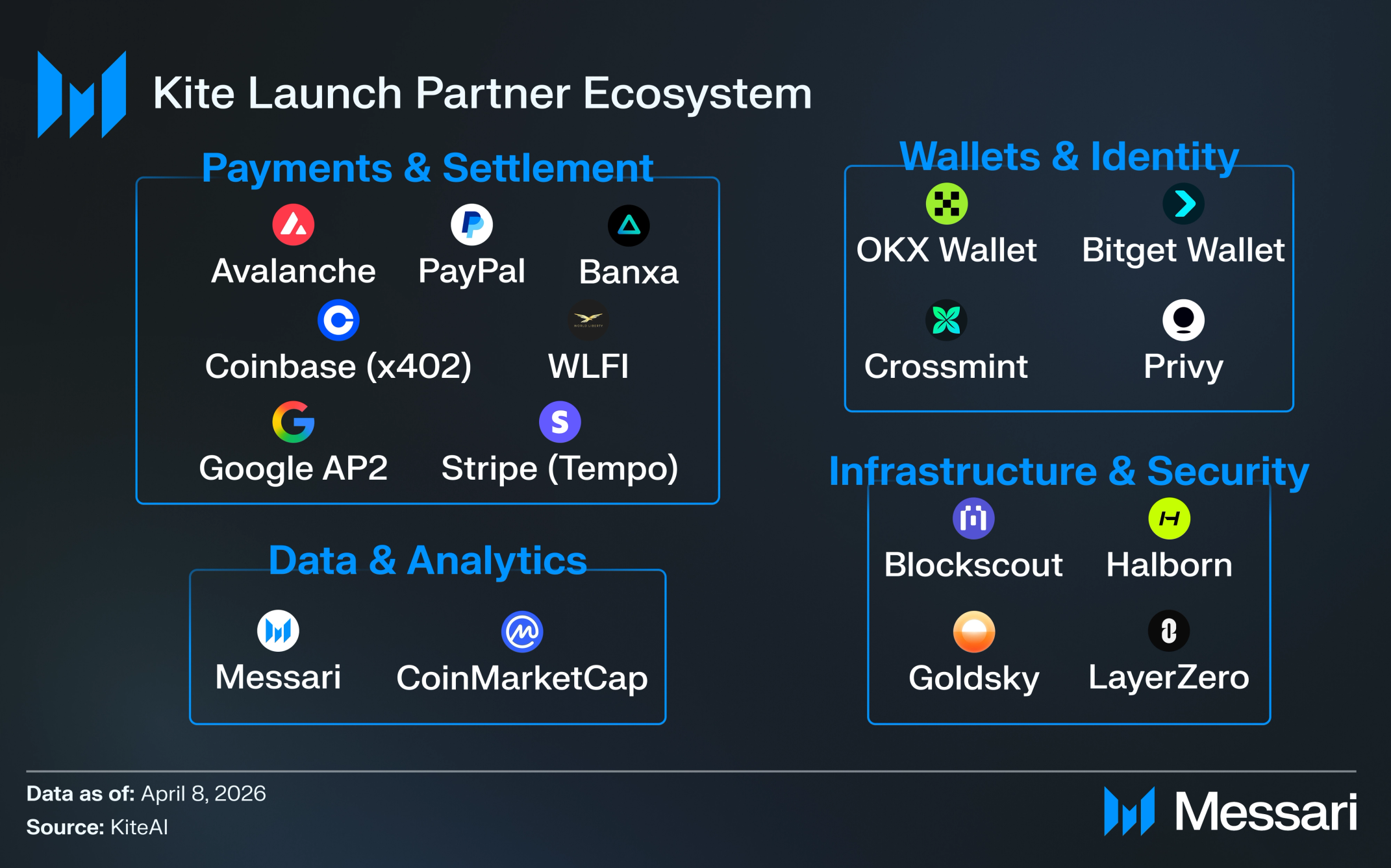
Kite enters mainnet with a broad launch partner roster spanning stablecoins, wallets, bridging, commerce, and identity. Partners include Google (AP2), PayPal (PYUSD), Avalanche, Coinbase (x402 integration), and more.
Kite serves as a unified hub for different payment standards, including Coinbase, Google, Stripe, and Visa, each of which has backed different agent payment standards, and Stripe’s Tempo has also launched a payments-focused Layer-1. Those efforts each target a single layer of the stack: a protocol standard, a wallet, or a chain. Kite bundles all three into one vertically integrated system.
KITE has outperformed amid broader market volatility, breaking into CoinMarketCap’s top 100 and climbing to a top-7 position on Upbit as agentic commerce gains traction, with KITE emerging as a beneficiary of that narrative.
The Agent Payment Problem
AI agents can now write code, generate research, coordinate across tools, and manage complex workflows. What they can’t do is spend money. That limitation is becoming a bottleneck. When an agent encounters a task that requires a premium API call, a data subscription, or a service purchase, it stops and hands the transaction back to the human. The entire promise of autonomous agents, that they can complete end-to-end tasks without human intervention, breaks down at the point of payment.
Traditional payment rails weren’t designed to solve this. Credit networks require human identity verification. Bank transfers operate on business-hour settlement cycles. Neither supports the sub-second, micropayment, machine-to-machine transaction patterns that agents operate at. An agent executing a multi-step research workflow might need to make dozens of API purchases in a single session, each costing a fraction of a cent. The checkout-and-confirm model that works for humans doesn’t translate to software that operates at machine speed.
Blockchains offer a foundation for directly resolving these constraints. They settle transactions in near real time, operate 24/7, support programmable payment logic, and don't require the payer to be a human with a bank account. Grayscale's February 2026 research argued that AI and blockchains are fundamentally complementary, with blockchains providing the financial rails and AI providing the autonomous actors that use them. The thesis has attracted capital from both sides. Google, Coinbase, PayPal, and Stripe have all committed resources to building agent payment infrastructure in the past year, and on the crypto side, the buildout has accelerated into a competitive race across settlement layers, wallet providers, identity systems, and payment protocols.
Kite is building a vertically integrated payment system for AI agents, combining a purpose-built blockchain, a programmable wallet identity (Passport), and native stablecoin settlement into a single stack. Founded by AI and data infrastructure veterans from Databricks, Uber, and UC Berkeley, the company raised $15 million in a seed round before closing a $20 million Series A in September 2025, co-led by PayPal Ventures and General Catalyst. Coinbase Ventures, 8VC, Samsung Next, the Avalanche Foundation, LayerZero, Hashed, HashKey Capital, and Animoca Brands also participated, bringing total funding to $35 million. With its mainnet now live, Kite's thesis faces its first real-world test as it works to attract consumers, service providers, stablecoin volume, and transaction activity that a dedicated blockchain requires.
Agent Payment Landscape
Kite is not the sole builder of solutions within the agentic payments space. The largest technology and financial companies in the world are investing in agent payment infrastructure, and several crypto-native competitors are targeting the same market. The competitive field has stratified into distinct approaches, each backed by organizations with the resources to set industry defaults.
Protocol Standards
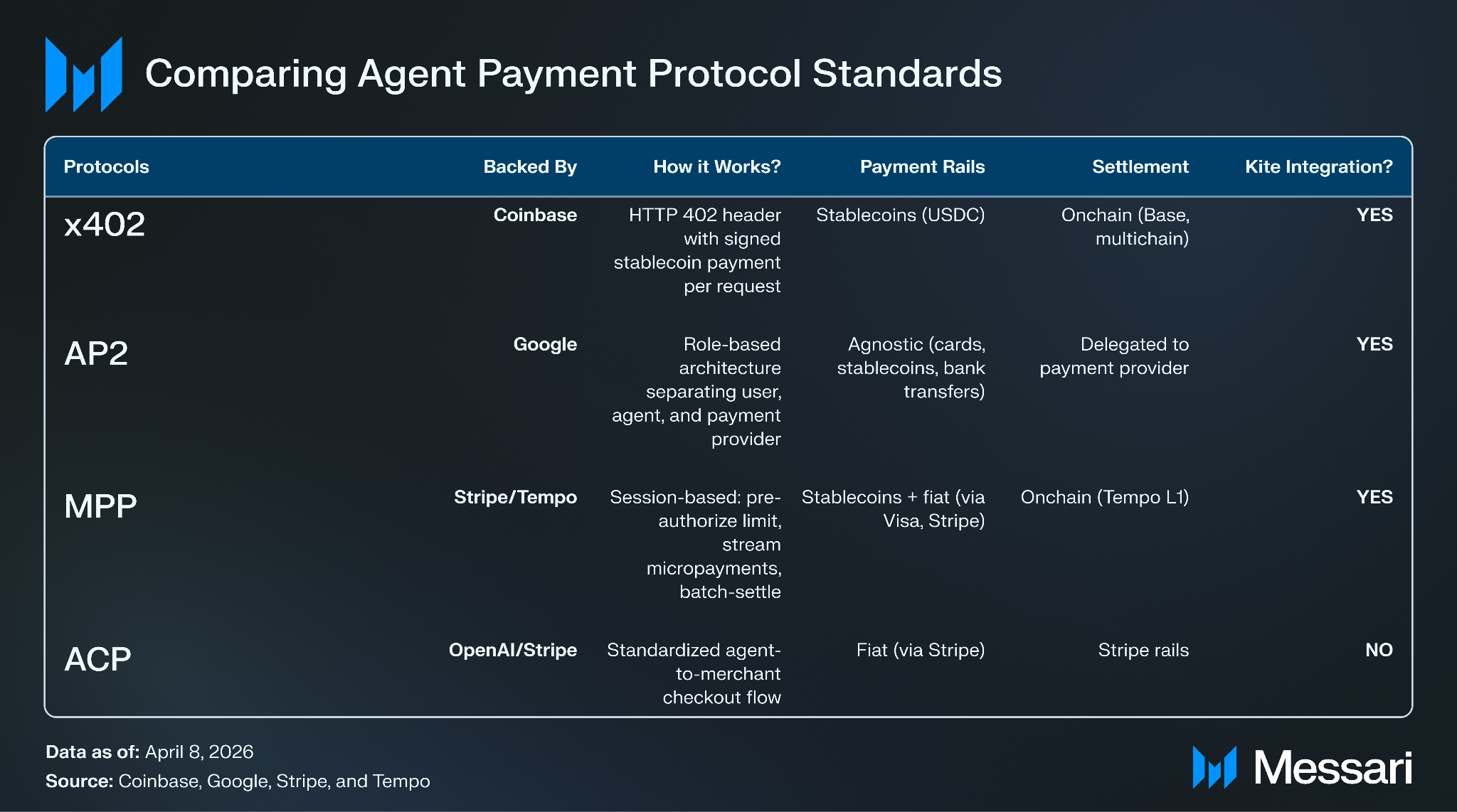
Four protocols are competing to define how agents pay for services. Coinbase's x402 extends the HTTP 402 status code to enable per-request stablecoin payments between agents and web services. x402 V2, launched in December 2025, added wallet-based identity, multichain support, and institutional partnerships with AWS, Stripe, Visa, and Lightspark. Coinbase is also building a competing agent wallet ecosystem on Base through AgentKit, putting it in an unusual position as both Kite's investor and a potential competitor for agent transaction volume. Google's Agent Payments Protocol (AP2) takes a payment-agnostic approach, supporting credit cards, stablecoins, and bank transfers through a role-based architecture with over 60 coalition members, including Mastercard, American Express, and PayPal. AP2 defines how agents obtain permission to pay, not how the money moves, making it complementary to settlement-layer infrastructure such as Kite Chain. Stripe and Tempo co-developed the Machine Payments Protocol (MPP), built around a sessions model where agents pre-authorize a spending limit and stream micropayments that batch-settle into a single onchain transaction. OpenAI and Stripe also co-developed the Agent Commerce Protocol (ACP) to standardize the checkout flow between agents and merchants, though OpenAI pivoted away from its initial ChatGPT Instant Checkout implementation to an app-based model within weeks of launch. Kite's native compatibility with x402, AP2, and Anthropic's Model Context Protocol (MCP) positions it to settle transactions regardless of which standard initiates them, though that interoperability may become table stakes as competing settlement layers adopt the same integrations.
Purpose-Built Settlement Layers
Tempo, the payments-focused Layer-1 blockchain incubated by Stripe and Paradigm, launched its mainnet on March 18, 2026, three weeks before Kite, with sub-second deterministic finality and design partners including Visa, Mastercard, Deutsche Bank, Shopify, OpenAI, and Anthropic. The near-simultaneous arrival of two purpose-built L1s optimized for stablecoin settlement reflects a broader institutional shift toward dedicated infrastructure for machine-speed transactions, with each chain anchoring a distinct segment of the emerging stack. Tempo’s footprint runs through Stripe’s merchant relationships, banking partnerships, and developer base, channeling fiat-adjacent volume from traditional commerce flows. Kite anchors the agentic side of that track as a unified hub for agent payments, routing activity through stablecoin issuers, wallet providers, and DeFi infrastructure that connect autonomous agents to onchain liquidity and programmable settlement.
Stablecoin and Wallet infrastructure
Circlelaunched USDC Nanopayments on testnet in March 2026, enabling gas-free USDC transfers as small as $0.000001 by bundling thousands of micropayments offchain into a single settlement transaction. The product targets the same pay-per-use billing model that Kite Passport enables, but without requiring a dedicated chain, challenging Kite's concept that agent payment patterns require purpose-built blockchain infrastructure. Kite's counter-argument is that settlement alone doesn't solve identity, governance, or programmable spending controls. On the identity side, ERC-8004 has emerged as a portable, open standard for agent identity across more than 12 EVM-compatible chains. If ERC-8004 becomes the default identity layer, Kite Passport needs to demonstrate capabilities that the open standard cannot provide, whether through tighter integration with spending controls, session-key management, or payment-specific features. Openfort offers a modular counter-thesis to Kite's vertical integration, providing an open-source agent wallet SDK with a trusted execution environment (TEE)-secured signing, enabling developers to assemble best-in-class infrastructure on any chain rather than adopting a single integrated stack.
Traditional Payment Incumbents
Visa launched Intelligent Commerce Connect in April 2026, a platform that lets AI agents make payments on behalf of consumers and businesses through a single merchant integration, with over 100 ecosystem partners and general availability expected by June. Visa’s entry tests whether existing card rails can accommodate agent payment patterns for consumer-facing use cases without new crypto-native infrastructure. Ant Digital Technologies, the blockchain arm of Ant Group, unveiled Anvita, a platform where agents register, discover each other, and settle payments in real time using USDC via x402, signaling that the agent payments race has expanded into the Asian fintech ecosystem. Together, Visa and Anvita illustrate that the competition extends well beyond crypto-native players.
Kite’s Positioning
Every existing team solves for one or two layers of the stack, but no one covers the entire loop. An agent on Tempo can settle quickly but lacks native identity or spending governance. An agent using x402 can pay per request but needs a separate wallet, a separate identity layer, and custom logic to enforce spending limits. An agent using Circle’s nanopayments can transact cheaply but lacks the access controls that make autonomous spending safe. Kite is the only product in the landscape where a developer creates a single Passport, and the agent inherits its identity, spending bounds, settlement rail, and protocol compatibility in a single integration. That full-stack coupling is what allows governance rules to execute at the chain level rather than the application level, meaning an agent can’t bypass a spending cap by routing through a different front end. If the market converges on the principle that no rational user will give an agent access to real capital without enforceable, protocol-level constraints, Kite is building the infrastructure that assumption requires.
A Chain Built for Agents
Kite Chain is an EVM-compatible Layer-1 (L1), powered by Avalanche, optimized for stablecoin payments, dedicated agent transaction lanes, and settlement at machine speed. The network delivers one-second block times, sub-second finality, and gas abstraction. Those specs aren't novel for a modern L1, but the design intent is. Kite’s team started with the transaction patterns that agents produce (high-frequency, low-value, multi-step, time-sensitive) and built the chain around them rather than adapting a general-purpose architecture after the fact.
The decision to launch as a sovereign L1 rather than a Layer-2 (L2) rollup reflects a specific technical tradeoff. L2s inherit their parent chain's finality characteristics, which introduces latency. For human-initiated DeFi transactions, a few extra seconds of confirmation time is rarely material. For agents coordinating across multiple services in a single task, that latency compounds. A sovereign L1 gives Kite direct control over consensus parameters and the ability to implement optimizations that matter only to agent workloads, while Kite's launch partner roster and Avalanche ecosystem integration provide the initial distribution a new L1 requires.
Kite Chain also embeds programmable governance directly into its smart contract accounts. Users can define compositional rules that constrain agent behavior, from spending caps and approved merchants to task-specific payment policies. These rules execute at the protocol level, not at the application level, meaning an agent can’t bypass them by routing through a different front end. This is the architectural feature that makes the rest of the system work. Without enforceable constraints, no rational user would give an agent access to their funds.
Kite Agent Passport
The governance layer sets the rules, and Kite Agent Passport is the product that makes them usable. Read about how to get started with Kite Agent Passport here.
Passport is a programmable wallet and identity system designed for AI agents. It lets agents hold stablecoins, check prices, and execute payments as part of automated tasks, all while remaining under the control of the wallet's human owner. The product sits at the intersection of identity, access management, and payments, three functions that existing crypto wallets handle for humans but that no widely adopted product handles for autonomous software.
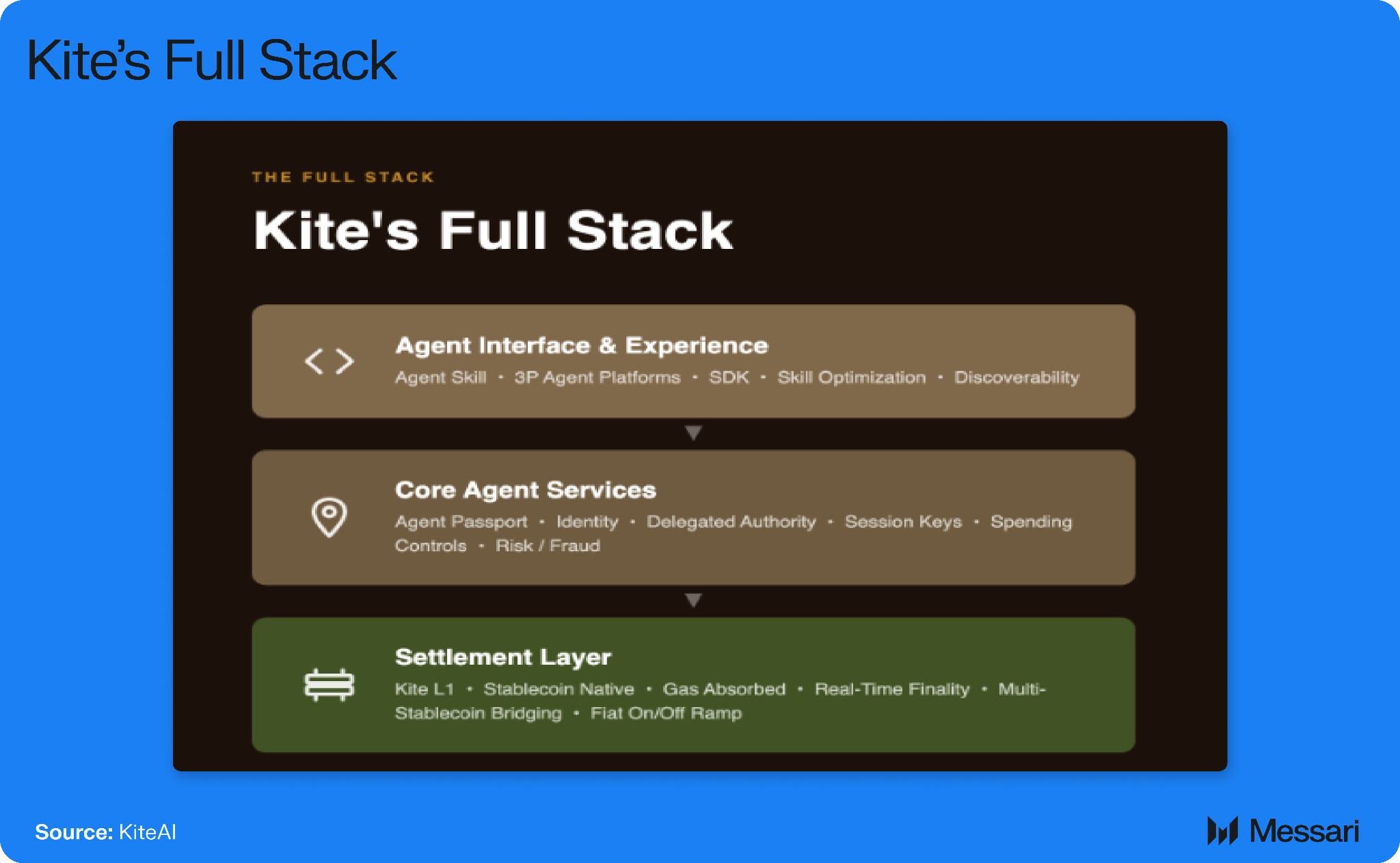
Kite's platform is built on three integrated layers that enable agents to operate autonomously.
Agent Interface & Experience, the top layer, covers agent skills, the SDK, agent discoverability, and third-party agent platform integrations.
Core Agent Services, the middle layer, houses the Kite Agent Passport, delegated authority, session keys, and spending controls.
Kite Chain Settlement, the foundation, provides stablecoin-native settlement, gas abstraction, and on/off-ramp connectivity to fiat payments for the broader consumer economy.
Kite is compatible with emerging agentic standards, including the x402 agent payment standards, Google's AP2 protocol, and Anthropic's Model Context Protocol (MCP). Kite also participates in the Linux Foundation's Agentic AI Foundation (AAIF).
The Passport experience walks users through the full agent commerce workflow, from funding the account to authorizing an agent to purchase goods from major e-commerce sites in a single session. Users install the Passport skill in Claude or another major LLM, authorize their agent to transact with merchants on their behalf, and set spending rules and kill switches that govern each transaction. Once authorized, the agent can query its balance, evaluate pricing across external services, confirm sufficient funds, and execute a series of payments programmatically. Each transaction settles on Kite Chain, and the full history surfaces on the Passport dashboard.
Agent developers can also register their agents with Kite Passport, making those skills and services discoverable to Passport users. Merchants can connect inventory APIs to let agents shop on behalf of consumers, operating within human-approved passkeys that enforce spending and time limits (sessions). Passport also integrates with major LLM platforms, such as Claude, allowing users to sign up in those environments and authorize purchases directly in the chat interface.
Kite's go-to-market targets agentic commerce across three categories: physical goods purchases, API payments for services, and agentic trading. The Kite Agent Passport enables AI agents to discover and pay for services on behalf of users, with the user retaining spending authority while the agent executes the remaining workflow.
The KITE token enters this system as an adoption incentive rather than a payment currency. Newly created Passports receive a promotional KITE allocation tied to ecosystem participation. Over time, the incentive structure can expand to reward wallet creation, transaction volume, and Kite Chain usage, linking token demand to infrastructure adoption.
Launch Partners
A payment network is only as useful as the services connected to it. Kite has assembled a launch partner roster that covers every layer an agent economy needs to function. The roster's breadth across stablecoins, infrastructure, wallets, protocols, and commerce signals that Kite is positioning as a universal settlement layer rather than betting on a single standard winning.
PayPal’s PYUSD provides a major stablecoin rail, adding merchant integrations to Agent Passport, with planned future incentive programs for Passport users. Banxa provides the fiat on/off-ramp layer, supporting bank transfers, credit cards, and local payment methods across 180+ countries, connecting traditional financial rails to onchain settlement for Passport users.
The Avalanche Foundation participated in the Series A and is actively co-marketing the mainnet launch. Avalanche also serves as the core infrastructure with Kite as an EVM-compatible L1 and is built for high-frequency, agent-driven settlement rather than human-paced trades. LayerZero powers crosschain bridging for Kite’s mainnet, enabling assets to flow into the ecosystem from other networks. Coinbase’s involvement spans venture investment through Coinbase Ventures, native x402 protocol integration for per-request agent payments, and exchange listing support through Coinbase and Coinbase Prime. Privy provides the embedded wallet and account abstraction infrastructure behind Passport’s user-facing experience, while OKX Wallet and Bitget Wallet extend Passport’s distribution across two of the largest crypto ecosystems in Asia.
On the commerce and identity side, Crossmint’s inventory API connects agents to major e-commerce goods and services, providing the merchant supply that agent commerce use cases require. Google’s partnership centers on the AP2/Universal Commerce Protocol with a focus on agent identity, connecting Kite’s Passport to the coalition of over 60 organizations that Google has assembled around its agentic commerce standard.
The agentic payment market hasn’t consolidated around a single standard, with Coinbase pushing x402, Google AP2, Stripe with Agent Commerce Protocol (ACP), and Tempo's Machine Payments Protocol. Rather than betting on a single standard for winning, Kite has built native compatibility with x402, AP2, Anthropic’s MCP, and OAuth 2.1. Kite Chain can settle agent transactions regardless of which communication or payment protocol initiates them. Kite's early multi-protocol compatibility gives it a head start in a market where most settlement layers have yet to build equivalent integrations, and its vertical stack (settlement, identity, governance) provides differentiation that extends beyond protocol support alone.
Strength in a Volatile Market
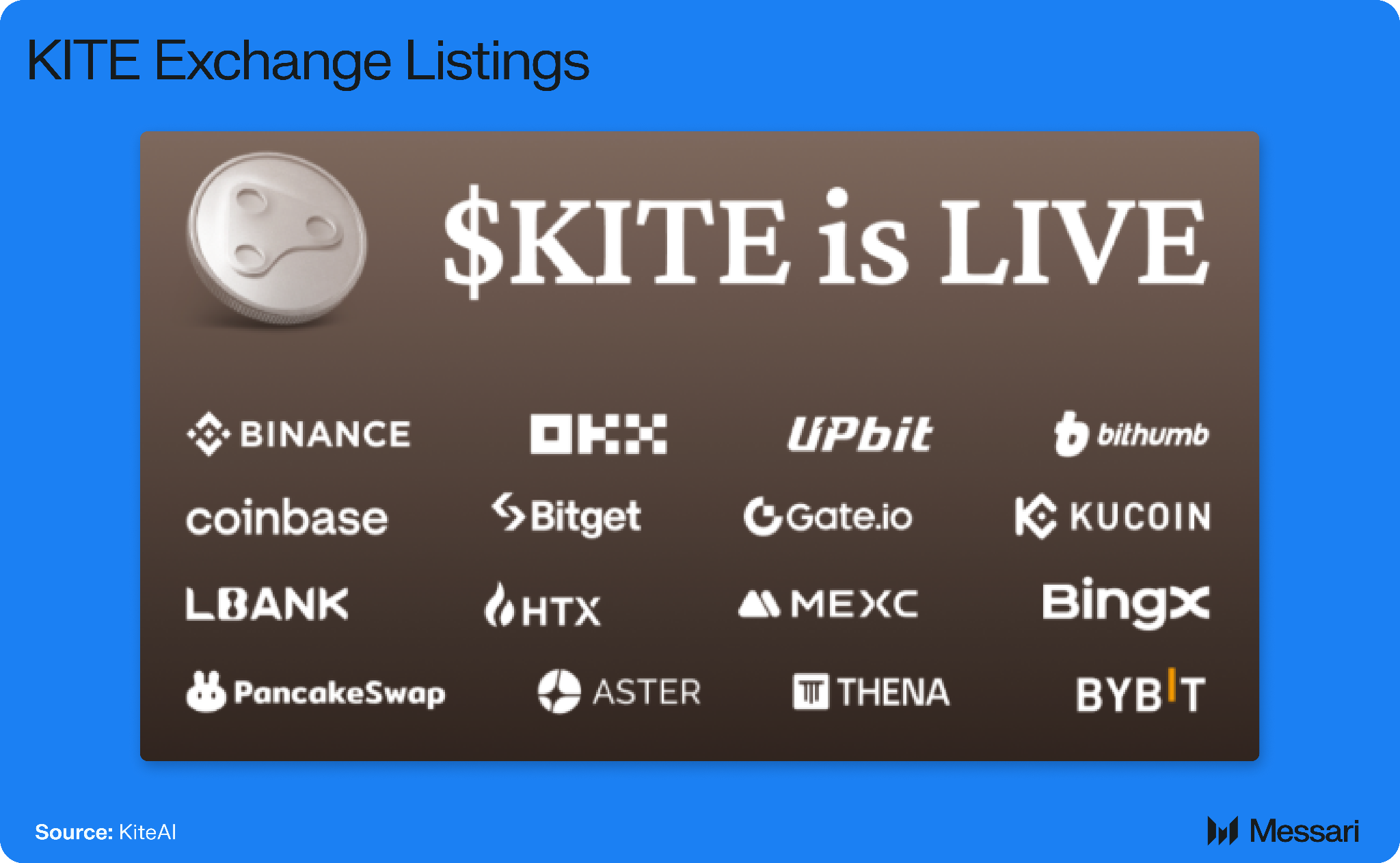
KITE is the native token for KITE Chain, launching via a token generation event (TGE) on Nov. 3, 2025, with listings across Binance, OKX, Upbit, Coinbase, Bitget, and Bybit. The token outperformed a volatile broader market in Q1, reaching an all-time high fully diluted valuation (FDV) of $3 billion on March 9, 2026. That run placed KITE among CoinMarketCap’s top 100 assets and drove it to seventh in 24-hour spot volume on Upbit, Korea’s largest exchange, on March 4, 2026. Grayscale cited KITE as a leader in the AI crypto sector in its February 2026 market commentary. Interest in agentic commerce, paired with KITE’s visibility within that narrative, sustained price strength heading into mainnet.
Closing Summary
As Kite’s mainnet goes live, the early metrics that matter are Passport wallet creation rates, stablecoin settlement volume, and the number of active agent integrations using the Kite Passport Skill. These will signal whether there is traction and growth for a dedicated agent payment chain.
Existing payment companies and cloud providers have committed resources to agent payment infrastructure in the past 12 months. That consensus validates the category. Kite is the unified hub for different agent payment standards, and the team believes that a blockchain designed from the ground up for agent workloads will outperform general-purpose chains adapted for them. Network and protocol activity over the next two quarters will begin to reveal the validity of that bet, as launch partner integrations go live and both consumers and service providers continue to integrate with Kite Passport, with transactions settling on Kite Chain.
This report was commissioned by DataLego Inc. All content was produced independently by the author(s) and does not necessarily reflect the opinions of Messari, Inc. or the organization that requested the report. The commissioning organization may have input on the content of the report, but Messari maintains editorial control over the final report to retain data accuracy and objectivity. Author(s) may hold cryptocurrencies named in this report. This report is meant for informational purposes only. It is not meant to serve as investment advice. You should conduct your own research and consult an independent financial, tax, or legal advisor before making any investment decisions. Past performance of any asset is not indicative of future results. Please see our Terms of Service for more information.
No part of this report may be (a) copied, photocopied, duplicated in any form by any means or (b) redistributed without the prior written consent of Messari®.
Eric is a research analyst at Messari and an ambassador for Maple Finance. He previously was a Product Manager for FINTRX and is passionate about DeFi and AI.
Eric is a research analyst at Messari and an ambassador for Maple Finance. He previously was a Product Manager for FINTRX and is passionate about DeFi and AI.