Is the Curve Flywheel Sustainable?

Curve Finance is the largest DEX by TVL and ranks second in trading volume. Currently, the protocol has $5.5 billion in TVL and does around $170 million in daily volume. The protocol rose to dominance by pioneering the StableSwap AMM and enabled liquidity pools for any token pair a year after its launch.
Most AMM DEXs require deep liquidity to provide efficient pricing for traders. These protocols typically deploy liquidity mining programs that attract LPs with native token rewards. As these tokens commonly lack utility or demand, LPs often immediately sell their rewards and create a constant sell pressure that is harmful to token holders.
Curve believes it has improved on the farm-and-dump model through sound token design. The structure allows other DeFi protocols to launch a Curve Pool for their token and use CRV emissions to reward the LPs. The high yields attract deep liquidity to the pool without running a dilutive liquidity mining program. Other DeFi protocols do not have to waste token equity to incentivize token liquidity when CRV emissions can be leveraged to achieve the same result.
CRV Tokenomics
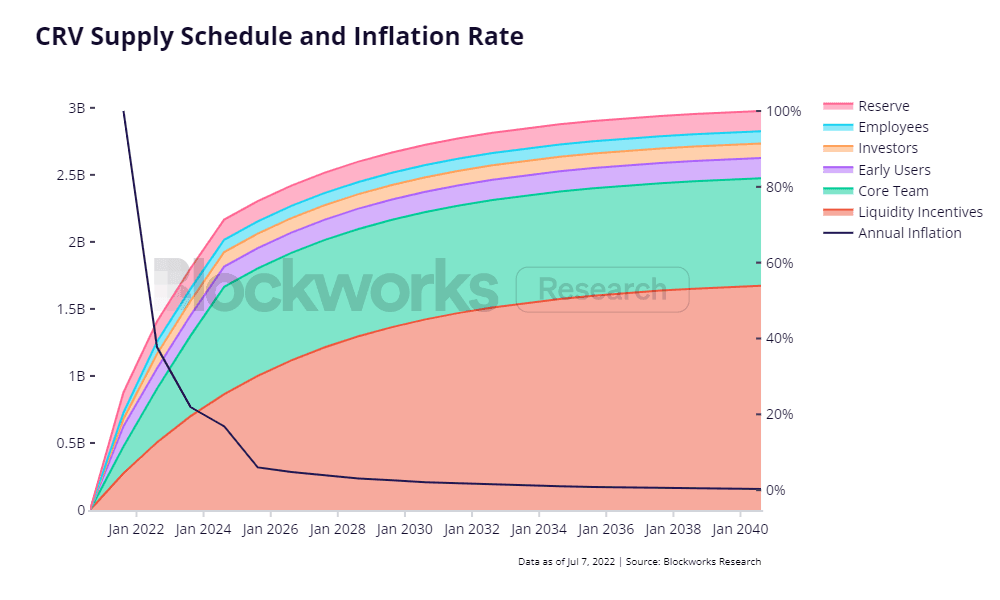
The maximum supply of 3.03 billion CRV is gradually released. 43% of CRV tokens were allocated to the core team (26%), early users (5%), protocol reserve (5%), investors (4%), and future employees (3%) that vest over 1 to 4 years from launch. The remaining 57% of tokens are used for liquidity incentives and are emitted at a decreasing rate until exhaustion. For example, 274.8 million CRV were emitted as liquidity incentives in year one, and the emission rate decreases by 15.9% each year until all tokens have been distributed. By the end of 2040, approximately 98% of the total supply will be issued.
CRV’s current inflation is driven by core team vesting. A large allocation to one small group could put pressure on token pricing if dumped. However, project developers are generally interested in the prolonged success of the protocol and have the best understanding of how to deploy CRV tokens productively. When core team vesting ends in 2024, CRV’s inflation rate decreases to 6.0% and then 0.3% in 2040.

Dan leads the build out of the Analytics product, spending most of his time with onchain data.