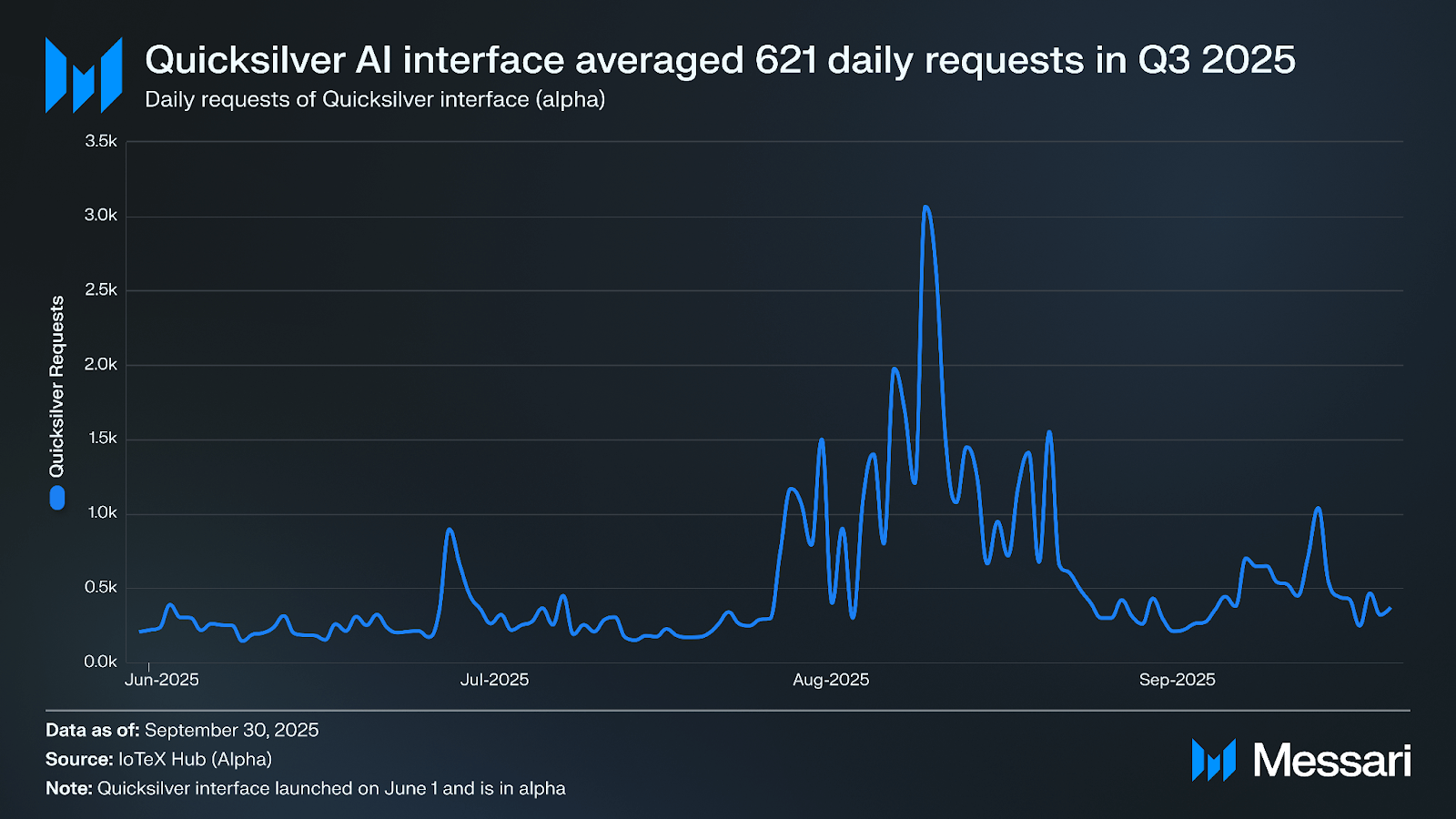
In Q3 2025, IoTeX recorded 621 average daily Quicksilver agent requests, more than doubling June activity. Usage peaked mid-August with over 3,000 daily queries before normalizing in September, reflecting increased developer experimentation and broader user access.
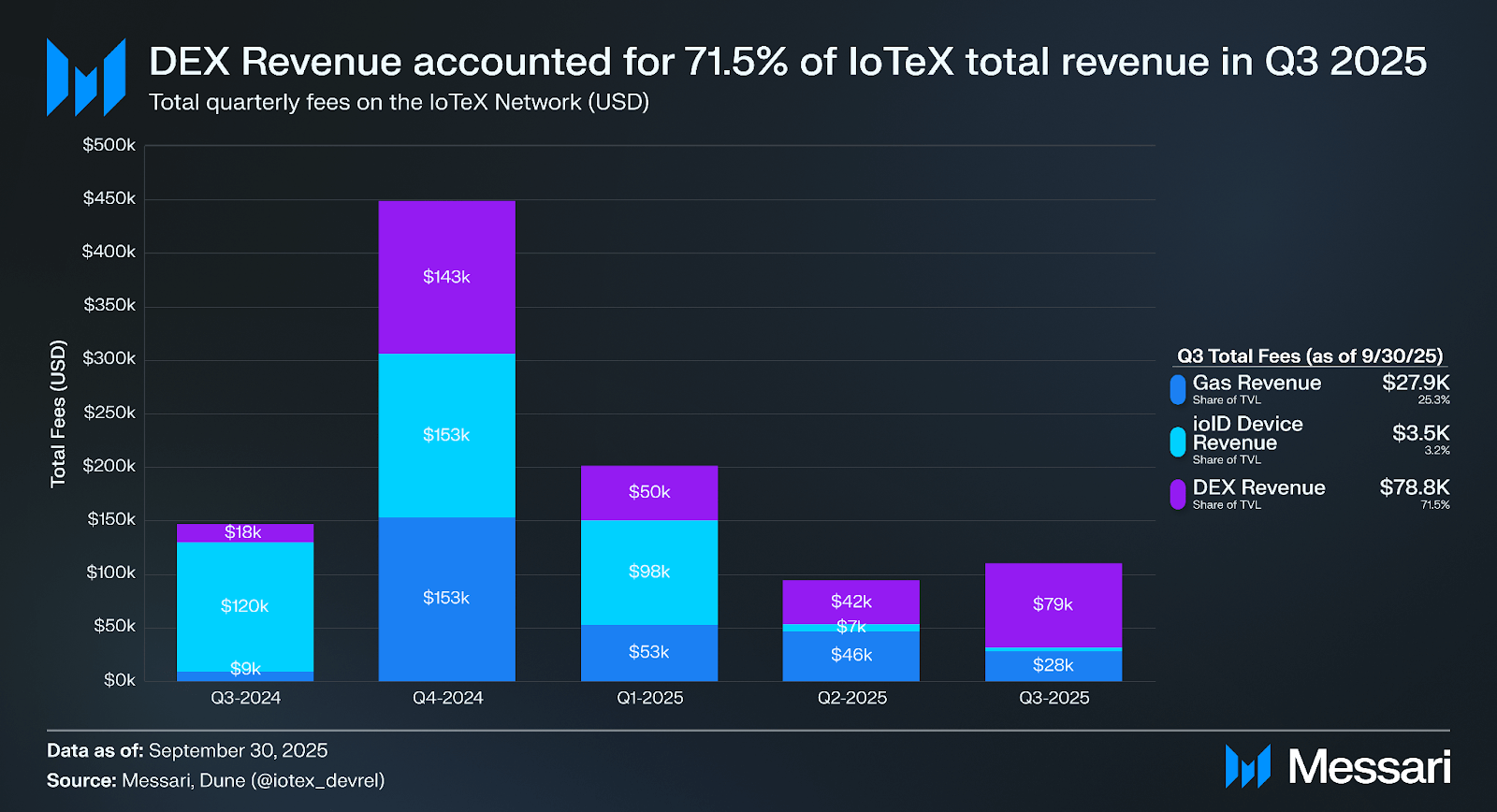
Protocol revenue increased 16.2% QoQ to $110,200, driven by a 90% surge in DEX activity, which accounted for 71.5% of total revenue.
IoTeX formed strategic partnerships with HashKey Exchange and Animoca Brands, strengthening its footprint in Asia and advancing compliant AI and digital asset infrastructure. The IOTX/HKD trading pair launched on HashKey, while Animoca joined as a validator and investor.
IOTX was added to CF Benchmarks on August 29, establishing a regulated institutional pricing index (IOTXUSD_RTI) under UK BMR standards. This listing enhances IOTX’s eligibility for ETFs, derivatives, and other compliant financial instruments.
Users can stake the IoTeX L1’s native token (IOTX) to vote for one or more community-elected delegates to secure the network, validate transactions, and produce new blocks. IOTX can also be used to pay gas fees on the IoTeX L1. The IoTeX L1 utilizes a Randomized Delegated Proof-of-Stake (Roll-DPoS) consensus mechanism, randomly selecting 24 of the top 36 delegates every hour to secure the network.
Quicksilver is a framework for integrating DePINs with AI agents, enabling them to process physical-world data, respond adaptively, and take AI-driven automated actions. These devices generate continuous data streams that W3bstream verifies before AI agents use them for analysis or task execution.
W3bstream is an offchain computing layer that uses zero-knowledge (ZK) proofs to verify data from DePIN devices and settle proof of real-world activity records onchain. This enables DePIN builders to verify the authenticity of device-generated data.
ioID is an onchain identity framework that authenticates smart devices, sensors, and agents. The core components of the ioID architecture are ioID identifiers, device NFTs, Machine-Bound Accounts (MBAs), and an ioID registry that links each device to its owner wallet and account.
For a full primer on IoTeX, refer to our Initiation of Coverage report.
A total of 130 applications use the IoTeX L1 to track device data and process offchain computations sourced primarily from smart devices, machines, and sensors.
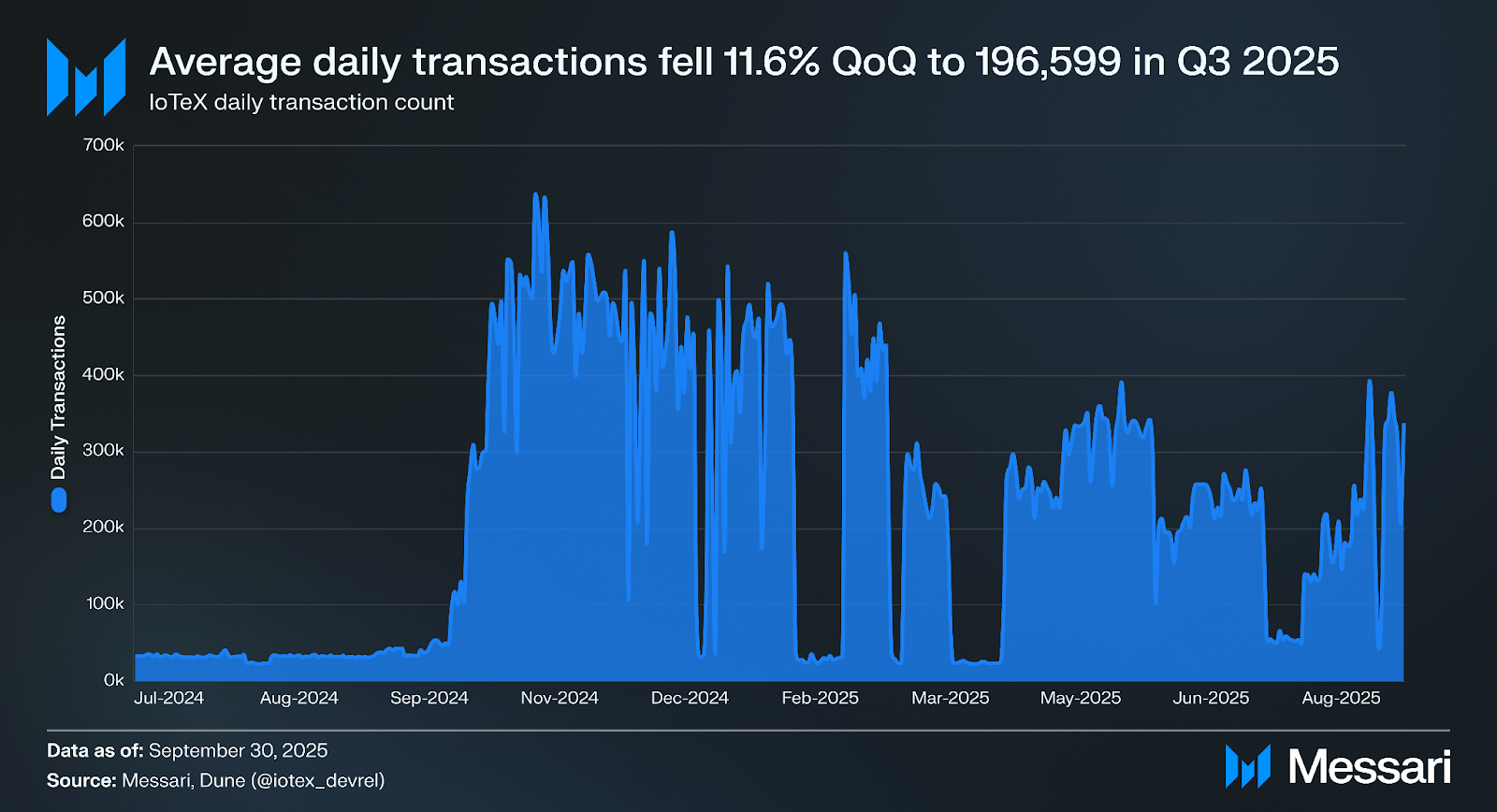
Average daily transactions on the IoTeX L1 fell 11.6% QoQ from 222,300 to 196,599. Despite the QoQ decrease, average daily transactions increased nearly 600% YoY, driven by sustained usage following the Q3 2024 launch of ioID, an onchain identity framework for smart devices and AI agents. While activity has decreased from its initial peak, network usage on IoTeX L1 has normalized over the past three quarters.
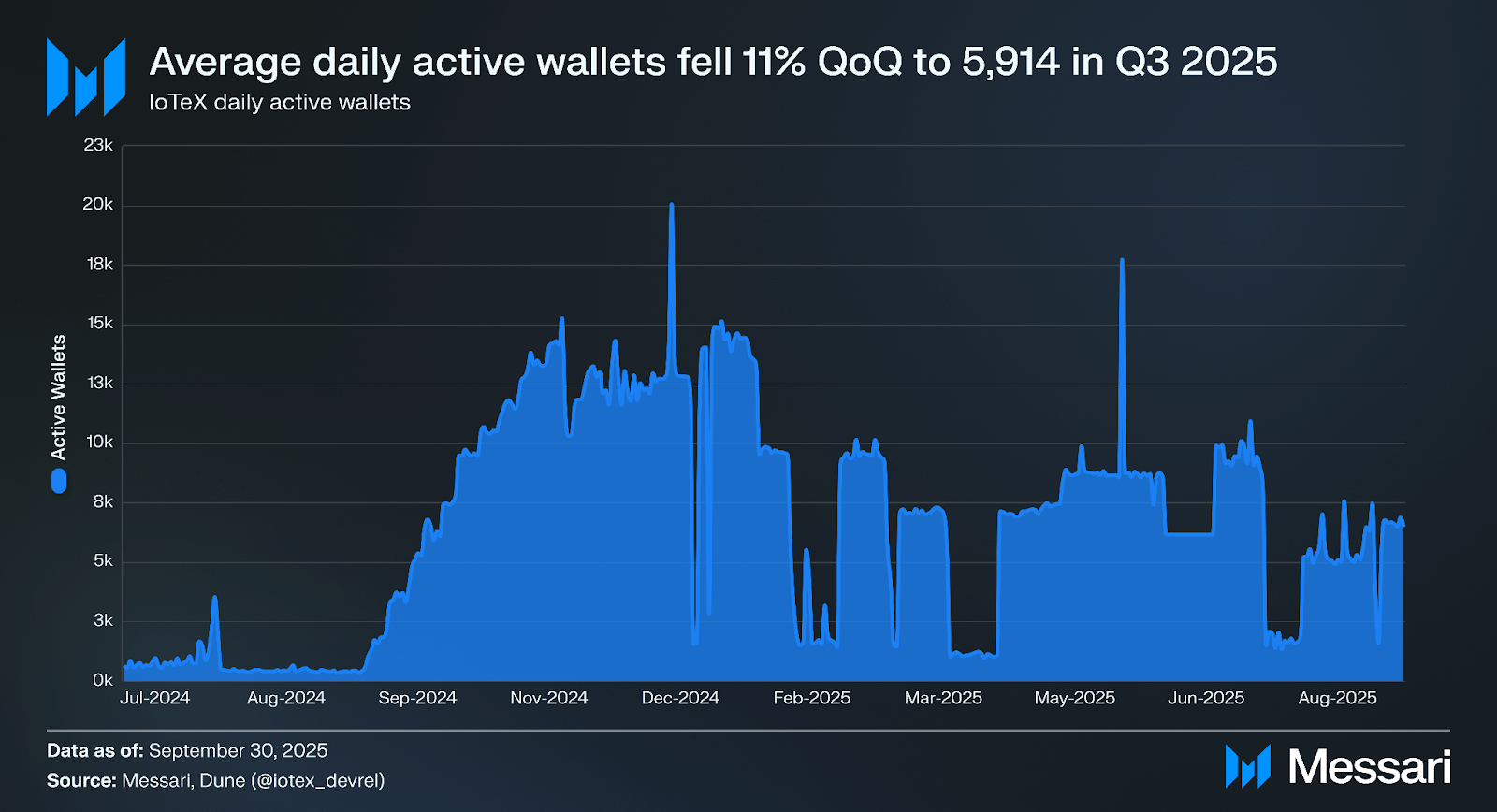
Average daily active wallets on the IoTeX L1 declined 10.8% QoQ to 5,914 in Q3 2025, mirroring the pullback in average daily transactions. Both metrics suggest that network usage has moderated in recent months, following elevated activity levels earlier in the year.
Staking Overview
IOTX is the native token used to pay transaction fees on the IoTeX L1 blockchain. Holders can stake IOTX and subsequently vote for delegates who secure the network, validate transactions, and produce new blocks. Stakers and delegates earn IOTX rewards in return for their services and capital.
Additionally, the ioID module requires IOTX tokens to be burned to create new onchain identities for devices, resulting in a dynamic burn rate based on the total number of new device registrations. Burning IOTX is also required for other actions in the ioID module, such as obtaining verifiable credentials (VCs) for decentralized identification (DIDs) and linking device identities to the IoTeX L1.
In 2019, IoTeX allocated 12% of the total IOTX supply (1.2 billion IOTX) for staking rewards, but this allocation became nearly exhausted. In November 2024, IoTeX 2.0 introduced inflationary staking rewards, minting new IOTX to distribute to delegates and stakers involved in network consensus. The annual inflation rate is determined by network-wide governance within a targeted range (6-11% APR staking rewards).
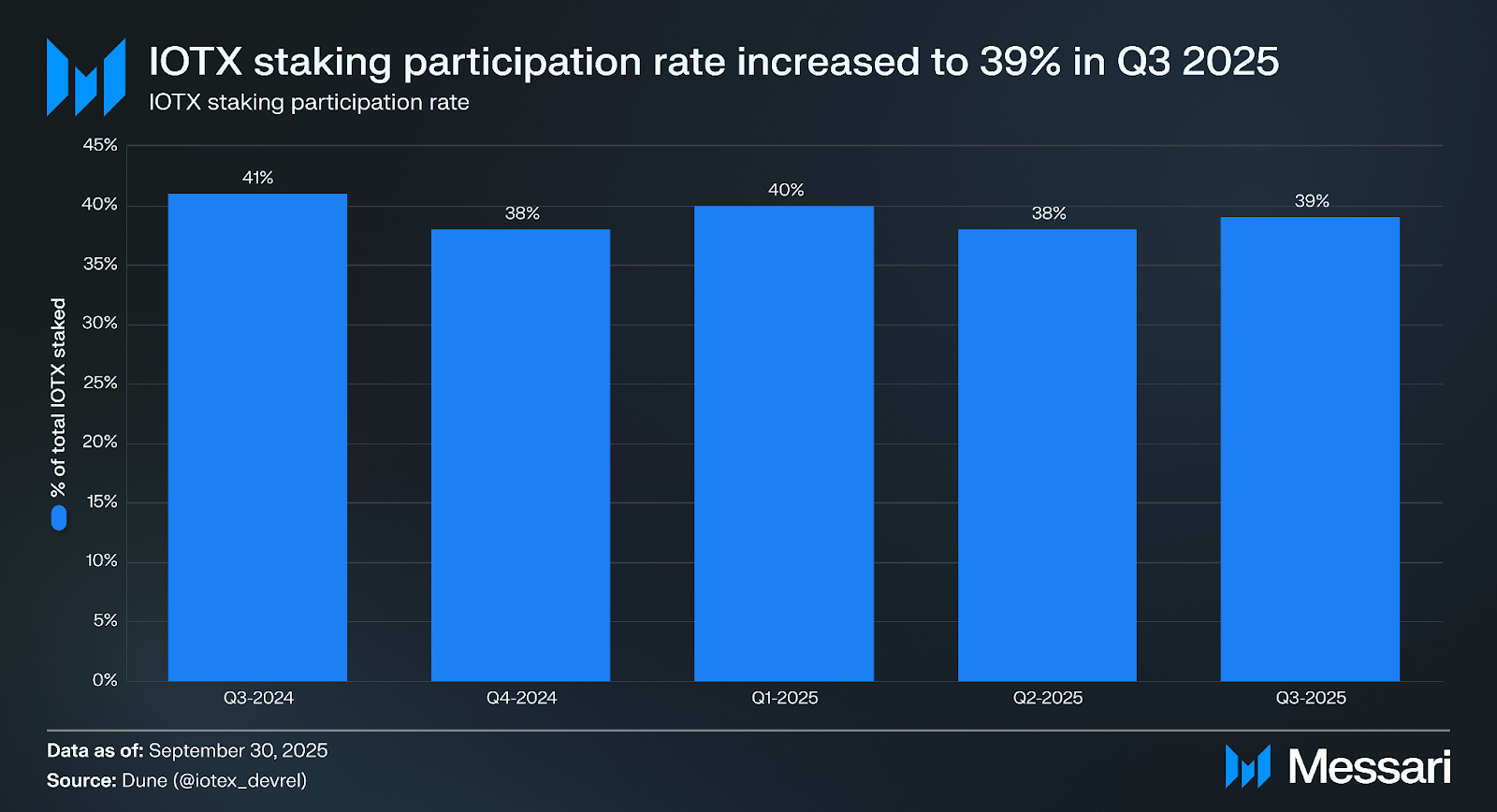
At Q3 close, 123 active delegates secured the IoTeX L1 blockchain. A total of 3.6 billion IOTX, valued at $77.5 million, was staked, marking a 1% increase QoQ. Animoca Brands remained the top delegate, holding 5.87% of total voting power, followed by IoTeXLab at 5.16% and Binance Staking at 5.09%.
ioID
ioID is designed to provide a universal onchain registry for machines and AI agents collecting real-world data, support MBA-based DeFi participation, enable autonomous M2M communication, and verify offchain device data. ioID is a dual-layer identity system combining both onchain and offchain elements. While an ERC-6551 token-bound account on the IoTeX blockchain represents a machine’s onchain identity and ownership, a decentralized identifier (DID) is leveraged offchain to realize secure communications among machines or AI agents. An ioID registry contract links the onchain and offchain identities.
A device NFT is an ERC-721 token that is the onchain representation of a physical machine or AI agent. The device NFT is then used to derive an ioID identifier and create a token-bound ERC-6551 account onchain. Each device NFT enables onchain registration of new physical assets, tracks ownership transfers, and access control via smart contracts. Manufacturers or operators mint device NFTs when the asset first enters operation. For example, minting might occur when a drone or IoT sensor is manufactured, or when provisioning a new node in a DePIN network. The generation of a device NFT bound ioID account (i.e., an ERC-6551 wallet) marks the exact moment a physical asset becomes verifiable and functional onchain, ready to interact with reward systems, staking protocols, or AI networks. Device owners pay IOTX to activate an ioID, and once activation completes, the minted Device NFT records onchain ownership of the device and the controller of the corresponding ioID account.
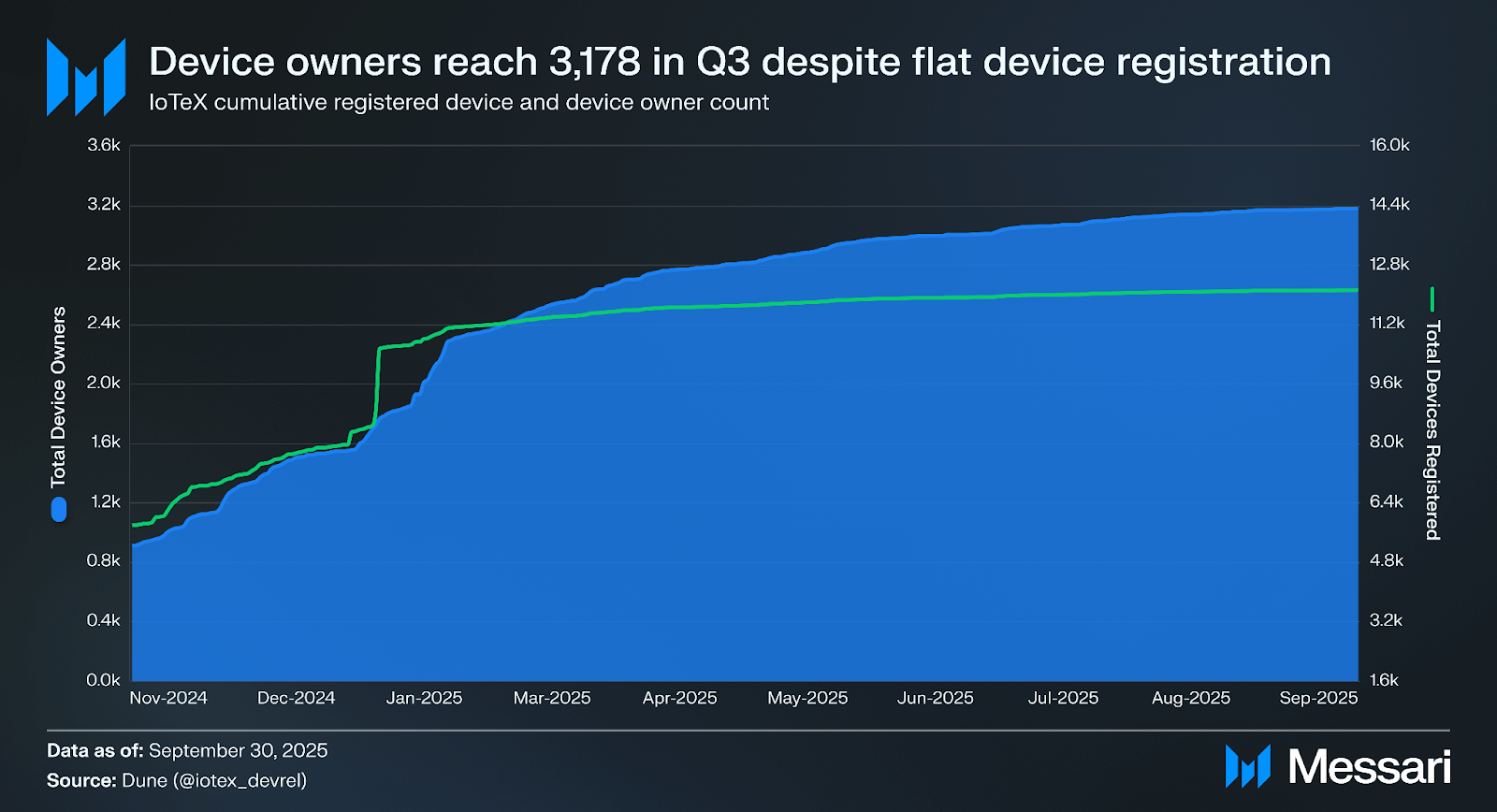
Device owners increased 11% QoQ, rising from 2,700 to 3,178 in Q3 2025. In contrast, new device registrations grew only 2%, from 11,900 to 12,107, continuing a trend of flattening adoption since the Q1 surge.
Registered devices remain highly concentrated. WatchX, a smart wearable device developed by IoTeX with health and payment features, represents 12%. GEO-PULSE, a consumer-grade navigation device built in collaboration with GEODNET, makes up 8%.
The divergence between steadily growing ownership and slowing registration suggests that recent adoption is driven more by the broader distribution of existing devices than by onboarding new ones.
Financial Overview
Fees
Protocol revenue for the IoTeX network comes from three IOTX-denominated fees: gas fees, ioID device-activation fees, and decentralized exchange (DEX) fees. Gas fees are paid by anyone initiating a transaction on the IoTeX L1 blockchain, similar to Ethereum's transaction fee structure. ioID activation fees apply when registering a new device. DEX fees primarily come from trades on Mimo, the leading DEX by TVL on IoTeX, which in 2024 launched the DePIN Liquidity Hub to let users trade DePIN tokens bridged from Solana, Ethereum, Polygon, and other chains.
Protocol revenue on IoTeX increased 16.2% QoQ to $110,200 in Q3 2025, rebounding from Q2's decline. The rise was primarily driven by DEX revenue, which accounted for 71.5% of total revenue, marking the first time in the past year that DEX activity represented the majority of protocol revenue. Gas revenue declined 40% QoQ, falling from $46,344 to $27,886, while ioID device activation revenue also decreased, dropping 49% QoQ from $6,921 to $3,504. These declines were more than offset by a 90% increase in DEX revenue, which rose from $41,554 in Q2 to $78,830 in Q3.
The revenue mix shift highlights the growing role of DEX activity in driving protocol value, while base layer transaction fees and identity-related revenue continue to decline.
Qualitative Analysis & Key Developments
Launch of Real-World AI Foundry
At the R3al World AI Summit during Token2049 Singapore, IoTeX launched the Real-World AI Foundry, a global initiative to develop decentralized, blockchain-based AI infrastructure. The Foundry introduces an open framework for building Real-World Models (RWMs), intelligent systems trained on live, verified data from machines, sensors, and human input.
The initiative addresses structural limitations in traditional AI systems, which IoTeX characterizes as closed-source, siloed, and centrally controlled. In contrast, the Foundry emphasizes openness, decentralization, and onchain coordination. Data contributors, infrastructure providers, and model developers are incentivized through crypto rewards based on the usage and quality of their inputs, tracked transparently via onchain registries.
RWMs differ from conventional AI models in that they are continuously updated with real-time data and optimized for context-aware applications in high-impact sectors such as mobility, energy, robotics, and healthcare. These models are governed collectively to support interoperability, privacy, and alignment with shared standards.
Initial governance is led by working groups formed by Alignment Partners, with future plans to incorporate token-based participation. Key founding partners include Filecoin, 0G, GEODNET, HashKey Chain, and Alchemy Pay, along with contributors from telecom, compute, and DePIN infrastructure.
Quicksilver Activity Accelerates Amid Expansion of Agent Infrastructure
In January 2025, IoTeX introduced Quicksilver, a modular, open-source framework for building AI agents and connecting them to various centralized and decentralized data sources (e.g., Web2 APIs, blockchains, decentralized physical infrastructure networks (DePINs), etc.). In June, IoTeX launched the first version of Quicksilver to a selected group of developers, enabling them to configure agent personality, logic, and API access, set pricing to monetize usage, and let selected users query those agents via chat or API using DePIN data.
Users can either interact directly with an agent-specific chat or use the global chat. Direct interactions return responses using only that agent’s data and logic. In the global chat, Quicksilver’s sentient AI “core orchestrator” acts as a coordinating AI layer, selecting the most relevant agents and APIs for each query and returning a response derived from their combined outputs.
In Q3 2025, Quicksilver recorded an average of 621 daily requests, more than doubling its June activity as access broadened and user engagement grew. Request volume peaked mid-August, briefly exceeding 3,000 daily queries, before tapering off and stabilizing in September. The increase in usage reflects greater experimentation with agent capabilities and broader exposure across platforms, though activity remains variable as the interface continues to operate in alpha.
Quicksilver agents process user prompts using LLM integrations with OpenAI (GPT-4o-mini), Anthropic (Claude 3.5 Haiku), and DeepSeek. They also pull data from APIs, blockchains, and DePIN networks, and execute actions such as sending transactions, posting to social platforms, or calling services. Quicksilver already integrates with Messari Copilot (research), DePIN Ninja (analytics), DefiLlama (protocol data), Nubila (weather), and CoinMarketCap (pricing data), with additional tools planned.
In August 2025, IoTeX released a developer preview of the Quicksilver platform, extending its pre-alpha capabilities with essential SaaS functions including user authentication, API key management, payment workflows, and a points-based rewards system. These upgrades followed a July usage peak of 1,700 daily requests, a 70% increase over June.
The BinoSwarm team focused on enhancing compliance and scalability, introducing PII redaction to mask sensitive data in logs and traces, ensuring no private information is sent to the LLM layer. They also implemented unified message processing across Telegram, Discord, and direct clients, reducing code duplication and enabling migration toward event-based architectures.
Quicksilver’s pre-alpha also introduced the first experimental instance of a Realm, a domain-specific knowledge layer, integrated into ioPay. This allowed users to query DePIN data directly within the wallet interface. Internal tools like DePINscan and external agents such as Caila and Nodey are expected to follow.
Key Partnerships & Expansion
Animoca Brands Invests in IoTeX and Joins as Validator
Animoca Brands has made a strategic investment in IoTeX and joined the network as a validator and ecosystem partner. The collaboration brings additional capital, technical resources, and external validation of IoTeX’s governance model. With a portfolio spanning over 540 Web3 companies, Animoca is expected to support IoTeX’s expansion across Asia, facilitate ecosystem partnerships, and drive adoption of real-world AI applications.
IOTX Listed on FUTU for Professional Investors
IoTeX’s IOTX token became available on FUTU in August 2025, Asia’s largest online brokerage and wealth-management platform. FUTU serves 27 million investors and manages $124 billion in client assets, with over $1 trillion in annual trading volume. IOTX joins a limited group of 19 digital assets listed for professional investors, expanding institutional access, increasing liquidity, and strengthening its presence in regulated Asian markets.
IoTeX Partners with HashKey Exchange to Build AI Ecosystem Center
IoTeX has entered a strategic collaboration with HashKey Exchange, Hong Kong’s first SFC-licensed virtual asset exchange, to co-develop the region’s first compliant AI Ecosystem Center and a foundational layer for regulated digital asset infrastructure. The partnership aims to integrate real-world AI systems, verifiable machine data, and decentralized technologies into Hong Kong’s regulated financial landscape.
The collaboration is structured around five key initiatives: secure digital asset issuance and circulation, a jointly operated AI Ecosystem Center, deployment of the IOTX/HKD trading pair for direct fiat access, integration of IoTeX’s L1 and AI infrastructure (including ioID, Quicksilver, and Realms), and institutional-grade compliance, custody, and auditing services.
Together, IoTeX and HashKey will develop infrastructure to support machine-driven economies and tokenized assets based on real-world data. The initiative also strengthens Hong Kong’s position as a hub for trusted AI and Web3 innovation, aligning with ongoing regulatory developments such as the region’s new stablecoin framework.
The IOTX/HKD listing on HashKey Exchange marks one of the first fiat pairs under Hong Kong’s regulated digital asset regime. The partnership combines IoTeX’s decentralized physical infrastructure stack with HashKey’s expertise in compliant finance to enable scalable, real-world blockchain applications across AI, mobility, energy, and more.
On August 29, 2025, the IOTX token was added to CF Benchmarks, the UK FCA-regulated provider of institutional crypto indices. The listing introduces the CF IoTeX-Dollar Spot Rate (IOTXUSD_RTI), calculated once per second using aggregated exchange data and meeting global standards for transparency, integrity, and regulatory compliance.
This inclusion enables IOTX to serve as a pricing reference for ETFs, derivatives, and other regulated financial products, joining the same benchmark platform used by CME Group, BlackRock, and Fidelity. The milestone enhances IoTeX’s institutional credibility and unlocks new pathways for investment vehicles.
IoTeX and Vodafone Partner on Decentralized Compute Infrastructure
At the IoTeX Chapter 3 Vision Launch during ETHCC, Vodafone’s David Palmer unveiled a proof of concept to bring real-world infrastructure onchain. IoTeX, together with Vodafone, Coinbase, and Chainlink, aims to decentralize the $7 trillion data center market by tokenizing the world’s 5 million cell towers. Each tower would serve as a low-latency edge data center, with investors rewarded through smart contracts whenever their tower provides compute. The initiative seeks to distribute AI infrastructure more equitably and reduce reliance on centralized hyperscale operators.
Closing Summary
In Q3 2025, the IoTeX network demonstrated continued maturity across usage, infrastructure, and institutional positioning. While average daily transactions and active wallets declined slightly QoQ, activity has normalized following the sharp post-ioID surge, indicating a stabilized user base and sustained application engagement. Notably, over 130 applications now rely on IoTeX L1 for real-world device data and offchain computation, anchoring the network’s role in decentralized physical infrastructure (DePIN).
Financially, protocol revenue rebounded 16.2% QoQ to $110,200, led by a 90% increase in DEX revenue, which overtook gas and ioID-related fees to become the primary driver of value on the network. Meanwhile, staking activity remained steady, with 3.6 billion IOTX staked and Animoca Brands, IoTeXLab, and Binance Staking retaining leading delegate positions.
Key developments included the launch of the Real-World AI Foundry with partners like Filecoin and HashKey Chain, and expanded usage of the Quicksilver AI agent framework, which surpassed 621 average daily requests in Q3. August’s developer preview introduced key SaaS upgrades, compliance improvements, and integrations with ioPay, reflecting growing ecosystem maturity.
Strategic partnerships further reinforced IoTeX’s institutional momentum. Animoca Brands joined as both validator and investor, while new listings on FUTU and HashKey Exchange extended IOTX access to professional and regulated markets in Asia. The addition of IOTX to CF Benchmarks also opened the door to future ETFs and derivatives, enhancing credibility with institutional finance. Lastly, the XPIN Network airdrop in September showcased ongoing community engagement and the expansion of IoTeX’s DePIN ecosystem.
This report was commissioned by MachineFi, Inc. All content was produced independently by the author(s) and does not necessarily reflect the opinions of Messari, Inc. or the organization that requested the report. The commissioning organization may have input on the content of the report, but Messari maintains editorial control over the final report to retain data accuracy and objectivity. Author(s) may hold cryptocurrencies named in this report. This report is meant for informational purposes only. It is not meant to serve as investment advice. You should conduct your own research and consult an independent financial, tax, or legal advisor before making any investment decisions. Past performance of any asset is not indicative of future results. Please see our Terms of Service for more information.
No part of this report may be (a) copied, photocopied, duplicated in any form by any means or (b) redistributed without the prior written consent of Messari®.
Alice is a Research Analyst on the Protocol Services team. She previously worked as a Research Analyst at The Block and was an Investment Intern at Variant Fund. Alice graduated from Northwestern University, where she studied Economics.
Alice is a Research Analyst on the Protocol Services team. She previously worked as a Research Analyst at The Block and was an Investment Intern at Variant Fund. Alice graduated from Northwestern University, where she studied Economics.