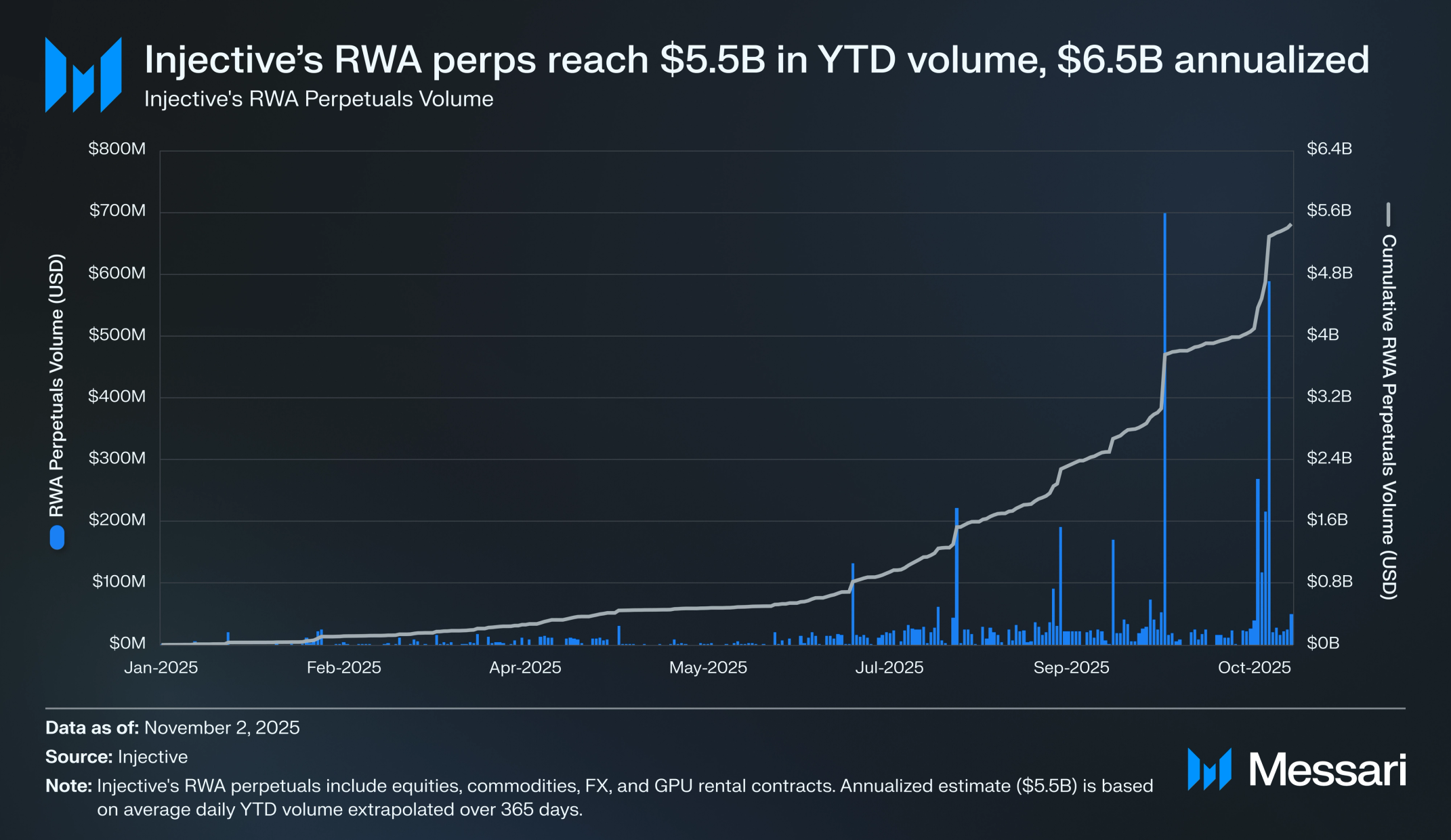
Injective's RWA perpetuals have processed $6 billion in cumulative trading volume as of November 2, 2025, reflecting a 221% increase over 10 weeks, on track to reach an annualized run rate of $6.5 billion by year-end.
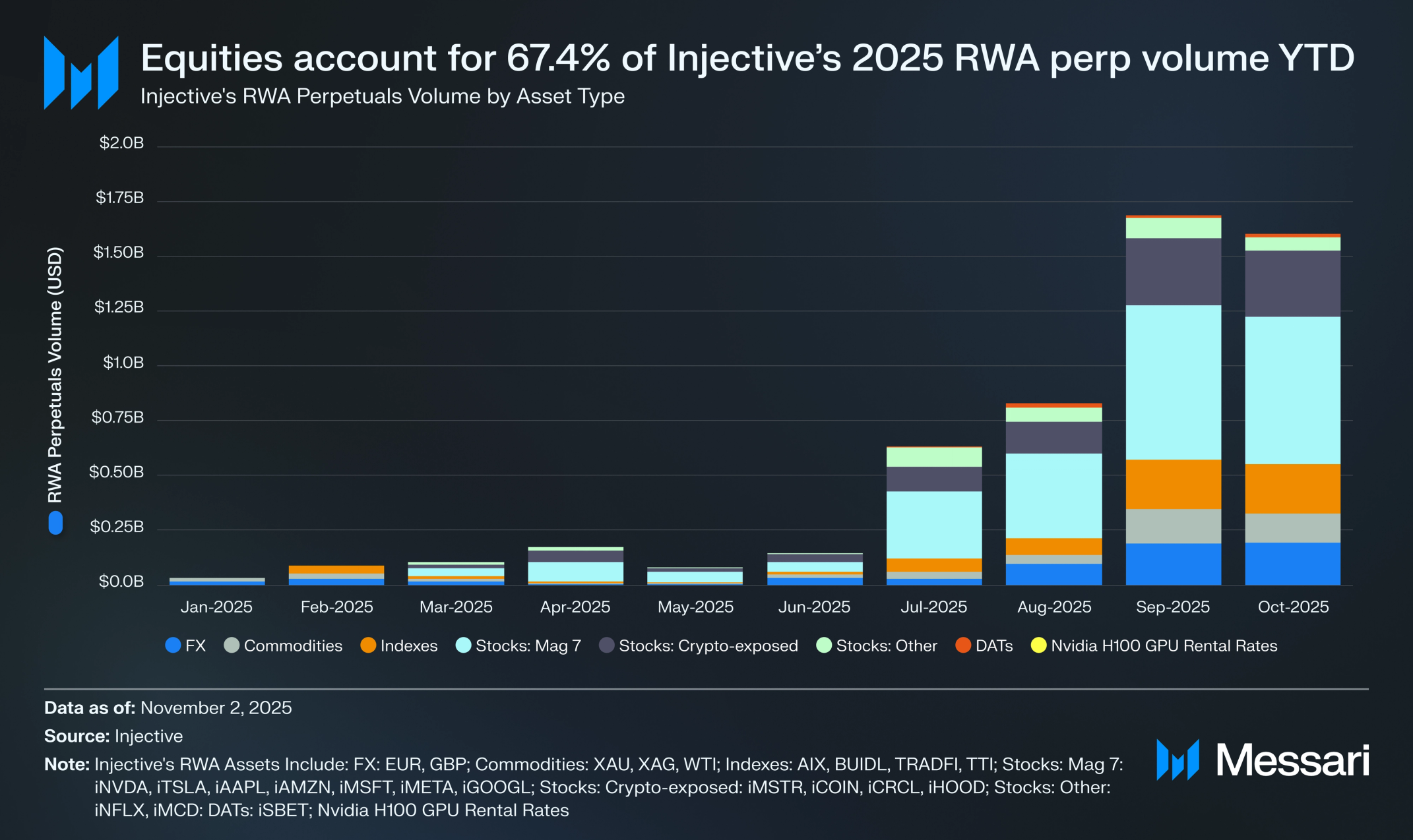
The “Magnificent 7” stocks account for $2.4 billion in trading volume(42.6% market share). Crypto-exposed equities add another $666.7 million (12.4% market share), reflecting growing interest in companies with digital asset exposure.
Digital asset treasury perpetuals have generated $363 million in cumulative volume, with MicroStrategy contributing $313.3 million. SBET, launched in July 2025, has added $49.7 million, demonstrating early traction for this new asset class.
Pre-IPO perpetual markets launched on October 1, 2025, bringing exposure to private companies like OpenAI, SpaceX, and Anthropic onchain for the first time. OpenAI leads early adoption, demonstrating demand for synthetic derivatives tied to high-growth private companies.
Injective's native EVM mainnet launched on November 11, 2025, introducing a MultiVM environment that enables developers to build using Solidity while accessing Injective's native financial modules, including the CLOB and iAssets framework.
Primer
Injective is a Layer-1 (L1) blockchain purpose-built for financial primitives. The protocol was founded in 2018 and incubated by Binance Labs. Injective leverages the Cosmos SDK to provide a high-performance execution layer tailored for derivatives, trading, and real-world asset markets. Injective integrates a native exchange module with an onchain central limit order book (CLOB), oracle connectivity, and shared liquidity, enabling financial instruments to be created and traded directly onchain. This design distinguishes Injective from CDP-based synthetic protocols, which allow users to create new cryptocurrencies using existing assets as collateral, by avoiding pre-funded collateral pools and instead relying on market makers to provide depth and dynamically allocate capital.
Injective delivers real-world exposure onchain through its iAssets framework, which enables programmable instruments that track the value of traditional assets. iAssets allow the creation of perpetual futures across equities, commodities, foreign exchange, and even more experimental markets such as Nvidia H100 GPU rental rates. This framework gives traders 24/7 access to markets that traditionally depend on centralized venues, supported by institutional market makers that help ensure liquidity.
In the current regulatory environment, onchain equities, whether spot or perpetual, do not confer the ownership rights associated with traditional stock ownership, such as voting rights or dividend distribution. Both formats provide price exposure rather than direct legal claims on the underlying asset.
The key distinction lies in capital efficiency and operational structure. Spot tokenization typically relies on a trusted intermediary to establish a special-purpose-vehicle (SPV), purchase the underlying equity, and mint a digital receipt onchain. This model locks capital in the SPV and creates a counterparty risk with the issuer. Perpetuals, by contrast, avoid this infrastructure entirely. They use oracle-based price feeds or Automated Market Makers (AMMs) as well as funding rates to create synthetic exposure, eliminating the need for pre-funded collateral pools or custodial intermediaries.
Additionally, a trader seeking $100,000 worth of Nvidia stock exposure needs to deploy the full amount in a traditional brokerage account. On Injective, the same exposure can be achieved with $4,000 in margin at 25x leverage (or $100,000 at 1x leverage for those preferring an experience closer to spot ownership). Given that current onchain equity implementations do not offer true ownership rights regardless of format, perpetuals provide a more capital-efficient path to the same economic outcome.
As of November 20 2025, the total value of RWAs onchain has reached $35.7 billion, up 2.9% over the past 30 days. Due to the advantages offered by perpetuals, RWAs on Injective have continued to grow as well, a trend that will likely continue as more and more assets are put onchain.
Injective's RWA Perpetuals Offering
RWA Volume on Injective
As of November 2, 2025, Injective's RWA perpetuals have processed $6 billion in cumulative year-to-date (YTD) trading volume. This represents a substantial acceleration from the $1.68 billion recorded through August 20, reflecting a 221% increase over ten weeks. Projected through the end of the year, Injective is on track to have an annualized RWA perpetuals trading volume of $6.5 billion.
Market Share by Asset Category
Injective's RWA perpetual markets span eight distinct asset categories (forex, commodities, indexes, Mag 7 stocks, crypto-exposed stocks, other stocks, DATs, Nvidia H100 GPU Rental Rates), each serving different trading strategies and risk profiles. Equities dominate overall activity, but diversification across forex, commodities, indexes, and experimental markets reflects broader infrastructure capabilities.
Microsoft currently leads trading activity among the Mag 7 listings, with $510.8 million in cumulative volume. Nvidia follows at $426.6 million, reflecting persistent demand for AI-related exposure, followed by Tesla ($378.3 million), Google ($376.6 million), and Apple ($363.4 million), Amazon ($235 million) and Meta ($193.9 million) represent the smallest Mag 7 assets traded on Injective. These markets benefit from up to 25x leverage and continuous trading hours, allowing participants to manage positions around earnings releases and macroeconomic events outside of traditional market windows.
Crypto-Exposed Stocks
Crypto-related equities have generated $666.7 million in cumulative YTD volume, representing 8.2% of Injective’s RWA perpetual market. Coinbase (COIN) leads the segment with $413.1 million, followed by Robinhood (HOOD) at $186 million and Circle (CRCL) at $67.7 million. Activity in these markets reflects the alignment between crypto-native traders and firms with direct exposure to digital asset infrastructure, allowing participants to express directional views on sector performance through equity-linked derivatives.
Other Stocks
Beyond the Mag 7 and crypto-exposed equities, Injective lists additional stocks that have collectively generated $353.7 million in volume, or 6.6% of total RWA activity. This category includes companies like Netflix (NFLX) ($258.6 million YTD) and other equities selected for their retail recognition and trading volume potential.
Indexes
Index perpetuals have processed $653.7 million in cumulative volume, representing 12.2% of the RWA market share. This category includes the TradFi Tech Stock Index (TTI), TradFi Stocks Index (TRADFI), Helix AI Index (AIX), and BlackRock BUIDL Fund (BUIDL). Each index serves a different purpose. TTI provides diversified exposure to the largest U.S. technology companies, TRADFI tracks the top 500 U.S. stocks, and AIX combines AI-focused crypto tokens with AI-related stocks for a hybrid exposure profile. The BUIDL perpetual uses a proprietary oracle feed from Stork, a decentralized on and offchain price feed, to track the net asset value of BlackRock's tokenized money market fund.
Forex
Foreign exchange perpetuals account for $606.3 million in volume, or 11.3% of total RWA activity. Current listings include EUR/USDT and GBP/USDT, both priced via oracle feeds and traded with up to 100x leverage. Forex markets launched on May 29, 2025, tapping into the $7.5 trillion daily turnover of traditional currency markets and bringing two-way trading opportunities onchain.
The EUR/USDT pair has led forex activity, benefiting from its status as the most liquid currency pair globally. GBP/USDT has also attracted consistent interest, particularly during periods of macroeconomic volatility affecting the British Pound.
Commodities
Commodity perpetuals have generated $441.4 million in volume, accounting for 8.2% of RWA market share. Current listings include gold (XAU/USDT), silver (XAG/USDT), and crude oil (WTI/USDT), each offering up to 50x leverage. These markets bring traditionally institutionally-dominated asset classes onchain, where pricing is sourced from oracles and all trades are executed through decentralized infrastructure.
Gold remains the most actively traded commodity on Injective, accounting for 48.6% of the total commodities volume. Silver comes in a close second with 47% of the total market share, and crude oil accounts for the remaining 4.4% of the commodities trading volume. The composability of commodity iAssets also enables their integration into structured products or multi-asset strategies that would be difficult to execute in traditional commodity futures markets.
Digital Asset Treasuries
As of November 1, digital asset treasury perps have generated $363 million in cumulative volume, accounting for 6.8% of total RWA activity. This category includes both SBET ($49.7 million, 13.7% of DAT volume) and MicroStrategy (MSTR/USDT, $313.3 million, 86.3% of DAT volume)).
SBET perps, which launched on Injective on July 24, 2025 provides traders with leveraged exposure to SharpLink's Ethereum holdings, which currently exceed $1 billion in staked ETH. The perpetual allows speculation on both the underlying ETH price and SharpLink's treasury management strategy.
MicroStrategy has driven the majority of activity within the digital asset treasury category. The MSTR perpetual offers exposure to the company's Bitcoin treasury strategy without the regulatory constraints or settlement delays of traditional equity markets.
Nvidia H100 GPU Rental Rates
Injective's most experimental offering is a perpetual tied to Nvidia H100 GPU rental rates, launched on August 18, 2025. This market has generated $12,185 in cumulative volume since launch, representing a negligible share of overall activity. The H100 perp was designed to allow traders to speculate on compute demand and AI infrastructure costs, creating a financial primitive around a real-world resource that has become critical to the AI industry.
While volumes remain minimal, the existence of this market demonstrates the capacity to extend the iAssets framework into unconventional territory. GPU rental rates are not a traditional financial asset, yet they represent a tangible input cost for AI model training and inference.
Pre-IPO Markets
On October 1, 2025, Injective launched pre-IPO perpetual futures markets, bringing exposure to private companies onchain for the first time. Initial listings include OpenAI, SpaceX, and Anthropic. These markets allow traders to speculate on the valuations of companies that have not yet gone public, an opportunity historically restricted to accredited investors, venture capital funds, and secondary market platforms with high minimum investment thresholds.
Pre-IPO perps on Injective operate similarly to other iAssets but with modified risk parameters. Leverage is capped at 5x, reflecting the higher uncertainty and illiquidity of private company valuations. Mark prices are initially calculated using an exponentially weighted moving average (EWMA) of the last 24 hours of traded prices on Injective itself, rather than relying on external spot markets that do not exist for these assets. If and when a pre-IPO company lists on a centralized exchange, the mark price mechanism transitions to a CEX API price feed, allowing the perpetual to eventually track the public market valuation.
OpenAI has emerged as the most actively traded pre-IPO market on Injective, representing $14.3 million in cumulative volume since launch. Interest in OpenAI's valuation reflects both the company's dominant position in generative AI and the broader narrative around AI infrastructure investment. The ability to trade OpenAI exposure 24/7, with leverage, and using only USDT collateral represents a significant departure from traditional pre-IPO access, which typically involves illiquid share purchases through secondary platforms or multi-month lockups.
The introduction of pre-IPO perps addresses a long-standing gap in market access. By removing minimum investment requirements, geographic restrictions, and lockup periods, Injective has created a structure where anyone with a wallet and USDT can gain synthetic exposure to private company valuations.
On The Horizon
On November 11, 2025, Injective launched its native EVM mainnet, marking a significant infrastructure expansion. The upgrade introduces a MultiVM environment where developers can build using both EVM and WebAssembly (WASM) in a unified execution layer. EVM-based applications can now access Injective's native financial modules, including the CLOB and iAssets framework, without sacrificing compatibility with standard Ethereum development tools like Hardhat and Foundry.
The mainnet launch included over 30 dApps and infrastructure providers, with the testnet phase recording more than 5 billion transactions across 300,000 unique wallets. The architecture enables seamless interaction between different virtual machines through Injective's MultiVM Token Standard (MTS), which provides a consistent token representation across the entire ecosystem. This eliminates the need for manual bridging and ensures atomic transaction execution.
For RWA perpetuals, the EVM upgrade represents a potential inflection point. Injective's RWA perps have processed $6 billion in cumulative volume, despite operating within a WASM-based environment that is significantly smaller in terms of developers and users compared to EVM. The WASM ecosystem has historically attracted fewer builders compared to Ethereum's dominant developer base, yet Injective has still managed to establish itself as one of the most active venues for onchain RWA derivatives. With EVM now natively integrated, any Solidity developer can spin up RWA perpetual markets using Injective's exchange module with built-in orderbook liquidity, oracle infrastructure, and professional market makers.
Ethereum remains the dominant ecosystem for DeFi development, and the ability to deploy familiar Solidity-based smart contracts while accessing Injective's specialized financial infrastructure lowers the barrier to entry for builders. The protocol has already demonstrated product-market fit within a niche developer ecosystem. Opening that infrastructure to the broader Ethereum community could significantly amplify growth.
The early success of Magnificent 7 equities suggests that additional stock listings could drive incremental volume. Forex markets may benefit from expanded currency pair offerings or the introduction of emerging market currencies, which traditionally face higher barriers in conventional trading venues. Commodity markets could extend into agricultural products, precious metals beyond gold and silver, or energy markets beyond crude oil.
Closing Summary
Injective has scaled its RWA perpetuals market to $6 billion in cumulative volume as of November 2, 2025, demonstrating that fully onchain infrastructure can support substantial derivatives activity across traditional asset classes. The protocol's iAssets framework has enabled perpetual futures markets for equities, forex, commodities, indexes, pre-IPO contracts, and digital asset treasuries. By relying on professional market makers for liquidity and separating collateral requirements from asset issuance, Injective has achieved a capital-efficient model that distinguishes it from overcollateralized synthetic protocols.
Equities dominate activity, with the Magnificent 7 stocks accounting for 42.6% of total volume ($2.4 billion), led by Microsoft at $510.8 million. Crypto-exposed companies have generated $666.7 million, with Coinbase contributing $413.1 million. Digital asset treasury perpetuals, introduced in July 2025, have reached $363 million in volume, primarily driven by MicroStrategy at $313.3 million. The October 2025 launch of pre-IPO perpetuals brought exposure to private companies like OpenAI, SpaceX, and Anthropic onchain, addressing a gap in market access without the minimum investment thresholds or lockup periods typical of traditional pre-IPO markets.
On November 11, 2025, Injective launched its native EVM mainnet, introducing a MultiVM environment where developers can build using both EVM and WebAssembly while accessing Injective's native financial modules. Whether this momentum translates into sustained adoption depends on continued liquidity growth, oracle reliability, and the ability to attract traders and developers to an ecosystem that increasingly blurs the line between traditional and decentralized markets.
This report was commissioned by Injective. All content was produced independently by the author(s) and does not necessarily reflect the opinions of Messari, Inc. or the organization that requested the report. The commissioning organization may have input on the content of the report, but Messari maintains editorial control over the final report to retain data accuracy and objectivity. Author(s) may hold cryptocurrencies named in this report. This report is meant for informational purposes only. It is not meant to serve as investment advice. You should conduct your own research and consult an independent financial, tax, or legal advisor before making any investment decisions. Past performance of any asset is not indicative of future results. Please see our Terms of Service for more information.
No part of this report may be (a) copied, photocopied, duplicated in any form by any means or (b) redistributed without the prior written consent of Messari®.
Alexander is a protocol researcher specializing in Layer-1 and Layer-2 infrastructure, as well as RWA's and Stablecoins. Before Messari, he worked at Jump Trading and Bull-Moose Consulting. He graduated from Northeastern University with a degree in Economics and Data Science, and helped run Northeastern's blockchain club.
Alexander is a protocol researcher specializing in Layer-1 and Layer-2 infrastructure, as well as RWA's and Stablecoins. Before Messari, he worked at Jump Trading and Bull-Moose Consulting. He graduated from Northeastern University with a degree in Economics and Data Science, and helped run Northeastern's blockchain club.