Infrastructure Trends & Crypto Company Predictions for 2020

From our Crypto Theses for 2020 - download the full report here.
1 Institutional Trading Tools, Custody, & Compliance It took a while for Bakkt to get out of the gates, but the ICE-backed crypto futures exchange has been steadily (if slowly) gaining market share vs. CME since its launch earlier this fall. Fidelity Digital Asset Services secured its New York State trust license. New institutional crypto custodians like Anchorage launched, while others merged (Coinbase-Xapo). Prime brokers like Tagomi launched to automate smart order routing and aggregate client trades on a “best execution” basis. Reference data experienced a major leveling up. In short, most of the critical pieces that were lacking in the last market cycle have been built and are capable of onboarding significantly larger customers. There might be some consolidation of these services if the market trades sideways for an extended period of time, but the infrastructure is now there to support institutional investors.
2 Lending Markets DeFi lending got a ton of hype in 2019 (more on that later), but it was the loan growth at centralized lenders that really went gangbusters. There was about $650 million in loans originated in all of DeFi. Meanwhile Celsius lent out over $2 billion over the course of 90 days. Even upstart lending businesses like Blockchain.com, that began operations in late 2019 have been lending over $100 million per month. The majority of these loans are crypto denominated loans being used by investors to short assets, however, more recently we’ve seen cash loans collateralized by crypto taking up a growing portion of the loan market. Genesis Capital Q3 insights provides insight into the breakdown of their loan book.
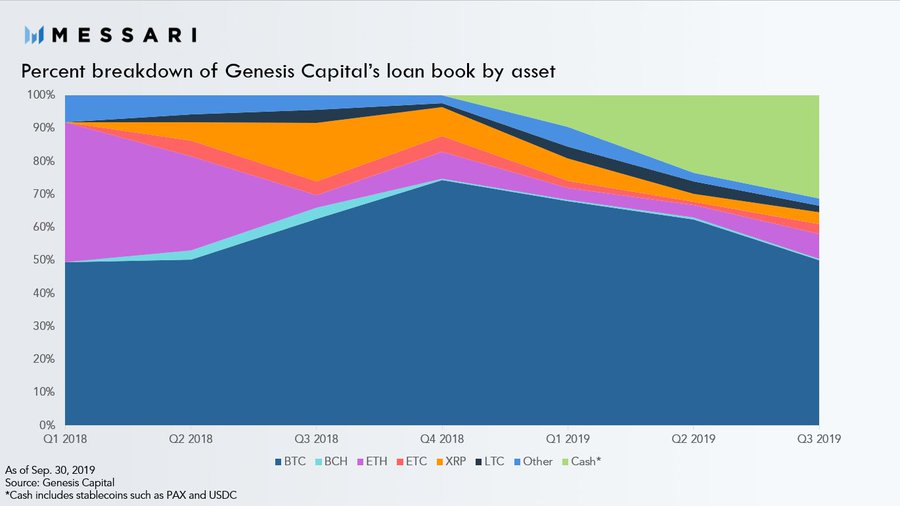
Despite the growth, lending is still an immature and underpenetrated market. We expect loan growth to continue its torrid trajectory higher, and predict we’ll see some spectacular lending desk blow-ups in the new year, as loan pricing gets more competitive and risk profiles rise.
3 Major Data / Research Upgrades. When we started Messari, CoinDesk and CoinMarketCap were basically the only data and information businesses with any degree of quality. Today, the Block, Decrypt, Delphi Digital, and a plethora of fund and exchange research groups offer a 10x improvement in the coverage and analytical rigor they bring to the market. Companies like CoinMetrics, Flipside Crypto and Kaiko (all Messari partners) provide exceptional and much more reliable metrics and data on the markets, blockchains, and off-chain trends affecting each protocol and its token. Still, there’s a lot of wood to chop if we want to get a handle on anything that could be understood as “fundamentals” for a new asset class.
Case in point, I checked the 24 hour trading volume on OKEx according to five different top data providers, and got this as the result:
- $523mm on CoinMarketCap
- $67mm on the "Blockchain Transparency Institute”
- $826mm on Nomics
- $2.5billion on FTX's volume monitor (includes derivatives volumes)
- $328mm per CryptoCompare
This is data for one of the largest crypto exchanges in the world. It’s no wonder the SEC doesn’t trust spot price data or have comfort with the internal compliance standards at even some of the most liquid global exchanges. Some of us, of course, will continue to drive data standards forward in the new decade, but the exchanges and projects have to meet us halfway with disclosures and some actual internal structure.
4 Governance Tools: How do teams that start centralized decentralize over time? How can projects launch and attract missionaries vs. mercenaries, now that it’s clear the magic of bitcoin and ethereum’s “fair” launches are not repeatable? How might we identify the sustainable models that attract long-term players, or govern the foundations and tech councils that push commits to protocols while minimizing the risk of self-dealing? How much governance should be enforced in code vs. legal entity levels, and how are the rules to the game updated over time?
There are a limited, but growing number of precedents for what constitute best (and worst) practices in crypto governance: in Ethereum, Tezos, Zcash, MakerDAO, and many smaller projects who are learning on the fly. One of the biggest gaps in crypto infrastructure right now is in what could loosely be defined as “governance services” as we rethink how to organize markets. Staking services might be closest to the pulse regarding what tools are needed to govern protocols effectively, and it’s on my 2020 roadmap to firm up political history for ideas.
5 Exchanges as Open Finance have nearly all the money and power within crypto because they pool liquidity. However, since it is such a ruthlessly competitive business and switching costs are relatively low, the pace of new product and service development is torrid by necessity. When users can move their assets fluidly across dozens of global exchanges, they expect their exchange to have A-grade security and service, seamless UX, and competitive fees as table stakes. But they also want margin trading, lending options, staking services, tax reporting tools, and whatever else becomes en vogue in the coming years, and they want it now.
I’d encourage you to take the time to read up on this mammoth report on exchange history from Nomics, and the Multicoin thesis on Exchanges as Open Finance, where Kyle Samani asks, “What if the exchanges haven’t peaked, but instead are only in the beginning stages of their ascent?” It’s a good question: exchanges can buy centralized services that become attractive, fork interesting lower-liquidity projects and bring their own liquidity pool to the same protocols, and offer their users a piece of the action via exchange tokens. Their power won’t subside anytime soon. It will increase.
6 Exchange Hacks Will Also Increase. It was another eventful year on the exchange hack front, with seven global crypto exchanges experiencing hacks that collectively cost them over $150 million in digital currency holdings. Binance, UpBit, and Bitthumb were among the victims in the top 20 global exchanges by volume (although it’s noteworthy that they covered all losses for their users). The targets will only get bigger in the years ahead as these teams swell in size (exposing them to greater risk of social engineering attacks), and exchanges roll out more of the services described above. AUM honeypots will grow, so attack frequency and sophistication will level up in lockstep. One nuclear-level threat for crypto will be the exploitation of a cold storage vulnerability on par with what we saw at Mt.Gox in 2014. If a similar scale attack happened to Coinbase, Binance, or a bigger institutional entrant like Fidelity, we can probably just sell our stakes and join another industry for a few years while the radioactive matter decays.
7 The Crypto Cowboy Survives. Last year, Eric, our head of research, predicted a large, offshore exchange would face serious legal action from a U.S. regulator (regardless of the exchange’s U.S. user access restrictions). “It will set up an epic legal showdown, as $10 billion companies usually don’t roll over without a fight.” And oh lawdy, what a year it was for exchange giant Bitfinex.
The Hong Kong-based exchange lost access to $850 million following the New York Attorney General’s office arrest of two men accused of laundering money through a shadowy payment processor called Crypto Capital that Bitfinex had leveraged for banking services. The AG then sued Bitfinex parent iFinex after alleging the company “engaged in a cover-up to hide the apparent loss of $850 million of co-mingled client and corporate funds” by borrowing from Tether, its affiliated stablecoin operator, to cover for the shortfall. Bitfinex disputed the AG’s claims, raised a $1 billion in a token sale in May to replenish the “temporary” shortfall, and then won a stay in the case against the AG’s office that limited the amount of information they were required to share with investigators in the Crypto Capital case. The drama is ongoing.
The company is still aiming to “unfreeze” the Crypto Capital assets they believe are being held primarily by European authorities, while still fighting off what they claim are overreaching inquiries from the NYAG.
There’s so much to unpack here as you think about the state of exchanges in 2020 and beyond.
- Early crypto exchanges aren’t necessarily “shady” or running afoul of KYC or AML laws, but their payment intermediaries might be! It all stems from the painful reality that crypto banking is still alarmingly scarce (and regulators make life impossible for exchanges).
- Tether appears to have been fully reserved before the Crypto Capital scandal, contrary to earlier speculation to the contrary. Circle Trade’s former head OTC trader, Dan Matuszewski claimed on a recent podcast (an absolute must-listen by the way) that he “knew for a fact” that billions of dollars were sent to create USDT because he himself initiated at least that much in new transactions amidst the market euphoria of 2017.
- Despite all the drama, Bitfinex remains one of the top three most liquid crypto exchanges worldwide. The outstanding supply of Tether has doubled since the beginning of the year. Professional crypto traders apparently embrace the exchange’s anti-fragility and Wild West approach to building the business. At least, for now. Although it is difficult to imagine a scenario where this persists as institutional traders begin to enter the market.
- If you make enough money, and don’t do things that are flagrantly illegal, you can hire the army of lawyers necessary to keep you in business. Cowboys.
For an excellent skeptic’s take on the drama at Bitfinex and Tether and what it says about the state of the crypto economy, you should read this vicious synopsis of the two entities’ histories.
8 Coinbase vs. Binance There is no better illustration of the struggle for crypto supremacy than the ongoing competition between Coinbase and Binance. Coinbase remains in pole position to build the West’s dominant crypto company and has redoubled efforts to attract crypto retail users with a variety of new “Open Finance” tools. Coinbase will probably take a big chunk of the institutional market as well, given its unique position as the custodian of the world’s largest fund, Grayscale’s Bitcoin Investment Trust, and its recent acquisition of Xapo’s custody business. The acquisition of New York-based institutional prime broker Tagomi was denied, but it makes a ton of sense; I hope it pans out in 2020.
Keep in mind, Coinbase has maintained this lead despite a tumultuous year that led to remarkable (and very public) turnover of the senior leadership, including CTO, COO, Head of Institutions, VP of Engineering, and three other engineering directors. The resilience is astounding and speaks to the depth of Coinbase’s ranks, as well as its competitive moat. Coinbase is still synonymous with “place to buy crypto” for millions of western consumers, the company has a Top 5 warchest to tap for M&A, and the company’s engagement with regulators puts it head and shoulders ahead of its counterparts from a compliance and “trust” standpoint. Circle is no longer a competitor as it heads towards a winddown or sale (perhaps to Coinbase?), Kraken does not offer nearly the same breadth of services, and new institutional entrants at Fidelity and Bakkt cater to different customers at (predictably) a much slower clip.
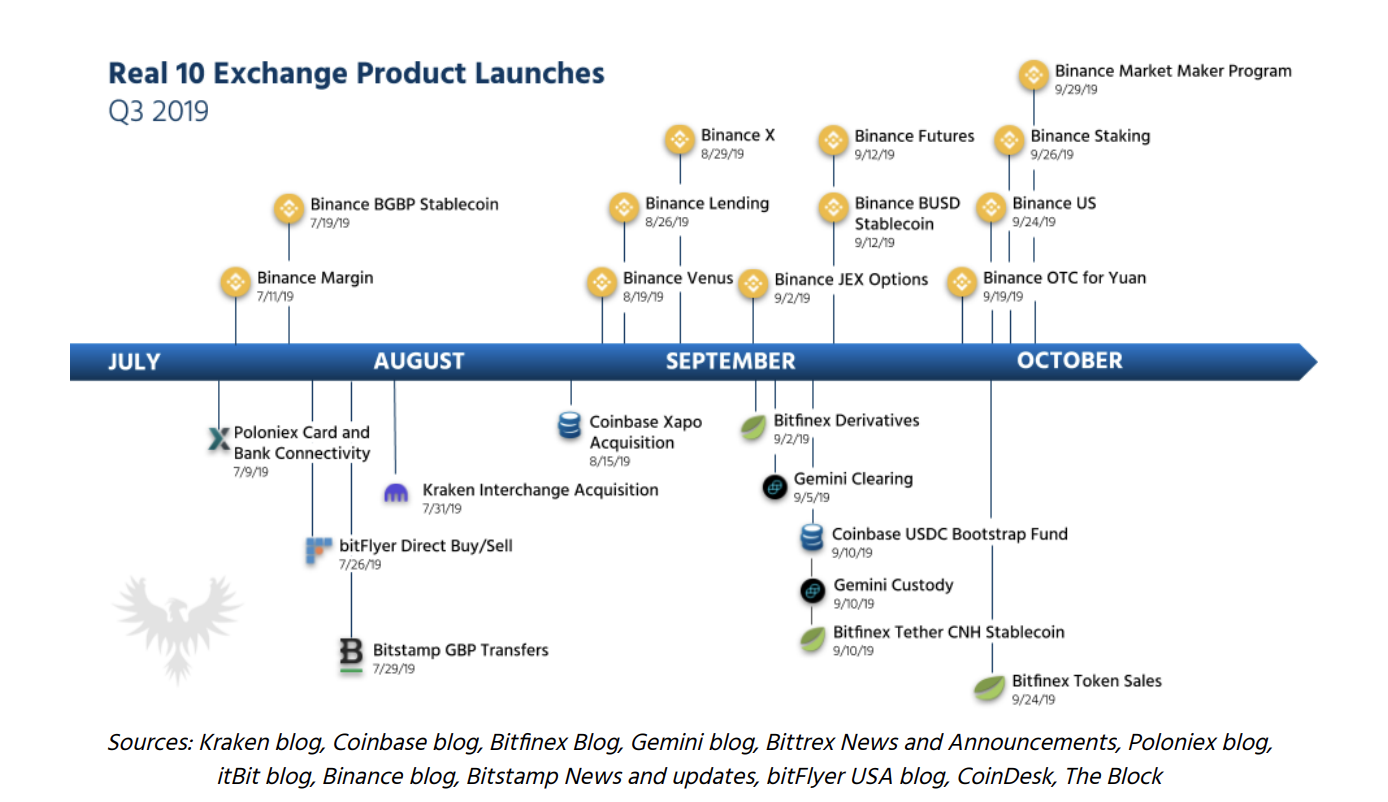
Coinbase’s only real threat is geo-political, something with which its top competitor can certainly empathize. The pace of growth at Binance is legendary. It has been one of the fastest growing companies - in any market - of all time, hitting a billion dollars in revenue within its first 18 months.* And the company shows no signs of slowing down. What makes Binance work?
The company is a master of regulatory arbitrage, and of abiding by the spirit of existing laws (protect users from fraud and manipulation), without getting caught up on the letter of the law or waiting for the explicit blessing of any individual regulator. That’s something Binance can afford to do with their globally distributed team and infrastructure, while still taking a country by country approach to legitimizing its fiat on-ramps. One concern has been whether this aggressive push would result in regulatory actions. Though they gated themselves from U.S. customers (temporarily) and had a controversial visit from the authorities (police? regulators?) in Beijing, they remain the dominant non-Chinese exchange by volumes - by a mile. They also spun out their decentralized exchange, launched lending, margin, staking, and a stablecoin initiative, and watched their token catapult to the top five assets by market cap at one point (currently #10). Oh, and they’ve recently begun to pick up their M&A activity.
As Multicoin has quipped, Binance continues to blitzscale.
*Technically, EOS creator Block.One is the fastest growing company in history, as its one year $4 billion crowdsale was likely treated as revenue. But that’s fodder for another time.
9 All other Liquidity Sources We could do a whole other report on crypto’s broader market micro-structure (and likely will next year), but suffice it to say Bitfinex, Coinbase and Binance might not even be the largest or most important exchanges in the market today. So much crypto trading and liquidity takes place at the mega-OTC desks (where the majority of original order flow originates today), on “unregulated” futures markets like BitMEX (which is arguably THE source of price discovery in crypto today), and behind the great firewall at mega-exchanges Huobi and OKEx. That also doesn’t even include the largest Japanese and Korean exchanges which may be nearly as large as Coinbase Pro. I’ve gotten more comfortable with Bitfinex over the years. But BitMEX still scares the shit out of me, and seems like a ticking time bomb from a regulatory standpoint. Fortunately, running the world’s largest crypto casino means you can also afford great lawyers.
10 Security tokens Outside of exchange tokens, which are quasi-securities, and synthetic instruments, which we’ll cover in our DeFi section, security tokens are so irrelevant right now that I nearly forgot to include them in this report (let that sink in!). Arjun had the thesis right in his post last year, when he wrote one of his standing rules was that “No investment vehicle should promise greater liquidity than is afforded by its underlying assets.” I agree, and this is especially true with assets that come with more regulatory restrictions than anything else that currently trades on crypto’s infrastructure.
Here are the most interesting things that happened in the securities token market this year: Harbor scrapped its $20 million dorm token sale, and the company’s CTO departed. SeedInvest may be the only business Circle can’t find a way to sell. tZero claimed it would raise $400 million then $100 million, then nothing? I thought maybe they raised a couple million after all that drama, but I don’t care enough to look it up because the only thing I remember about the company is that Overstock CEO (and tZero booster) Patrick Byrne seemed to have used it to screw over his company’s short sellers for a hot minute before resigning, fire-selling his shares, and moving to South America after “exposing the deep state.” (Matt Levine’s posts on this subject were pure art.)
Security tokens seem to be one of those solutions without a known problem, and are quickly taking the place of the “blockchain not bitcoin” as the most over-hyped and nonsensical meme in the market. If anything, companies seem sooner to decentralize their business models with token-powered networks than to tokenize (and destroy liquidity for) their equity and debt. Full scale crypto lending and derivatives markets need to materialize before security tokens get interesting in 5-10 years, so maybe we’ll include them more prominently in our 2030 report.

Prior to founding Messari, Ryan was an entrepreneur-in-residence at ConsenSys, and on the founding teams of Digital Currency Group, where he managed the firm’s seed investing activity, and CoinDesk, where he led the company’s restructuring & annual Consensus conferences. He has been an investor & prolific writer in the crypto industry since 2013.