InfinityPools: New Leverage Mechanics

Key Insights
- Typical leveraged protocols are constrained by unguaranteed liquidation mechanics and oracle dependencies which limit both the markets available and the leverage offerings.
- InfinityPools released a new design that guarantees the liquidation mechanics upfront thereby relaxing the major design constraints of leveraged protocols.
- The result of the design is a leverage protocol that can offer unlimited leverage for any asset provided the liquidity is available all without external dependencies on oracles.
DeFi primitives are basic building blocks such as simple token swaps (DEXs) or loans (money markets) that may provide the foundation for more complex protocols. Given both the simplicity and foundational impact, new primitives appear relatively rarely. However a new primitive, InfinityPools, recently released details of a new leveraged swap protocol that natively executes all facets of leveraged trades without outside, off-chain dependencies on liquidators, counterparties, or oracles like other leverage products.
The InfinityPools protocol builds upon Uniswap V3’s concentrated liquidity automated market making (AMM) primitive. At a high-level, the protocol works by having DEX liquidity providers (LPs) deposit their LP tokens to the protocol, which are subsequently aggregated and borrowed by traders seeking leverage. The leverage (loan) is created by unwinding a portion of the underlying LP assets to purchase more of the trader’s leveraged asset.
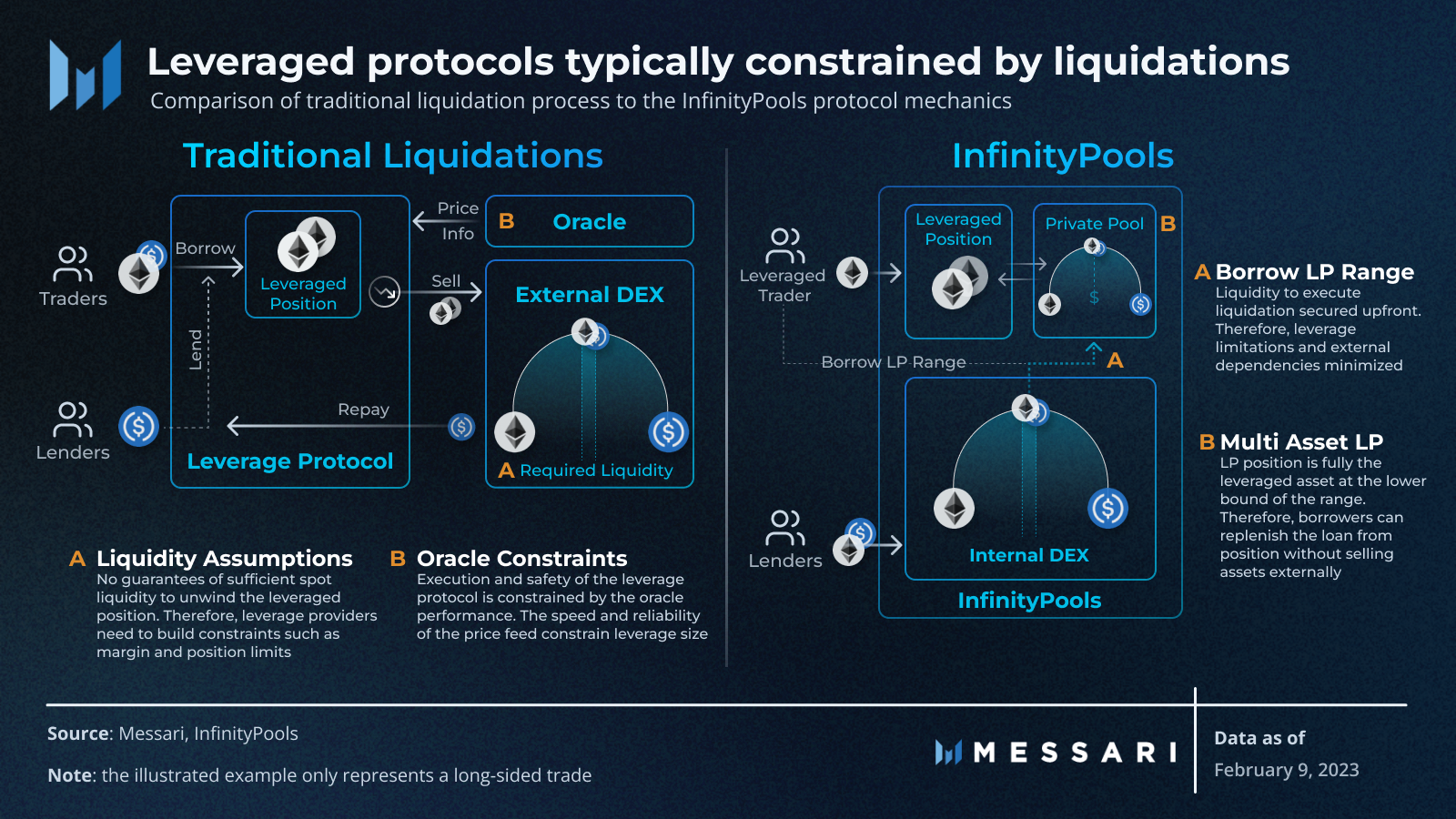
Using LP tokens as the loan source has a subtle but monumental impact on the way liquidations are handled. Normally, leveraged positions are created by borrowing assets such as cash (USDC) from another party. Therefore, the loan is expected to be paid back in those same assets borrowed. This creates an issue when the trade goes south and the position needs to be liquidated since the leveraged assets must be sold for the exact amount of USDC borrowed or else the protocol incurs bad debt. To ensure there is liquidity to safely liquidate, protocols must set guardrails such as margin and leverage limits, which curtail the scalability and user experience.
By using LP positions as the loan source, the payback of the loan can be in either of the LP assets removing the traditional cash constraint. For example, if a trader is leveraged long on ETH and the price moves against the position, the underlying LP position makeup would shift to be entirely ETH, which the trader would pay back from their position. As a result, levered assets don’t need to be sold on the market to pay back the loan. Therefore, the liquidity needed to perform the liquidation is initially baked into the loan source itself (the LP position). This results in a few advantages:
- Unlimited Leverage – with upfront secured liquidation liquidity, leverage levels can scale nearly infinitely (constrained by DEX tick size in practice).
- Unlimited Assets – any asset can be safely leveraged since the protocol uses existing DEXs. This makes the protocol entirely permissionless.
- No Oracles – since prices are implicit to the borrowed LP positions and with the underlying AMM usage, there is no dependence on external oracles (which are an attack vector and thus a limitation for adding long-tail assets to other leveraged products).
- No Liquidations – without the cash loan dependency, there is no need for traditional liquidations where leveraged assets are sold on the market (leveraged assets are paid back in kind).
- Scalability – without liquidation bot or oracle dependencies, the protocol can stand entirely by itself (with the exception of underlying DEXs), which allows it to scale into any asset market, only limited by the spot liquidity available (like all other markets).
While these are significant advantages over other on-chain leverage protocols, there are some nuances to the design that affect the protocol’s scalability and attractiveness for LPs.
How InfinityPools Works
InfinityPools, launching on testnet in Q1 2023, is a protocol for constructing leveraged positions. The leveraged products created can be options-like or perpetual futures-like. There are three main parties involved in the process; LPs, traders, and the protocol itself.
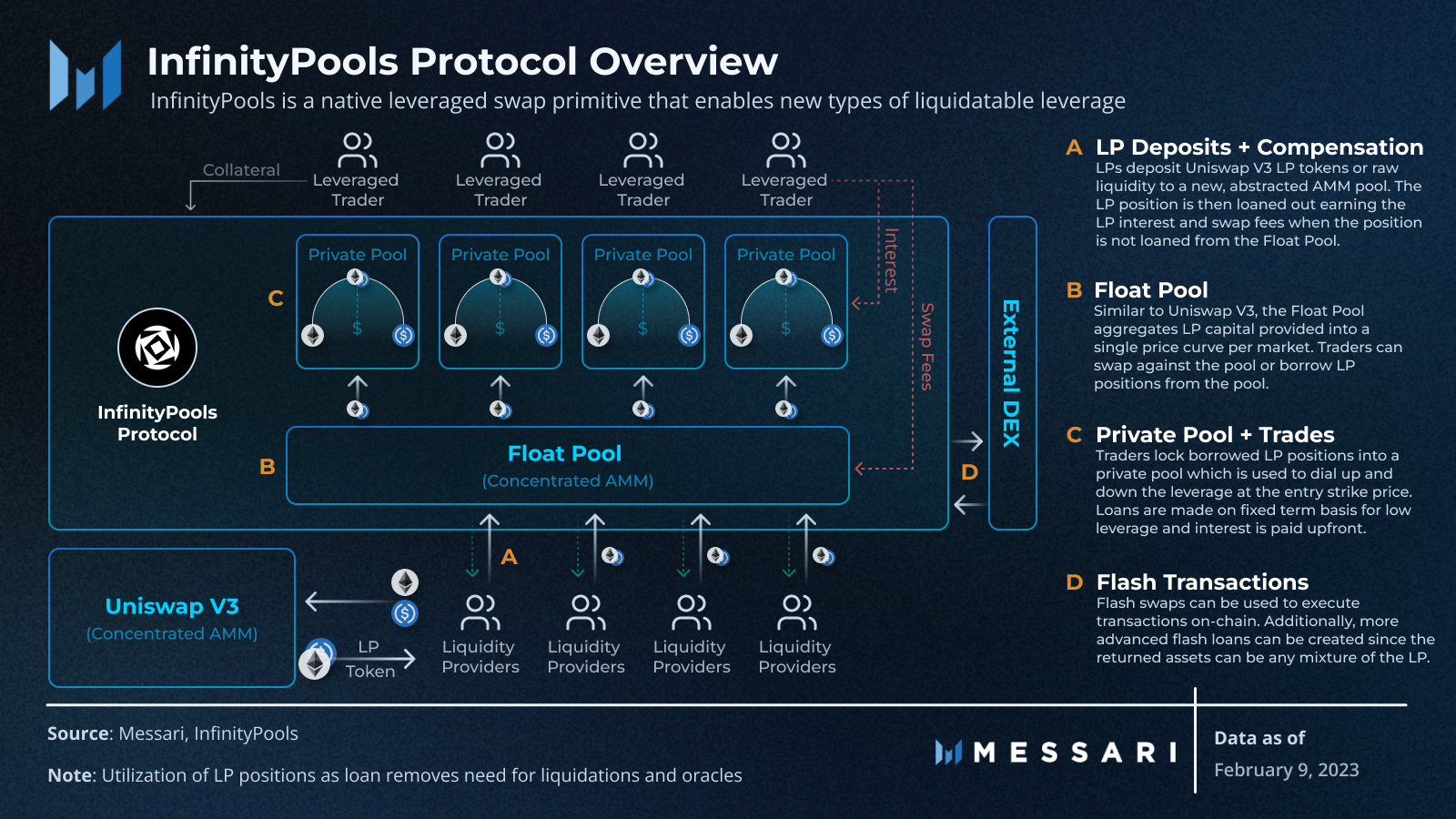
- LPs – First, LPs provide raw capital to Uniswap V3 around their price range of choice. Then, the LP token is deposited into the InfinityPools protocol where it is aggregated and made available to traders. Additionally, LPs can directly supply raw capital to InfinityPools.
- InfinityPools Protocol – The protocol combines LP assets into a new concentrated liquidity AMM pool called the Float Pool (similar to Uniswap V3 with some small differences). Assets in the pool are made available for both spot swaps and leveraged loans. Leveraged traders can take out one of two types of loans from the Float Pool; a fixed-term loan for leverage less than ~40x and variable loan for greater leverage. The protocol rolls loans together as long as the position is open to creating a perpetual-like product.
- Traders – Initially, traders deposit collateral to back their loans. When traders take out an LP loan, they lock the LP assets into a new “private pool” called a Swapper that has a set price the trader can perform unlimited fee-less swaps on effectively dialing up or down the leverage at a particular entry price. The closer the selected strike price is to the current price, the more leverage is available to the trader at the expense of tighter loss windows. To compensate for the LP loan, traders pay a continual interest rate depending on how much of the available LP capital they have borrowed at a particular price point (similar to utilization on Aave). The interest on fix-term loans is paid upfront by the borrower, which more closely resembles an option premium versus the funding rates used in traditional perpetual products.
Collateral
Since the LP position has a defined range of asset mixes, the collateral required is known upfront. For example, assuming a $1,000 ETH price and $1,000 worth of liquidity placed tightly at $900 ETH on the AMM, the LP position can range from 1.11 ETH or fully USDC as $1,000. Therefore, if a trader is wanting to go 2x long on an existing 1 ETH, they would need to post an additional 0.11 ETH or roughly $100 USDC as collateral in order to ensure the LP position will always be made whole.
The amount of collateral required (and the leverage) is thus determined by the strike price at which the trader borrows the LP capital at and of course the amount borrowed.
Loan Maturity and Payment
In addition to collateral requirements, the trader must also have funds to pay interest on the loans. The fixed-term loans are paid upfront, but if the trader wishes to keep the position open and have the loan continually roll forward, they must continually replenish capital. If they don’t, the position will be wound down automatically.
To the trader’s benefit, a maximum interest rate can be set where the protocol will unwind the loan and forgo rolling the loan forward if the interest rate exceeds some maximum tolerance set by the trader. Additionally, when the interest rate falls back below the tolerance rate, the protocol will wind the position back up.
Taking Profit and Executing Trades
Closing a trade is done on an external DEX such as Uniswap or Sushiswap via flash transactions where the swap and the re-deposit back to InfinityPools occurs in the same step. Traders, at any point during the trader’s loan duration, are able to swap on an external DEX and take profit. By swapping on the external DEX, the trader will incur slippage and swap fees on the notional amount.
Fees
The loan fee structure of the protocol changes the payoff function for LPs. Normally, LPs would only earn yield if their liquidity is in range and earn fees from swaps. With the InfinityPools loan model, LPs are able to both earn swap fees while capital is in range on the Float Pool as well as when the capital is loaned to traders. Additionally, this means LPs are able to hold only their preferred asset by providing liquidity out of range and still earn yield from interest payments.
This changes the LP position to more closely resemble underwriting options strategies such as a covered call. The LP collects the premium from the trader (loan interest), and in return, the LP’s position upside is limited to the upper end of their liquidity range.
Challenges
While the InfinityPools system is largely closed, with no risk vectors from oracles or liquidations, there are core challenges facing the protocol such as the capital requirements and competitively controlling fees.
Since the liquidity to execute liquidations and leverage is acquired upfront, the protocol requires more capital than competing perpetual protocols that take on more liquidation risk. This affects how fast the InfinityPools protocol can scale, since acquiring more liquidity from the system is both more costly and takes longer. Additionally, the LP capital will have to be partially managed to move assets to different ranges on the price curve for every market.
Additionally, traders will be faced with higher fees on InfinityPools’ leveraged products since the trades are closed on an external DEX, which can have nearly 10x or more per swap fees than perpetual DEXs. For example, Uniswap fees range from 0.1%-0.3%, while dYdX fees start at 0.05% and scale down based on notional volume traded. With significantly higher execution costs, attracting traders will be challenging for top markets already supported by existing perpetual DEXs and centralized exchanges (CEXs).
Implications
With the future launch of InfinityPools, the major implications will be the ability to create leveraged markets for long-tail assets and the subsequent liquidity and fees driven back down to the underlying DEX (Uniswap).
Current perpetual DEXs, such as dYdX and GMX, are only able to offer markets for a handful of assets due to the liquidation risk constraints and market makers required (dYdX). For example, dYdX has 37 markets that are nearly all top-end assets from a liquidity standpoint. More constrained, GMX only offers 4 tradable markets. With InfinityPools, perpetual-like markets can be opened permissionlessly, which means InfinityPools will have near-exclusive offerings of many assets that have never had a leveraged market before on-chain.
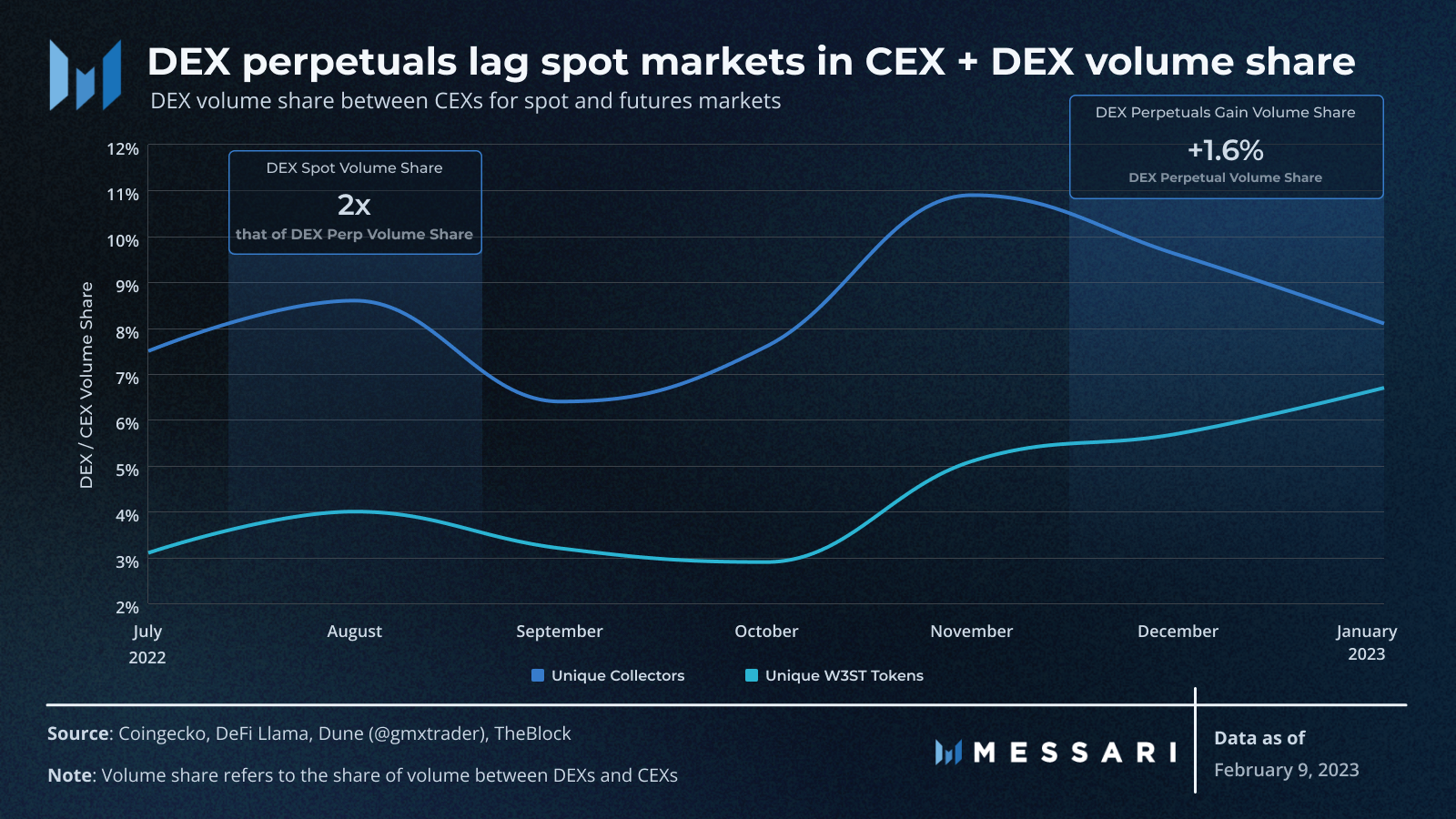
Since InfinityPools will be executing these trades on underlying DEXs, the expected volume and fees for major DEXs should be a major benefactor. The notional volume of decentralized perpetuals was over 4x as much as the on-chain spot DEX volume in January 2023. Furthermore, while spot DEX volumes are roughly 10% of CEX spot markets, decentralized perpetual protocols have done roughly 4% of the CEX perpetual volumes historically until the recent uptick following the FTX collapse. Therefore, the decentralized perpetual market has significant room for growth – particularly for long-tail assets – which should all end up accruing value to the base spot DEXs given InfinityPools’ design.
In addition to the major impacts mentioned, InfinityPools’ design will likely take market share from on-chain options protocols. The LP payoff curve in InfinityPools closely resembles that of writing options (the overwhelmingly popular use of option protocols) with additional flexibility and ways capital can earn yield. For long-tail assets in particular, InfinityPools’ design gives holders of any asset a way to earn yield by underwriting leverage, which sets a new paradigm for on-chain asset potential.
-----

Dustin was previously the Enterprise research director at Messari. He has a broad focus across crypto with a particular interest in AI x Crypto, Consumer financialization, DeFi, and general infrastructure.