Incentivizing testnet participation

A look into how projects use test networks (testnets) for more than testing experimental technology. We cover projects like Cosmos ($ATOM) and Polkadot ($DOT), among others, that offer rewards for tesnet participation to help bootstrap a community of developers.
This post was originally published on October 07, 2019, and sent to Messari Pro subscribers.

Preparing for the mainnet release of a crypto protocol may be a major technical milestone, but the larger challenge facing new market entrants is whether their projects can ultimately win enough miner/validator and developer mindshare to spark network growth in its launch stages. Testnet rewards events present opportunities for teams to bootstrap critical early engagement.
The testnet rewards framework originated with Ethereum’s Olympic testnet. Olympic was the final Ethereum ($ETH) proof-of-concept released prior to mainnet launch. Its stated purpose was to reward participants for testing the limits of the Ethereum design by “spamming the network with transactions and doing crazy things with the state.” Only then could the Ethereum core team understand how the network would actually hold up under high levels of load.
The Ethereum Foundation offered a pool of 25,000 ETH for the top miner and developer participants in the Olympic testnet launch, with smaller amounts allocated to general participants. Broad testnet engagement unearthed critical bugs and simple optimizations in the live system that the core team was able to identify and resolve pre-mainnet. At the same time, it helped a community of early participants become network stakeholders (and tinkerers) immediately. The Olympic testnet provided several design precedents for other teams looking to incorporate testnet reward programs in their pre-launch strategies.
The stakes are higher than ever today, as the “smart contract wars” start to heat up.
After years of private development, the first in a slew of high-profile, venture-backed Ethereum competitors launched last month with Hedera's Hashgraph coming live. Several other launches are anticipated this quarter, including Telegram’s $TON, and Web 3 Foundation’s Polkadot ($DOT).
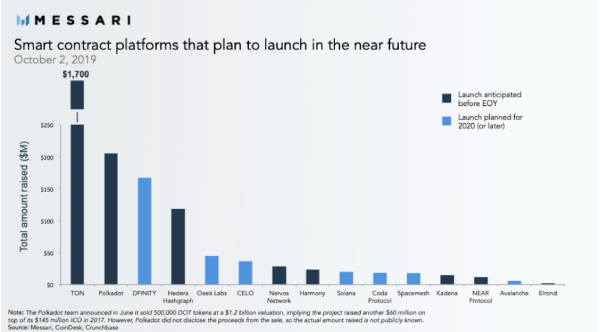
Newer smart contract platforms will need to provide adequate incentives to attract community interest amidst a crowded field of new entrants--not to mention steal developer mindshare away from Ethereum. They must go beyond developing potential technical advancements in-state processing and storage, as the best technologies do not always win in a field dominated by network effects. The “If you build it, they will come” strategy may be foolish when competitors are optimizing their early community’s financial incentives.
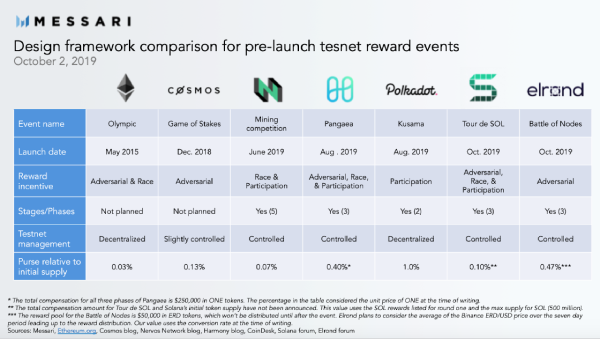
We believe testnet reward programs offer the best option to spark engagement within a project’s early community. We studied six soon-to-launch blockchain projects in order to identify themes in the experiments that have been run to date. Each has coordinated testnet events that financially rewarded miners/validators and developers for their pre-mainnet engagement.
Testnet programs benefit platform development teams in four ways: (1) increasing developer exposure (i.e. marketing to those who will ultimately need to build on the system); (2) stress testing the network in a more practical environment; (3) incentivizing participant buy-in as the project transitions to mainnet; and (4) widening the breadth of the initial token distribution.
Here are the major design characteristics featured in some of the recent testnet reward programs.

Wilson Withiam was a Senior Research Analyst at Messari. Previously, he worked at Circle Research where he conducted research on cryptoassets. He graduated with a B.Sc. in Kinesiology and Exercise Science before studying computer science and economics at UConn.