How to Nail the Messari Hub Application

TL;DR Messari Hub is building an army of contract analysts from all walks of crypto life. To apply, aspiring analysts have to provide a short writing sample. This post provides insight into what we are screening for and how to get started if you don’t already have some samples lying around. We also touch upon crypto research as a field.
We wrote about Messari Hub and hosted a webinar for interested prospective analysts a few weeks ago. There were a lot of questions about what we are looking for in the short writing assignment that is the application. This post is aiming to shed some light on that. In particular:
- What are we screening for?
- What is crypto research anyway?
- How to get started with your piece
I will start with a brief re-introduction to Messari Hub.
What is Messari Hub?
Messari Hub provides contributing analysts the opportunity to write crypto research through a community-driven marketplace that connects qualified analysts to crypto organizations looking to fund independent crypto research. Messari is one of these organizations. We pay analysts bounties to write research reports for our Pro offering and to research assets to create our freely accessible asset profiles.
Why Hub?
As crypto adoption grows, so does the demand for trusted research that helps drive informed decision making and investment by ecosystem participants. However, an army of analysts is needed to cover every corner of the industry. The Hub enables the production of high-quality independent research at scale.
What are we screening for?
We ask applying analysts to send us a short writing sample.
“Samples should focus on a crypto project, theme, or sector you are particularly excited about. Ideal candidates showcase their understanding of crypto, writing skills, and ability to provide new, data-driven, actionable insights.“
Let’s break this down.
Short
Long enough for us to assess your crypto knowledge and writing skills but less is more. Around 750 to 2,000 words. Google Doc can count the words for you. 750 words is about 3 pages.
Knowledge of crypto
We expect you to have some knowledge of crypto but understand that there are different levels of knowledge and that people come from different angles (finance, tech, academics, business).
Ways to reflect your crypto knowledge in your writing sample would be things like explaining the working of the protocol you are writing about, the token, it's tokeneconomics, the project’s roadmap, and/or, risk and opportunities that you see. Furthermore, you could discuss the positioning of the protocol against competitors or dig into sector data that you downloaded.
Also, the ability to describe these things succinctly and simply will be a good reflection of your understanding.
Writing skills
Structuring writing is an undervalued skill. I love this (slightly modified) matrix by James Valentine. It basically says that in order to get your message across you not only need to have good content but also deliver it in a well-constructed message.
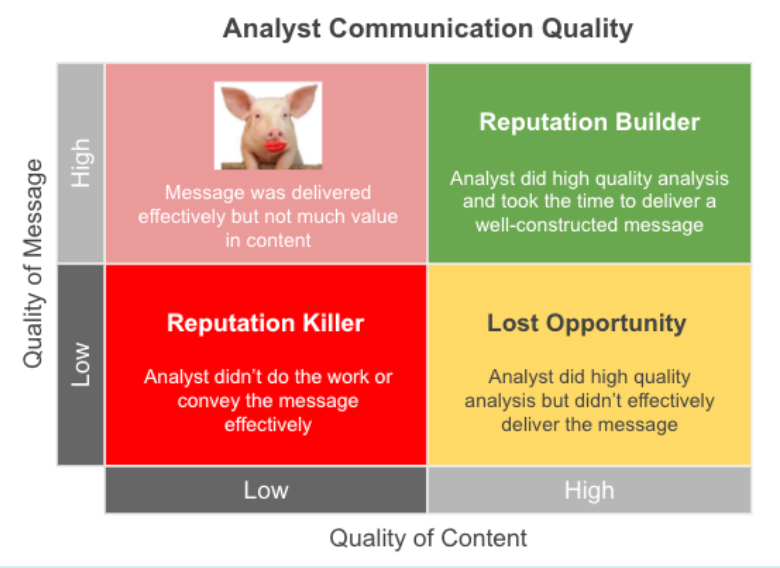
Key elements we are looking for in your writing are:
- Clear structure / narrative: is your writing well organized, does it have a natural flow?
- Clarity and simplicity: is your writing clear, in plain English, and easy to understand?
Structure refers to the order in which sections, paragraphs, and sentences appear. If writing is unclear, it is often because the ordering of the ideas conflicts with the capability of the reader’s mind to process them. The mind automatically imposes order on everything around it. The reader is going to look for a structure connecting the ideas as they are presented to him/her.
Important things to keep in mind:
- How to highlight the structure (e.g. (sub)headings, numbering, etc.)
- Does the structure showcase your thinking process?
- Does it tell a story (e.g. combining data with narrative) that is easy to follow?
I am a big fan of Barbara Minto’s pyramid principle. This is certainly not the only way to think about structure but is illustrative of what it could look like.
New, actionable insights
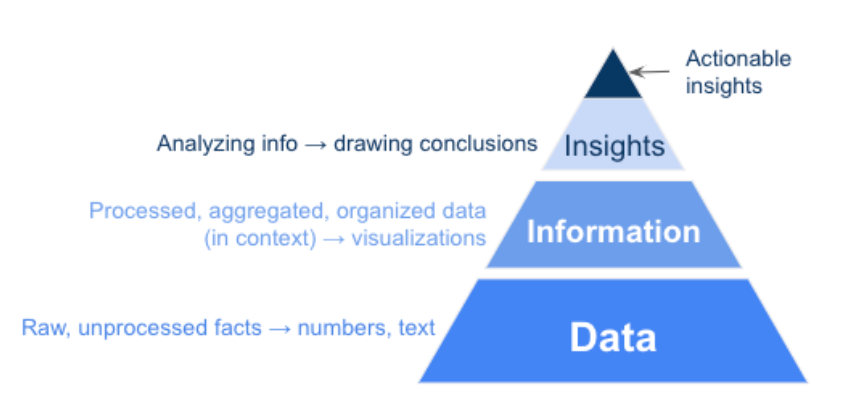
When I put together the Hub Analyst Manual I came across this article. I used and tweaked a couple of the points to get across what we mean by new, data-driven, and actionable insight.
It starts with (another) pyramid (see picture below). The pyramid says that generating actionable insights starts with raw data, which is then processed and organized into information, which can be analyzed to turn it into insights. These insights are made actionable through synthesis and contextualization that is of value to the consuming audience.
Example
Pull data from e.g. Dune Analytics about DEX trading volumes. Put it into a chart (information) and conclude that Uniswap V3 is the 2nd largest DEX on Ethereum. Make it actionable by putting it in the context of the promise of the recent upgrade (capital efficiency) and compare V3’s capital efficiency to that of competing protocols. Draw a conclusion.
I didn’t make this up, check out Ryan Watkins’ recent piece on Uniswap V3 through the link to example Messari research below.
Deconstructing “new, data-driven, actionable insights”
New insight. Help the reader walk away with new insight, a key takeaway, or a new framework for how to think about something. This is the “so what?” / “why you should care to read my piece” factor.
Data-driven
- The data leads the narrative
- The data is meaningful (not vanity metrics) and it is used to provide new insights
- Incorporates charts and other visualizations
Actionable (insights). The research has practical value for the reader. Just for reference, here are the six attributes of an actionable insight:
- Alignment: with key business goals, aka inform business and investment decisions
- Context: putting things in perspective
- Relevance
- Specificity: explain why something occurred
- Novelty: challenge or evolve current knowledge and beliefs
- Clarity: communicating insights effectively
Don’ts for the writing sample
- No tweet threads, it has to be an actual narrative, aka writing
- No thought pieces i.e. stick with fact-based, data-driven insights, and be detail-oriented, not strongly opinionated and idea-driven
What is crypto research anyway?
Crypto research is a nascent field where Messari has been one of the pioneers.
Research as an activity “involves the collection, organization, and analysis of information to increase understanding of a topic or issue.”
Traditional sell-side (equity) research is targeted at buy-side investors. It provides analysis of listed companies: the company’s business, the industry it operates in, the management team, its financial performance, risk factors, and the impact of key corporate actions and external events. This is all shared with investors through periodic reports that include a recommendation on whether investors should buy, hold, or sell the company’s shares. It typically also includes a 12-month target price for the asset.
Crypto research is different in that it is not meant to be investment advice and as such doesn’t give a recommendation or target price. This makes sense, as crypto is a nascent and very quickly evolving field with no existing standards for things like valuation models, and business and financial reporting. A lot of the data is also available to everyone. What crypto research is meant to do is inform decision making for participants in the ecosystem including investors, builders, service providers and business professionals.
In that regard, crypto analysts are very much so in the business of:
- Increasing transparency and understanding of specific protocols / networks / assets
- Derive insights from data and observations to further understanding of (sub-)sectors, themes, what works and why (tokeneconomics, governance, technology, etc.)
- Help the space evolve with their analyses: set standards for key sector metrics, develop frameworks for valuation and analysis, provide advice to the crypto community on the back of these insights
If that sounds exciting to you, that is because it is! It is a very important role too, and Messari Hub will provide you the opportunity to contribute to this ecosystem and develop your skills.
How to get started with your piece
You may have written something that fits the bill already. If so, great! You can apply here.
If not, here is some advice on how to get started.
Pick your crypto topic
Ideally something you are passionate, knowledgeable, or curious about. It could be an overview of a specific protocol, a theme/sector, or an analysis around some data that you pulled from Dune Analytics or elsewhere.
Messari research reports
If you don’t have a Pro subscription (a perk of being a Messari Hub analyst), look for (free) reports that are marked “analysis” for inspiration. I also saved a few other research reports for your benefit here. The Uniswap V3 article would be a good example of a data-driven piece if that is your aim.
Read up about your topic
Resources to learn about protocols:
- The project’s website will usually tell you where to find more info
- Pull up the asset page on Messari and study the asset’s profile. The page also has links to key project resources (at the top) and community channels. It is free
- GitHub for code (if you are a techie) and release notes
- GitBook for project documentation
- Project blog (Medium) and weekly/monthly updates
- The project’s Discord channel (community forum) usually has a good sub-channel with links to resources and is a great source of information in general. It is also a good place to get any questions you may have answered
- Third party research and news articles (some of it is behind a paywall) from providers like Messari, The Block, Delphi Digital, CoinDesk, Decrypt
- The project's social media channels on Twitter, Telegram, Reddit
Other resources:
- VC blogs: Paradigm, Multicoin Capital, Jake Brukhman (CoinFund), placeholder, Deribit Research, VeradiVerdict, Crypto Canon by a16z
- Other blogs: Our Network, Bankless, The Defiant
- The Daily Ape for project-specific news
- Messari’s quarterly sector overviews (just out for Q2 and free)
- Data and analytics: Jack Purdy’s Ultimate Guide to Crypto Data Tools
- 101s: Token Design
- Vetting crypto projects: The Defiant’s Framework for Vetting Crypto Projects Part 1, Part 2, Part 3; The crypto investment process by Jason Choi of Spartan Group; Building Conviction In Magical Founders and Projects by Delphi Digital.
- How to get get into the weeds on crypto
- Storytelling is a superpower
Write your outline
Make sure you have:
- An introduction: what question are you looking to answer, what is your main topic?
- Main body: what are your key headings / sections telling the story and getting your message across
- Brief conclusion or wrap-up
For a specific asset, you could touch upon things like:
- Background: how did the project come about, why was it created
- Describe the project/protocol, how it works
- Explain the token, tokeneconomics, how it accrues value
- What does the roadmap look like
- Traction
Start writing
Start writing, edit, repeat, until you are happy with it. Then ask your friend to read it to see if it reads well, makes sense, and give some feedback. Make your final edits and send it off to us!
Have fun and keep it simple!
You are doing research on a topic that you are passionate about. You get to write about it with the aim to become part of an awesome community that will help you become a full time analyst (potentially a freelance nomad!), get a job in crypto, increase your visibility in the ecosystem, or whatever your goal is. And you will learn some new skills along the way.
Ready to apply?
I hope that gave you some guidance and inspiration. Please use this form to apply. Good luck and looking forward to seeing your application!
