The information contained in this report and by Blockworks Inc. and related affiliates is for general informational purposes only and is not intended to provide legal, financial, or investment advice. The report should not be construed as an offer or solicitation to buy or sell any security, token, or financial instrument and does not represent any recommendation or endorsement of any investment or financial product or service. Blockworks Inc. and related affiliates are not registered as a securities broker-dealer or an investment adviser in any jurisdiction or country.
Layer-1Layer-2
How to Launch a Chain

Key Takeaways
- New chains do not need to begin with the applications that eventually justify them. Robinhood set out to bring traditional assets onchain, but memecoins created the users and liquidity that allowed tokenized equity supply to cross $150M in less than three months.
- Distribution matters more than simply being accessible. Wallet integrations provide rented distribution, while exchanges such as Robinhood, Coinbase and Binance can directly list, promote or integrate applications for millions of existing customers.
- The strongest ecosystems tend to have a main character. Figures such as Vlad, CZ and Ansem can direct attention towards builders, give emerging projects legitimacy and shape the culture forming around a chain.
- Early wealth creation is one of the most effective ways to bootstrap activity. Airdrops, discounted presales and breakout tokens create winners who reinvest their profits across the ecosystem and attract the next wave of users.
- For investors, the best opportunities may appear while a chain still looks unserious. The combination of distribution, culture and early winners can signal that something larger is forming before its long-term use case becomes obvious.
Introduction
When Apple opened its App Store in July 2008, it launched with roughly 500 applications. Some of them promised to turn the iPhone into a platform for work, finance and communication. Others simply made the screen look like a glass of beer, turned the phone into a lightsaber or even just played fart noises.
If you think about it, the unserious applications were some of the first to take off on the App Store. For instance, iFart reached number one on the App Store and generated around $9,200 for its developer in a single day. At its peak, iBeer reportedly brought in between $10,000 and $20,000 per day.

These apps were hardly the future of the mobile phone as we see it today, but they gave users a reason to experiment with their new phones and showed developers how quickly money could be made. The App Store recorded 10M downloads in its first three days. Within a month, users had downloaded 60M apps and spent around $30M.
These unserious applications eventually gave way to banking, transport, healthcare and other use cases that have become embedded in our daily life. New blockchains should follow the same path.
Robinhood Chain launched with the promise of bringing equities and other RWAs onchain. Yet its early success did not begin with tokenized stocks. It came from memecoins, launchpads and a wave of speculation that went on to spur innovation and onboard tokenized equities in scale.
Robinhood provides a useful case study for what it now takes to bootstrap a chain. To understand why it worked, we will keep returning to stories from the early App Store, which faced a surprisingly similar challenge. Both case studies show how distribution, culture and early wealth creation can bring users in long before the platform fulfils its larger ambition.
Every Serious Goal Needs an Unserious Beginning
Obviously Robinhood did not build a chain so people could trade MONITOR against PLTR. Their goal was to bring equities and other RWAs onchain, let them be tradable 24/7 and eventually make them composable across different DeFi use cases such as lending, options etc.
Users on the other hand leaned into speculation as they naturally tend to do. Daily network REV reached $8.3M at its peak, with daily DEX volumes hitting the highs of $3.7B out of which 20% came from memecoins.

Around 60% of the chain’s fees have come from memecoin-related activity across launchpads, DEXs and trading terminals, with that share reaching 78% at the peak. The token pairs with the most volume on DEXs continue to be memes paired against stocks. The poster child for these pairs is Artificial Inu which is paired against Nvidia and briefly touched a MC of $380M at its peak.

Most would look at this and conclude that Robinhood has become another memecoin chain. However, this speculation has brought the chain closer to its original goal. Less than three months after launch, tokenized equity supply on Robinhood has crossed $150M and is spread across more than 1.2M wallets.

The chain also accounted for between 23% and 44% of weekly tokenized equity transfer volume during this period.

The most interesting piece of data is that 70% of tokenized equity trades and volume actually occurred outside regular US market hours.

The increase in liquidity as a result has also attracted developers to build unique applications on top of it. For example, Longbow is developing a credit layer for lending and borrowing tokenized stocks, while Stonkbroker is building options markets through AMMs. These use cases are much closer to Robinhood’s original vision than the memecoins that first brought users onto the chain.
This tells us that memes did not distract Robinhood from tokenization. Instead, they brought in users, created liquidity and gave developers a reason to build around the assets already trading onchain. The unserious beginning helped establish the market needed to pursue the serious goal.
However, memes alone cannot explain Robinhood’s success. Almost every new chain has tried this playbook from Kraken’s Ink to Circle’s Arc. Yet few have seen the same traction Robinhood has. The difference comes down to distribution.
Distribution Gets Users Through the Door
Distribution is all about getting a product in the hands of the end user in the least number of steps. In crypto, however, users continue to have to navigate wallets, bridges, and somehow acquire gas before they can make their first trade. Distribution aims to reduce that friction. For a new chain, the most important question is how the chain can give its native applications and tokens better access to users and liquidity than other chains.
But not all distribution is the same and the distinction between rented and owned distribution matters.
Arc launched on day one with integrations across Fomo, Phantom, MetaMask, Rabby and other wallets. Users could access the chain through an interface they already understood and this helped to attract activity initially. But retaining that activity and liquidity was difficult as most of that distribution was rented. Those same wallets support many other networks and it becomes so easy for the end user to move that liquidity from one chain to the next.
Dapps face the same problem. While being on Phantom or MetaMask improves access, it does not give an Arc project for example an advantage over the many other applications available on those wallets.
Owned distribution works differently because the platform controls the path between the product and the end user. Exchanges such as Robinhood, Coinbase and Binance can list ecosystem tokens, surface dapps inside their wallets or integrate them directly into their main products. This allows users to access these tokens and projects in an exchange interface they are already familiar with and have all the blockchain elements abstracted away.
Going back to our App Store example. Angry Birds launched in December 2009 but it struggled to gain traction in the largest English speaking markets. All that changed when they approached Apple. In February 2010, Apple featured Angry Birds as Game of the Week on the front page of the UK App Store.

The game jumped from around 600th to first. The developers had spent years building the game and promoting it, but a single placement inside Apple’s owned distribution channel changed its trajectory. Apple had the ability to decide which application millions of users would see when they opened the store and that is a classic example of what a distribution edge looks like.
Robinhood demonstrated the same advantage with CASHCAT. Within weeks of Robinhood Chain going live, the memecoin was listed on Robinhood’s main trading platform and rose close to 78% around the announcement. The listing showed every developer and token launcher on Robinhood Chain that success could lead to placement in front of Robinhood’s 27.6M funded customers.
Coinbase is another great example of using your owned distribution to your advantage. Coinbase has focused heavily on integrating protocols into its existing products. Morpho powers its crypto backed lending product, allowing customers to borrow USDC through Coinbase without interacting directly with Morpho or Base. Close to 55% of Morpho’s deposits on Base now come from Coinbase user deposits.

Tokenized equities are extending this model. Coinbase recently launched tokenized equities on Base with Aerodrome providing the primary onchain liquidity underneath. Aerodrome has since become the dominant venue for tokenized equity trading on Base.
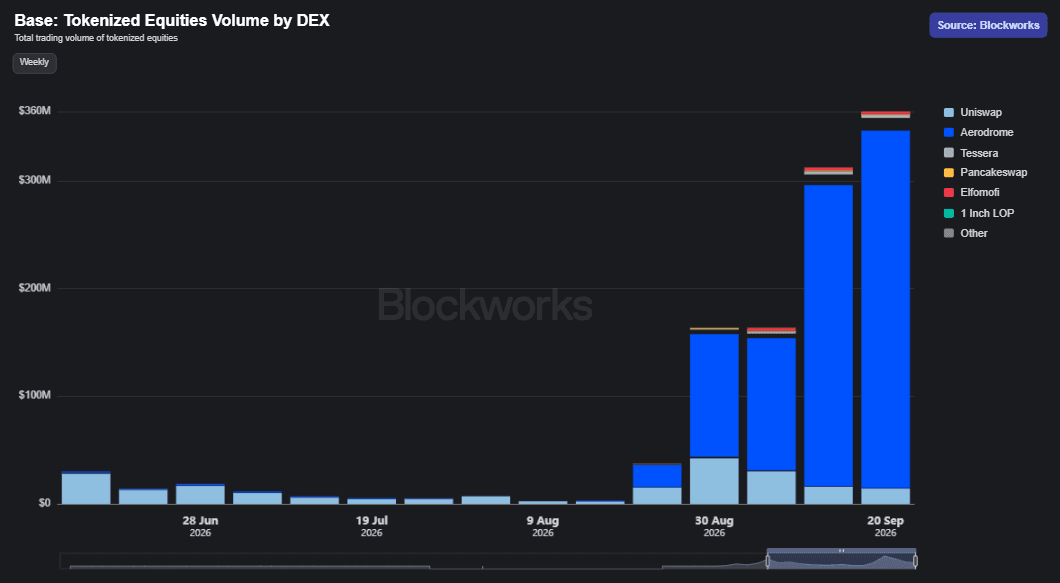
New chains need to do more than make their chains accessible. They need to figure out their competitive edge that gives their applications the shortest path to the user and removes the blockchain complexity along the way.
Rented distribution can fill a chain temporarily but owned distribution gives it repeated opportunities to bring users back. Even that does not fully explain Robinhood’s success, however. Exchanges like Kraken and Bybit also control large distribution channels, yet their chains have not generated the same recent speculative energy. The difference is that the most successful chains often have a visible personality at the centre of them.
Every Chain Needs a Main Character
Distribution gets applications in front of users, but someone still needs to tell them where to look. I noticed that every successful chain seems to have a “main character.” Someone willing to champion its builders and create the sense that something is always happening on the chain.
If it is still unclear what I mean, think of CZ for BNB Chain, Vlad for Robinhood, Ansem for Solana, Jeff for Hyperliquid or more simply, Elon Musk for Tesla and SpaceX. These people command their own sphere of influence both online and in person. A follow, reply or mention from them can feel like an endorsement, even when it technically is not. That attention can be enough to move a token, create its first winners and attract more users, traders and capital. For builders, the opportunity to have their work championed by one of the ecosystem’s largest voices is a distribution advantage that is difficult to replicate elsewhere.
The main character does not necessarily need to be the CEO or founder. They just need to have that aura. I know that “aura” is hardly a scientific metric, but most people on CT know it when they see it.
Steve Jobs was perhaps the clearest example of what a charismatic founder could do for an ecosystem. His keynotes speeches were like cultural events, with audiences waiting to see not only what Apple had built, but what Jobs believed would matter next. For many then, Apple would equate to Steve Jobs. His attention carried so much weight because he had become part of the product itself.

He knew this and would use this charm of his to champion developers and pull them into Apple’s story. At its 2008 developer conference, Apple gave roughly a third of the keynote to teams building applications such as Super Monkey Ball and eBay. These developers got Steve Jobs’ stage, his audience and some of his magic. This would send a clear message to people watching that if you build something interesting enough for the iPhone, Apple will make sure the world sees it.
Crypto founders now play a similar role. Vlad is one of the clearest examples. Watch any of Robinhood’s major product announcements and you will understand why. They are closer to theatre than earnings presentations and it is easy to see why Vlad’s personality has resonated with a younger generation of retail investors.

Robinhood Chain was built around tokenized RWAs, but all it took was one post from Vlad saying that it “works great for memes too” for the tone around the chain to change. Transactions began surging right after that tweet on July 8 and the rest is history as we know it.

Vlad did not stop there. He followed MEADGod, the founder of Pons, and defended Robinhood’s tokenized AMC market when it attracted criticism after being paired with a memecoin. None of these actions were formal endorsements, but they showed builders that Robinhood’s founder and CEO was watching, understood the culture forming around the chain and was willing to champion what was being built.
Next up is CZ, who still commands a cult-like following among eastern users and across BNB Chain. CZ tends to be more direct. His publicly associated wallet swapped 1 BNB for MUBARAK and another 1 BNB for TST on PancakeSwap in March 2025. Both tokens were later listed on Binance spot and crossed $100M in MC. The number of tokens launched on BNB surged as a result and we got a wave of meme season driving volumes and activity on BNB.

He followed a similar playbook with Aster. CZ had already posted about the perpetual exchange several times before revealing in November 2025 that he had bought its token with his own money.

His shadow endorsement was one of the big reasons why Aster managed to grab a large chunk of market share from the leader Hyperliquid.

But does the chain’s talisman always need to be its founder or former CEO? Not necessarily. Ansem’s recent campaign on Solana is a good example, and what makes it more interesting is that Solana does not have an exchange behind it to manufacture distribution.
Ansem took it upon himself to revive the Solana trenches. He posted repeatedly about why PUMP had bottomed, publicly bought the token near its lows and continued calling for a recovery in SOL. He continued putting his reputation behind the ecosystem especially when sentiment was weak.
He then embraced the community-created ANSEM token, helping it rise several multiples, and used some of the tokens and creator fees he received to reward members of his community. He took things further by building an ANSEM launchpad on top of Pumpfun, where projects could burn ANSEM in exchange for promotion by Ansem and his team. While the initial metrics tapered off after about a week, the concept holds promise. Ansem is a great example of how an influential community figure could champion an ecosystem and create distribution without controlling an exchange.

But attention is still only one of the ingredients. The real flywheel only begins when people start to participate in the upside of the chain.
First, Give Users a Piece of the Pie
The easiest way to get people excited about anything is to show how much money they could make from it. On a chain, early users who win big tend to spread their gains into other tokens and applications, which in turn attracts more users and gives builders a reason to launch there. These users also tend to display a higher level of loyalty to the chain and application that made them money. People always remember the hand that feeds them.
The early App Store followed a similar pattern. Two months after launch, solo developer Steve Demeter had already made $250,000 from a simple puzzle game called Trism. His success inspired Ethan Nicholas to build his own iPhone game after work. A few months later, his application iShoot was earning $37,000 a day. Nicholas quit his job, while stories of ordinary developers striking it rich helped turn the App Store into a gold rush.
For a chain, the most direct way to create this moment is through an airdrop. Hyperliquid distributed 31% of HYPE to roughly 94,000 early users, with no allocation to private investors. Many of them became Hyperliquid’s loudest supporters because the platform had changed their lives.
Apart from the chain, the airdrop from applications on the chain can also have a huge impact. Jito and Jupiter launched their tokens within two months of each other between December 2023 and January 2024. Those airdrops put hundreds of millions of dollars into the hands of people already active on Solana just as the ecosystem was recovering from its post-FTX lows.
A lot of that money remained onchain and moved into memecoins, NFTs and other Solana applications, while the success of Jito and Jupiter encouraged users to hunt for the next airdrop. The TGEs did not single-handedly take SOL from around $20 to $180, but they helped restore something the ecosystem had been missing: the belief that using Solana could make you money.

Presales can create the same effect if early participants receive a sufficiently good deal. Plasma sold 10% of XPL through its deposit campaign at a $500M valuation. By launch, the token was trading at a $9B valuation, handing presale participants a large paper gain.
To make things even better, eligible pre-deposit participants received a bonus of 7,500 XPL, worth close to $10,000 at its peak, even if they had deposited just $1. People loved the gesture, and the instant wealth it created helped explain the early run-up in both network activity and XPL’s price despite its hefty launch valuation.

Plasma did not have the owned distribution of an exchange, but this stimulus was enough to get people exploring the chain. A memecoin wave followed, with tokens such as Trillions briefly reaching a $50M MC. The excitement eventually faded for several reasons, but the early response showed how quickly newly created wealth can bootstrap activity.
Robinhood produced the same effect more organically. PONS ran from below $20M to around $800M, while AI climbed from under $2M to roughly $350M. Those moves in a timespan of a month created a visible group of winners whose wallets could be tracked through Fomo as they rotated profits into other memes and ecosystem projects.
After PONS broke through its previous high on August 24, launchpad volumes began rising and Pons and Long gained market share across Robinhood. The chain only needed a few early winners large enough to convince everyone else that they might be next.

Closing Thoughts
Every platform wants to be remembered for what it eventually became. Apple is remembered for changing how we work, communicate and move through the world. It is easier to forget that the App Store first won attention with games and simple apps.
Chains are no different. The first wave does not need to fulfil the grand vision. It needs to bring people in, let early users and developers share in the upside and leave enough capital and activity behind for the next wave to build upon. Robinhood’s memecoin boom may eventually fade, but it has already created the market from which more serious applications can grow.
For investors, the next great chain will probably look unserious before it looks obvious. Before the App Store produced Uber, it produced iBeer. The gap between the two is where the opportunity lies.
Let us know what you loved about the report, what may be missing, or share any other feedback by filling out this short form. All responses are subject to our Privacy Policy and Terms of Service.

Mentioned Assets