How DBS Bank Can Catalyze an STO Revolution

Security Token Offerings (STOs) have been the “next big thing” since the inception of ICO’s in 2017. Might a perfect blend of traditional financial instruments, regulatory clarity, and support from one of Asia’s most prominent banks catalyze a change?
DBS, the largest bank in Southeast Asia, accidentally announced their Digital Exchange, STO, and Custody suite of services in a post last month. With a market capitalization of $47 billion and a presence in six countries including China and India, it is the first major bank in the world with investment, corporate and retail banking to directly offer digital assets to its customers.
STOs will be able to attract institutional adoption where ICOs did not. ICOs provided an avenue for utility, governance, and membership, while STOs conform to government regulations and tokenize securities on an underlying asset, such as equities, bonds, special purpose vehicles, or real estate. For the purposes of this discussion on the potential of STOs, we’ll look at Southeast Asia with a population of 650 million people, however, the case is relevant for both developing and emerging markets worldwide.
Market Size
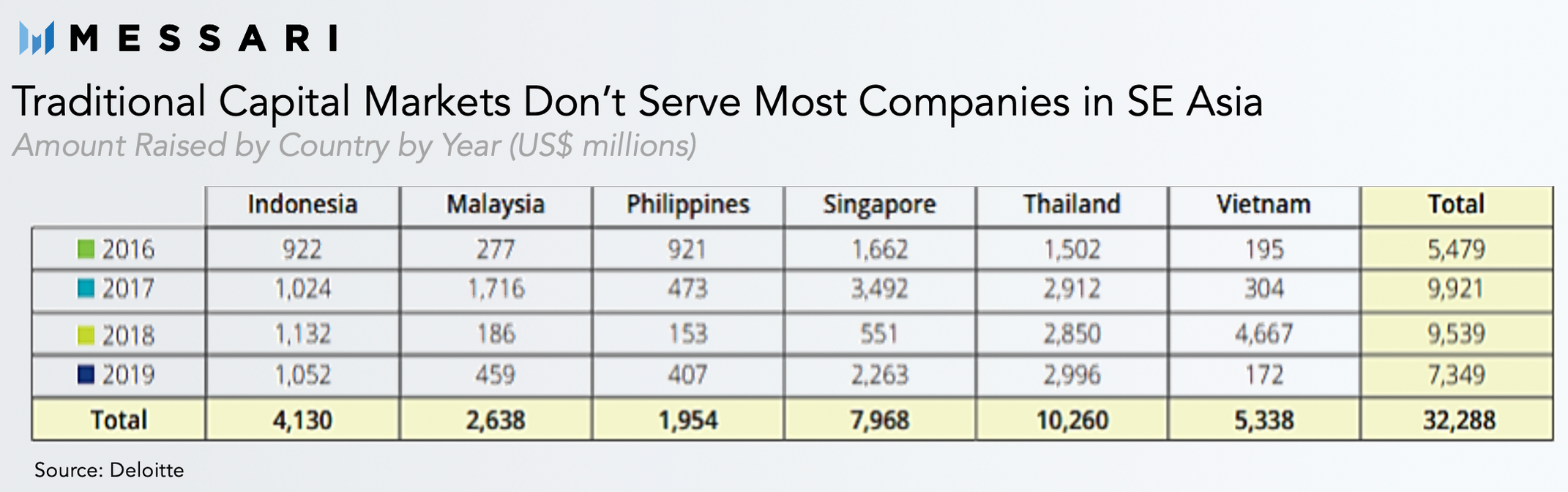
The market share of private funding is outpacing public equity. Globally, pools of private equity, private debt, as well as unlisted real estate and hedge fund assets,grew +44% in the five years ending 2019. Indonesia, with a population of 270 million people saw only $1 billion in IPO fundraising per year (see table below). However, this is not due to a lack of capital required, but an inability to tap traditional capital markets and to match investors with available investment opportunities. Occasionally, we see the true funding requirements in Asia, when the window of capital markets open. In equity markets, Malaysia (2017) and Vietnam (2018) saw equity fundraising increase 6x and 14x compared to the year prior respectively.
Below we see that the amount of funds raised through IPOs, which can be volatile depending on the year.

Mira was a Senior Research Analyst at Messari. Prior to joining Messari, Mira was a Senior Portfolio Manager for a US$6 billion Asia Pacific equities fund at APG Asset Management. Mira received a BA in Economics and Mathematical Methods in the Social Sciences from Northwestern University.