How crypto could fit in your portfolio

When talking (pitching) Bitcoin to the uninitiated I try to avoid any talk about price and focus on the “why.” It helps people see the big picture and understand the brilliance behind it. Often times this involves delving into the origins of money, what makes for a good store of value, and the unique properties of bitcoin compared to other forms of money. However, at a certain point, you have to go beyond ideology and prove why it makes for a good investment. This type of thinking is becoming increasingly important as sophisticated investors start to consider allocating capital to cryptoassets. To make the case for bitcoin these investors need to see how bitcoin can provide positive returns for an overall portfolio. Even better, you want to show that an asset can provide positive risk-adjusted returns. Basically, if you are putting money into something highly volatile, like bitcoin ($BTC), is the return high enough to compensate for the added risk? Or would you be better off with a lower return but less volatile investment like real estate.
For this, you need cold hard data and one of the most commonly used measures is the Sharpe Ratio. To illustrate how various assets stack up on this measure we examined risk and return metrics for a hypothetical investment in major asset classes from Jan. 1, 2014, a period that gives us multiple market cycles for bitcoin. Note that our chart shows a five-year window to remove visual outliers.
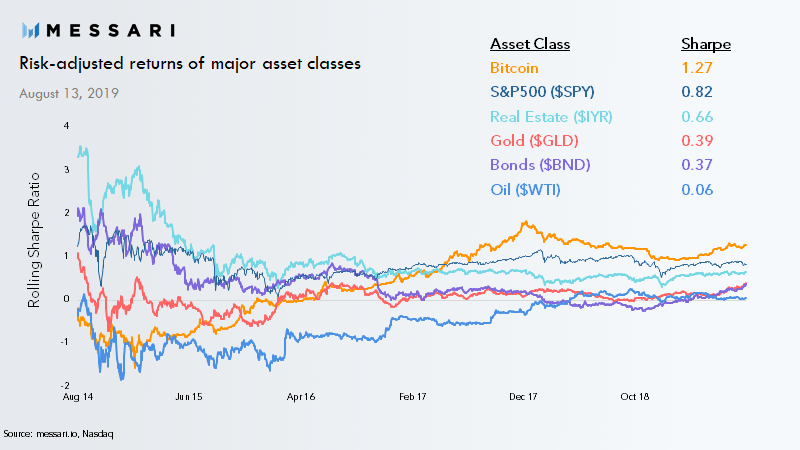
Comparing bitcoin to these asset classes, as represented by ETFs, we see that bitcoin had a superior Sharpe Ratio during the observed period, proving that investors were well rewarded for the extra volatility they endured. But looking at single assets doesn’t tell the whole story. Sophisticated investors are generally asset allocators, and in order to further reduce portfolio risk, they create diversified portfolios. A common reference portfolio is an allocation to 60% stocks and 40% bonds. Most managers will also rebalance these portfolios in order to maintain this ratio over a given period.
Taking our previous analysis a step further we modeled the impact of adding a 10% allocation to a standard 60/40 portfolio taking into account the impact of rebalancing.
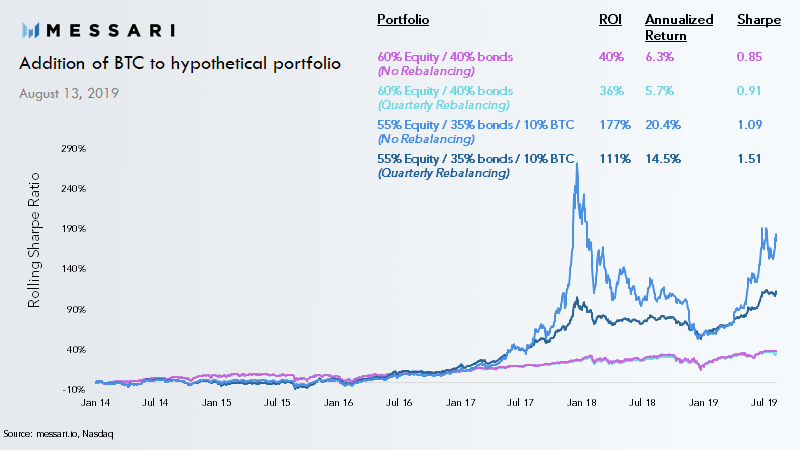
The 10% allocation to bitcoin made a substantial difference to both the annualized and risk-adjusted return. It’s interesting to note that the quarterly rebalancing decreased the total return on investment, but measurably improved the Sharpe ratio. This intuitively makes sense because without rebalancing the portfolio can quickly become overweight bitcoin during a run-up. Not rebalancing heightens returns but it also opens an investor up to more risk as we see during bear markets. Starting at 10% bitcoin without rebalancing would result in a 55% allocation today, and 69% at the peak. This analysis demonstrates the benefits of making a small allocation to bitcoin.
