How CLARITY Reshapes Crypto Regulation

Overview
The Clarity Act defines which Federal regulator oversees each part of the US digital asset market, with a primary focus on delineating the roles of the SEC and the CFTC. As it pertains to tokens, the SEC oversees the initial sale and early life of a token (referred to as an ancillary asset). The CFTC takes over when an ancillary asset becomes a “network token,” the decentralized version. This requires a certificate from the SEC showing that the asset has met its criteria. There is also an equally strong focus on protecting against illicit finance. It expands the Bank Secrecy Act, imposes operational friction on Digital Asset Kiosks, and mandates public-private threat intelligence sharing.
Defining the Boundary Between Tokens and Securities
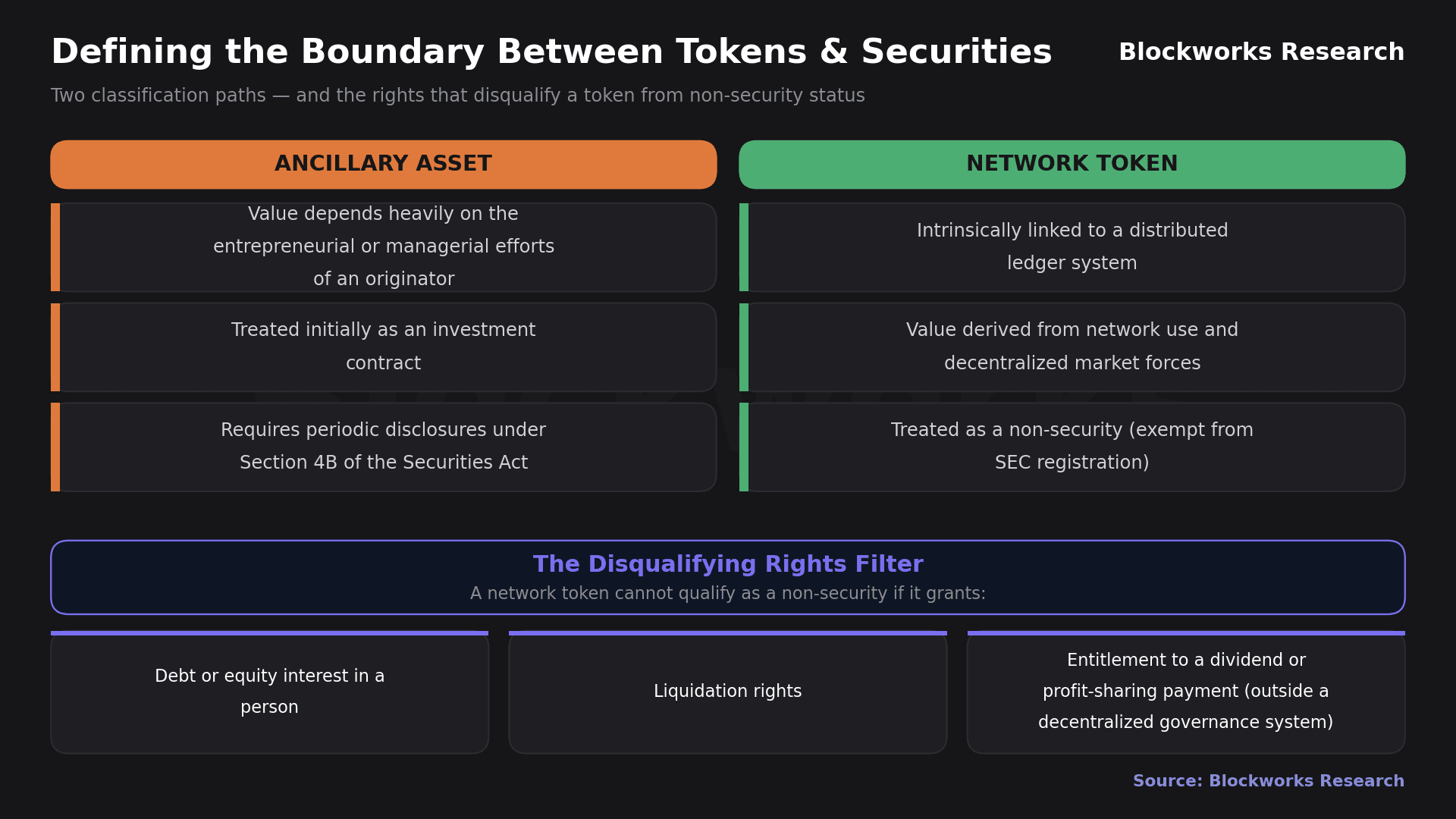
The distinction between ancillary assets and network tokens determines the regulator, disclosure requirements, and insider-selling limits (see Note 1). Ancillary assets derive their value from the managerial efforts of a project originator and are initially treated as investment contracts (under the Securities Act). Network tokens operate under fundamentally different mechanics. Their value is intrinsically linked to a distributed ledger system and emerges from decentralized network use and market forces rather than centralized management, placing them outside the SEC's securities framework altogether. However, the Disqualifying Rights Filter establishes clear limits on what constitutes a genuine network token, specifically, a token cannot claim non-security status if it grants holders debt or equity interest in a person, liquidation rights, or dividend and profit-sharing payments structured outside of a decentralized governance system.
Becoming a Network Token
A network token is treated as a digital commodity. The token must be intrinsically linked to a distributed ledger system, derive its value from the use of that system, and successfully pass the "decentralization test." To legally prove decentralization, when self-certifying, a project must satisfy two main sets of criteria:

Marc covers Ethereum, Bitcoin and their L2s. Previously led Ethereum and DeFi research at CoinShares.