How CasperLabs differentiates itself from the crowded Smart Contract Platform landscape

Messari: I’d like to thank Medha Parlikar, CTO at CasperLabs for joining us today. Welcome!
Medha Parlikar: Hello! Thank you for having me.
Messari: Medha, can you start by giving us a quick background on yourself and how you got into crypto?
Medha Parlikar: I fell into the rabbit hole in mid-2017, when I was invited to manage an open source blockchain project. I left that project to found CasperLabs in October of 2018. I have been an executive in SaaS companies for about 20 years on the technology side. Managing technical and cross-disciplinary teams in the Role of engineering leader, Program Manager or Product Manager
Personally, I love what crypto brings, because I believe that Crypto will bring opportunity and access to wealth creation to the middle class.
Messari: Yes, the proverbial crypto rabbit hole definitely resonates!
Medha Parlikar: Indeed. I have found my calling.
Messari: That's a great mission. Is that part of the reason why you founded CasperLabs? And can you give us a brief rundown on what CasperLabs is trying to accomplish?
Medha Parlikar: Absolutely. I founded the company to help bring the vision of Blockchain technology to the masses.
We are trying to accomplish a few things,
- We believe that the CBC Casper protocol - a protocol that is secured by economics, rather than in protocol constraints - will scale without sacrificing security or decentralization. We want to have the protocol see the light of day.
- We believe that there is an opportunity to create a delightful user experience for developers in the smart contracting layer, that blockchain technology comprises a piece of a larger application architecture - and a system that supports this needs to be built.
Messari: This is great — we have a number of questions pertaining to both goals. I'll start with the first one.
- How is CasperLabs different from other PoS blockchains in terms of Safety and Security? Are these a focus?
- What makes CasperLabs unique from a feature perspective compared to other solutions?
Medha Parlikar: CasperLabs is not joining the ‘TPS race’. Protocols that claim to have tens of thousands of transactions / second cannot possibly be accounting for security. We are building a protocol that will have security properties that will stand the test of time. To us, sacrificing the security that decentralization brings is not an option. Our researchers have spent thousands of hours investigating innovative ways that an attacker could hit our system, so we can ensure that such attacks are infeasible or very expensive to execute.
Compared to many others, the consensus protocol specifically will not sacrifice security and decentralization for performance. Our engine has many important features for smart contract developers that makes building real applications possible. Additionally, CasperLabs provides support for familiar tools and workflows, predictable pricing, upgradable infrastructure and more. You can learn more on our website here: https://casperlabs.io/
Messari: Agreed, security and speed exist on a spectrum. Going in one direction will lead to certain tradeoffs
Medha Parlikar: Correct, we believe that the primary value proposition of public networks is decentralization - and the security and trust it brings.
For specific features on the system here is a list (it's a long one!)
- CasperLabs uses wasm for contract execution, so developers can write their smart contracts in any language that compiles to web assembly. Presently we support Rust and Assembly Script. Developers do not have to learn a new language to work with CasperLabs.
- *Our Rust development kit for smart contracts includes a testing environment and contracts runtime that integrates into existing Rust toolchains, making the programming experience natural for developers.
- Our blockchain supports storing contracts at an immutable address or permissioned reference - which supports versioning and upgrading of contracts- helping developers make needed updates to their contracts.
- The consensus protocol provides flexible levels of finalization, and has a very low orphan rate - when transactions are submitted, there is a high degree of certainty that the transaction will be finalized quickly.
- Our account structure is flexible and powerful, enabling developers to support any kind of permissioning they need.
- Traditional blockchains use the ‘sender pays’ model, CasperLabs supports unlimited payment options through custom payment code execution for smart contracts. Developers can specify how transactions are paid for.
- GraphQL for state queries, makes it very easy to learn about the internal state of contracts.
Our developers are working to build a platform that they would love to use. Our Node also has telemetry and monitoring built into it, for Node Operators and Validators to monitor performance of the system. We also have weighted keys and thresholds, enabling unlimited multi-signature capabilities
Messari: What is it about CBC Casper that makes it different from say Tendermint or Ethereum's proposed PoS design?
- How does CasperLab's proof of stake design differ from that of Ethereum 2.0?
Medha Parlikar: Ethereum is using Casper-FFG, which is essentially an overlay on top of Proof of Work. Blocks will be added to the chain using Proof of Work, and Casper-FFG will use the safety properties of the Casper GHOST rule to finalize blocks and transactions. In other words, Ethereum is a hybrid approach that adds PoS-based finality to a PoW network, as an additional security feature and an intermediate step towards pure PoS.
CasperLabs invested in significant research to solve the liveness problem so we can eliminate Nakamoto Consensus (PoW) from our protocol. CBC Casper is pure and correct PoS-only. Our network will not include any Proof-of-Work mechanism. Honest validators that propose and finalize blocks in accordance with the protocol will receive rewards, and those that do not will be penalized.
The Highway Protocol that we designed, is more efficient than Tendermint, and is partially synchronous. What's more, Highway actually adjusts to network latency, and makes room for validators with different levels of performance to participate. We want our protocol to be as inclusive as possible, while maintaining a solid level of performance. The paper can be found here. And here is a less dense read.
Messari: The difference is fascinating. What is Casper's approach to slashing? Will it be a flat percentage?
Medha Parlikar: This is a great question. We haven't settled on the final algorithm for slashing, but in principle I see it as a flat percentage, where the percentage will increase over time as the network grows and becomes more solid and stable (and hopefully of higher market cap)- and eventually reach 100%
Messari: Understandable — I look forward to seeing what the final decision is. One more question on staking. Will token holders be able to delegate their stake to validators similar to other designs?
Medha Parlikar: Yes - they will be able to stake their tokens with a bonded validator of their choice. We are still working out some of the mechanics, but it should operate like a simple transaction.
Messari: Awesome! alright moving on, we have a couple of questions related to Casper's other primary goal
- What features make the casperlabs blockchain more developer friendly?
- What makes your platform more developer friendly than others?
Medha Parlikar: As mentioned, there’s an extensive feature set to ensure developers have a seamless experience with CasperLabs. Here are some big ones:
- Open access with wasm: CasperLabs uses wasm for contract execution, so developers can write their smart contracts in any language that compiles to web assembly. Presently we support Rust and Assembly Script. Developers do not have to learn a new language to work with CasperLabs.
- Support for CI/CD & Testing: Our Rust development kit for smart contracts includes a testing environment and contracts runtime that integrates into existing Rust toolchains, making the programming experience natural for developers. No need to run a node to build contracts.
- Upgradeable or Immutable Contracts: Our blockchain supports storing contracts at an immutable address or permissioned reference - which supports versioning and upgrading of contracts- helping developers make needed updates to their contracts.
- The consensus protocol provides flexible levels of finalization, and has a very low orphan rate - when transactions are submitted, there is a high degree of certainty that the transaction will be finalized quickly. A small transaction can be considered final immediately, a larger one - can take longer - it up to the user.
- Unlimited Multi-signature/Account recover and Delegation: Our account structure is flexible and powerful, enabling developers to support any kind of permissioning they need.
- Flexible payment code: Traditional blockchains use the ‘sender pays’ model, CasperLabs supports unlimited payment options through custom payment code execution for smart contracts. Developers can specify how transactions are paid for.
- Easy and on demand queries on state changes: GraphQL for state queries, makes it very easy to learn about the internal state of contracts and the blockchain.
You can check out some of the features here. Our block explorer has a graphQL interface in it. Here is the live interface.
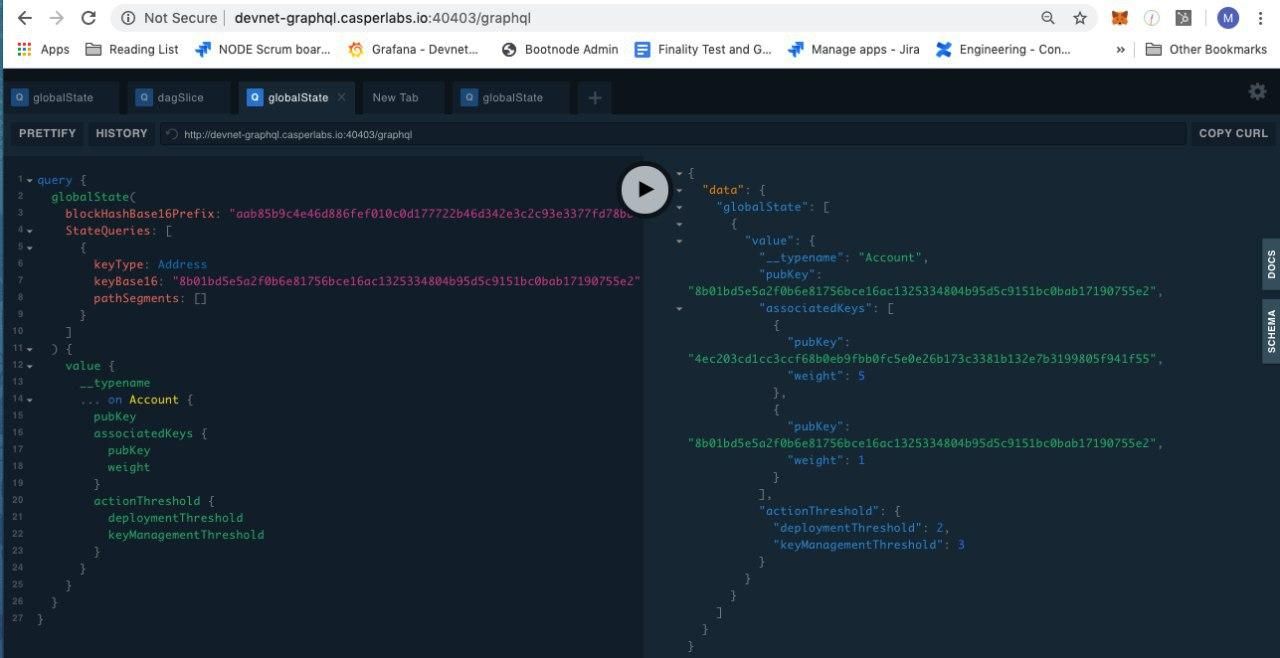
This is open- for anyone to use - we have our DevNet up and running.
Messari: This is very cool. Thanks for the extensive breakdown. You already answered the first part, but I'm curious to know if there's a consideration for more down the road
- What languages do you support/will support? How does this affect adoption?
Medha Parlikar: I'm excited to report that we just added support for AssemblyScript. It will become available as part of our release that ships this week. So Yes! As new compilation targets become available for wasm, we will create contract libraries for them. This is part of our ethos, we want blockchain technology to be accessible to everyone. Supporting multiple languages is part of that.
CasperLabs uses wasm for contract execution, so developers can write their smart contracts in any language that compiles to web assembly. You can find the full list of languages here. Presently we support Rust and Assembly Script. Developers do not have to learn a new language to work with CasperLabs. Our ethos is to ‘Scale opportunity for everyone’ - and this includes developers not familiar with blockchain. We believe by using a platform that supports multiple, existing languages is central to this.
Messari: Exciting! Yes, we've been keeping up with your releases. Development is chugging along. In relation to new releases, what does the upcoming roadmap look like for Casper?
- When will testnet launch?
Medha Parlikar: Our first testnet with ‘Honest Highway’ is planned for end of March, 2020. We anticipate that the full protocol will be ready by late Q2. We are targeting mainnet in 2020. During our testnet phase, we intend on focusing on protocol security and performance, and we plan on inviting Validators and security professionals to attack the network.
Messari: Yes, love the adversarial approach. will this include an incentivized testnet event?
Medha Parlikar: Yes - absolutely. We will have an incentivized TestNet starting with the March milestone.
Messari: Looking forward to it. Alright we have a couple of questions on some contributors to the projects:
- Is Vlad Zamfir still part of the project?
- Could you tell us about Dr. Daniel Kane and his involvement in the project?
Medha Parlikar: Vlad participated in the research efforts as part of completing the Highway Protocol paper. It can be found here. Now that the research is complete, the team is fully focused on implementing the protocol in code.
Dr. Kane is a significant contributor in Consensus research. He is the primary author of the consensus protocol. Dr. Kane is an associate professor of Computer Science and Mathematics at UCSD.
We are very grateful for both of their contributions to the Highway Protocol.
Messari: That's great to hear. So are they still advising the work being done, or are they no longer directly involved?
Medha Parlikar: Dr. Kane meets with the team regularly and is guiding the engineering implementation of the protocol. To be more specific, we are focused primarily on research around attacks at the moment. Equivocations and spam attacks.
Messari: Good to know! Just curious, what's a PoS attack vector you've explored or discovered that many may not know?
Medha Parlikar: Maybe I can share that once I know I have a solution for it? 😉 Spam protection is a particularly hard problem to solve, since validator end points have to be open to accept transactions.
Messari: Hahaha good plan. We'll check back in a few months
Medha Parlikar: Here is what I can say:
- Long range attacks is a problem for which the solution we make must integrate software consensus and social consensus in a smart way; this is a challenge
- Algorithms of fork-choice and finality lead to difficult implementation problems, namely the problems with performance, which implies a lot of optimization work on our side
But primarily, equivocation attacks, and long range attacks are a challenge with fork-choice type protocols. This is why most fork-choice PoS protocols are not 'open' and decentralized.
Messari: Great breakdown, very much appreciated
Medha Parlikar: I"m not sure if I know of any open fork-choice protocols.
Messari: I'm with you there, but now I'm curious. I'll keep an eye out.
Medha Parlikar: Sounds good, let me know!
Messari: Alright next question's on a go to market strategy
- How are you gonna make awareness of the project?
Medha Parlikar: It’s true, there are a lot of blockchain projects out there. We have some exciting announcements coming in the next few months that we believe will be a game changer - much like the consensus protocol and platform we are building. And, as we get close to our TestNet launch, we will have an incentivized testing program and programs for the developer community to engage. Stay tuned, so make sure to follow us on Twitter.
Messari: We'll definitely stay tuned in. Next questions are on how you view the competitive landscape
- Who are CasperLabs' competitors? What's your competitive landscape look like?
- Ethereum has DeFi, Tezos has STOs, what use case will you be targeted when you launch the network?
Medha Parlikar: Plenty of blockchain projects out there. We see Near Protocol, PolkaDot, and other wasm based blockchains as our competitors.
You can also join our Telegram and our Discord to follow us.
CasperLabs will support general purpose computation, much like Ethereum. We believe that the system will provide a great deal of security and flexibility, depending on what contract authors need. We are targeting use cases that need security for transactions and flexibility for permissions, contract upgrades and innovative payment schemes.
Here is a slide on the landscape as we see it.
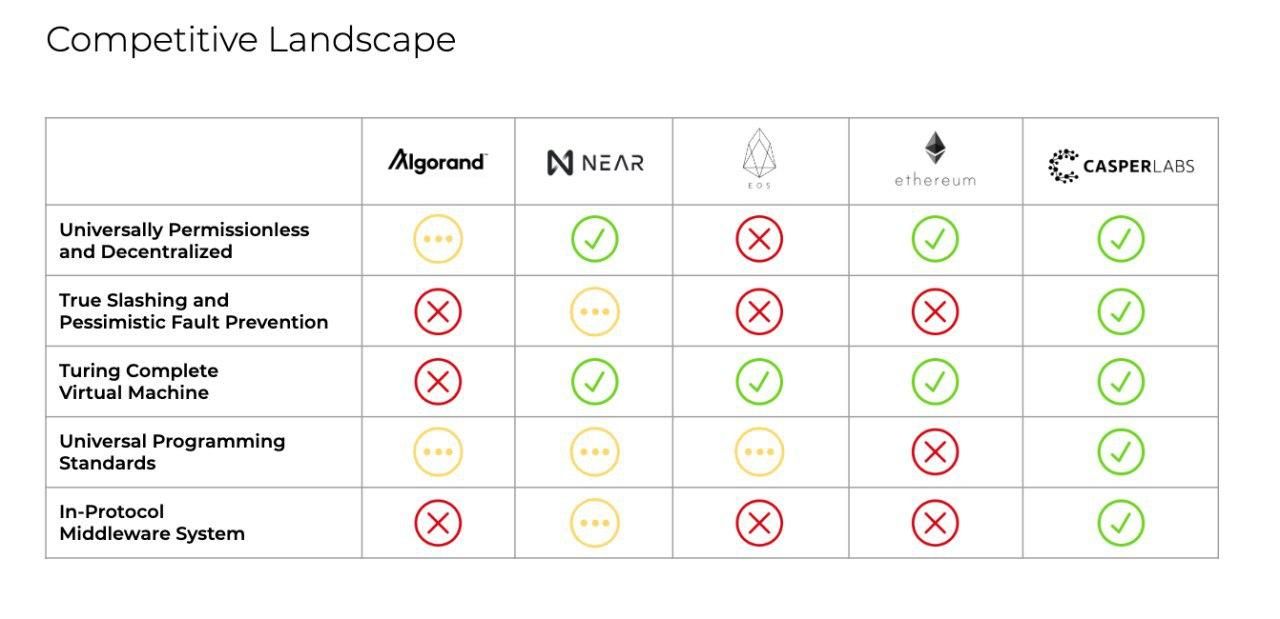
Our platform supports blockchain as part of a larger architecture, making it an excellent candidate for applications that want to take advantage of the additional security that blockchain offers. What we are building will integrate well into existing architectures. Our Node software conforms to Site Reliability best practice requirements for configuration, logging and monitoring. This makes it a great candidate for businesses that want to add blockchain to their applications. With GraphQL, Rust and Assemblyscript, support for continuous integration and testing, companies can easily add our technology to their stack.
Messari: Thank you for the breakdown! We're starting to reach the end of our hour. Medha, thank you so much for joining us today! It was a lot of fun. At this point I would ask how we could learn more or stay in touch, but you've provided so many links, we have plenty to go through. So I'll end with this, what are you looking forward to most about the project either short or long team?
Medha Parlikar: Likewise! Thank you for giving us your time and attention! Catch us on Discord or Telegram - you will find me lurking there. 😉
I'm looking forward to shipping! And then seeing the community engage and how the features we have built are used. We are building a computational platform, that we would love to use, and we are anxious to see what emerges. 😊