History of Tether

This post was originally published on May 02, 2019, and sent to Messari Pro subscribers.

Depending on who you talk to in crypto, Tether ($USDT) either represents the most important liquid reserve in the ecosystem or its largest systemic threat. Very few debate that this digital dollar has played an integral role in the market’s evolution, and an even more important role in one of the world’s oldest and largest crypto exchanges, Bitfinex. Last week, it became clear that the Tether stablecoin had lost its full reserve due to banking issues and the seizure of some $850 million of reserves. Tether is easy if you just put it into a nice, neat little diagram like this:
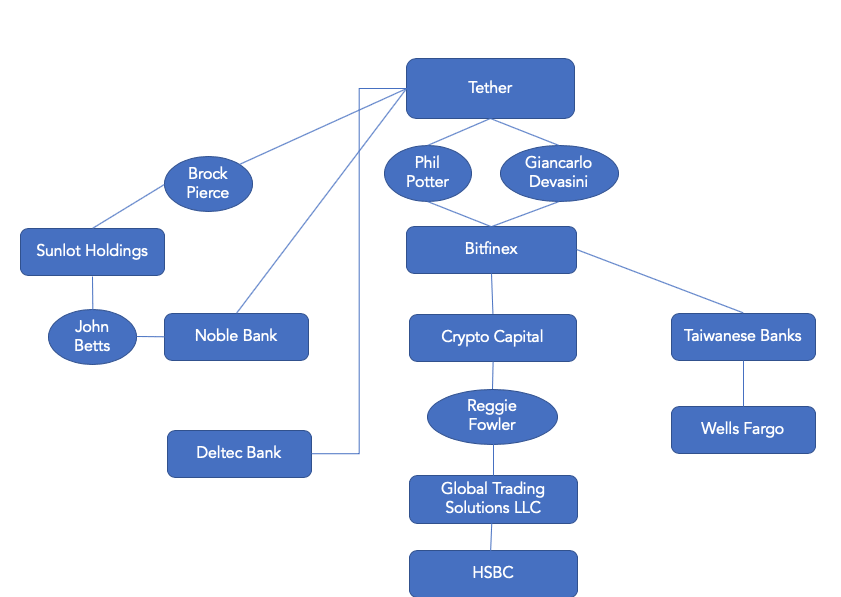
Well, maybe not easy, but let’s walk you through the history
Realcoin
Tether got its start in July 2014 as “Realcoin”, a new cryptographic token that aimed to maintain a peg against various fiat currencies by holding an equivalent amount of cash reserves. Realcoin was the brainchild of entrepreneurs and investors Brock Pierce, Reeve Collins, and Craig Sellars. Sellars, the CTO of Mastercoin at the time (a “bitcoin 2.0” protocol that was one of the early precursors to the ICO and later rebranded to “Omni”… just to add to the confusion), was ultimately instrumental in building the system at Tether, too, as it was (and is) the Omni protocol’s top application. While the Realcoin site has been down for years now, an archived version shows that Realcoin promised many of the things Tether later fulfilled or promised to fulfill in the ensuing years, namely that its reserve would be audited and verified by third-parties.
