Helium Halving Tailwinds

Growth Drivers
Deflationary Dynamics Post-Halving
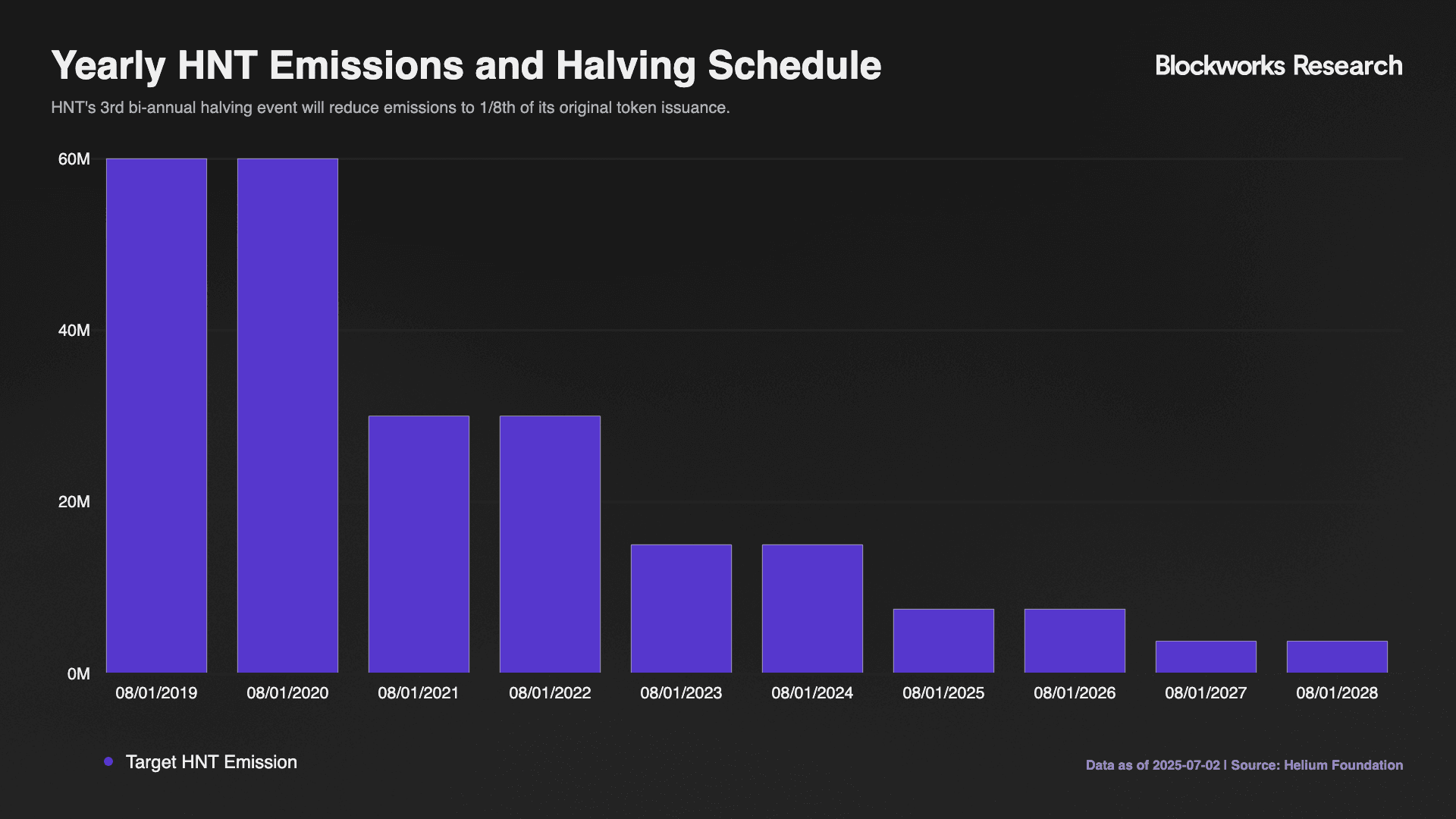
In August 2025, HNT’s emission schedule will be reduced from 15M to 7.5M tokens annually. This bi-annual halving indicates that at a ~4x increase in ARR from ~$4.4M currently to ~$17.6M at the current HNT price of $2.30, the DC burn rate would surpass the emission rate, making HNT effectively deflationary. This dynamic could substantially bolster HNT’s token economics, supporting higher valuations if demand growth remains consistent.
Explosive DC Burn Growth Driven by Telecom Partnerships
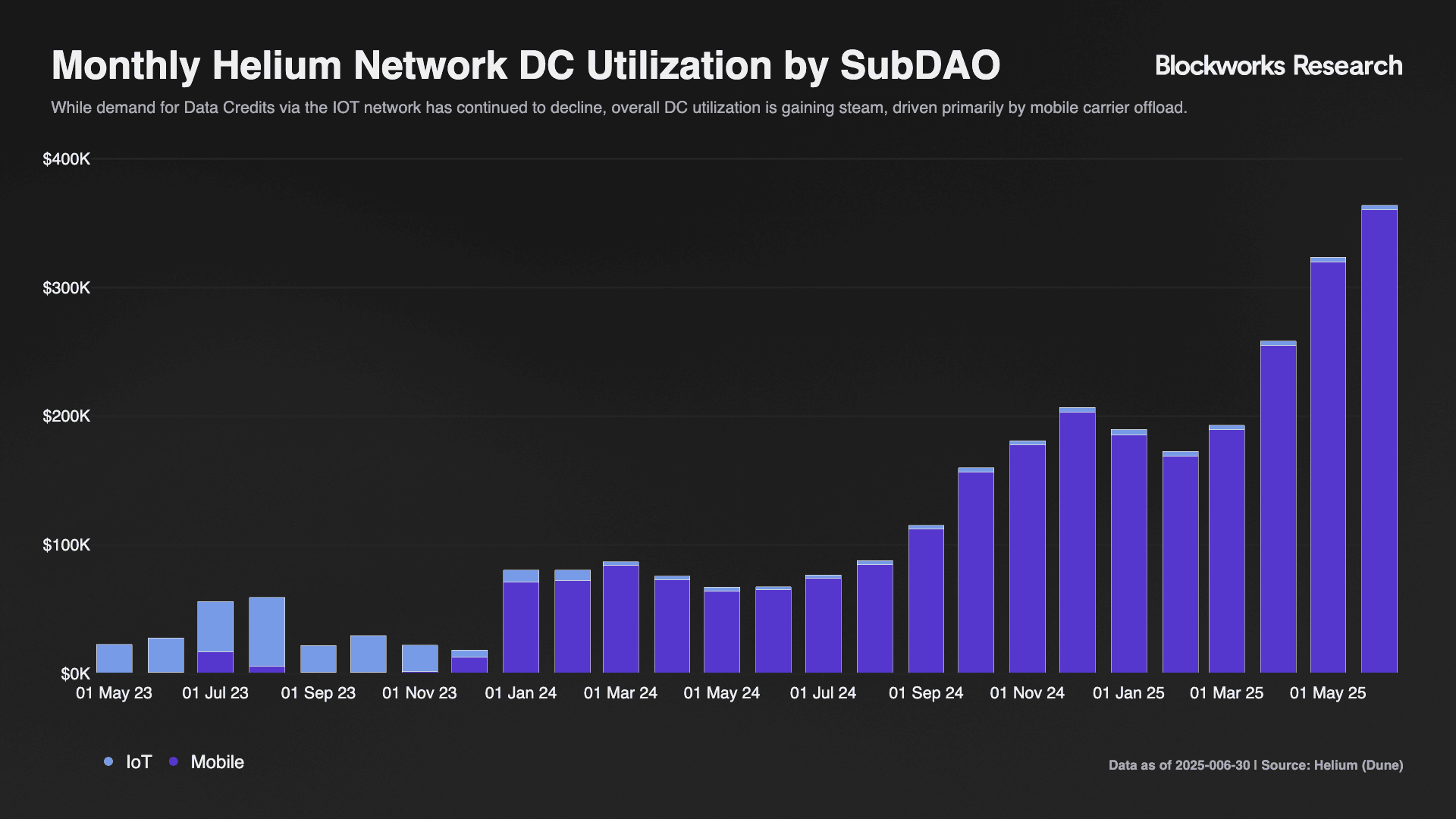
The monthly DC burn rate attributed to mobile usage recently surged from ~$189K in early March 2025 to ~$361K in June 2025. This significant increase primarily stems from growing mobile offload volumes from major telecom carriers, notably AT&T and T-Mobile, rather than Helium’s own branded MVNO, Helium Mobile. Carrier offload now accounts for over 85% of total DC burn, highlighting the dominant role telecom partnerships play in driving network revenue growth. Nova Labs CEO Amir Haleem, underscored that token economics must evolve beyond traditional per-gigabyte pricing, emphasizing that successful scaling inherently pushes cost per GB towards zero, complicating value capture. For context, Helium's network now supports ~800K-1.1M daily users, surpassing Boost Mobile, which, despite its established brand, had only about 1M users actively utilizing its own infrastructure as of Q4 2024. Boost Mobile customers predominantly roam on AT&T and T-Mobile networks, highlighting Helium's comparatively rapid adoption trajectory. As telecom partnerships scale and offload volumes continue rising, the pace of DC burn, and thus HNT demand, is expected to accelerate, further tightening token supply dynamics post-halving.

Nick leads coverage on the DePIN and Proof of Work sectors. Previously led research and engineering at a DePIN-focused accelerator.