Hashflow is a decentralized exchange (DEX) that uses a request-for-quote model with pricing provided by market makers.
Hashflow's signature-based pricing offers traders guaranteed execution price, MEV-resistance, and no slippage.
A number of prominent market makers, including Wintermute, Jump Crypto, GSR, and LedgerPrime, are involved in the project as investors and/or market makers.
H1’23 will bring more improvements for users like smart order routing, a fiat on-ramp, and Hashflow’s first non-EVM deployment.
The planned upgrades for the second half of 2023 include limit orders, time-weighted average price (TWAP) trading, and an order book.
Decentralized exchanges (DEXs) have been one of the few bright spots of the past year. They led DeFi in gross revenue and maintained relatively stable usage without misappropriating user funds like some of their centralized peers. However, despite cementing themselves as the trustless and open-access point for crypto, they still left much to be desired.
The typical automated market maker (AMM)-based DEX has a plethora of drawbacks. The two most concerning for traders are uncertain price execution and maximum extractable value (MEV), which exposes traders to sandwich attacks and front-running.
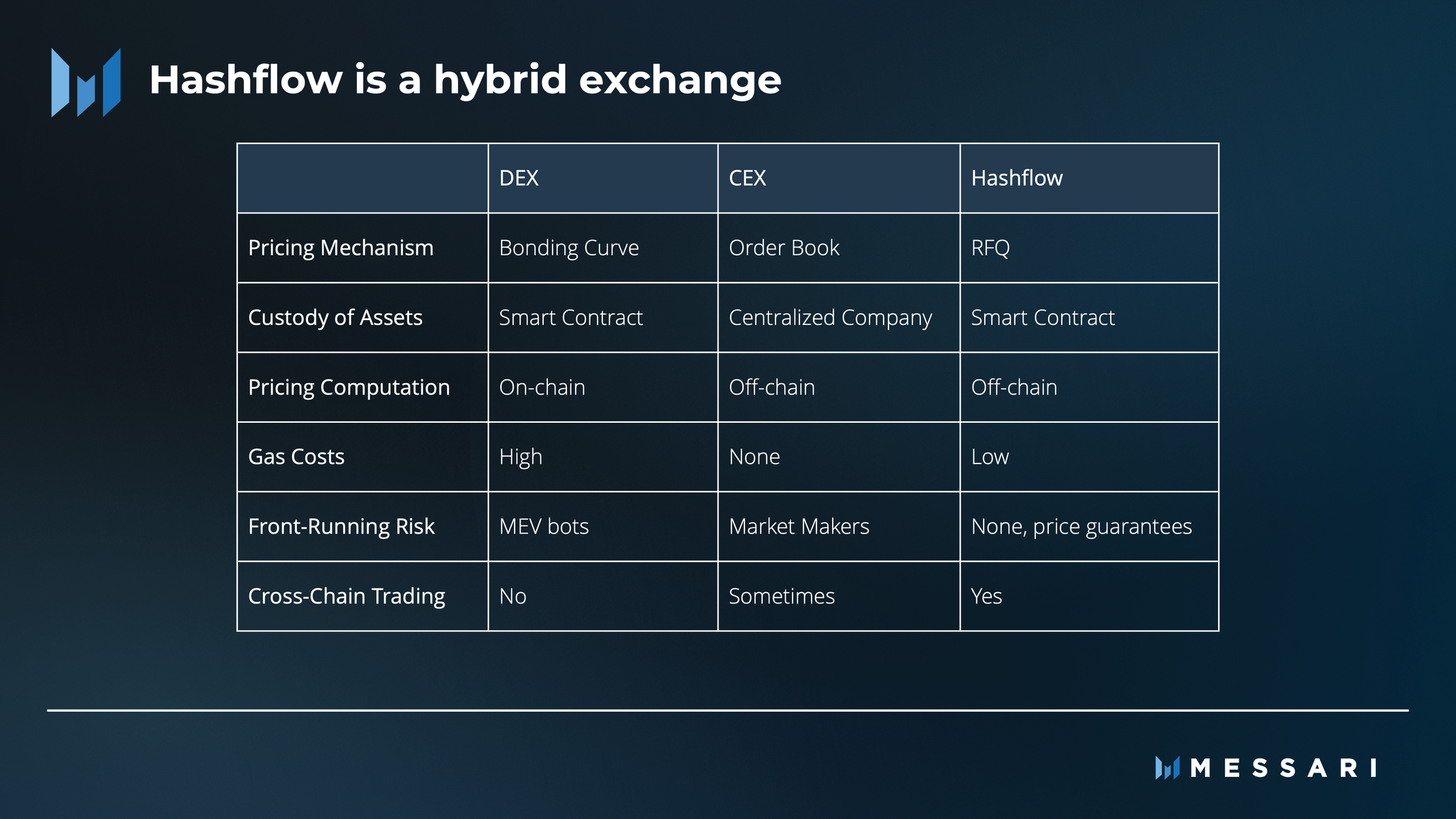
Hashflow is a new type of DEX where traders can know the price of a trade before executing it. It offers traders prices through a request-for-quote model (RFQ) with professional market makers, instead of a bonding curve. The implementation uses signature-based pricing, allowing market makers to do pricing computation off-chain. This approach addresses shortcomings that are prevalent in AMMs, offering MEV-resistance, no slippage, and access to cross-chain liquidity.
Background
Hashflow was founded in 2020 by Varun Kumar, Victor Ionescu, and Vinod Raghavan. After launching in Private Alpha in April 2021, Hashflow fully launched last August. Since initially launching on Ethereum, it expanded to Arbitrum, Avalanche, BNB, Polygon, and Optimism in early 2022.
How It Works
There are two main stakeholders in the Hashflow ecosystem: market makers and traders.
Market Makers
Market makers (MMs) provide liquidity in markets. In traditional markets, MMs are institutions with capital that provide bids and asks on assets to allow price takers (traders) to exchange those assets.
In crypto, many professional market makers (e.g., Wintermute, Jump Crypto, and GSR) tend to focus on centralized exchanges like Binance and Coinbase that allow them to do fast and intensive computations off-chain. The market makers compete with each other to place bids and asks in order books using custom pricing strategies. MMs capture their earnings from the spread between the bid and ask prices.
Crypto has innovated in the space by introducing automated market makers (AMMs). This mechanism enables anyone to provide liquidity for assets priced on a predefined bonding curve. AMMs are a good solution for decentralizing liquidity provision, but they introduce some major drawbacks for LPs and traders. Liquidity providers’ suffer from divergence loss and capital inefficiency. Traders suffer from limited execution options and front-running in the form of sandwich attacks.
Hashflow is a protocol that connects off-chain market makers to on-chain traders. It solves problems like uncertain price execution and MEV front-running (sandwich attacks).
Traders can permissionlessly interact with the Hashflow protocol and request a quote to trade any listed asset (i.e., to buy ETH for 1,000 USDC). Hashflow relays the RFQ to MMs, who do off-chain computation to determine their best bid or offer. After the MMs respond with their prices, the Hashflow protocol finds the best price and shows it to the trader.
Traders can then agree to trade at that price or choose to hold off. If the trader agrees to the price within the time window, the assets are swapped between the trader and MM liquidity pool. Up until then, the trader has custody of their assets at all times. Because the MM prices assets off-chain and cryptographically signs the quote, there is no front-running opportunity for MEV bots.
Currently, the Hashflow core team does due diligence on market makers and is responsible for giving them access. The Hashflow Foundation also requires know your customer (KYC) procedures and binding legal contracts. The long-term objective is to create permissionless access to becoming a market maker.
Traders
By entering an order, traders are placing a request-for-quote (RFQ) with MMs on the Hashflow platform. Pricing happens off-chain, and quotes are signed by market makers. The Hashflow router optimizes for the best quote, and then traders can agree or not to execute the trade.
The Hashflow protocol has several benefits for traders:
Guaranteed price execution, rather than setting a maximum slippage tolerance.
Tighter spreads. MMs can price assets closer to fair market value rather than on a bonding curve.
MEV-resistance. No front-running via sandwich attacks or gas wars.
Traders have the option to natively swap assets across chains without any external bridges (Wormhole works in the backend for message-passing).
Traders also have the option to enable gasless trading. Because this feature includes gas fees in the quote, traders don’t need to hold a given chain’s native asset.
For the foreseeable future, there are no trading fees, but the DAO is able to turn on fees down the road.
HFT
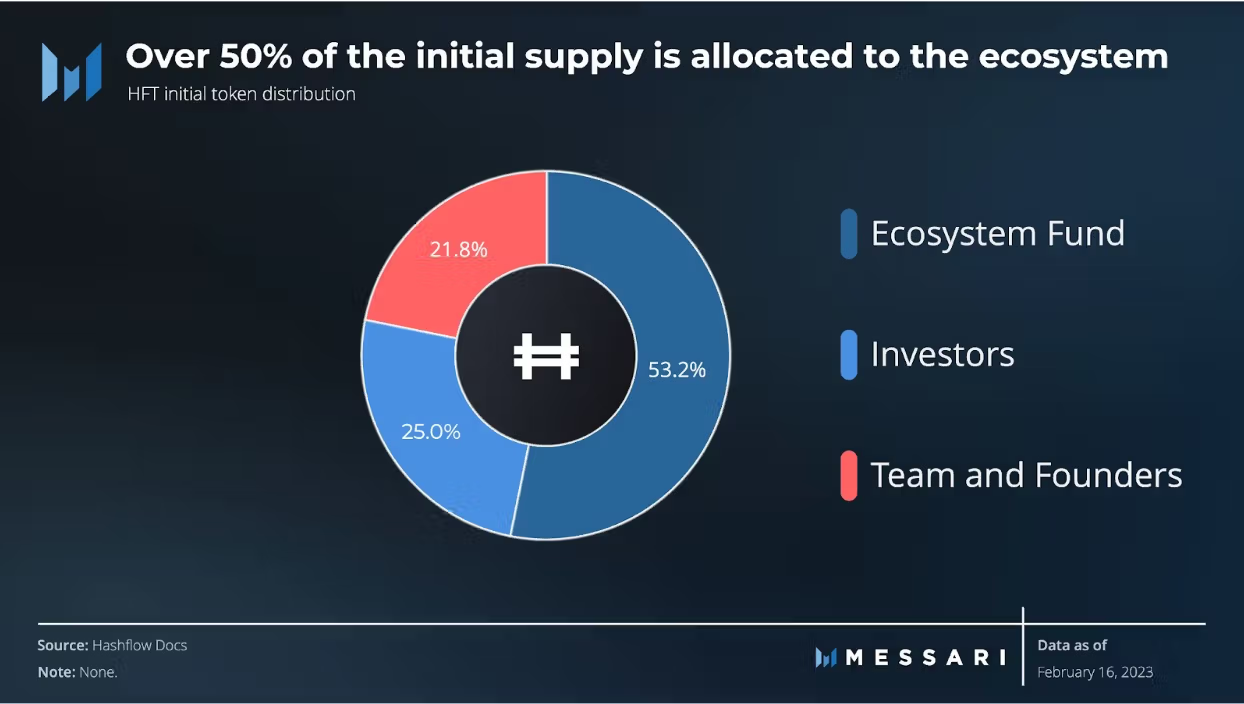
In November 2022, Hashflow launched HFT, its Ethereum-based ERC-20 governance token. At the token generation event (TGE), ~17.5% of the total supply (175 million HFT) was unlocked and distributed to various community members (NFT holders), users (traders, market makers, and liquidity providers), and external contributors outside of the “Ecosystem Development” allocation.
Beyond that, ~19.3% of HFT of the total supply was allocated to the Hashflow team, with an additional 2.5% for future hires. These tokens have a 1-year cliff and a subsequent 3-5 year vesting period.
Shortly after the launch of its Private Alpha (April 2021), Hashflow announced a $3.2 million seed round led by Dragonfly Capital and Electric Capital. In July 2022, Hashflow raised a $25 million Series A at a $400 million valuation. In addition to follow-on investments from Electric Capital and Dragonfly Capital, the Series A designated a number of prominent market makers as Hashflow stakeholders, including Jump Crypto, Wintermute, LedgerPrime, Altonomy, and GSR. Other prominent investors include Galaxy Digital, Coinbase, Balaji Srinivasan, and Jason Choi. Collectively, these investors received 25% of total HFT supply with a 1-year cliff and 3-year vesting period.
The largest allocation from the initial supply is for “Ecosystem Development.” As such,~53.2% of total HFT supply is set to go to ecosystem partners, community members, the community treasury, and other external stakeholders. Different stakeholders have different vesting schedules, with over one-third of Ecosystem Development HFT already unlocked.
Additionally, the community treasury will be the sole recipient of HFT’s perpetual 4% inflation, which starts in November 2026.
The Hashverse
The Hashverse is Hashflow’s soon-to-be-launched gamified user introduction platform. The design is meant to expand the holder base of HFT and help new users take advantage of the protocol’s features. Aside from growing the community, the Hashverse should also help increase trading activity on Hashflow.
HFT holders can lock tokens to create an in-game character. They will then be able to complete tasks and quests to earn additional HFT and further increase their voting power. The experience is intended to strengthen the community while creating opportunities for users to contribute and earn HFT.
Traction and Key Metrics
Since its launch in August 2021, Hashflow has had a cumulative $12.3 billion traded through its platform. Like most exchanges, Hashflow has experienced spikes in volume around high-volatility events like the Terra/LUNA collapse in May and FTX’s collapse in November.
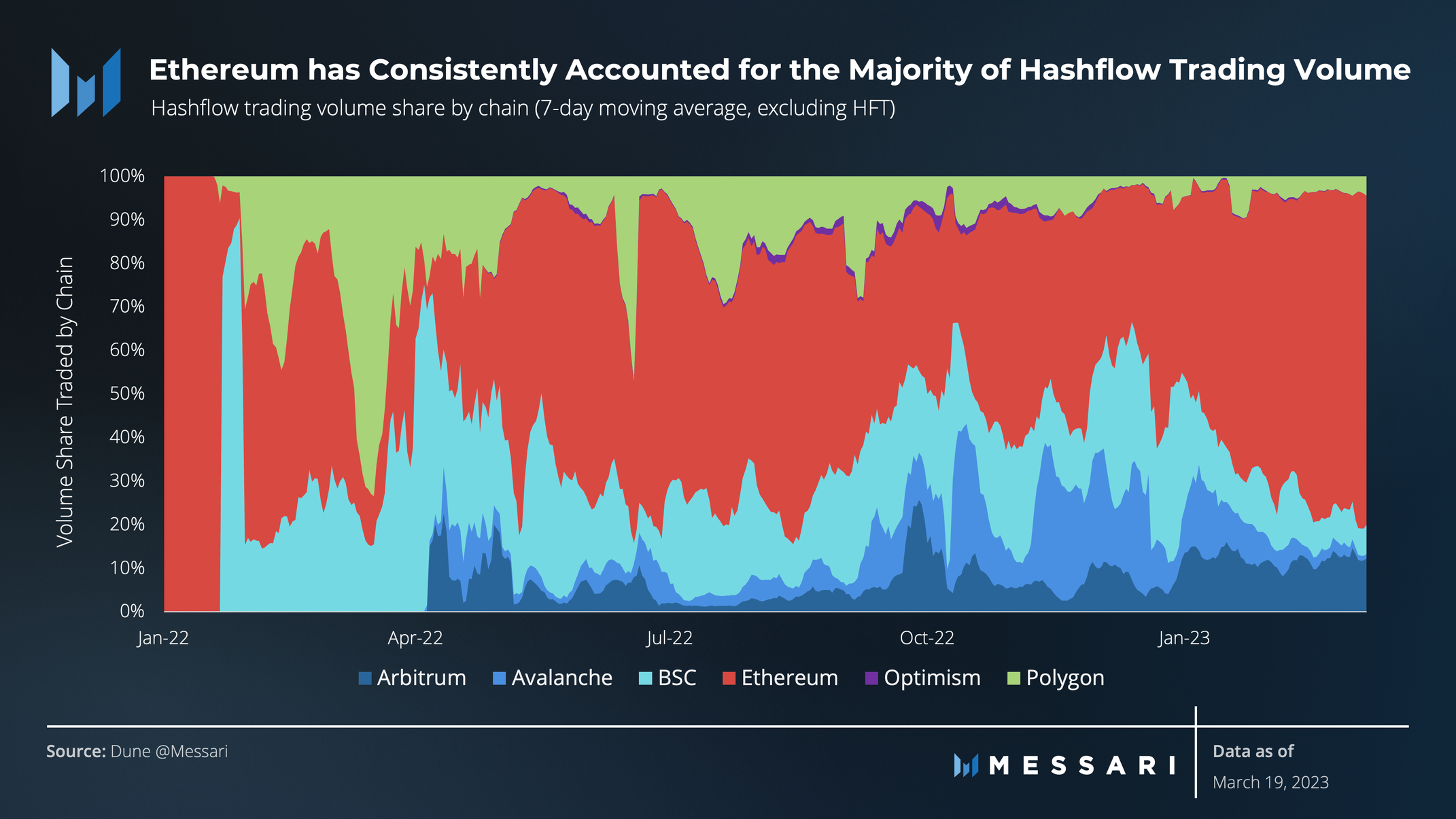
Ethereum has the lion’s share of volume, hovering around 50%, with BNB Chain (25%), Arbitrum (13%), and Avalanche (5%) capturing most of the remaining volume. Since their April 2022 launch, cross-chain swaps have accounted for roughly 0.4% of total volume.
In addition to its core user interface, Hashflow has attracted volume through integrations with projects like DEX aggregator 1inch, DefiLlama, Odos, OpenOcean, OKX, and smart wallet Zerion. Hashflow has also onboarded eight market makers. While some of the market makers have yet to be named publicly, the team has announced a partnership with Wintermute and noted the participation of other Series A investors (i.e., LegderPrime, GSR, etc.).
Note: Hashflow has been incentivizing activity (market making, liquidity provision, and trading) on the platform.
Competitive Landscape
Hashflow is competing in two main areas: exchanges and bridges.
Exchanges
CEXs have maintained a significant volume lead over DEXs, doing between 7x to 10x the volume, even after the FTX debacle. Despite the drawbacks of counterparty risk, KYC-AML, and permissioned asset listings, centralized exchanges still comfortably outpaced decentralized protocols. The benefits of trading on CEXs like ease of execution and ability to execute limit orders have comfortably outweighed the risks of centralization like custodying assets and censorship.
These complications present an opportunity. Hashflow is significantly more decentralized and on-chain than CEXs, while also providing the certainty in execution that DEXs lack. Traders and capital allocators can hold and swap assets in a trustless manner but still get the same pricing and guarantees as CEXs — all while paying no trading fees and reduced gas fees in the swap execution.
These advantages are especially powerful for large traders, who are frequently subject to slippage and front-running due to MEV. Hashflow could be compared to dYdX (in its current rollup iteration), which provides decentralized trading with centralized order execution. Users who prioritize decentralization in its entirety may shy away from the hybrid-DEX, but the majority will likely prioritize execution with self-custody of assets.
Hashflow’s unique model makes it difficult to compare its volume to that of other DEXs. AMMs attract a lot of additional volume, since they rely on takers taking advantage of arbitrage opportunities to keep prices in line. Recent research has found that upwards of 20% of volume of major DEX trading pairs is from sandwich attacks. Hashflow, on the other hand, just relies on traders requesting quotes.
Bridges
With a bridge, users typically have to first escrow tokens on chain A and then receive the wrapped version of those tokens on chain B. The risks of escrowing tokens on a native chain and holding wrapped tokens on a new chain have led to substantial hacks and losses for holders. With Hashflow, users can simply swap from one native asset to another cross-chain — no need for wrapped assets and no escrowing assets.
Executing cross-chain swaps through Hashflow also saves users from needing to pay gas fees for a transaction on the destination chain.
Wormhole executes the cross-chain messaging part of the protocol. Hashflow has gateway contracts that validate the first leg of the transaction has been executed. Hashflow already has contracts on various chains, and it has the ability to add more.
Although Hashflow is a cross-chain DEX and not a bridge, it does compete for users looking to trade across chains.
Roadmap
Hashverse and Governance
Front and center for Hashflow is the full launch of the Hashverse DAO. Superconductor, a leading creative agency, is working with the core team to combine familiar crypto-primitives (NFTs, GameFi, and DAO governance) into a unique experience. Once launched, it will be a good test case for a new way to grow a DeFi community and hopefully increase DAO participation.
Smart Order Routing (SOR)
The Hashflow router receives prices from MMs and shows the best quote offered to the trader. This implementation is limited to complete fills by one MM. Once SOR is available, MMs can return tiered pricing for different trade sizes, regardless of the size of the entire RFQ. The Hashflow router can then aggregate the small orders and offer better prices to traders.
Fiat On-Ramping
Most DEXs are limited by the need to get assets on-chain. Adding an on-ramp feature will enable Hashflow’s users to skip the external step of first getting assets on-chain before trading in order to directly interact with Hashflow.
Limit Order, TWAP, VWAP Chain Expansion, and more
Several roadmap items focus on reducing the price impact of larger trades and increasing execution options for traders. Limit orders, time-weighted average price (TWAP) orders, and volume-weighted average price (VWAP) orders are heavily used in TradFi but are not widely available yet in DeFi.
Hashflow will be adding its first non-EVM chain in H1’23 and continue to add new chains in the back half of the year. Given the growth in L2 usage and momentum behind multichain app development, Hashflow can be a solution to quickly and securely move assets across chains.
Another upcoming development is the release of new asset classes beyond spot. Since computation (pricing) is done off-chain, Hashflow can support more complex assets like structured products without increasing latency or gas fees.
Transparency and Centralization Risks
Hashflow’s codebase is closed source, and its smart contract addresses are not public. The protocol has passed three audits. An audit by Certik identified Hashflow’s major risk vector to be centralization, with a key contract currently managed by the core team around permissioning pools. The permissions include enabling new pools and market makers as well as limiting existing ones. The team is working on updating the contracts to include an immutable and more limited permissions contract.
Closing Thoughts
Hashflow has introduced a new and differentiated option for traders and market makers in the DEX ecosystem. The unique offering brings a hybrid market maker model that could offer better execution for traders and change the market structure for market makers. Hashflow’s next major challenge will be to grow market share by bringing new users into DeFi or taking share from existing DEXs.
This report was commissioned by the Hashflow Foundation. All content was produced independently by the author(s) and does not necessarily reflect the opinions of Messari, Inc. or the organization that requested the report. The commissioning organization may have input on the content of the report, but Messari maintains editorial control over the final report to retain data accuracy and objectivity. Author(s) may hold cryptocurrencies named in this report. This report is meant for informational purposes only. It is not meant to serve as investment advice. You should conduct your own research and consult an independent financial, tax, or legal advisor before making any investment decisions. Past performance of any asset is not indicative of future results. Please see our Terms of Service for more information.
No part of this report may be (a) copied, photocopied, duplicated in any form by any means or (b) redistributed without the prior written consent of Messari®.
Before joining Messari as a Senior Research Analyst, John worked in Equity Derivatives on the buy-side and sell-side for over five years. He studied macroeconomics and markets for almost a decade. Now, John spends time thinking about token design, DeFi protocols, and governance.
Before joining Messari as a Senior Research Analyst, John worked in Equity Derivatives on the buy-side and sell-side for over five years. He studied macroeconomics and markets for almost a decade. Now, John spends time thinking about token design, DeFi protocols, and governance.