Grow the Pie: Developers Are Here to Stay

How do technology platforms capture and increase their value over the long-term? According to a16z, the core template for value capture in Web3 protocols is the alignment of incentives between developers and users. This often translates into a positive feedback loop between code development and application usage: On one hand, sustained code development fosters the creation of widely-used applications; on the other hand, wide usage of applications incentivizes further development of new protocol functionalities.
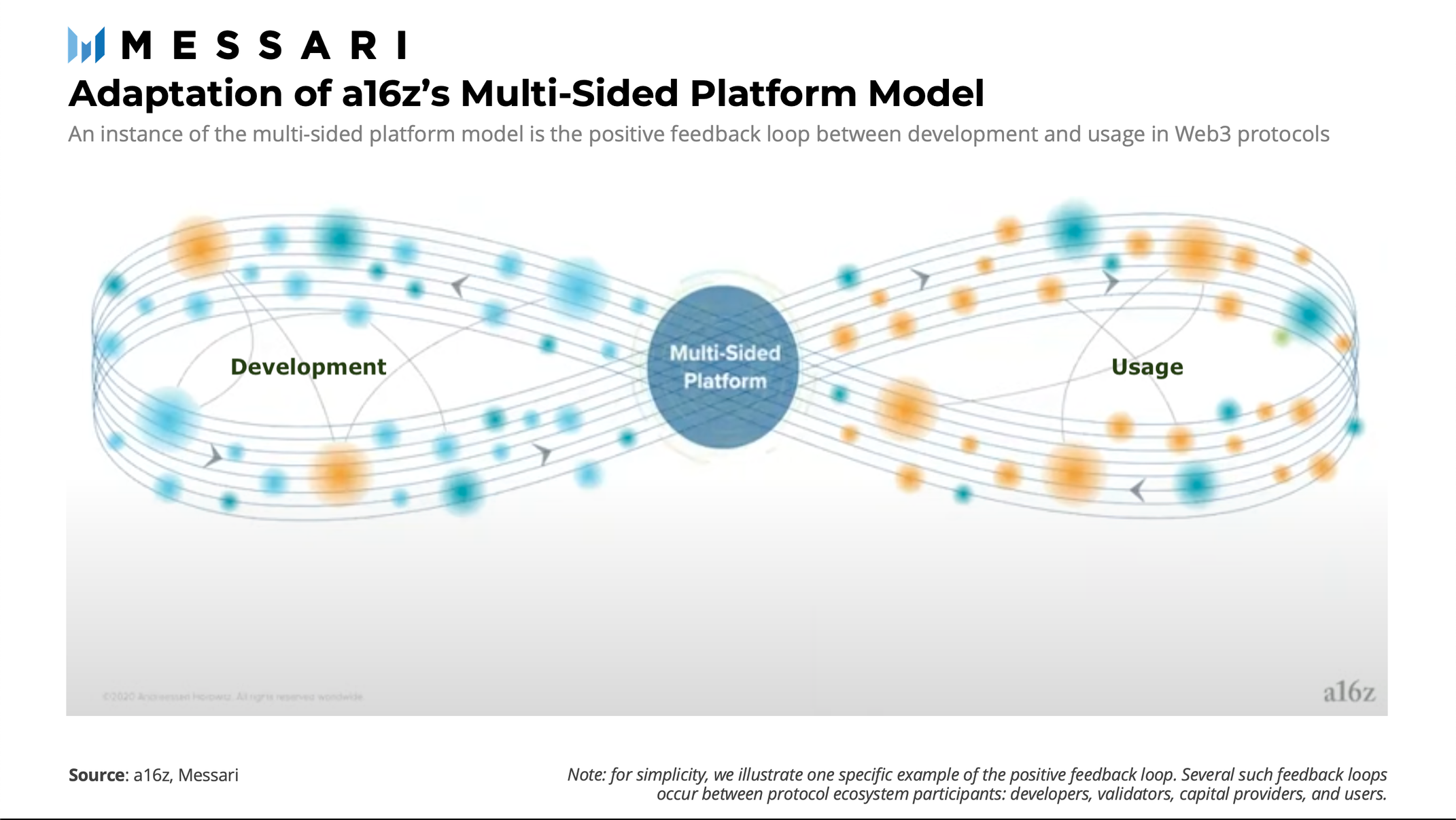
This positive feedback loop differs from the ad-based value capture model in Web2 platforms monetized by Amazon, Youtube, or Uber. While value in Web2 platforms is usually generated by content creators, only a chunk of ad revenues flows back to content creators. To be able to maintain and increase value over time, Web2 platforms usually incentivize content creators to continue to generate valuable content over the long-term.
In contrast, incentive alignment in Web3 is more straightforward, in part thanks to the more transparent nature of open-source software development. The mechanics of this incentive alignment are as follows: Applications are developed by open-source communities on top of Web3 protocols. As these applications get adopted by users, more capital flows back into the protocols. Thus, value is captured at the protocol layer. This oftentranslates into superior protocol functionalities that support new applications. As these new applications get adopted by more users, developers are incentivized to further build on top of “composable” Web3 protocols. As Layer 1 protocols are increasingly gaining adoption, sustained code development is paramount to create a lock-in effect that "grows the pie" over time.
Yet, when analyzing Web3 protocol success in the long-term, few analysts systematically assess code development activity. In fact, most analysis focuses on on-chain metrics for usage (e.g. number of wallets, number of applications, flow of funds, trading volume, public sentiment, or media awareness). While most on-chain analysts agree on the importance of code development for Web3 protocol success in the long-term, the topic is still largely considered abstract.
Missing Piece: Development Metrics
To help address this gap, Santiment and CoinGecko offer custom developer activity metrics. These metrics attempt to capture code development progress in GitHub repos in isolation, on an individual-project basis. A recent report from Galaxy Digital concluded, in terms of code development, alternative Layer 1s are closing in on Ethereum’s heels. While acknowledging difficulties in quantifying development activity, the report provides a static comparison of the number of bookmarks for core GitHub repositories as a proxy of where talent is currently focused.

Mihai is Director of Research at Messari. Mihai leads Protocol Research, covering base layers, mid-layer infrastructure, DeFi, and consumer apps. Prior to joining Messari, Mihai was a tech entrepreneur and worked in AI at UBS and Swiss Re in Zurich. His background is in computer science and math. Mihai holds a PhD in information systems from ETH Zurich, Switzerland