Governor Note: Coinbase USDC Institutional Rewards for MakerDAO

Key Insights
- Coinbase has offered custody service for $1.60 billion USDC from MakerDAO’s Peg Stability Module in exchange for a reward of 1.5% yield per annum.
- MakerDAO could become Coinbase’s first client for its USDC Institutional Rewards program and pay no custody fee.
- The proposal comes amid recent events involving USDC blacklisting of Tornado Cash sanctioned addresses, Binance’s decision to delist USDC, and MakerDAO’s plan to wean itself off its real-world assets, including USDC.
Coinbase has proposed onboarding MakerDAO, creators of DAI decentralized stablecoin, as the first client of its USDC Institutional Rewards program. The proposal involves moving 33% of USDC from Maker Protocol's Peg Stability Module (PSM) to Coinbase Prime, an estimated $1.60 billion, for a yield of 1.5%. The move could earn MakerDAO approximately $22.5 million annually.
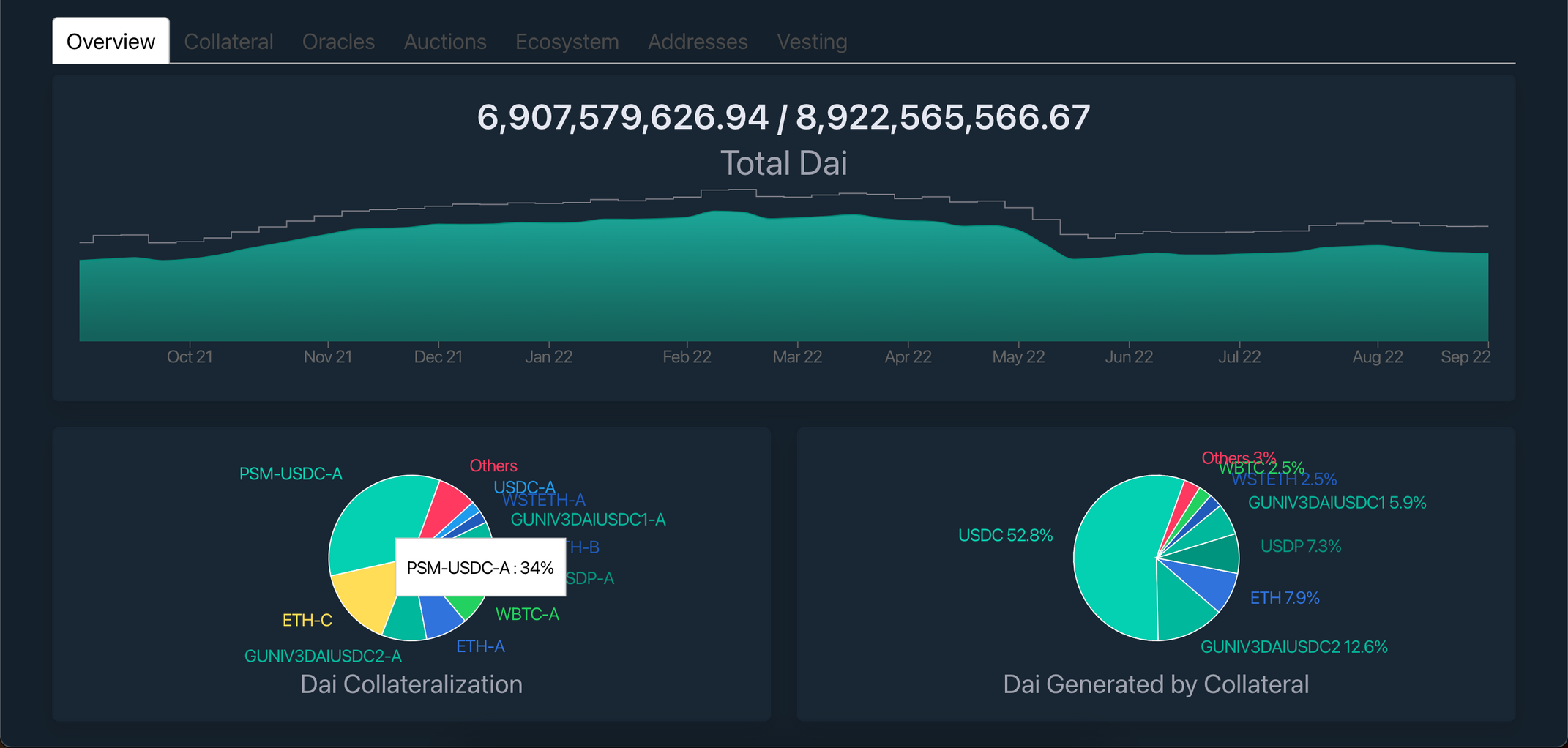
Source: Dai Stats
The submission (MIP81) is a response to MakerDAO's “Declaration of Intent to Invest in Short-Term Bonds.” MakerDAO had requested "any party" to provide a solution that allows the organization to generate revenue from its underutilized balance sheet. The protocol also sought to eliminate the bad PR and counterparty risks associated with holding centralized stablecoins. As a custody provider, Coinbase claims to be uniquely positioned to meet MakerDAO's evaluative criteria for safety, cost structure, and flexibility.
There is support for the proposal from MakerDAO Co-Founder Rune Christensen, Sam McPherson, who authored the proposal implementing the PSM, the MakerDAO Growth Core Unit and Strategic Finance Core Unit, and some of the DAO delegates. However, there was a similar amount of opposition, with recent sanctions against Tornado Cash illustrating how centralized entities can expose the DAO to regulatory risk.
To understand the impact of this proposal on MakerDAO, Coinbase, and Circle's fiat stablecoin USDC, more context is needed.
MIP81 Specifications
Coinbase specifies that Maker Governance will need to appoint an arranger to facilitate its onboarding to Prime via Coinbase, Inc. However, the custodial service will be provided by Coinbase Custody International, Ltd. (CCI).
CCI is a private company incorporated in Dublin, Ireland; it is not licensed in any jurisdiction as a custodial service provider and offers its services to clients in jurisdictions where registrations and/or licenses are not required. Thus, while Coinbase, Inc., the parent company, and Coinbase Custody Trust Company, LLC (Coinbase Custody) are licensed and regulated by the U.S. Government, CCI is not. CCI’s mission is to serve international clients as a custodian and manage Coinbase’s staking services.
This arrangement is supposed to allay fears that the government could pressure Coinbase, Inc. into seizing a client’s asset. Further, the company asserts that clients’ “assets are held in segregated accounts,” not traded, and "cannot be deemed as Coinbase assets” for claims from Coinbase creditors. Therefore, in the case of bankruptcy — à la Three Arrow Capital or Celsius — MakerDAO’s USDC in custody would be safe.
In terms of cost structure and flexibility, Coinbase will not charge MakerDAO any custody fee, and the DAO will be able to unwind the USDC from Coinbase’s custody in under six minutes (MakerDAO’s declaration required a minimum of a week unwinding under normal circumstances and two weeks in stressed situations). On the other hand, Coinbase will pay the USDC reward to Maker based on its USDC Institutional Rewards POC program rates: 1% APY on the first $100 million and 0.1% more APY on each $100 million after that with a maximum of 1.5%, on the calculated weighted average of assets each month on the fifth business day of the following month.
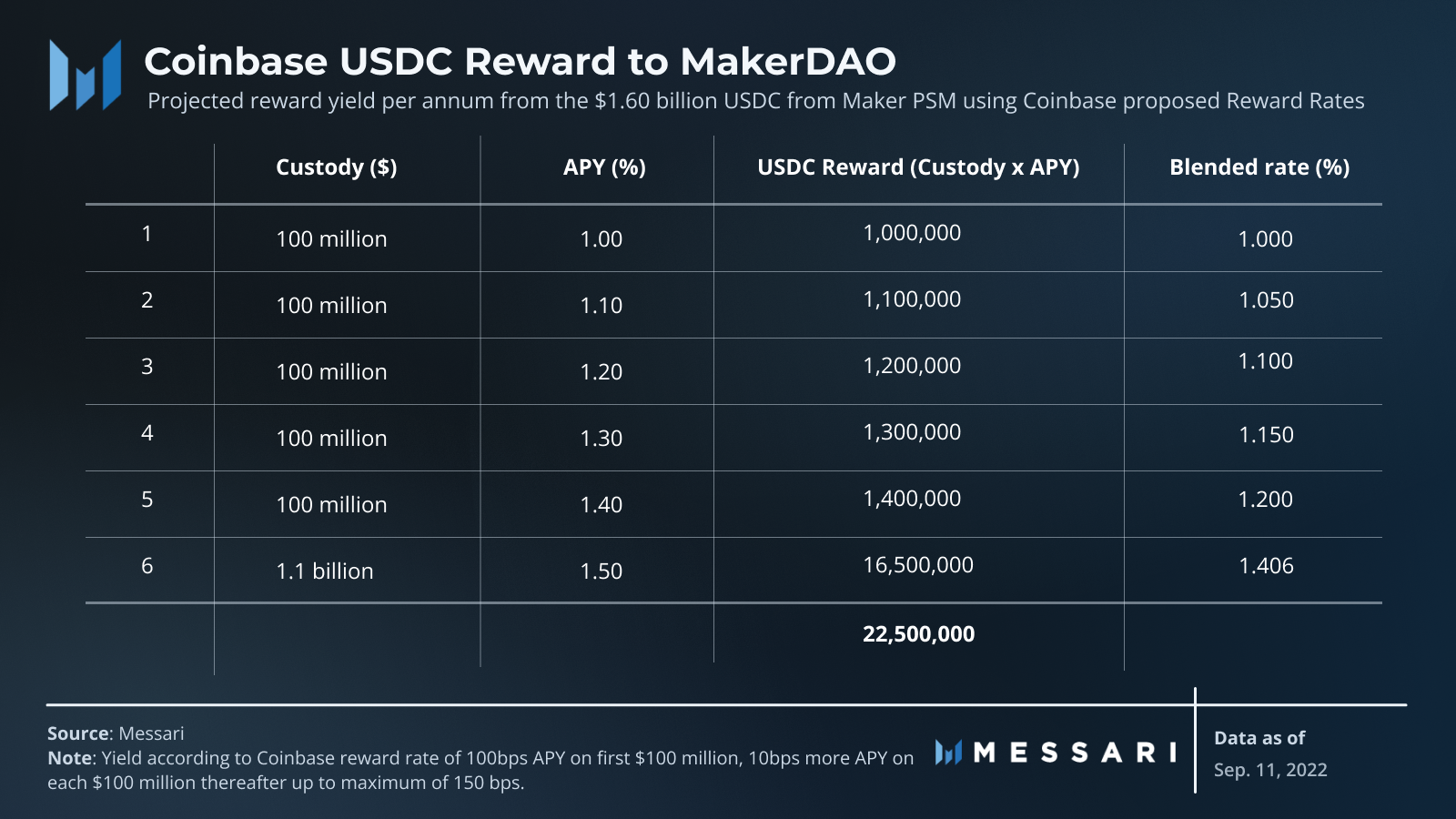
Source: Messari
The final payment will be in January 2023 if the proposal passes and is enacted. Assuming the proposal passes and is executed for Q4, Maker will earn ~$6 million in risk-free USDC reward before Coinbase reevaluates its reward rates for 2023.
MakerDAO seems to have found a good deal for just holding USDC from PSM in a Coinbase wallet. The proposed 1.5% yield in reward is more than the targeted 1% yield stipulated in the declaration, albeit the same goes for the targeted allocation of $1 billion. Since this isn’t “technically” an investment, MakerDAO will not need to award 1 million DAI to finance the solution.
But "there ain't no such thing as a free lunch," and DAO members and delegates who have yet to pledge support of the proposals still have two questions: “Where does the reward come from?” and “What’s in it for Coinbase?”
Where does the yield come from?
Coinbase stated that the USDC rewards for the program come from an inventory of USDC that it funds through USDC purchases and payments from a revenue-sharing agreement with Circle. Along with Circle, Coinbase is a founding member of Centre, the issuer of USDC. In other words, MakerDAO will be entitled to a share of the revenue generated from USDC reserves through the custody of USDC with Coinbase.
What’s in it for Coinbase?
Coinbase had just come off a not-so-great quarter, reporting a loss of $1.1 billion in Q2 2022. The company is working to improve its bottom line, especially by growing its institutional clientele. They had already succeeded in establishing a partnership with BlackRock, the world’s largest asset manager, to onboard users to Coinbase Prime. Similarly, securing MakerDAO as a Prime customer would be a huge win for the company’s reputation, wrapping up the year at the cost of ~$6 million. Maker is the longest-running project in the decentralized finance (DeFi) ecosystem powering the largest decentralized stablecoin in the world, DAI.
The proposal comes against the backdrop of the Tornado Cash sanction. Circle and Coinbase’s decision to blacklist the OFAC-sanctioned wallet addresses magnified the concerns of the DeFi ecosystem. At the same time, the proposal was submitted just a day after Binance announced it would be ending support for USDC trading pairs and auto-converting USDC deposits into BUSD. All of these events were invariably impacting USDC utility and, thus, its market cap.
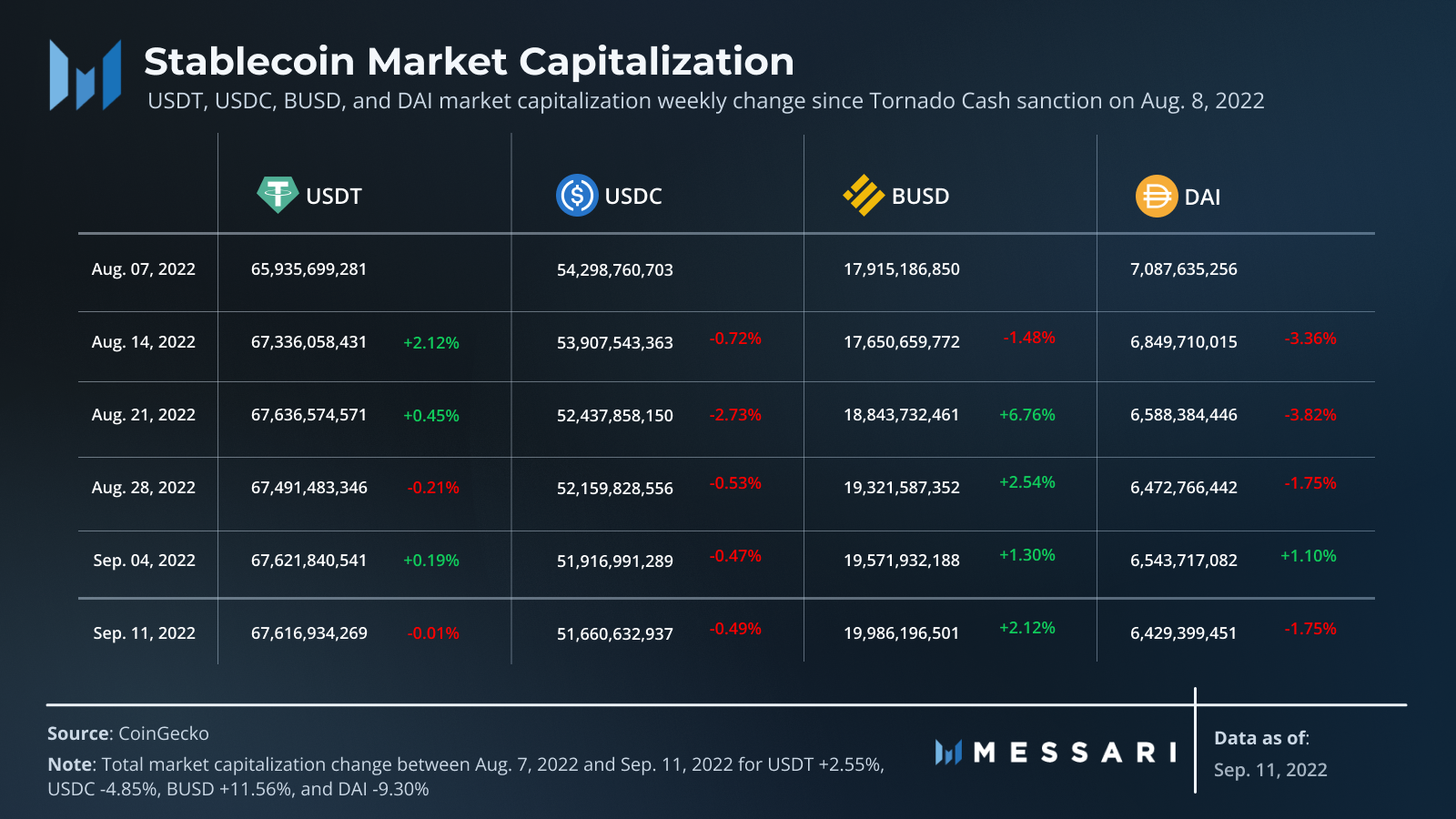
Source: CoinGecko
Since the bulk of DAI gets minted with USDC, the correlation is a reduced circulating supply. A reduced circulating supply for USDC equates to a reduced amount of revenue generated from USDC reserves, which results in reduced revenue for Circle and Coinbase.
Pros and Cons of MIP81 for MakerDAO
MakerDAO will have to manage the Pros and Cons of MIP81 to ensure it arrives at the best decision. These Pros and Cons have been summarised as follows:
Pros
- Quick Short-term Revenue Generation: MakerDAO has been discussing an Endgame plan — a long-term vision to restructure the DAO and improve its resilience to regulatory risk by eventually free-floating DAI. Following the sanction of Tornado Cash, the plan includes three progressive strategies or stances aimed at removing Maker’s reliance on real-world assets (RWAs: USDC stablecoins and loans to regulated entities) that the government can seize to shut down MakerDAO.
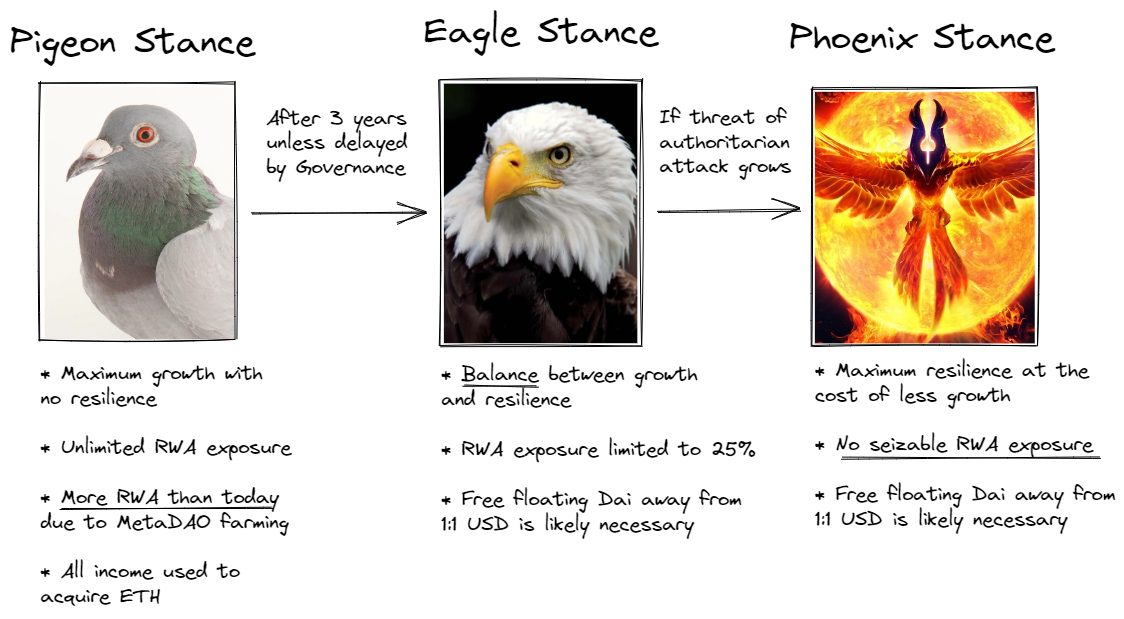
Source: MakerDAO Forum
Rune believes that the regulatory risk of a seizure by holding USDC in the PSM and custody of the USDC with Coinbase is no different. Since Maker must rely upon its RWAs in the short term, the DAO should take advantage of them to build the capital it needs. The Coinbase proposal is in line with MakerDAO’s Endgame plan and allows the DAO to quickly use its underinvested balance sheet. Nadia Alvarez, MakerDAO’s Head of Growth, also pointed out that the proposal aligns with the DAO’s restructuring plan: one of its proposed MetaDAOs could act as an arranger in facilitating the deal with Coinbase.
- Highly Liquid Yield: Besides Coinbase offering a seemingly low-risk fixed yield at no cost, the liquidity of the yield is a very favorable feature for this proposal. Unwinding such a large sum is made possible only by the fund remaining idle in Coinbase custody. As such, it can be initiated for withdrawal almost immediately. No alternative investment will give similar flexibility.
- Coinbase Reputation and Partnership: The success of this proposal could position Coinbase Prime as a useful DeFi tool, and MakerDAO can leverage Coinbase’s network to broaden its real-world assets. If there were any issues following the approval of custody to Coinbase, the company's custodial service might not recover from the reputation damage. If the program succeeds, there is a likelihood that Coinbase Prime will attempt to onboard a few more customers from the DeFi ecosystem, creating a synergistic relationship between DeFi and TradFi while growing USDC utility. Ultimately, MakerDAO’s Coinbase Prime Account could open the doors to new lenders in the real world connected through Coinbase’s network. Additionally, the proposal could foster a relationship between the two organizations dating back to Coinbase’s support of DAI as the first stablecoin for the Coinbase card.
Cons
- Unpredictable Legal Loopholes: Dealing with regulated entities involves a lot of legal considerations to avoid missteps. The scuffles surrounding this proposal are due to Maker community members seeking to gain clarity to make an informed decision. Although these concerns will be addressed with the help of an internally appointed Arranger (or MetaDAO), the unpredictability of the regulatory landscape can impact yield in the short to long term, as well as require the DAO to act fast in times of emergency.
- Low Fixed Yield compared to Market Alternative Investments: A number of the DAO participants pointed out that the 1.5% reward yield was low, especially when compared to investment options at a similar risk profile like T-bills and government bonds. Others suggest that Coinbase provides a variable rate that reflects market conditions. Either way, Coinbase will set its reward rates at its own discretion.
- Bad PR: MakerDAO stated in the declaration that the failure of its current state to generate revenue brings bad PR and counterparty risk. This proposal has been controversial. Although it generates revenue, it does not eliminate bad PR. MakerDAO will have to educate its community to gain the buy-in necessary to scale through Pigeon stance. Chris Blec, a MakerDAO recognized delegate, was vocal about how the proposal opposes the philosophy of decentralization. He stated that the DAO should focus on cutting costs rather than seeking revenue. Other critics shared this view while pointing out that the proposal had not removed the counterparty risks involved with USDC but had rather amplified these risks by turning DAI into a USDC wrapper.
Conclusion
The MakerDAO Delegates' call revealed that there were uncertainties regarding the proposal that needed clarification. The custody process could be automated using smart contracts to win DAO members' confidence. Considering recent precedents, it's unsurprising that community members prefer to verify rather than trust the details of this proposal.
Suppose the community decides to move forward with the proposal. In that case, MakerDAO will have to find ways to balance its decentralization ideology and the long-term sustainability of the protocol.
Let us know what you loved about the report, what may be missing, or share any other feedback by filling out this short form.
Author(s) may hold cryptocurrencies named in this report and each author is subject to Messari’s Code of Conduct and Insider Trading Policy. Additionally, employees are required to disclose their holdings, which is updated monthly and published here. This report is meant for informational purposes only. It is not meant to serve as investment advice. You should conduct your own research, and consult an independent financial, tax, or legal advisor before making any investment decisions. Messari does not guarantee the sequence, accuracy, completeness, or timeliness of any information provided in this report. Please see our Terms of Use for more information.
On September 22, 2022, the U.S. Commodity Futures Trading Commission stated that DAI is a "commodity." A couple notes: (1) Messari does not provide financial or trading advice - our services are for informational purposes only; and (2) Messari's services are impersonal - do your own due diligence. Please refer to our Terms of Service for more info.

Karo joined the Messari Governor team in late 2021 and specializes in decentralized governance and digital ethnography. He is also a contributor at the Aragon Network DAO and has a background in economics and finance.