Since launching Messari Governor last December, our governance analysts have curated over 3,000 proposals. These proposals increasingly reflect the health of the space and DAO voters' sentiments towards macroeconomic trends. As the bear market continues on, stakeholders need to be able to easily track governance processes and make more educated votes.
In our first Governor Insight, we will focus on findings from the three main Messari Governor features: the Proposal Tracker covering 85 DAOs, the DAO directory compiling 851 DAOs, and the DAO tools directory compiling 387 tools.
Proposal Tracker
Following a surge of proposal activities at the end of March as DAOs voted on quarterly spending and changes, the 7-day Simple Moving Average (SMA) for the number of proposals peaked at 15. This number declined during April and May, coinciding with a widespread sell-off across the crypto markets. While it’s unclear whether the declining prices of crypto assets affected DAO governance activities, the increased volatility certainly affected DAO operations. For example, Perpetual Protocol was faced with difficult governance decisions when a liquidation crisis forced the protocol to halt trading on May 15, 2022.
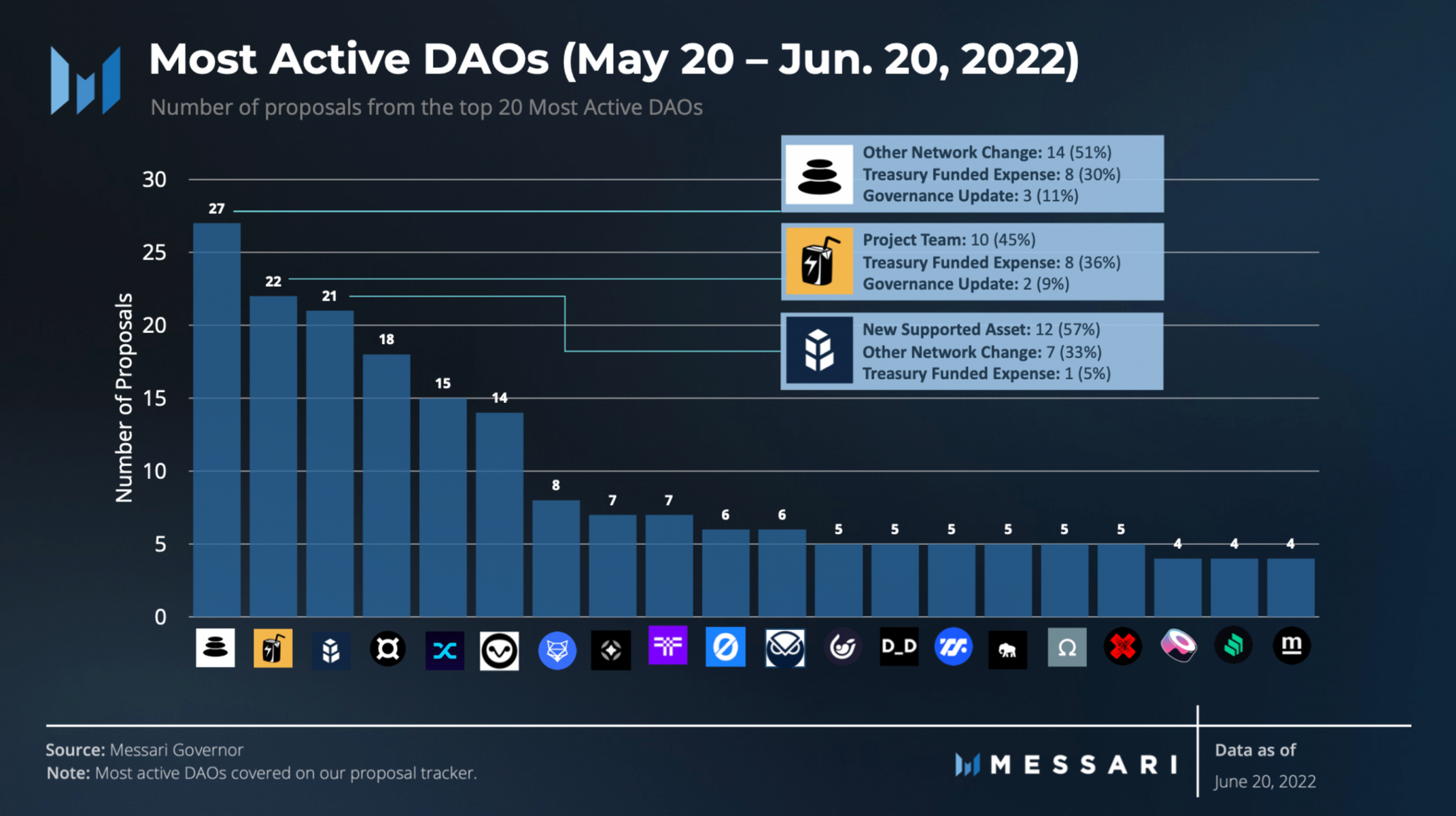
A DAO’s proposal activity can vary depending on its governance process and structure. For example, following Balancer’s veBAL gauge activation, over 50% of Balancer’s recent proposals have related to the veBAL gauge system. A diverse range of proposals also followed the new tokenomics related to Treasury Funded Expenses and Governance. There were votes to form an Emergency SubDAO and approve a new Operating Framework (BIP 1). These programs introduced the adoption of “Balancer Improvement Proposals (BIPs)” and streamlined the processes for the DAO’s service providers.
JuiceBox DAO uses a 14-day funding cycle that requires the DAO to update contributor payouts via governance. This approach results in many proposals and votes compared to other DAOs. About 64% of the DAO’s proposals tracked in the last month were rated “Low Importance,” indicating that most were routine, although the number of proposals was high.
In contrast, Bancor’s governance is largely influenced by its status as a decentralized exchange (DEX). Its governance votes were often to approve support for new assets, reflected by the New Supported Asset category. These proposals accounted for 57% of the submissions between May 20, 2022, and Jun. 20, 2022. Another common proposal category for Bancor governance is Other Network Change. This often accounts for the DAO’s active management of asset pools through actions such as disabling deposits or adjusting trading liquidity limits.
Notable Discussions:
ApeCoin x Immutable X Integration: This proposal explores a partnership with Immutable X to utilize Immutable X’s ZK-rollup to achieve scalability for the ApeCoin DAO. Immutable X will become a strategic partner and provide the ApeCoin DAO with access to the 500 million IMX Development Fund.
mStableDAO Restructure (TDP 44): This proposal is the first of four proposals regarding the restructuring of the mStableDAO. TDP 44 will introduce a general universal contributor title and elections process for the Asset Management and Treasury subDAO. The Asset Management and Funding subDAOs would be absorbed by the Treasury subDAO, and the proposal introduces a new Product and Builder subDAO.
Alchemix Aave Launch Strategy Configuration (AIP 52): AIP 52 outlines the configurations and parameters for all Aave V2 strategies launched on Alchemix. The strategies will use the following assets as accepted collateral: DAI, USDC, USDT, ETH, aDAI, aUSDC, aUSDT, and aETH. The proposal will also reduce the deposit caps on the Alchemix Yearn vaults for yvDAI, yvUSDC, yvUSDT, and yvWETH.
Notable Active Votes:
FXS Buyback Program Using TWAMM (FIP 77): This proposal from Frax founder, Sam Kazemian, aims to use 20 million FRAX to buy back FXS using Fraxswap Frax-FXS TWAMM pair. This buyback will last a minimum of 3 days. The FXS bought back will be either burned entirely, placed in veFXS, or retained in the treasury until a future governance proposal allocates it.
Tokenomics Update Phase 1: Goldfinch Membership (GIP 13): GIP 13 represents Phase 1 of the Goldfinch V2 Tokenomics roadmap and aims to establish the Goldfinch Membership system. Phase 1 will allow members to receive a share of protocol fees and greater governance voting power by locking up their GFI tokens and invested capital (either from the Senior Pool or Borrower Pools).
Governance Process - Amendment 5 (JBP 215): This proposal aims to amend the Juicebox DAO governance process by removing temperature checks, changing the snapshot quorum from 15 voters to 80 million affirmative JBX, removing emergency governance processes, and requiring proposals to specify multisig actions.
Notable Closed Votes:
Creation of the TrueFi DAO: TrueFi DAO successfully adopted on-chain governance using OpenZeppelin Governor smart contracts and Tally. On-chain governance allows for the execution of code directly on-chain, delegation and voting using sktTRU. The new system will adopt a proposal threshold of 100,000 stkTRU, a quorum threshold of 15%, and an approval threshold of 50%.
Gnosis x MakerDAO Partnership (GIP 49): This successful proposal, authored by KarpatKey, established a partnership and token swap with MakerDAO. The proposal approved a $70 million GNO-MKR token swap, the rebrand of xDAI (the Gnosis chain’s native token) to DAI, and an intent to explore using a MakerDAO vault with the Gnosis DAO treasury to mint 100 million DAI (using GNO and stETH) to fund Gnosis Chain development.
Ribbon Bond Issuance (RGP 17): This proposal approved the issuance and sale of $3 million of convertible bonds backed by $15 million worth of RBN collateral. Ribbon DAO will issue the bonds through Porter Finance. The capital raised will be used to bootstrap Ribbon DAO protocol-owned liquidity, stablecoin supply in the Ribbon Fuse pool, or undercollateralized lending through Maple Finance.
In October 2021, Merit Circle Ltd (MCL) announced a $4.5 million seed round to scale Merit Circle’s operations and accelerate the play-to-earn industry. Investors participated using a Simple Agreement for Future Tokens (SAFT), a security agreement that allows investors to convert a cash investment into the right for future tokens. Following the launch of the MC token, the Merit Circle DAO adopted authority of the token supply, and MCL transitioned from the Merit Circle bootstrapping entity to a core contributor of the DAO.
Yield Guild Games (YGG) and Co-Founder Gabby Dizon participated in the Merit Circle seed round, committing $175,000 in exchange for 5,468,750 MC tokens at a rate of $0.032/MC. The seed round accounted for 14.06% of the total MC token supply and was subject to a 6-month cliff and 36-month linear vesting schedule. The YGG deal was split between a $100,000 investment from YGG and a $75,000 investment through Gabby Dizon’s personal fund, Nifty.
Following the seed round, the MC token value rose to an all-time-high on Dec. 2, 2021, of $11.70 before falling to a market cycle low of $0.68 on Jun. 15, 2022. Despite market volatility, seed round investors have remained insulated even at all-time-lows and have enjoyed a 20x valuation at the lowest market prices.
In April 2022, in anticipation of the expiring 6 million cliff, Merit Circle Ltd. issued an Accountability & Transparency Initiative. The post asked early investors to demonstrate their value-added to Merit Circle and long-term intentions. The controversial initiative requested that the 10 entities and 28 individuals who participated in the seed round respond. YGG, one of six total respondents, published their Contributions post on May 6, 2022. YGG cited access to investor networks, co-investments with Merit Circle, an offer to lend assets to Merit Circle, coordinated marketing, and two articles as contributions. Merit Circle also committed to staking its first tranche of MC tokens for one year.
Community member AdmiralErik immediately expressed discontent with YGG’s contributions. On May 20, 2022, Honey Barrel escalated the critique with MIP 13, an unprecedented attempt to cancel YGG’s SAFT investment, refund YGG and Gabby Dizon, and return the SAFT tokens to the DAO. With no voting power until their tokens unlocked, YGG’s investment was subject to the community’s decision, unless they wanted to buy up enough market MC to sway the vote. The proposal was instantly controversial. Honey Barrel’s reasoning concluded that YGG was a competitor, “only interested in extracting profit,” and against the ethical principles of Merit Circle. YGG called the allegations unfair, stating that “none of the seed investors are obligated under the legal documentation of the SAFT to provide any specific value add services.” Despite community support for MIP 13, both BambinoValue and CryptoLawyer explored the proposal's immediate and downstream legal consequences. They expressed that enforcing a claim in contract towards the DAO could be impossible given the DAOs lack of legal status. Although the SAFT did not include terms that required investors to provide services, Michael Tant, the co-founder of CitizenX, expanded on the legal gray area. Michael explained that the Merit Circle Ltd formation documents limited Yield Guild Games’ right to sue since the documents clearly stated that token authority would be transferred to the DAO and away from MCL.
While MIP 13 ultimately succeeded, a last-minute clause to MIP 13 delayed the proposed actions and gave YGG one week to submit a counter-proposal. Following MIP 13’s success, Simone Conti and Ozan Polat from Dialectic (a seed investor in both YGG and Merit Circle) published a proposal urging the Merit Circle community to extend the deadline for a response to an additional three weeks. The post underlined the gravity of a SAFT cancellation and warned of unforeseen “2nd and 3rd order implications'' for the greater ecosystem. The extension was ultimately unnecessary as, on Jun. 4, 2022, MIP 14 introduced an agreement in which Merit Circle would purchase YGG’s token allocation at a 10x valuation of $0.32/MC. The agreement earned the blessing of the community’s most active proponents of MIP 13, including Honey Barrel, Sad Cat Capital, and AdmiralErik. Following MIP 14’s approval on Jun. 9, 2022, YGG and Merit Circle Ltd released a joint statement on Jun. 14, 2022. The statement listed additional contributions YGG made to the DAO, including providing access to a network of investors and consultation around Axie Infinity breeding strategies, and reflected Merit Circle Ltd.’s position that the return of YGG’s tokens was never “the intention or desire.” In the end, MIP 14 offered de-escalation from a potentially costly legal battle, and YGG received an immediate exit from its position (at a 10x return) at the beginning of what could be a prolonged bear market.
Reviewing the DAO Legal Landscape
The precedent of Merit Circle DAO reverting a signed SAFT agreement exposes unclear legal grounds that VCs may overlook. The legal jurisdiction is reminiscent of a similar case in which community members of the Juno Network DAO attempted to remove a large whale’s token allocation, claiming that the whale unfairly gamed an airdrop. These events will likely dismay some investors from participating in future SAFT deals. The settlement also frames a recent trend in DAO legal structure, which has seen DAOs looking to protect themselves against pending legislation. Messari Governor has covered a handful of proposals exploring regulatory frameworks, many of which have reached a successful consensus in DAO governance.
In June, a leaked draft of the Lummis-Gillibrand Responsible Financial Innovation Act surfaced on Twitter. Included in the draft was Sec. 204 Decentralized Autonomous Organizations, which defined a DAO as an entity “properly incorporated or organized under the laws of a State or foreign jurisdiction as a decentralized autonomous organization, cooperative, foundation, or any similar entity.” If passed in its current form, the bill would require DAOs to register as recognizable entities by December 31, 2022, conceivably adding a more transparent legal environment for investors.
As DAOs mature, Venture Capital firms haven’t shied away from educating DAOs on adopting legal structures. It seems likely that investors will request greater clarity and legal protection when investing in DAOs. Increasing research in regulation and DAO legal frameworks is something a majority of firms, including a16z and Paradigm, will continue to embrace moving forward. Merit Circle’s recent actions have unintentionally highlighted at least one reason why.
An Insurance fund is a crucial component of any exchange that allows leveraged trading because it gets used to cover unexpected losses and prevent bankruptcy during liquidations. According to the Perp Protocol litepaper, two main scenarios could trigger the use of the Insurance fund: the insolvency risk due to losses incurred from failed liquidation during market volatility and the imbalance between long and short positions resulting in a negative equity balance from funding payments. In these scenarios, the protocol uses the Insurance fund and mints new PERP tokens to sell and settle traders when the fund gets depleted. However, the Perp Protocol team no longer maintains Perp v1. The new Perp v2 was developed to tackle limitations from v1, but there were still traders who had open positions in v1 regardless. As a result, during market volatility on May 15, 2022, the team had to decide between allowing the Perp v1 Insurance fund to get drained or pausing its operation to sunset the exchange and settle traders with its remaining funds (5.5M USDC). They chose the latter. The liquidation from the market volatility resulted in a loss of over $5.7M for Perp v1. The team had offered four options for a Settlement Plan detailed here.
A Google sheet to show the outcome of either of the four options reveals a disproportionate distribution of the funds between users. Option 1 favors users with large positions, Option 2 seems to provide an equitable balance for all users, Option 3 tends to users with the smaller positions before the pause, and Option 4 is a variant of Option 2. While some users argue about favoring those with the smaller positions, others like Non2 pointed out that every trader using the protocol as intended should be considered the same and take an equal share of the protocol loss proportional to their position. Most users lamented how the shutdown impacted them because they had protected positions only to get forced to realize their losses. Thus, according to the Perp docs, the consensus supported minting new PERP tokens. But Perp Protocol's Head of Operations, Hana Mizuki, stated that the team had abandoned the minting mechanism to use Perpetual DAO funds instead. And should that be considered, the community can submit it for voting. Following this consideration, a new proposal to unlock 27.6M PERP tokens and compensate users was raised for discussion. The proposal borrowed elements from some of the suggestions argued in the original submission. Still, it failed to gather momentum as users deliberated many alternatives to the four proposed options, including:
using forms for compensation to shave off some accounts;
sorting users' positions for Option 2 by margin ratio rather than size to avoid penalizing those protecting their positions;
closing positive PnL to pay cost basis, then negative PnL closure with any remaining collateral used to repay the position, while positive PnLs get the remaining funds;
using the PERP in the staking pool, which shoulders the protocol risks to compensate users according to the protocol documentation. This option was countered by LeeKB, who pointed out that the litepaper and whitepaper described the idea behind the project but were not the final implementation.
As the community voted on the available options, LeeKB reminded users that there was not sufficient data to analyze the diverse community options. Therefore, a second vote will require more detailing if the option voted was to evaluate one of the alternative proposals from the community entirely.
This proposal reveals a misalignment between Perp protocol users' expectations from its documentation and the protocol functionality. It also begs the question regarding what constitutes informed votes as the community debated the different options. But the most telling point is that more options are not always better with DAO voters. This is evident from the follow-up proposal to provide additional reimbursement with Perpetual DAO funds to users who had received less in Option 2 than they would have received with Option 4. Even though it seemed like the consensus initially, the proposal failed, conceivably due to voter fatigue.
DAO Directory
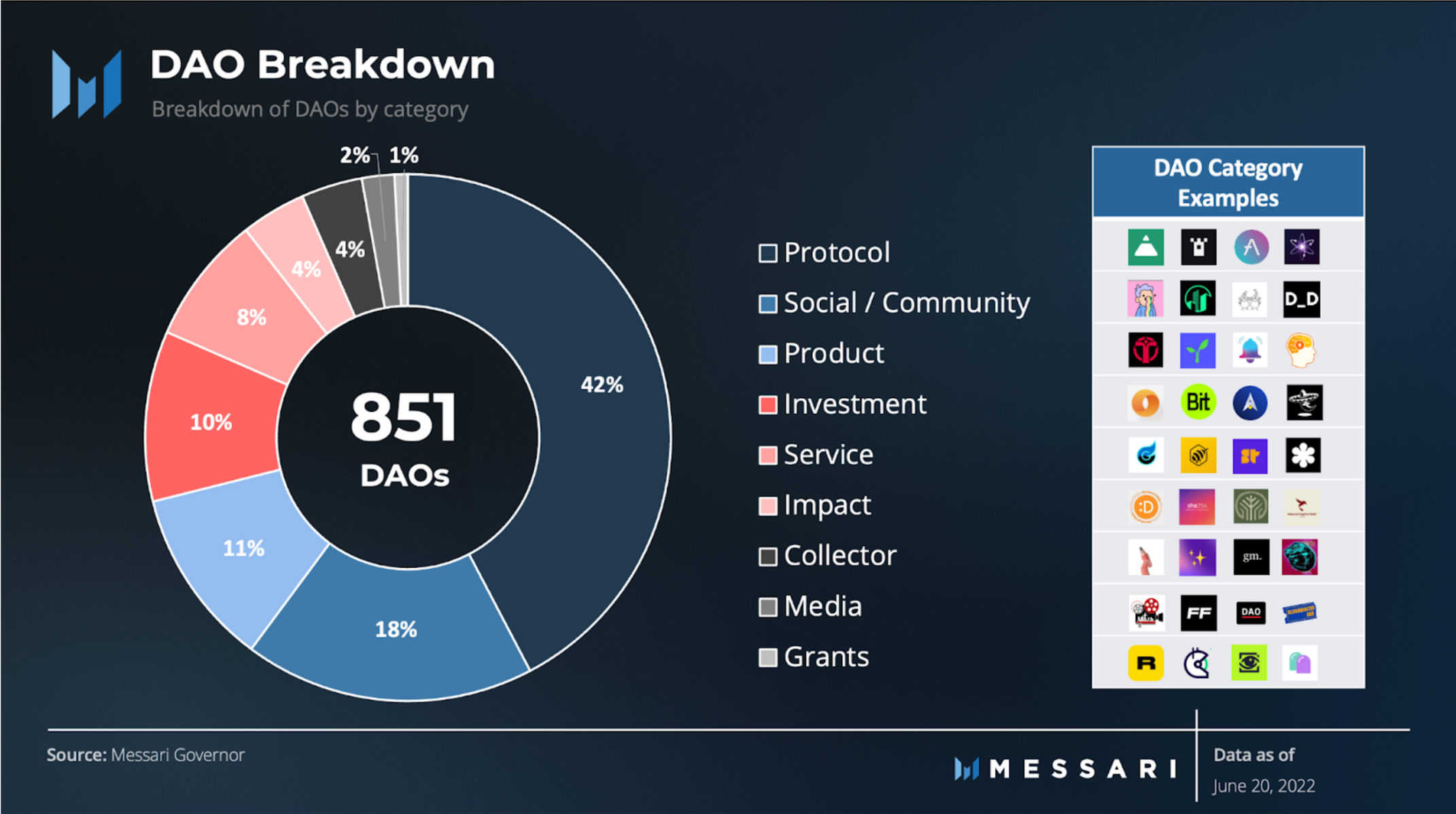
The DAO landscape has diversified significantly since DeFi Summer, which emphasized DeFi products and a resurgence of protocol DAOs. While Protocol DAOs still represent 42% of DAOs, the second-largest category, Social / Community, represents both the rise of on-chain communities and the popularity of NFTs. DAOs such as Doodles, CityDAO, and Friends with Benefits represent online communities focused on ownership and decentralized governance. As the DAO landscape has grown, so has the appetite for crypto-native investment communities such as MetaCartel, Merit Circle, and BitDAO, which currently occupy 10% of the DAO landscape. However, popularity is not always indicative of value. While Grants DAOs, like Gitcoin, represent just 1% of the entire DAO landscape, the impact of these DAOs that spent more than $200m in the last couple of years cannot be understated.
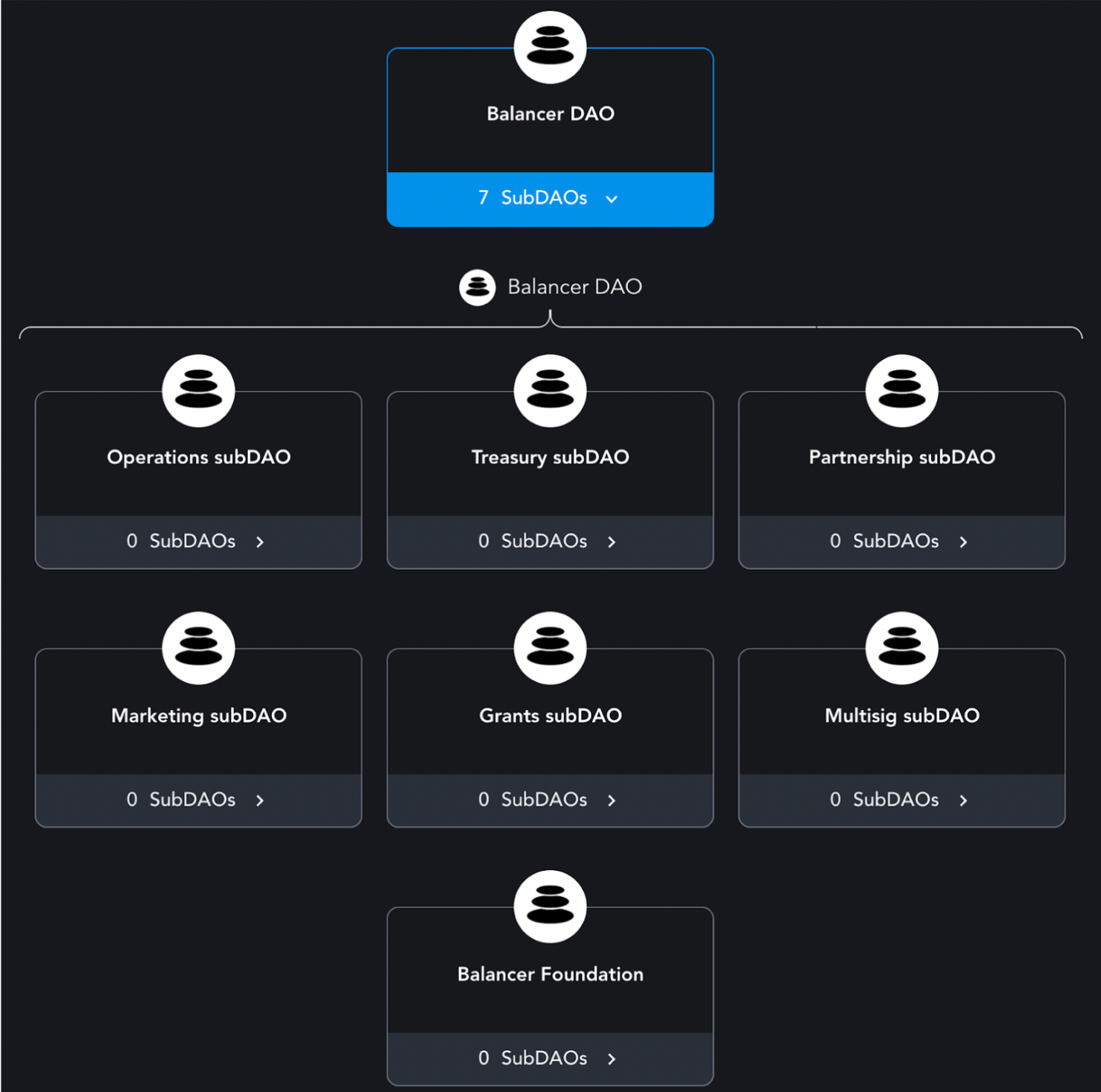
Balancer is among the most active DAOs. The DAO has published 144 proposals since Messari Governor’s launch. Anyone can participate in Balancer DAO governance discussions and votes if they hold BAL tokens. Balancer DAO is currently organized into subDAOs, which function as autonomous groups of contributors empowered by BAL token holders to act on behalf of the DAO in specialized roles.
The new Operating Framework for the DAO introduces a switch from the current subDAOs structure into a Service Provider (SP) structure. Although the SPs and subDAOs can be used interchangeably, the uniqueness of the new structure is that SPs are not internal units within the DAO. They act as external contracting entities that could be an incorporated legal entity or simply a loosely organized group of anonymous Balancer contributors. These entities will get funded to deliver short-term or one-off services to the DAO from its treasury and through its legal proxy, the Balancer Foundation. Notably, the new design allows the DAO to interface with legal bodies for services and sign contractual agreements through the Balancer Foundation. There are currently seven Service Providers funding proposals to replace the subDAO structure as follows:
The Balancer Foundation remains the legal proxy for the DAO operating on a formal scale and engaging with service providers who require formal contracts.
Balancer Grants DAO Service Provider will act as managers of an independent Balancer Grants Program to accelerate the development of the BAL ecosystem while optimizing contributor rewards.
Orb Collective is a group of former Balancer Labs and Balancer DAO contributors to provide scale and grow the Balancer protocol through partnerships, marketing, integrations, design, and people operations work.
Balancer Maxis are the Balancer community contributors focused on maintaining the protocol and offering Multisig management, Governance, Community, User/Project support, and Record-Keeping.
Balancer Community Group (BCG) provides services to the DAO in the Marketing and Growth domain to build relationships, networks, strategic partnerships, events, and media cooperations.
Kolektivo a.k.a Ecosystem Ops and Development Squad, operates in the DAOops, Business Development, and Design domains.
Front-end team will be the Service Providers tasked with maintaining the Balancer front-end interfaces.
DAO Tool Directory
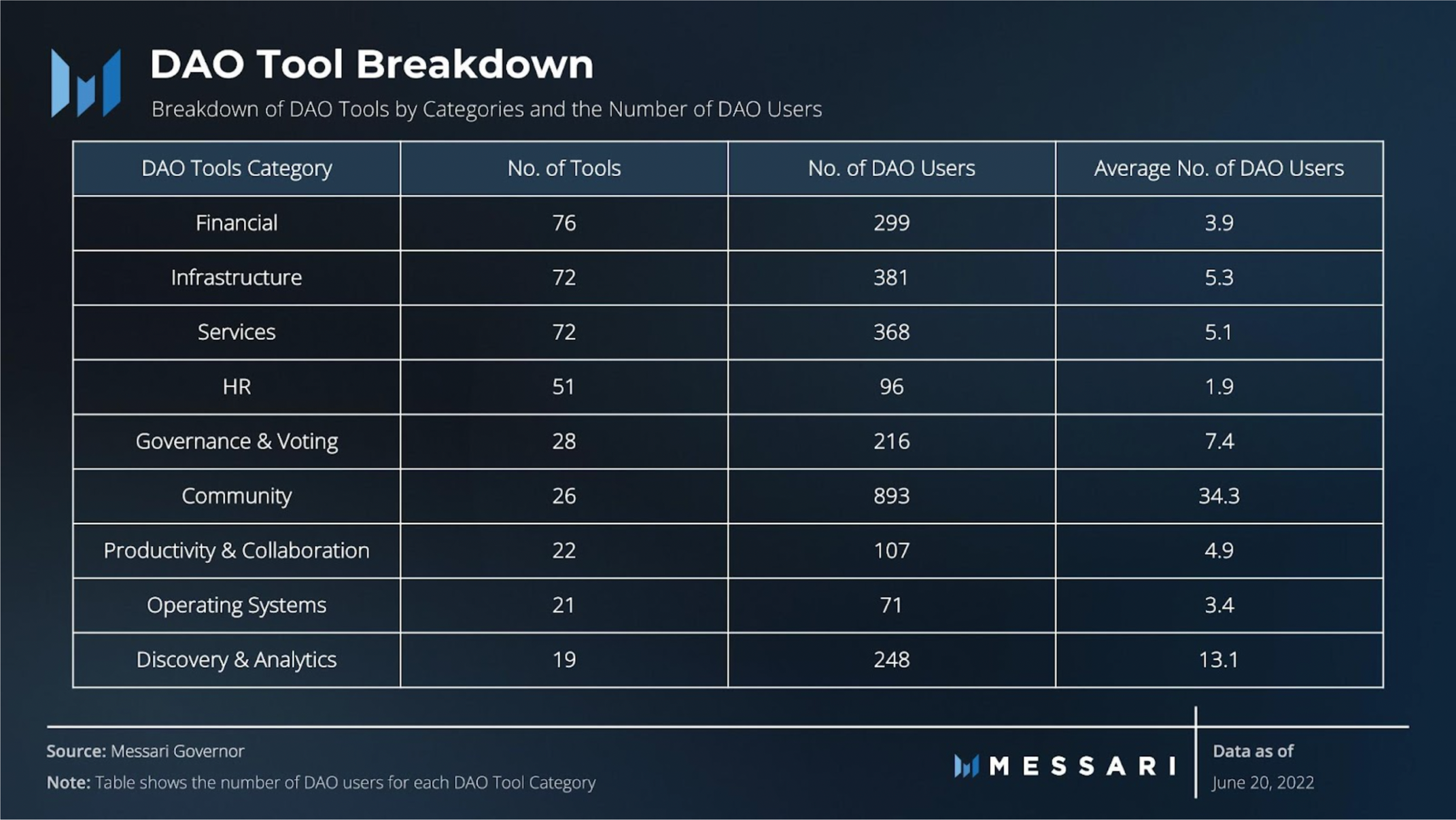
Financial (19.7%), Infrastructure (18.6%), and Services (18.4%) tools are the most popular categories in the DAO landscape. Many financial tools align with the prevalence of Protocol DAOs and their strong demand for financial management tools (treasury, asset, liquidity, or yield management) or support (compensation, fundraising, or taxes). Similarly, infrastructure (identity, reputation, and access control) and services tools (software development or security) may be replete because they often serve a broader range of users. On the other hand, coordination and contributor management tools in the HR category and tools enabling governance & voting have grown in the past year as the number of DAOs rises. We can also witness this rising number in the Operating Systems category, with new entrants (Syndicate, Tribeca, Myco) providing DAO creation and management alongside older enablers like Aragon, DAOstack, and DAOHaus.
We analyzed the DAO tools directory to understand what tools were in the most demand by DAOs regardless of their types, whether a product or protocol, impact or investment DAO, etc. Community tools were the most utilized, followed by Infrastructure and Services tools. DAOs are community-first organizations, so having discussion (Discord, gm.xyz, Telegram), publishing (Mirror, Medium), and moderation tools (mee6bot, Sesh) on top of our list is not surprising. In terms of infrastructure tools, developer tooling is the most used, likely because they are network agnostic (Github) and available on many networks (The Graph, Alchemy, Parsiq). This demand is concentrated across a small group of community tools (26) compared to Infrastructure and Service' (72) or Financial tools (76). Tools in the Discovery & Analytics category were the fewest, suggesting that this category may be a blue ocean.
All content was produced independently by the author(s) and does not necessarily reflect the opinions of Messari, Inc. Author(s) may hold cryptocurrencies named in this report. This report is meant for informational purposes only. It is not meant to serve as investment advice. You should conduct your own research and consult an independent financial, tax, or legal advisor before making any investment decisions. Nothing contained in this report is a recommendation or suggestion, directly or indirectly, to buy, sell, make, or hold any investment, loan, commodity, or security, or to undertake any investment or trading strategy with respect to any investment, loan, commodity, security, or any issuer. This report should not be construed as an offer to sell or the solicitation of an offer to buy any security or commodity. Messari does not guarantee the sequence, accuracy, completeness, or timeliness of any information provided in this report. Please see our Terms of Service for more information.
No part of this report may be (a) copied, photocopied, duplicated in any form by any means or (b) redistributed without the prior written consent of Messari®.
Tomas Molin is the research lead of Messari Governor. Prior to joining Messari, Tomas worked at Ardian in the Growth Equity team focusing on technologies. At Messari, he began within the Intel team covering DeFi and governance related topics before taking the lead of the Governor team when the product was launched.
Tomas Molin is the research lead of Messari Governor. Prior to joining Messari, Tomas worked at Ardian in the Growth Equity team focusing on technologies. At Messari, he began within the Intel team covering DeFi and governance related topics before taking the lead of the Governor team when the product was launched.