Gear Protocol is a general purpose Substrate-based cloud infrastructure and smart contract platform. Gear features are tailored for asynchronous programming and parallel execution, including the actor model, persistent memory, and the WebAssembly execution environment.
Vara Network is the first Layer-1 developed using the Gear Protocol. It seamlessly integrates Gear Protocol's suite of features.
The Vara Network Mainnet has launched after two years of development, featuring over 40 applications and integration with 30+ ecosystem partners.
Background
Gear Protocol was introduced in September 2021 by core developers who were involved in the genesis of Polkadot and Substrate.
Co-founder and CEO Nikolay Volf has been involved with Polkadot and Substrate since 2015, spearheading the first WebAssembly smart contracts at Parity Technologies. Co-Founder and CFO Ilya Veller has over two decades of experience in the finance sector with firms like Renaissance Capital, Morgan Stanley, and Bank of America. Aleksandr Bugorkov, the Co-Founder and Head of Development, has technology experience with companies like Lyft, New Relic, and Spotify. CTO Petr Volynskiy brings expertise in product development and technical leadership.
In December 2021, Gear Protocol completed a $12 million venture round led by Blockchain Ventures with participation among others from Three Arrows Capital, Lemniscap, Distributed Global, and individuals from the Web3 Foundation and Parity Technologies.
In the year following Gear Protocol's introduction, the core developers actively integrated it into the Polkadot ecosystem. They established connections with various wallets, data platforms, and governance platforms. In February 2023, Vara Network was unveiled as Gear Protocol's inaugural Layer-1 network. In September 2023, its PoS mainnet launched.
As of this report, both Gear Protocol and Vara Network have transitioned to community-led development and are on a path towards continued decentralization.
Gear Protocol
Overview
The Gear Protocol is a Substrate-based smart contract platform utilizing WebAssembly (Wasm) programs. This enables it to compile contracts from diverse programming languages like Rust, C, and C++. The protocol's APIs enable deployment across several networks without needing to modify the contract. Unique to Gear are features tailored for asynchronous programming, including the actor model, persistent memory, and the WebAssembly execution environment.
Substrate
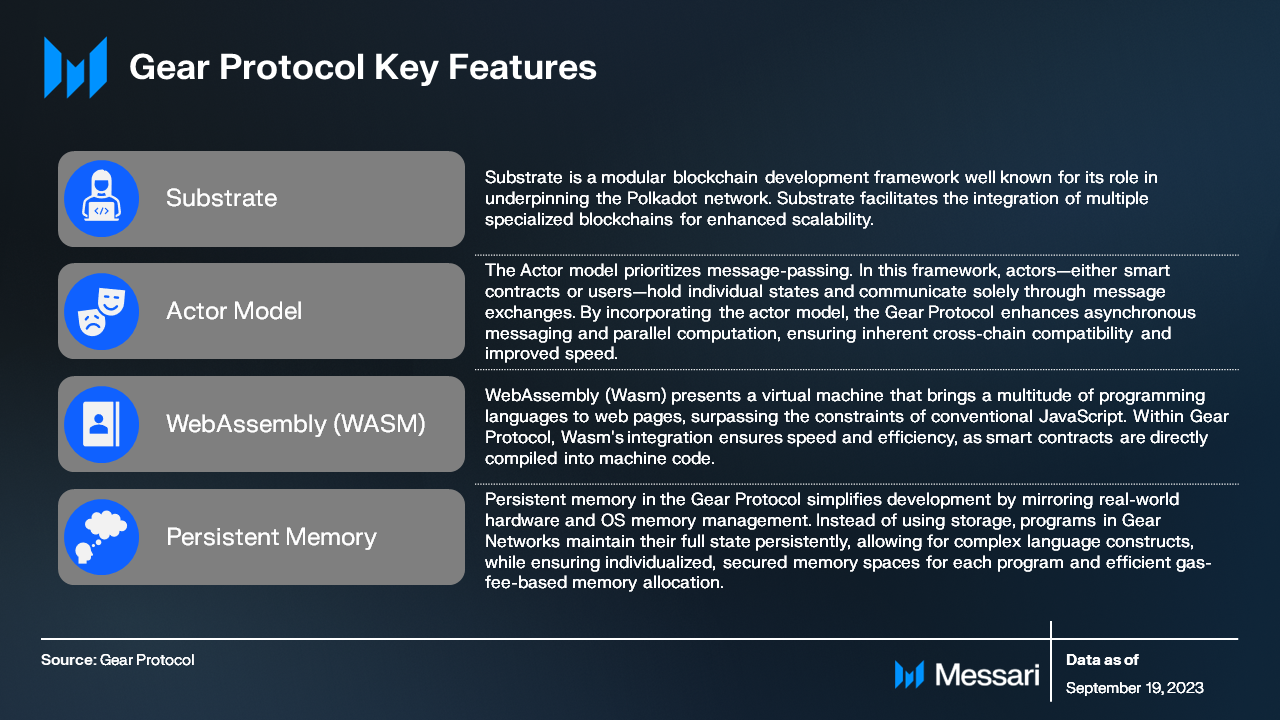
Substrate is a modular blockchain development framework well known for its role in underpinning the Polkadot network. Substrate facilitates the integration of multiple specialized blockchains for enhanced scalability. Key Substrate features include:
Forkless updates
Built-in coordination
Cross-language support via WebAssembly
Light-client adaptability
Guaranteed finality
Easy integration
Leveraging Substrate, Gear Protocol accelerates the development process, highlighting its core components and capitalizing on the security and efficiency of Rust. This streamlines the experience for developers, allowing them to concentrate on business logic of their specific projects without building a complete blockchain infrastructure. Moreover, it simplifies integration into the Polkadot and Kusama networks for projects developed under Gear Protocol.
Actor Model
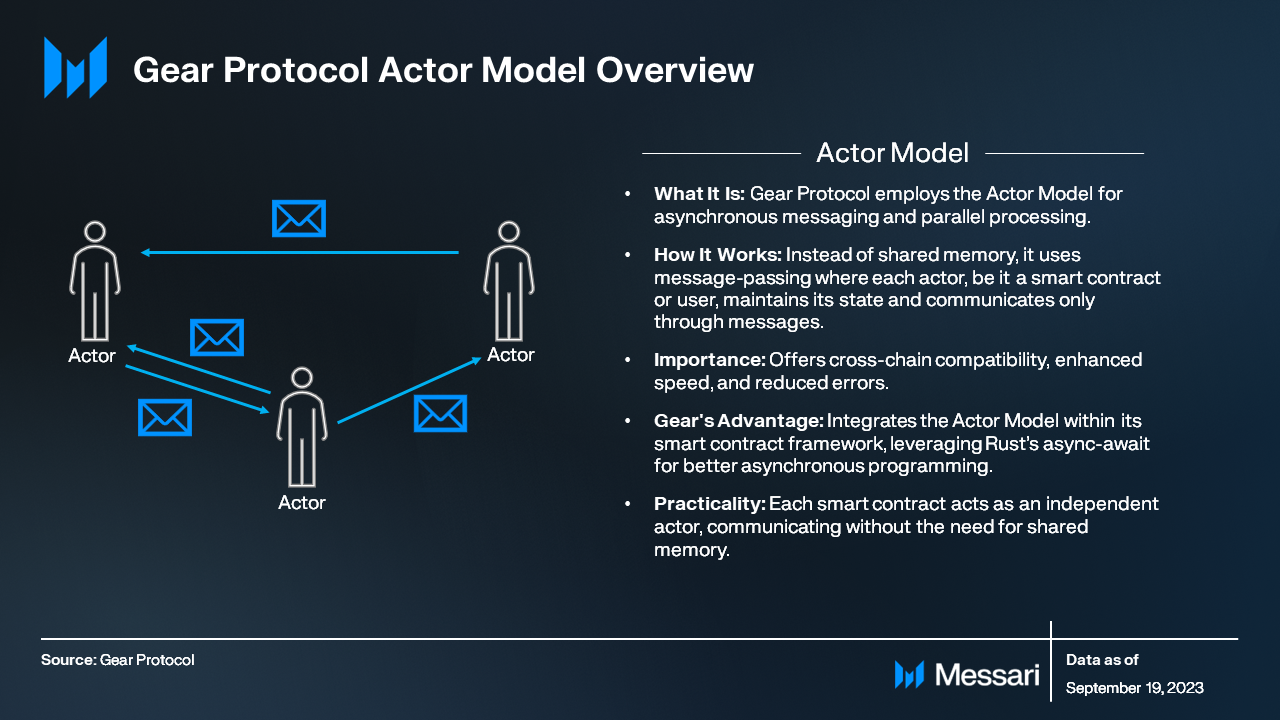
Utilizing the actor model, Gear Protocol optimizes asynchronous messaging and parallel processing, ensuring cross-chain compatibility and enhanced speed. Contrary to systems that rely on shared memory communication, the actor model emphasizes message-passing. Within this structure, actors, whether they are smart contracts or users, maintain individual states and interact exclusively through message transmissions. Gear Protocol further refines this process by implementing mechanisms that maintain sequential messaging.
Actors can modify their state, initiate new entities, or engage without the need for shared memory. Gear Protocol seamlessly incorporates the actor model into its smart contract framework, leveraging Rust’s async-await for asynchronous programming. This methodology directly accommodates the async/await syntax, minimizes errors, and provides both synchronous and asynchronous messaging options.
WebAssembly (WASM)
WebAssembly (Wasm) is a binary instruction format designed as a portable compilation target for high-level programming languages. It allows code written in languages like C, C++, and Rust to be executed in web browsers and other environments at near-native speed. Wasm is designed to be secure, efficient, and platform-independent, making it suitable for a wide range of applications, including web applications, gaming, and more. Within Gear Protocol, Wasm's integration ensures speed and efficiency, as smart contracts are directly compiled into machine code, ensuring optimal performance with reduced transaction fees.
Advantages of WebAssembly include:
Speed & cross-platform compatibility.
Readable format enhancing manual code intervention.
Safe execution in a sandboxed environment in line with typical web security protocols.
Language versatility, as Gear Protocol supports Rust and has potential for future C#/C++, Go, and JavaScript adaptations.
Persistent Memory
Gear Protocol utilizes persistent memory, reflecting real-world hardware characteristics to simplify development. By choosing persistent memory over traditional storage, Gear preserves the complete program state, facilitating the use of sophisticated language structures. Through enhanced memory virtualization, Gear directly manages memory allocation.
Within Gear's framework, parallel message processing aligns with CPU cores, ensuring efficient task handling. Messages are categorized based on their designated programs, permitting multiple messages to instruct a single program within a processing cycle. Once processed, messages re-enter the queue for subsequent cycles.
Highlighted Capabilities
Through the platform’s custom runtime powered by the actor model and persistent memory technologies, Gear Protocol offers technical capabilities such as:
Decentralized Execution: Unlike most platforms requiring external triggers for smart contracts, Gear's asynchronous messaging enables contracts to send delayed messages. This promotes richer applications, genuine decentralization, and increased user value.
Messaging Automation: All Gear messages consume gas. With its gas reservation system, if a program's gas runs low, it can use reserved gas. Notably, contracts can schedule messages for future actions, similar to traditional cron jobs, ensuring multiple autonomous onchain operations as long as gas is available.
Payless Transactions: Gear introduces vouchers for a superior user experience. Issued by network entities, vouchers let users message specific programs without gas fees. This mirrors conventional web services, increases user engagement, and simplifies application adoption, making the decentralized space more inclusive and user-friendly.
More intricate examples of complex program logic or microservices architecture for use cases in sectors like DeFi, Gaming, Social, and applications include onchain automation, time-delayed messaging, stop-loss mechanisms, dollar-cost averaging strategies, auto-compounding features, limit-order functionalities, and subscription services.
Vara Network
Overview
Vara Network is the inaugural Layer-1 platform developed using the Gear Protocol. It seamlessly integrates Gear Protocol's suite of features, including the actor model, persistent memory, WASM, and more. Built on the Substrate framework, Vara ensures forkless runtime upgrades. Additionally, it boasts features like reduced transaction fees, staking, active governance, and ambassador programs.
In contrast to most Layer-1 platforms, including newer entrants like Sui (which focuses on sharding but lacks parallel execution) and Aptos (which offers parallel execution but omits sharding), Vara is designed to support both sharding and parallel execution. Additionally, Vara optimizes the developer experience through precise data specification.
Vara Token
VARA is Vara Network's native token with a total supply of 10 billion. The distribution is as follows:
Founders/Team/Advisors: 20% is locked for a year, followed by 36 months of linear vesting.
Investors: 21.5% remains locked for 12 months, then undergoes 12-month linear vesting.
Foundation: 23% are allocated for education, public relations, events, foundational, and ecosystem development operations. This also includes market maker activities and liquidity management.
Community: 35.5% are designated to support developer and validator grants, airdrop programs, and to counterbalance inflation in the total token supply
Every network operation utilizes VARA, including transaction fees, staking, and governance mechanisms. Community members are exploring a model to reward application developers, drawing parallels with existing systems like Astar, Archway, and Evmos. If this developer rewards model were to be adopted, tokens would automatically be allocated as a portion of the block rewards.
VARA features an annual inflation rate of 6%. To mitigate the impact of inflation, 10% of the total token supply is allocated for an Inflation Offsetting Pool. Approximately one-third of the block rewards, which are secured by the foundation, are channeled into this pool to replenish it. Tokens from this pool are subsequently sent to a designated burn address. Through community governance, there is the option to reallocate funds from this pool toward developer grants, or to partition a segment of block rewards into a protocol treasury for the purpose of encouraging future growth. Additionally, community voting can be used to adjust the annual inflation rate downward.
Staking
Vara implements a Nominated Proof-of-Stake (NPos) consensus model. This approach, also used by Polkadot, diverges from the Delegated Proof-of-Stake (DPoS) consensus as nominators who stake their VARA are exposed to slashing risk.
Validators are paid every 12 hours for completing payable actions, known as era points. Every 12 hours, a subset of validators are randomly assigned to validate with a multiplier on the era points earned. The combination of era points and random validation results in a probabilistic guarantee that validators earn nearly identical rewards. Because validators earn near equal rewards and distribute these rewards pro-rata to their nominators, nominators are incentivized to stake with lower-staked validators to earn higher rewards. The validator-nominator reward model is designed to decentralize Vara Network’s validator set.
Governance
Vara leverages the OpenGov framework as its native governance model. The OpenGov framework, which is also used by Polkadot, allows any VARA holder to participate in Vara’s governance.
OpenGov enables every decision within the Vara Network to result from referenda proposed by the community. Multiple referenda can run simultaneously, accelerating the approval of motions. Proposals are categorized into tiers with specific conditions, such as designated voting periods, a maximum number of eligible votes at a time, and a required VARA deposit. As tiers increase, the conditions for passing a proposal become more stringent.
OpenGov also has a governing body known as the Fellowship. The Fellowship fulfills three primary roles: acting as a technical advisor, maintaining and developing core protocols and code, and promoting VARA’s technology. The Fellowship functions like a developer DAO, allowing all users to join and reducing centralization concerns. A ranking system featuring multiple mechanisms ensures decentralization, including a constitution, community voting for senior positions, and checks and balances to limit leadership control. While the Fellowship cannot pass referenda, it can whitelist them, making them easier and quicker to pass.
The model also introduces flexibility for delegation, allowing users to delegate their voting power based on conviction and the number of tokens committed. The new delegation features aim to ensure required turnouts for proposals, while preserving voter anonymity and maintaining a censorship-free design.
Each of these networks emphasize unique trade-offs. The Cosmos Interchain, leans heavily towards sovereignty. In contrast, the Ethereum and Polkadot ecosystems place a higher emphasis on shared security.
A significant portion of users are rooted in EVM chains. To stand out, it's imperative to present developers with an enhanced development experience. Further, they'll need to draw in and retain users, likely by introducing a groundbreaking application or feature.
Progress and Future Path
Since its unveiling in late 2021, the core team has been proactive in integrating Gear Protocol and Vara Network into the Substrate ecosystem. They've established integrations with top ecosystem wallets such as Talisman, SubWallet, and Nova Wallet. Additionally, they've formed partnerships with notable parachains and Substrate ecosystem ventures, including Crust Network, Automata Network, Polkassembly, Subscan, to name a few.
Vara Network initiated its testnet in 2023, which, as of this report, boasts over 20,000 participants. These individuals have engaged in activities like NFT minting, gaming, and staking.
The Vara Network mainnet was also unveiled recently this year. As they progress, the foundation aims to support the community to enhance core technologies, expand functionalities, and attract a broader user base.
Conclusion
Gear Protocol is a Substrate-based cloud infrastructure and smart contract platform designed for asynchronous programming and parallel execution, offering features like the actor model, persistent memory, and WebAssembly execution. Vara Network, the first Layer-1 built on Gear Protocol, seamlessly incorporates its feature set. On September 20, Vara Network's Mainnet launched after two years of development, boasting over 40 applications and partnerships with 30+ ecosystem collaborators.
Gear Protocol and Vara Network are entering a hyper-competitive blockchain environment. Their success hinges on harnessing the network's core capabilities to craft a compelling and unparalleled user and developer experience.
This report was commissioned by Gear Foundation. All content was produced independently by the author(s) and does not necessarily reflect the opinions of Messari, Inc. or the organization that requested the report. The commissioning organization may have input on the content of the report, but Messari maintains editorial control over the final report to retain data accuracy and objectivity. Author(s) may hold cryptocurrencies named in this report. This report is meant for informational purposes only. It is not meant to serve as investment advice. You should conduct your own research and consult an independent financial, tax, or legal advisor before making any investment decisions. Past performance of any asset is not indicative of future results. Please see our Terms of Service for more information.
No part of this report may be (a) copied, photocopied, duplicated in any form by any means or (b) redistributed without the prior written consent of Messari®.