Fuse: The Energy Network and TGE

Key Insights
- Fuse’s Energy Network targets an inefficiency in modern electricity markets: renewable energy is increasingly cost-effective, but grid congestion, balancing costs, and peak demand dynamics prevent those savings from reaching customers.
- Fuse is already servicing approximately 200,000 households with over $400 million ARR, primarily through its UK retail energy and installation businesses, providing an existing customer base to bootstrap the adoption of The Energy Network.
- The Energy Network functions as a crypto-incentivized coordination layer for distributed energy resources (DERs), such as batteries, EV chargers and solar panels. The network aggregates flexible household demand and device-level control into a virtual power plant that reduces costs for participants and the entire grid.
- ENERGY tokens are earned through verifiable grid services, such as shifting energy usage to off-peak times, and can be burned for discounts on hardware. Over time, they could potentially be used for energy-related services like energy bills.
Primer
Fuse Energy is a vertically integrated energy company building a crypto-native coordination layer for electricity systems. The company operates across retail energy supply, is a licensed trader on wholesale power and gas markets, renewable generation, distributed energy resource (DER) installation, and is developing The Energy Network to aggregate household-level flexibility into a grid-scale resource. At the center of this system is the Energy Dollar (ENERGY), a utility token on Solana that rewards verifiable contributions to grid stability, such as shifting usage to off peak times. ENERGY can be burned to provide discounts on energy-related goods and services, permanently reducing supply. Fuse’s mission is to deliver low-cost clean energy to the world.
Fuse is targeting a structural inefficiency in modern electricity markets. While wind and solar generation have driven the cost of producing electricity lower, retail prices remain elevated due to grid congestion, balancing costs, and peak demand dynamics. Existing grids were built for centralized, dispatchable generation and struggle to accommodate intermittent renewables alongside rising electrification from EVs, heat pumps, and data centers. These systems were optimized for predictable, one-way power flows from large thermal plants to passive consumers, not for two-way flows, real-time variability, and millions of distributed devices that both consume and export electricity. As a result, grids are suffering scalability issues – they rely on expensive plants during peak periods and curtail excess renewable supply during low-demand hours, increasing volatility and system costs.
The Energy Network is designed to address this problem by connecting and optimizing distributed energy resources, such as EV chargers, batteries, and solar, at the household level. By shifting consumption away from peak periods and exporting energy when the grid is under stress, participants reduce system costs and are rewarded with ENERGY based on their real-life actions. Fuse acts as the participation layer between these households and regulated energy markets, enabling aggregated flexibility to function as a virtual power plant (VPP) that reduces costs for both the grid and end-users.
Founded by Alan Chang and Charles Orr, both early employees from Revolut, Fuse has raised $170 million from Accel, Multicoin, Lowercarbon, Balderton, and other investors at a $5 billion valuation.
What is Fuse Energy
The core problem Fuse targets is the disconnect between energy generation cost and energy delivery cost. This divergence is down to two factors: limited grid capacity and a demand base that is passive and incapable of responding to price or grid conditions. The current system has a failure of coordination. While the Levelized Cost of Energy (LCOE) for solar and wind has dropped dramatically, often falling below the marginal cost of coal and gas, retail electricity prices have not followed suit. In fact, prices have risen in many jurisdictions.
A key factor keeping retail prices high is grid congestion and balancing costs:
- Renewables generate power when nature dictates, demand does not respond. Solar peaks at noon; passive demand peaks in the evening. This forces grid operators to discard billions of low-cost, clean energy during the day and fire up expensive, dirty "peaker plants" at night.
- Renewable energy generation is often located far from demand centers (e.g., offshore wind vs. cities). Transmitting this power increases congestion on limited capacity transmission lines.
- To maintain the grid's frequency at exactly 50Hz or 60Hz, operators pay billions in "balancing services" and "congestion payments", to make up for inflexible demand. In the UK alone, network charges and balancing costs now comprise up to 40% of the household energy bill under the current price cap. This is reflected across many Western countries.
Fuse sees this not as an inevitable cost, but as a coordination failure. The grid lacks a real-time signaling mechanism to help households automatically use energy when it’s cheapest and cleanest. Legacy smart meters and time-of-use tariffs are too blunt and slow. Fuse targets this gap by creating an automated layer that instantly aligns consumption with generation.
Fuse has developed a comprehensive energy platform that encompasses the entire value chain.
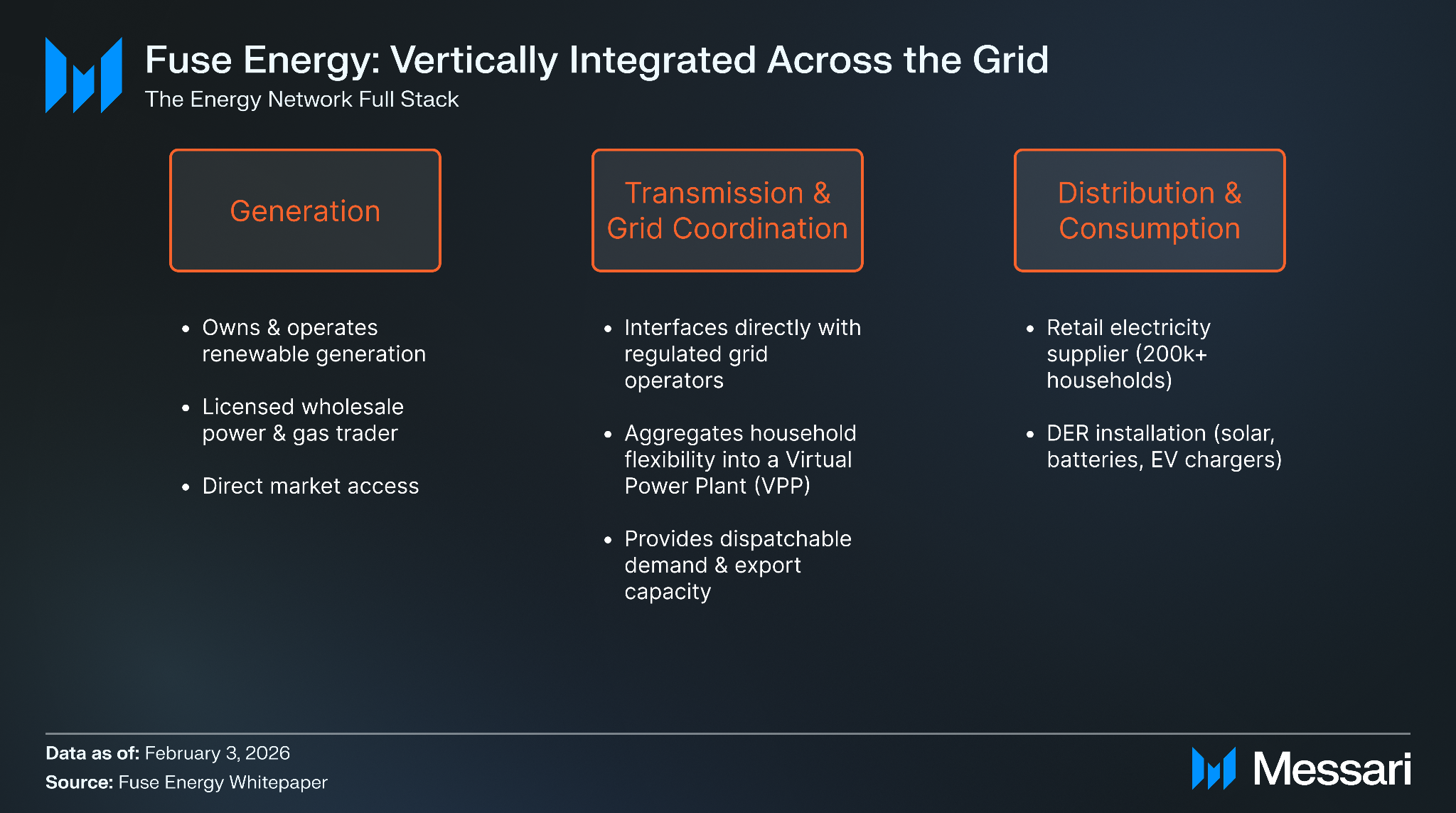
At the base of the stack is Fuse's regulated entity, a licensed electricity supplier. Currently live in the UK, Fuse buys power directly from the wholesale market and sells it to end consumers. This division has achieved rapid scale, with the Fuse team claiming to have onboarded over 200,000 households and reached $400 million in annual recurring revenue. Fuse also operates a portfolio of live solar and wind farms, and a DER installation service to electrify households.
The Energy Network
The Energy Network serves as the coordination layer, transforming this integrated utility footprint into a programmable, token-incentivized platform for DERs and flexible demand.
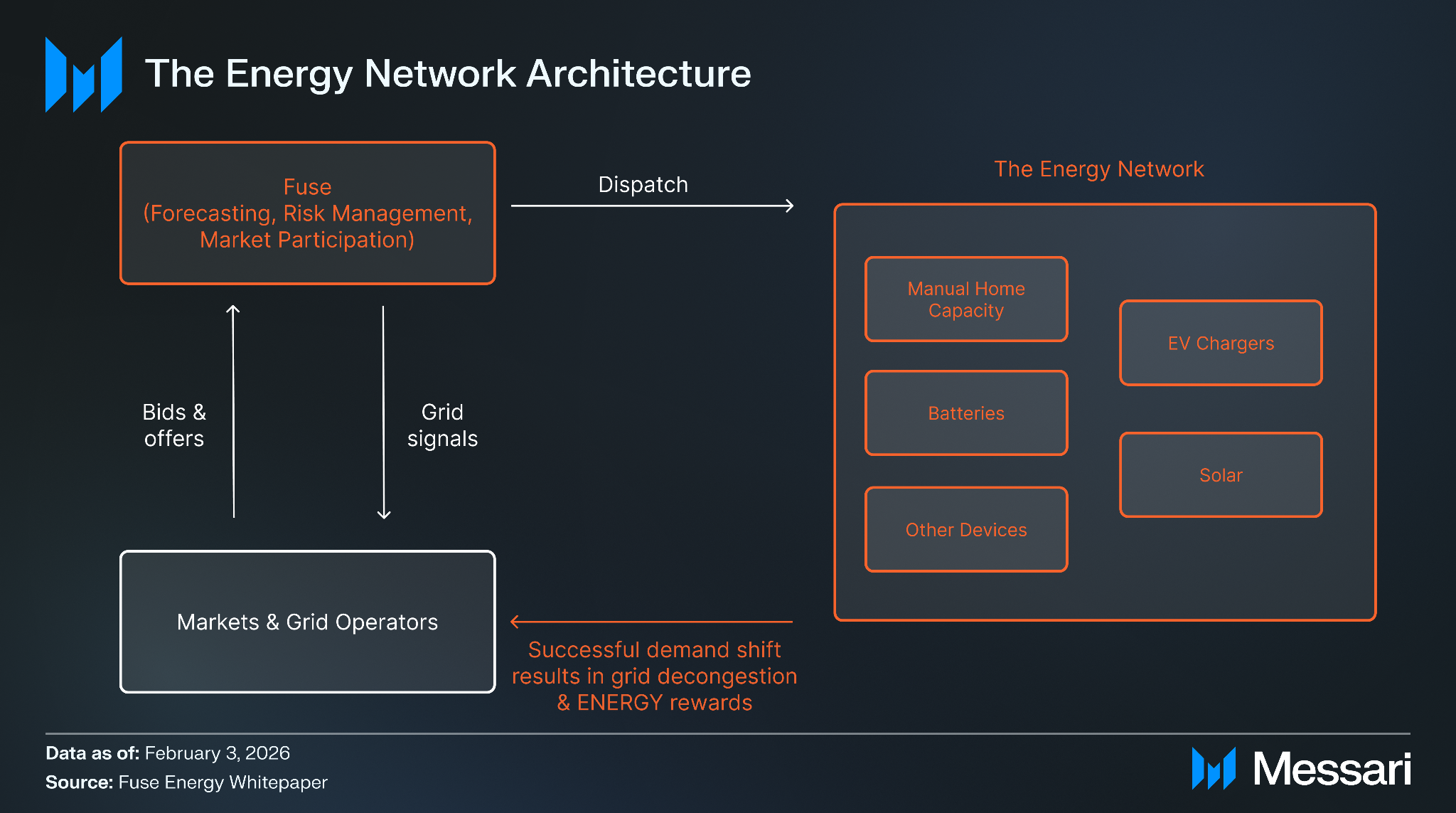
Key architectural elements include:
- Device-agnostic hardware integration: The network is designed to work with a wide range of EV chargers, batteries, and solar inverters, millions of which already exist in homes; no proprietary Fuse hardware is required.
- Smart meter-led onboarding: When customers switch their home supply to the network, Fuse installs a smart meter at no additional cost. The meter, combined with software integrations, connects household devices, EVs, batteries, solar, and potentially smart appliances, to The Energy Network.
- Participation layer: Fuse acts as the interface between The Energy Network and regulated markets, handling market entry, risk management, settlement, and dispatch notifications. Since Fuse is licensed as a retailer, generator, trader, and DER installer, it can both serve households and operate a virtual power plant using the same underlying asset base.
- Optimization & dispatch: The network optimizes device usage based on price and grid signals, subject to user-defined constraints such as minimum battery charge state or time windows for flexibility. The core financial mechanism is time-based arbitrage: devices charge or consume when prices are low and discharge or shift load when prices are high, lowering system costs. Savings are shared with customers via lower bills and Energy Dollar rewards.
- On/offchain split: Initially, registration and dispatch logic run offchain due to latency and regulatory constraints. Over time, Fuse intends to migrate more functionality onchain as it becomes viable.
This architecture allows The Energy Network to function as a virtual power plant at scale, orchestrating thousands or millions of small devices as a single, responsive grid asset. It ingests real-time data from smart meters, inverters, and EV chargers, utilizing this data to forecast load and dispatch instructions.
By coordinating when and how electricity is used across connected homes, The Energy Network reduces household energy costs by shifting consumption away from expensive peak periods and toward times when clean energy is abundant and inexpensive. Instead of drawing power during high-price hours, when grids are congested and costs spike, the network automatically schedules flexible devices, such as EV chargers and batteries, to consume, store, or export energy when prices are lower. This reduces wholesale energy costs and avoids peak network charges, resulting in savings that are passed directly back to households. Over time, as more homes participate, this coordinated flexibility smooths demand across the day, preventing price spikes, reducing system congestion, and lowering the overall cost of serving electricity without requiring new power plants or grid infrastructure.
ENERGY Tokenomics
The Energy Dollar (ENERGY) is the native utility token of The Energy Network. It quantifies the value a user provides to the grid, whether by shifting consumption away from peak hours, exporting clean energy during a deficit, or investing in grid-stabilizing hardware.
The token acts as the economic bridge between the physical physics of the grid (electrons, voltage, frequency) and the behavioral economics of the consumer. It turns energy bills into an opportunity to earn rewarding customers for flexibility actions they’d choose anyway.
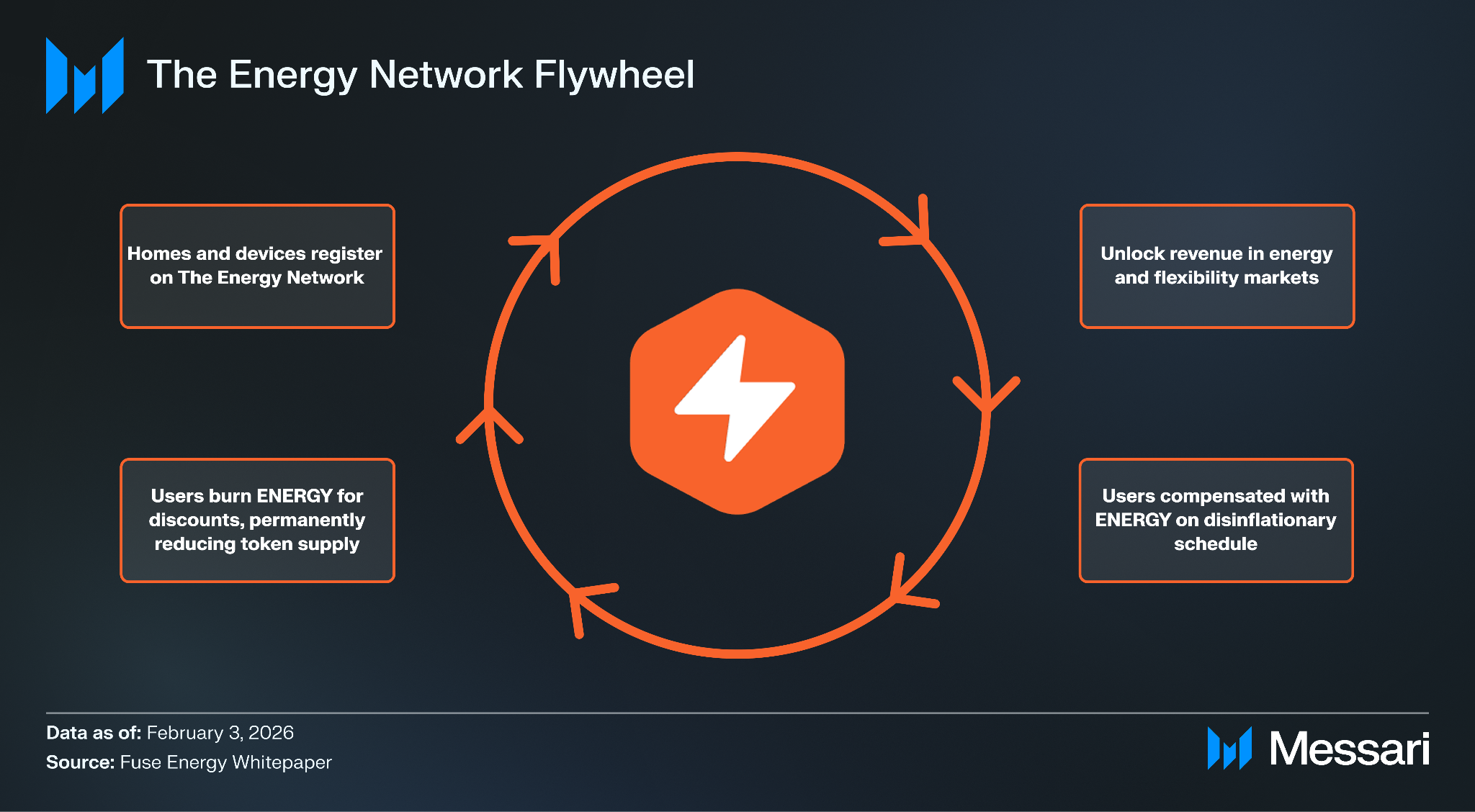
Users accumulate ENERGY through actions, verifiable onchain on Solana. Examples of actions include:
- Load Shifting: Delaying EV charging from peak hours to off-peak hours.
- Export: Using a charged home battery and sending the energy back into the grid when local frequency dips.
Fuse will read high-resolution smart meter data to train its demand-forecasting AI models. The amount of ENERGY earned is dynamic, calculated based on work contributed to the network at that specific moment. For example, a kWh shifted during a critical grid alert is worth significantly more tokens than a kWh shifted on a mild spring day.
The primary demand sink for the token is the "Burn" mechanism. When a user burns tokens, they are permanently removed from circulation. This creates a deflationary pressure on the supply. Users can burn their ENERGY tokens to unlock discounts on Fuse goods and services, for example:
- Hardware Subsidies: Tokens can be burned to reduce the upfront cost of the solar kit, home batteries, or EV chargers.
The maximum supply is 10 billion ENERGY, with emissions planned over a 25-year period. Reward distribution for a given period is predefined by the core team, and participants earn rewards based on their share of the total value created during that period.
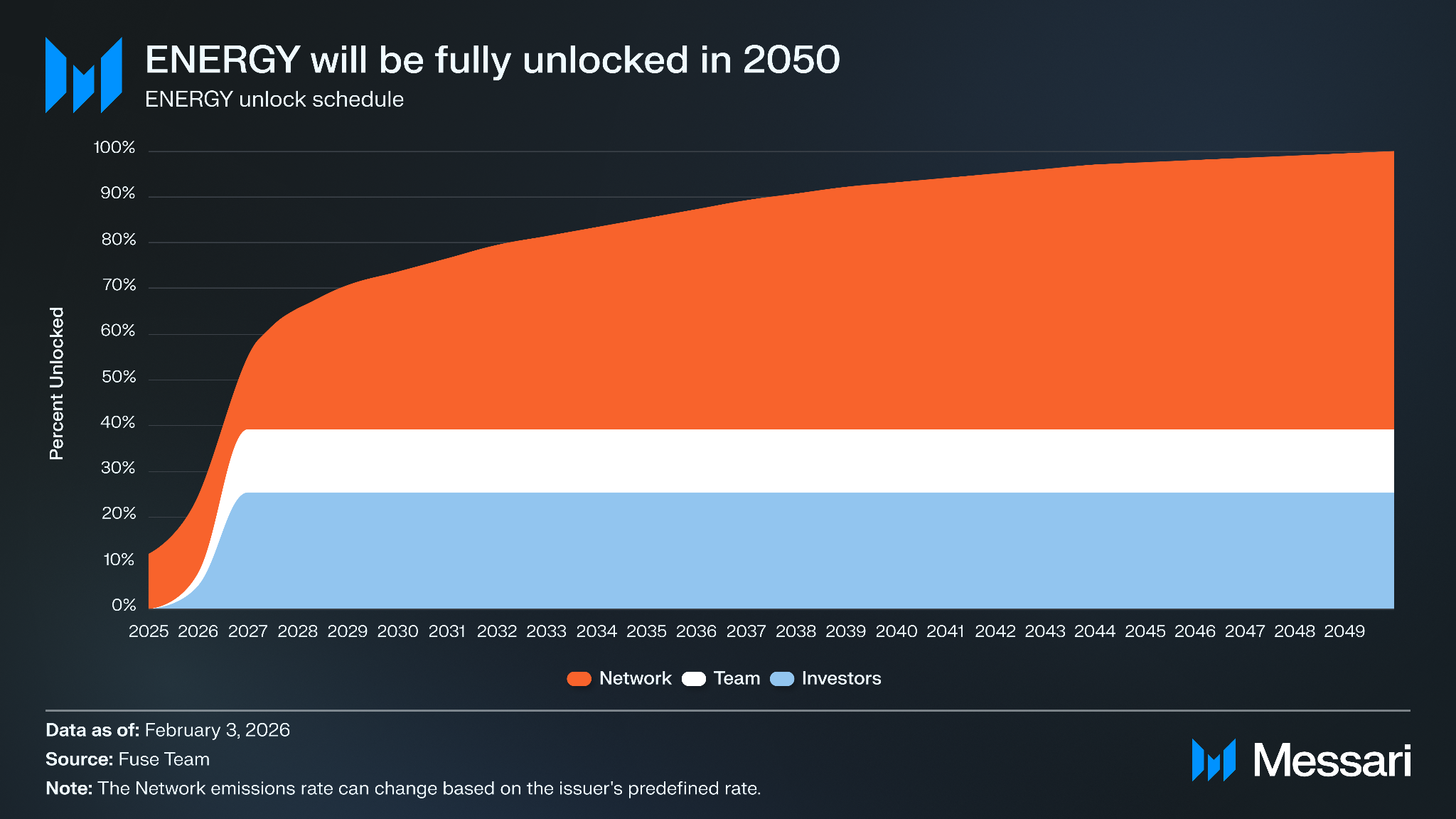
The token distribution is as follows:
- 60.8% (6.08 billion tokens) to the network
- 25.4% (2.54 billion tokens) to investors
- 13.8% (1.38 billion tokens) to the core team
Team and investor allocations have a cliff of 20% in December 2026, with the remaining 80% vesting in equal 20% quarterly increments thereafter.
TGE will occur in Q1, and ENERGY has already been added to Coinbase’s listing roadmap.
Roadmap
Per a roadmap shared on Telegram by the core team:
Q1 2026
- Launch of The Energy Network and listings
- Implemented export tariffs for solar customers
Q2 2026
- Launch of plug‑n‑play solar‑battery kit (portable, renter-friendly; positioned as dramatically cheaper than traditional systems)
- Launch of Autopilot (home energy OS optimizing usage via time-of-use pricing; managing EV chargers/batteries/solar; multi-rate tariffs; increasing Energy Dollar earnings)
- Expansion to Ireland
H2 2026
- Expansion to the United States
- Expansion to Spain
- Launch non-domestic energy supply
2027+
- Development of vertically integrated global energy supply infrastructure
- Deployment of 1 TW of clean energy capacity
- Continued expansion across Europe, North and South America, and the Asia-Pacific regions
- The Energy Network becomes the de facto scaling layer for grid systems worldwide
Closing Summary
Fuse Energy is building a coordination layer to scale energy systems that are increasingly constrained by congestion, volatility, and a passive demand base. As renewable generation becomes cheaper, the primary challenge facing grids has shifted from energy production to energy distribution and balancing. Fuse’s core thesis is that introducing demand flexibility, coordinated across millions of small, household-level assets, can unlock meaningful cost savings and system resilience without requiring large-scale investments in new generation or transmission infrastructure. The Energy Network aggregates distributed energy resources into a programmable virtual power plant, using tokenized incentives to align household behavior with real-time grid conditions.
The Energy Dollar (ENERGY) is designed as a consumptive utility token, with value derived from verifiable grid services and burn-based redemption for hardware and energy-related products rather than governance or fee capture. This anchors token demand to real-world usage. Fuse’s thesis is that the grid doesn’t need consumers to use less. It needs better coordination to drive down the cost of energy, so people and businesses can use more energy to do more and live better. If Fuse can successfully execute its near-term roadmap, particularly the launch of the Energy Network, deployment of Autopilot, and international expansion, the company could emerge as the most credible institution to integrate crypto incentives directly into critical energy infrastructure.

Matthew is a Research Analyst in Protocol Research. He graduated from MIT with a Master's and Bachelor's in Comp Sci, Economics, and Data Science where he wrote his thesis on DeSoc. Matthew also has previous experience as an Analyst at Goldentree's crypto fund.