Flashnote: The Uniswap Fee Switch

Uniswap is the leading decentralized exchange by market share, regularly seeing over $1 billion in daily trading and accounting for almost 70% of total DEX volume. Uniswap differs from traditional order book exchanges as an automated market maker (AMM). Those unfamiliar with Uniswap and AMMs should read our asset profile.
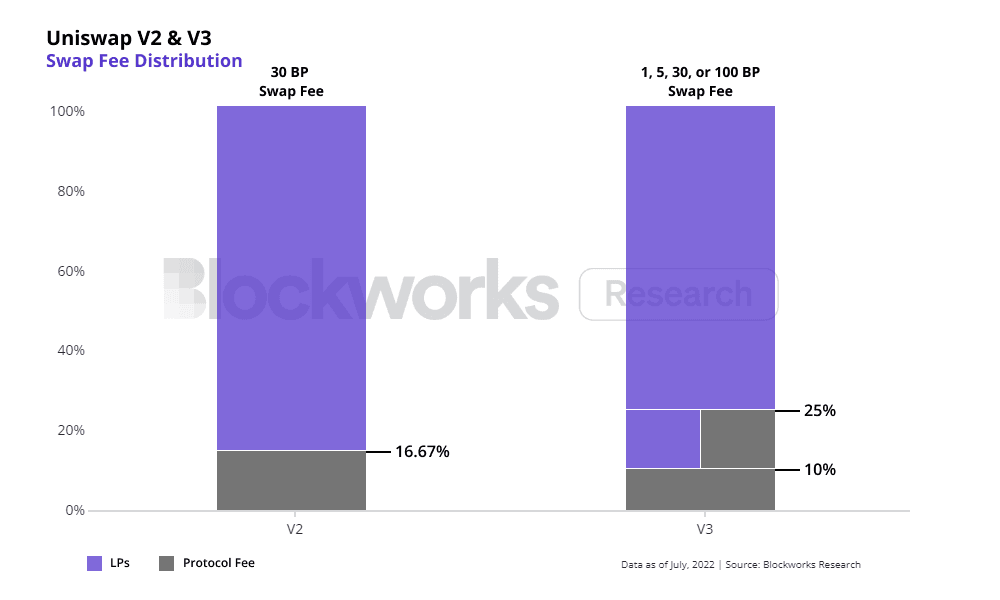
Every trade on Uniswap V2 sustains a 30 basis point (bp) (0.3%) swap fee. In V3, liquidity providers (LPs) can set swap fees to 1 bp, 5 bp, 30 bp or 100 bp. Low fee pools allow Uniswap to compete in low-risk stable swaps (e.g. USDC for DAI). For now, all trading fees are returned to LPs.
Both V2 and V3 have a dormant protocol fee that can be turned on if approved by UNI holders. UNI governance can turn on this “fee switch” at any time, sending 0.05% of the trade notional (for V2) or between 10-25% of the LP swap fee (for V3) to a DAO-specified address, likely the treasury. In V2, all pools are immediately subject to the fee switch. In V3, the protocol fee can be applied to specific pools.
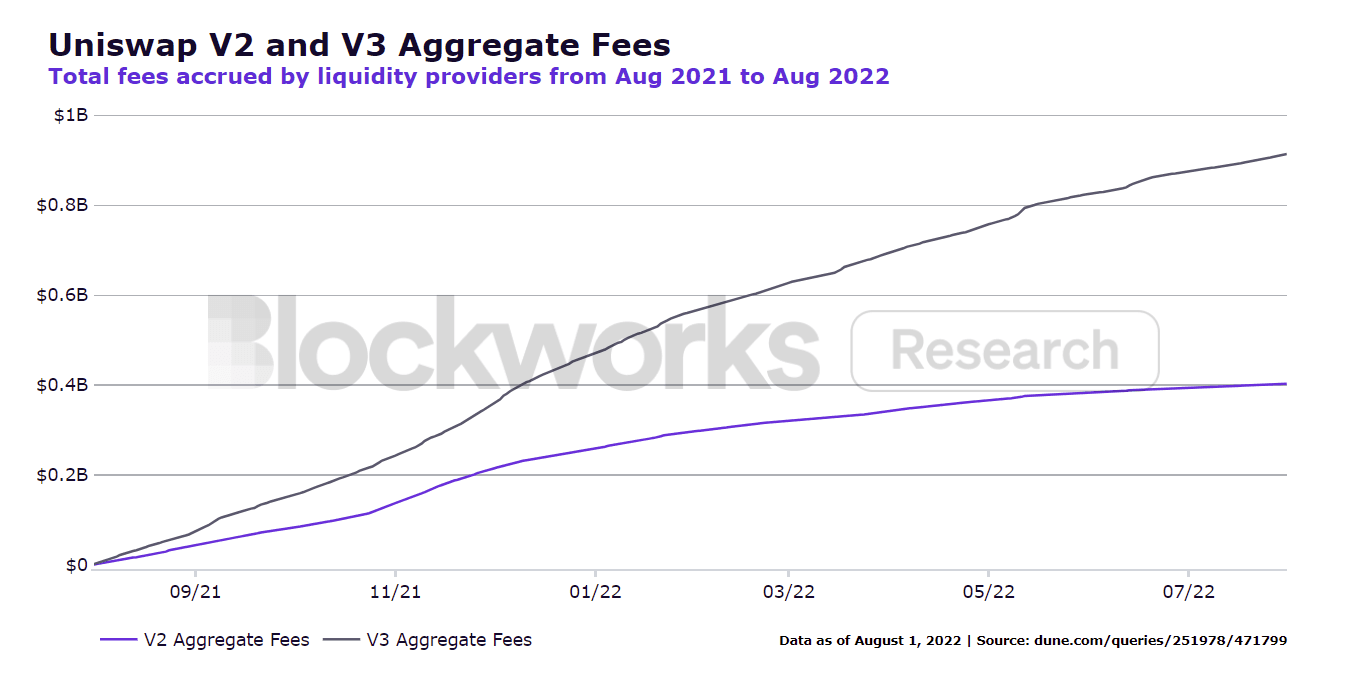
If the fee switch had been turned on across all pools in V2 and V3 (at the minimum 10%) over the last year, assuming volumes stayed the same, over $150 million dollars in protocol revenue would have been returned to the treasury.
The Proposal

Matt leads coverage on DEXs, derivatives, governance, and the Avalanche ecosystem. Previously he worked as an Analyst at Ikigai Asset Management and Teller Finance.