Flash Note: Yearn Finance V3 Vaults and veYFI

Yearn Finance, DeFi’s first large yield aggregator, had been fairly quiet until very recently when the team started hinting at new developments. Yearn’s TVL peaked at nearly $7B in December of 2021, but has since dropped to under $500M.
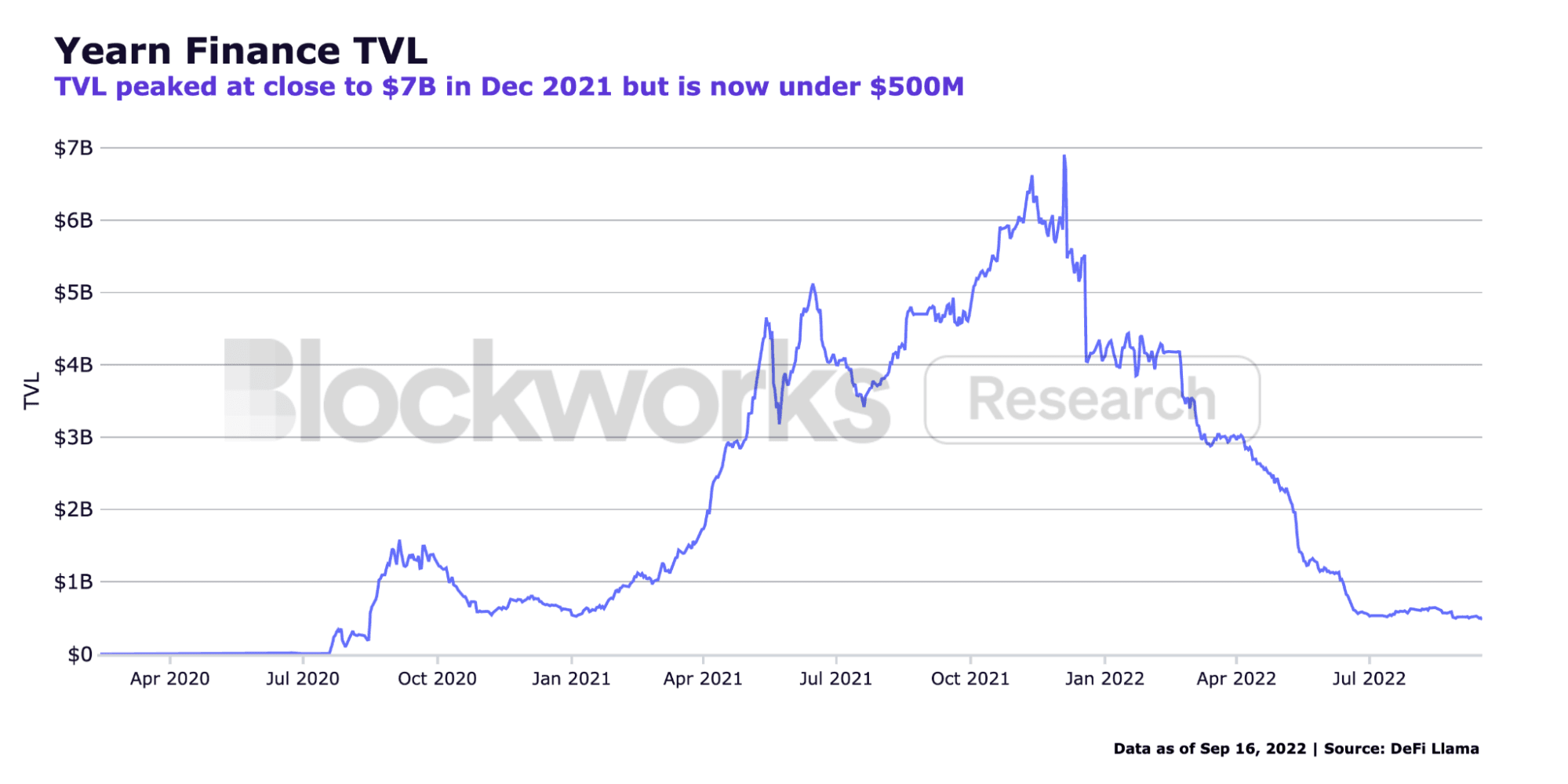
As a result of a drop in adoption, Yearn has been working all year on new updates to their vaults and a set of revamped tokenomics that they hope will catapult vault development and user adoption heading into Q4 and beyond.
V3 Vaults
Yearn is making immense improvements on their V2 vaults on a technical level. Similar to Synthetix V3, they are building a new modular architecture to allow for greater flexibility and decreased code complexity. Each vault will no longer be limited to just 20 strategies, and multiple partners can share control over the vault management. V2 code is also written in Vyper, which limits their ability to attract developer talent, so in V3 this will be replaced by Solidity. Another problem with current v2 vaults is their gas usage through ySwaps. Code improvements will be much more gas efficient leading to higher APY returns on all vaults. They are also looking to expedite the development process by decentralizing the way in which vault strategies are endorsed, as the current centralized process takes a lot of unnecessary time. Due to these improvements, we will likely see a higher number of far more complex vaults built with Yearn.
One of the hallmarks of V3 will be in use of ERC-4626, the Tokenized Vault Standard. Yield bearing tokens, such as xSUSHI, often require complex code and are completely different from token to token. ERC-4626 helps standardize yield bearing tokens so that they can be easily created and immediately composable with other DeFi protocols. Yearn is the first protocol to express public support of the standard and will look to utilize it with their vaults, allowing quicker development and greater composability with other applications.
Yearn is also looking to add riskier strategies with a contract model that breaks up risk and returns into two “tranches”. Senior Tranches are the first to be paid and take on less risk but yield very little, and the Junior Tranches are the last to be paid and take on more risk but are compensated accordingly. By being able to break up strategies into two risk tranches, users can choose vaults more suited to their risk appetite, and those who are looking for high risk/high return vault options that don’t exist elsewhere are able utilize a Junior Tranche.

Westie leads coverage on Ethereum, L2s, and Synthetix. Previously he worked in public sector technology Consulting at Guidehouse.