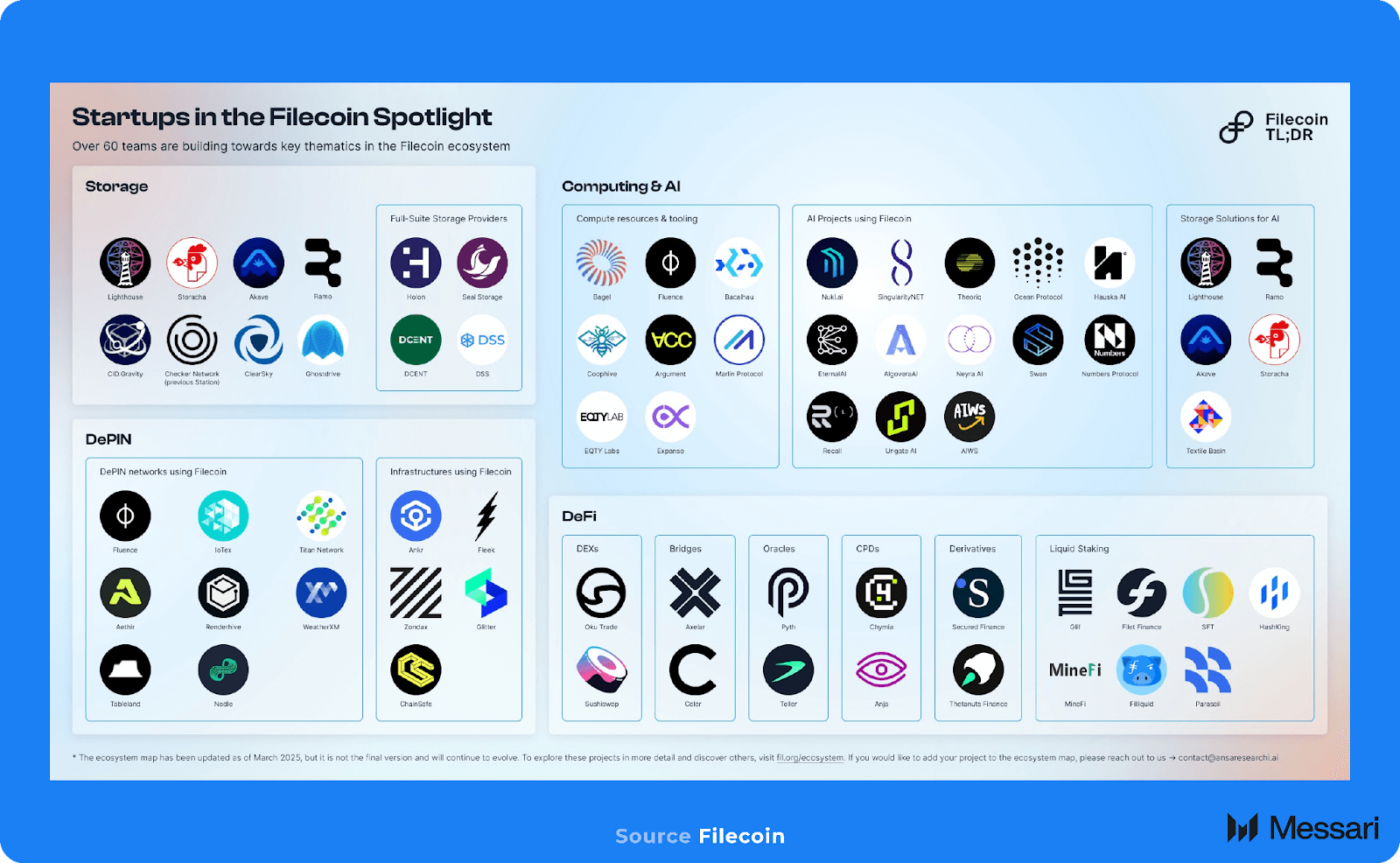
Filecoin’s ecosystem is diversifying across sectors and layers, with over 175 projects across developer tooling, data lakes, storage gateways, and sector-specific integrations in AI, NFTs, and public goods.
Filecoin-native stablecoins are addressing price volatility. USDFC, an overcollateralized FIL-backed stablecoin by Secured Finance, enables predictable pricing for storage deals and supports onchain settlement.
Filecoin is expanding accessibility through emerging on-ramps protocols. Akave, Basin, and Storacha enhance performance by enabling hot storage, structured data management, and real-time access across verticals
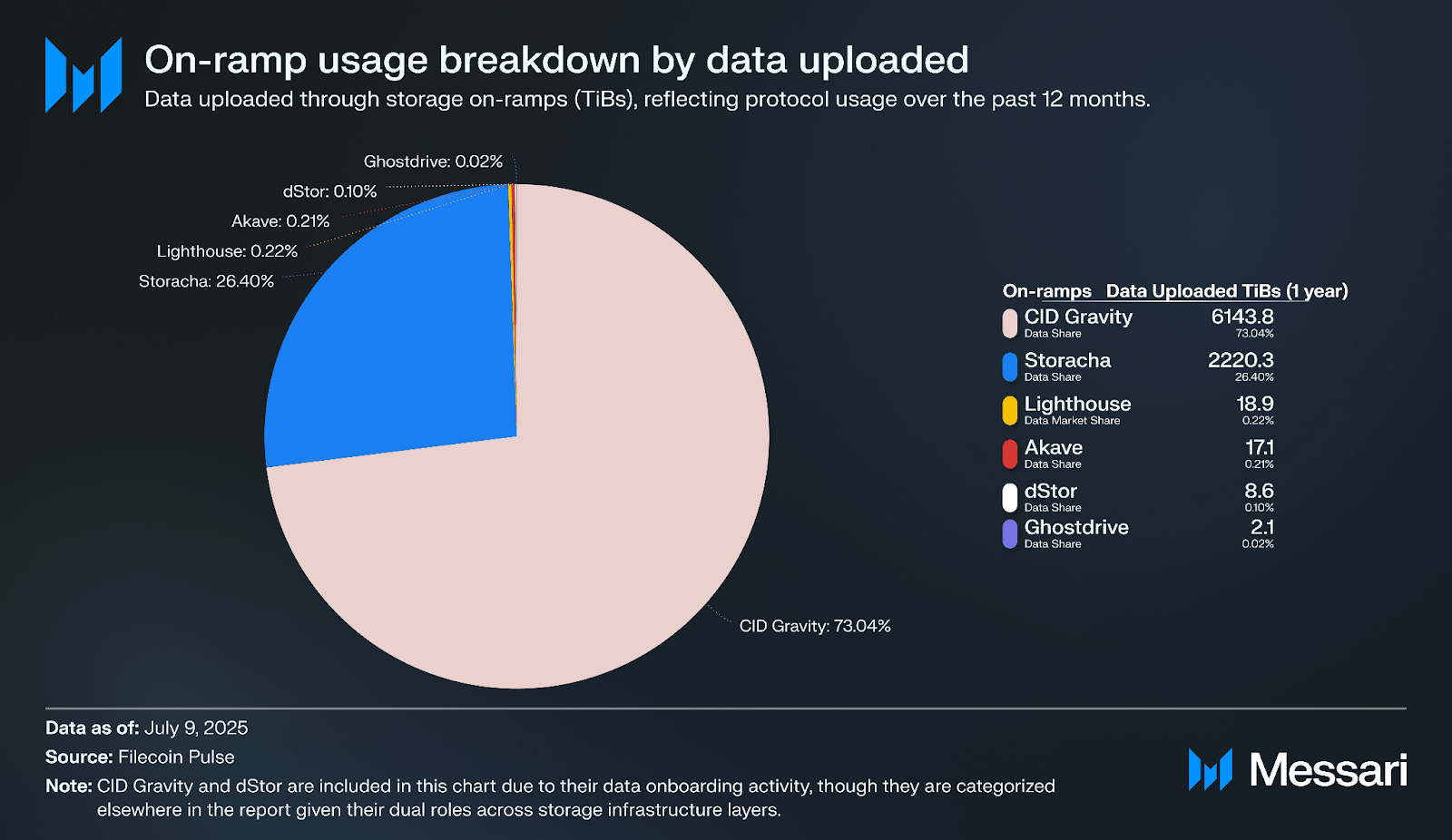
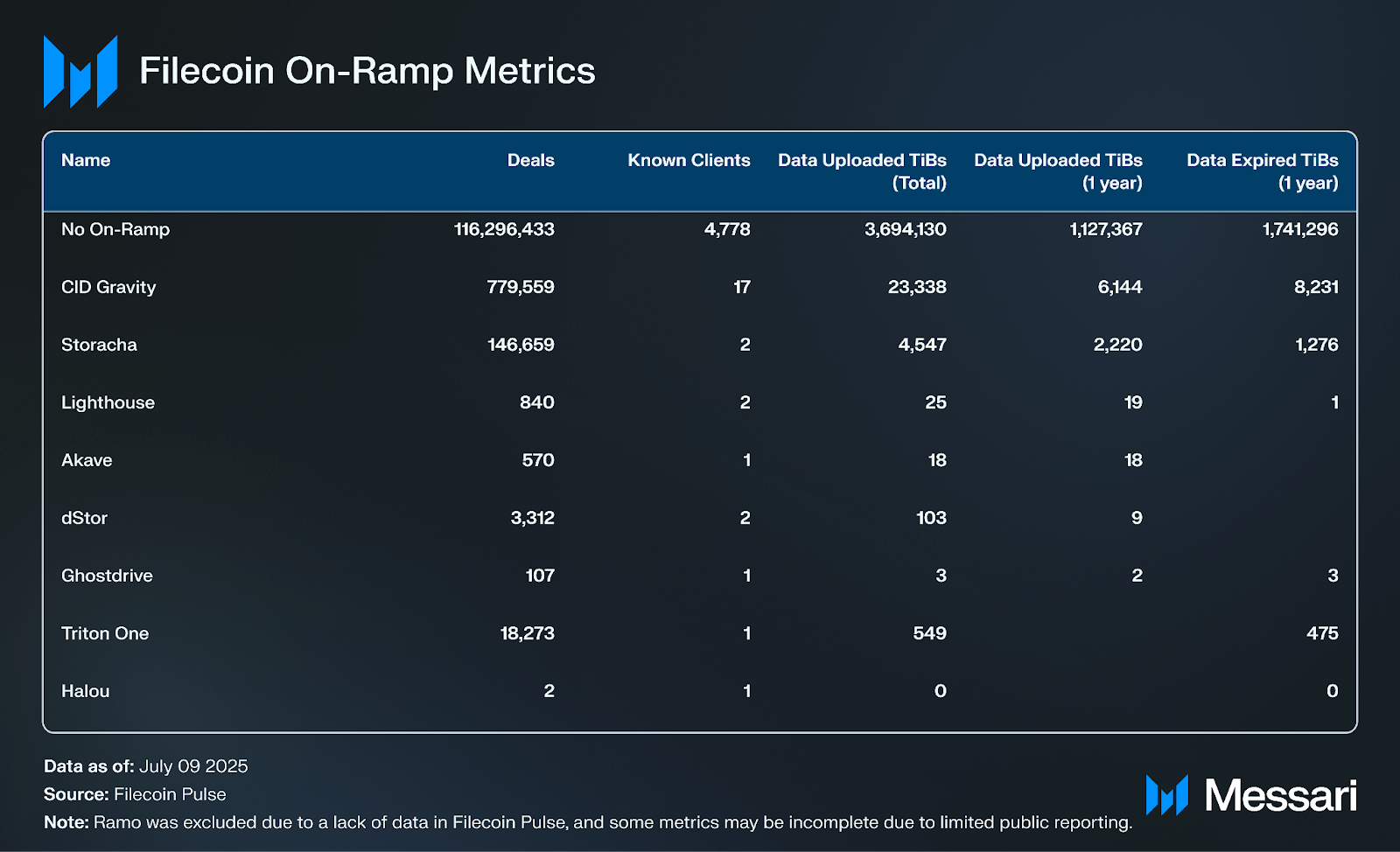
As of mid-2025, Filecoin on-ramps have facilitated roughly 28,600 TiB of data across about 950,000 storage deals, reflecting a gradual shift toward more structured and interface-driven onboarding within the ecosystem.
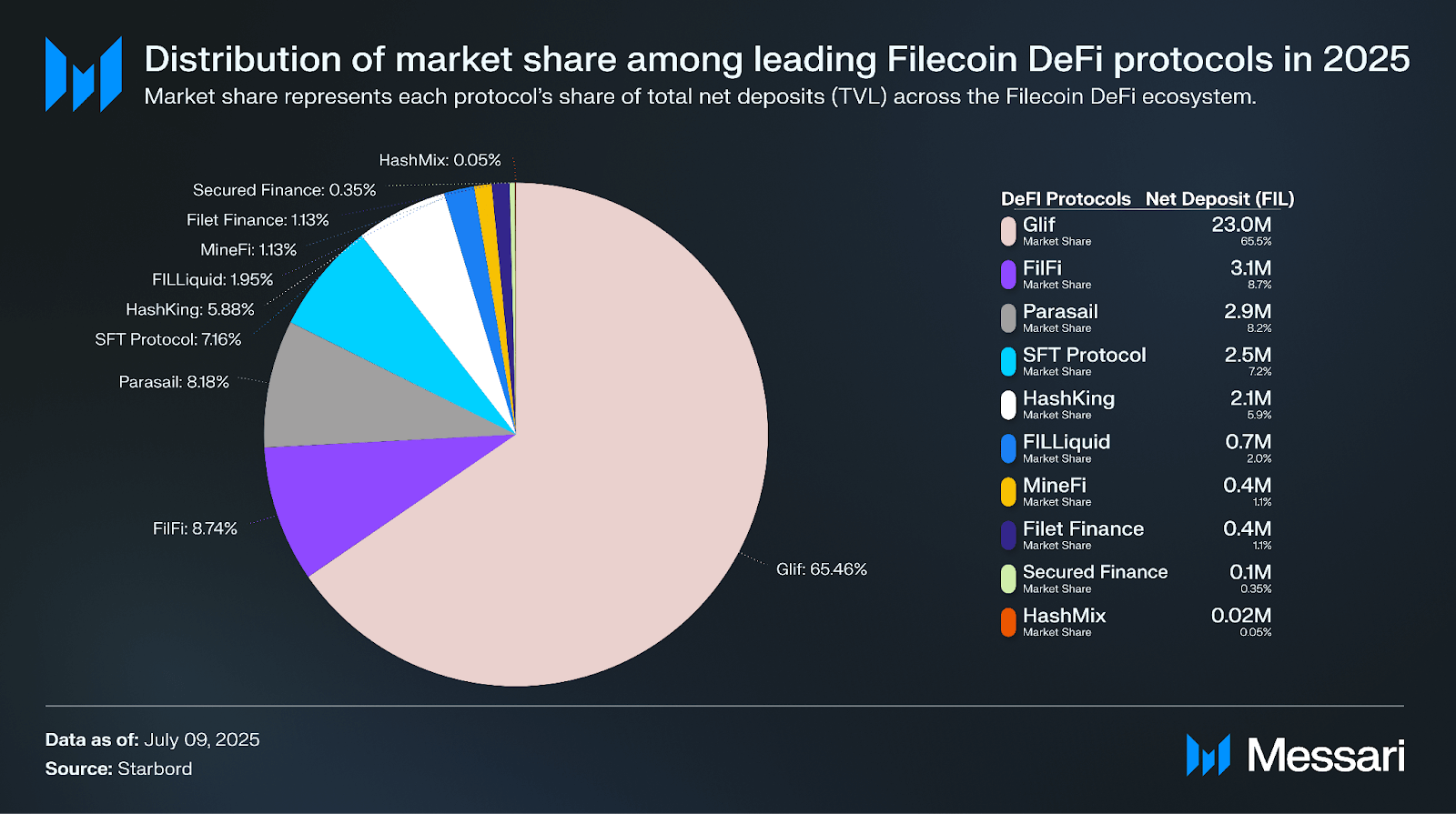
Glif holds around 65% of net deposits in Filecoin DeFi, while emerging protocols such as Parasail and SFT Protocol contribute to a more diversified capital layer tailored to the storage market’s financing needs.
Introduction
The modern internet depends on a handful of centralized cloud providers to store and manage the majority of the world’s data. This centralization creates structural risks, ranging from high costs and vendor lock-in to reduced data sovereignty and vulnerability to outages or censorship. These issues are becoming more pronounced as data-intensive sectors like Web3, AI, and open scientific research expand, demanding infrastructure that is verifiable, decentralized, and composable by design.
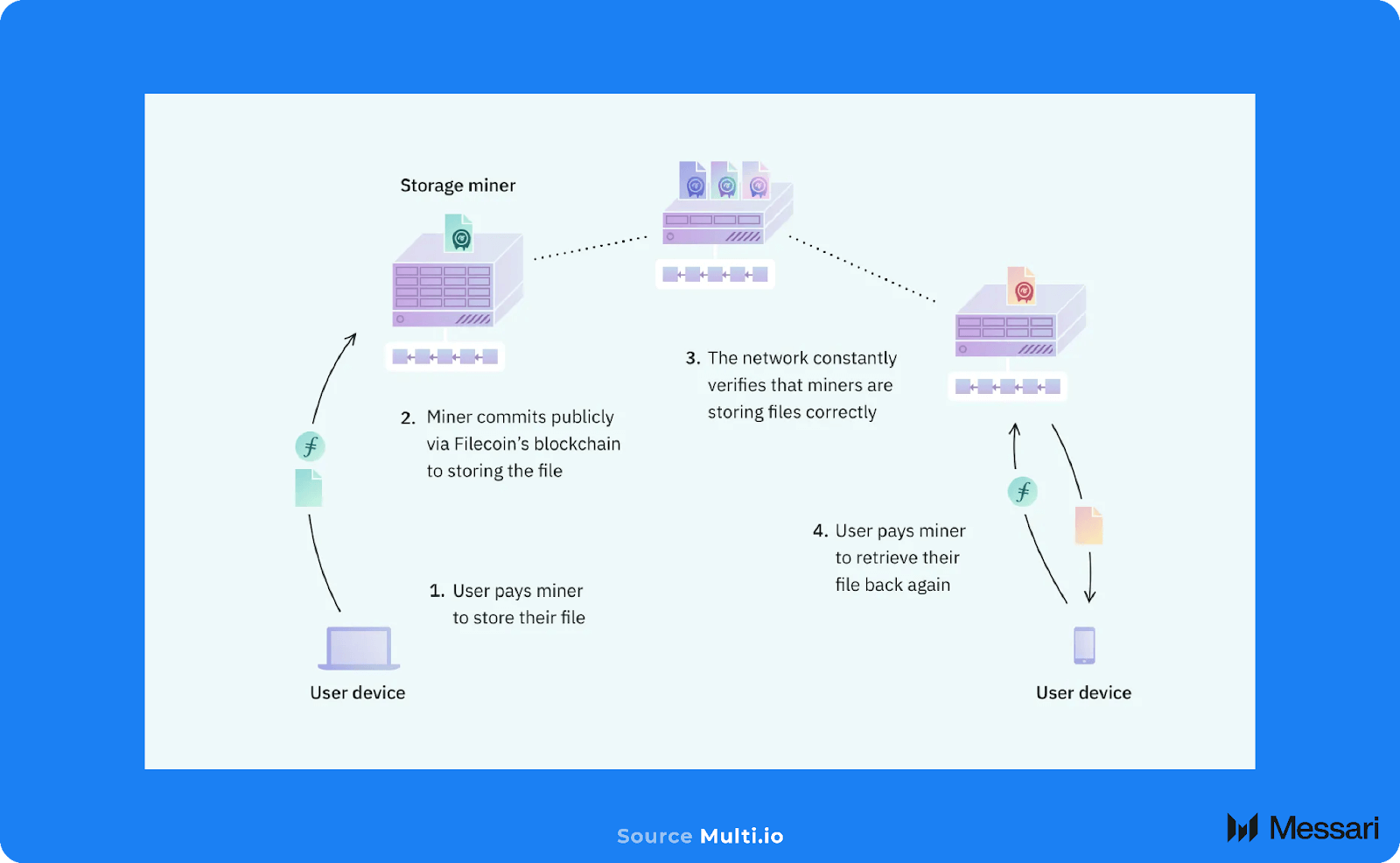
Filecoin addresses these gaps through a decentralized storage network where clients and providers transact in an open marketplace. The protocol uses cryptographic proofs, such as Proof-of-Replication and Proof-of-Spacetime to verify that data is stored reliably over time.
Background
Filecoin (FIL) was developed by Protocol Labs, a research and development organization founded by Juan Benet in 2014. Protocol Labs also created the InterPlanetary File System (IPFS), a peer-to-peer protocol for decentralized content addressing. Filecoin builds on IPFS by introducing cryptoeconomic incentives for persistent and verifiable storage across a decentralized network.
In 2017, Filecoin raised $257 million in one of the largest ICOs at the time. After multiple testnet phases, it launched its mainnet in October 2020. Early growth was driven by supply-side incentives, with Storage Providers (SPs) rewarded for onboarding capacity. This led to a rapid increase in raw storage, peaking at over 17 exbibytes (EiB) by 2022, but much of it was underutilized or filled with low-value data.
To address this, the project launched Filecoin Plus (Fil+), a social trust program offering enhanced rewards for locking additional collateral and storing verified, high-utility datasets. Subsequent Filecoin Improvement Proposals (e.g., FIP-0036, FIP-0056) refined the incentive structure to prioritize meaningful storage demand over sheer capacity.
The protocol has since undergone major technical upgrades. The HyperDrive upgrade (July 2021) improved transaction throughput, while tools like Web3.Storage (August 2021) simplified onboarding for Web3 applications. In March 2023, the Filecoin Virtual Machine (FVM) introduced smart contract programmability, enabling programmable storage markets, DeFi, and data DAOs. These enhancements also supported integrations with ecosystems like Solana and Avalanche.
Filecoin’s development and governance are supported by the Filecoin Foundation (FF), a nonprofit responsible for protocol development, ecosystem growth, and governance coordination. A sister entity, the Filecoin Foundation for the Decentralized Web (FFDW), was initially established in 2020 to advance public-good initiatives such as digital preservation and open knowledge infrastructure, though these efforts are now integrated under the broader Filecoin Foundation umbrella.
Protocol Labs continues to support Filecoin alongside other foundational technologies such as IPFS (decentralized content addressing), Libp2p (modular peer-to-peer networking), and IPLD (data modeling across distributed systems)
Over time, Filecoin has evolved from a storage incentive layer into a programmable infrastructure stack for decentralized, verifiable data.
Technology
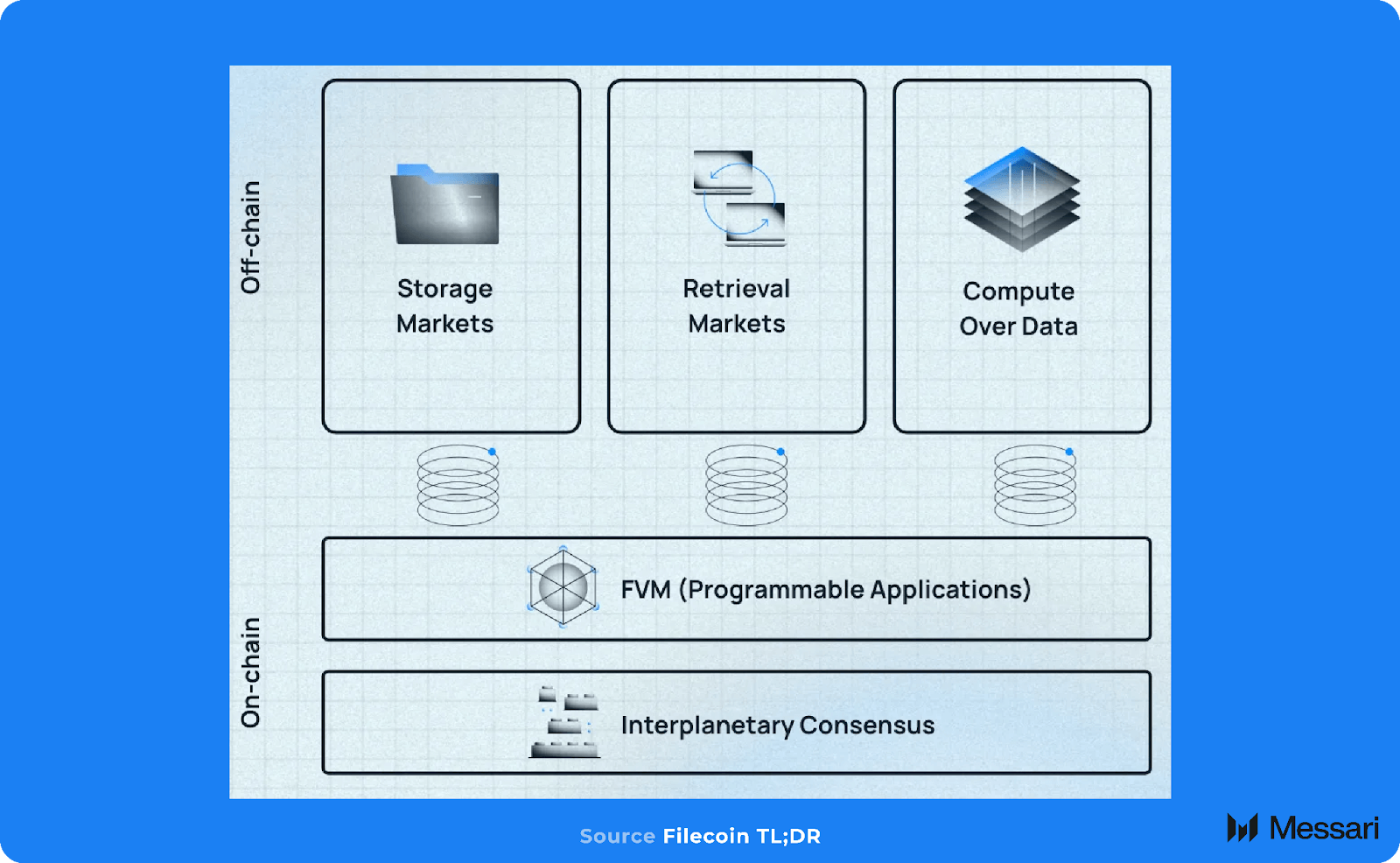
Filecoin is a Layer-1 (L1) network purpose-built for decentralized and verifiable data storage. For clarity, this report categorizes the Filecoin technology stack into three primary domains: (1) the base protocol, (2) access and infrastructure layers (on-ramps, retrieval, and compute coordination), and (3) applications.
Layer 1 (Base Protocol Layer)
The foundational infrastructure of Filecoin is an L1 that handles core protocol operations such as consensus, data verification, token economics, and decentralized deal-making for storage and retrieval. It is responsible for ensuring that data is stored correctly and durably over time.
Proof-of-Replication (PoRep): Ensures a unique, encoded copy of data is stored by a provider. This prevents duplication and enforces uniqueness.
Proof-of-Spacetime (PoSt): Validates that providers are continuously storing data over a given duration. This proof is submitted regularly to confirm storage integrity.
Proof-of-Data Possession (PoDP): Introduced in May 2025, PoDP enables providers to prove they hold data that is immediately accessible, enhancing support for hot storage and real-time applications.
PoRep and PoSt are directly integrated into Filecoin’s Expected Consensus protocol, which probabilistically assigns block production rights based on quality-adjusted power (i.e., the amount and type of verified data stored). Together, these mechanisms form the foundation of Filecoin’s decentralized, verifiable, and trust-minimized storage network.
Storage Modalities
Filecoin supports two categories of storage based on access needs:
Cold Storage: Optimized for long-term, infrequently accessed data like archives or NFT metadata. It offers lower costs and allows users to choose providers based on factors like performance, location, or compliance (e.g., SOC 2, HIPAA).
Hot Storage: Built for high-performance, frequently accessed data. While Filecoin began with cold storage, access and infrastructure solutions like Akave and Storacha now enable fast retrieval and programmable access, unlocking use cases in AI, DeFi, and real-time data streams.
Economic Participants
Filecoin’s protocol-level economy relies on three primary actors:
Storage Providers (SPs): Storage Providers contribute raw disk space to the network and engage in storage contracts with clients. They seal client data into cryptographically verifiable sectors and are required to submit continuous proofs, (PoRep and PoSt) to confirm that data is being continuously stored. In return, they earn payments in Filecoin’s native token, FIL and receive additional block rewards, with enhanced incentives for storing verified data (and locking additional requirements) through the Fil+ program.
Retrieval Providers: Retrieval Providers are envisioned participants designed to serve stored content to users efficiently, forming a key part of Filecoin’s long-term retrieval market design. While these participants do not yet operate at scale, early implementations such as FilCDN, Titan, and Ramo are actively developing decentralized content delivery systems that cache data and enable low-latency access. These services are expected to use offchain micropayment channels for streaming or pay-per-byte settlements, enabling efficient and cost-effective retrieval once fully deployed.
Clients / Users: Clients include individuals, developers, DAOs, and enterprises seeking to store or retrieve data. They initiate storage deal proposals, specifying parameters such as price, duration, and redundancy. Once a deal is accepted, it is published onchain and becomes economically binding. Clients also engage with retrieval providers to access previously stored content.
Clients & Implementations
Filecoin’s decentralized network is supported by multiple client implementations that maintain node infrastructure and enable interaction with the protocol. These clients are distinct from end-users. They provide the software that allows participants (storage providers, retrieval providers, and clients) to run nodes, validate proofs, and engage with the network.
Lotusby Protocol Labs: The reference implementation widely used across the network, supporting full node operation, mining, and storage deal coordination.
Forestby ChainSafe: A Rust-based implementation designed for modularity and performance, particularly useful for custom deployments.
Block Producers: Storage Providers that earn block production rights through Expected Consensus, which probabilistically selects winners based on their quality-adjusted storage power. These participants validate proofs and extend the chain but are not fixed validators in the traditional sense.
Tokenholders: FIL holders supply collateral for storage deals and contribute to Filecoin’s open governance through the Filecoin Improvement Proposals (FIPs), which enables community-driven protocol upgrades without token-weighted voting.
Filecoin’s Native Token (FIL)
Filecoin’s economic model is designed to align incentives across users, storage providers, and the protocol through its native token, FIL. FIL is essential for participating in the storage market, paying for retrieval services, collateralizing storage deals, earning block rewards, and enabling governance.
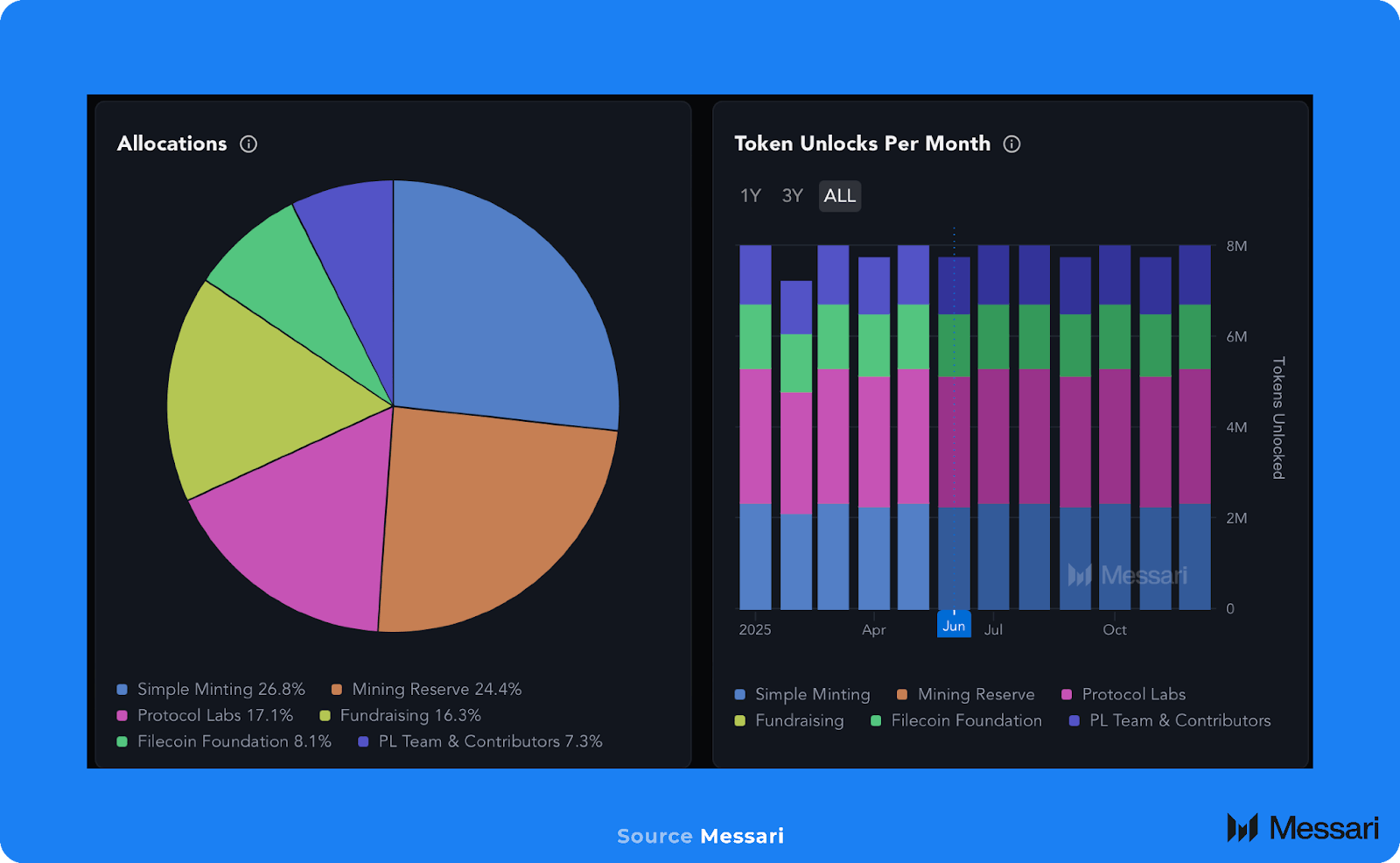
Filecoin’s maximum supply is capped at 2 billion FIL, defined in August 2017 and activated at mainnet launch in October 2020. The initial allocation was as follows:
70% (1.4B FIL): Block rewards for storage providers, distributed over time
15% (300M FIL): Protocol Labs, vested over 6 years
10% (200M FIL): SAFT investors (2017 sale)
5% (100M FIL): Filecoin Foundation, vested over 6 years
Simple Minting: Releases FIL on a fixed decay schedule, over 20+ years.
Baseline Minting: Issues FIL in proportion to network storage growth relative to a predefined baseline that scales toward one yottabyte of quality-adjusted storage. The minting schedule cannot complete in less than 20 years, but may extend beyond that horizon if storage growth lags behind the baseline target.
To participate, storage providers must lock FIL as collateral, ensuring reliable storage delivery. Failing to meet commitments can result in slashing, including:
Fault fees for missed proofs
Termination fees for removed sectors
Consensus fault penalties for protocol violations
Additionally, burn mechanisms (from transaction fees and slashing) introduce deflationary pressure, contributing to FIL’s disinflationary supply dynamics. Overall, Filecoin’s tokenomics are tightly coupled to network performance and verifiable behavior, reinforcing security, reliability, and long-term sustainability.
Filecoin Virtual Machine (FVM)
Building on its foundation as a decentralized storage network, Filecoin introduced the FVM in March 2023 to bring programmable smart contract functionality to the protocol. The FVM supports two environments: (1) Filecoin-native actors written in WASM and (2) the Filecoin Ethereum Virtual Machine (FEVM) which allows developers to deploy EVM-compatible contracts using Solidity. This expansion broadens Filecoin’s use cases to include programmable storage markets, DataDAOs, FIL-backed stablecoins, and trustless integrations across Web3, AI, and DePIN.
Access and Infrastructure layer
While the L1 supports secure storage and base programmability, it is not optimized for high-throughput logic, compute-intensive workloads, or real-time applications. To address these gaps, Filecoin’s access and infrastructure layer has evolved around a mix of on-ramps, data coordination frameworks, and experimental scaling environments that aim to make Filecoin more accessible to developers and data-driven use cases.
These systems may leverage two main architectural frameworks:
InterPlanetary Consensus (IPC): A sharded, hierarchical framework in development that enables parallel subnets on top of Filecoin. IPC is designed so that subnets can inherit Filecoin’s core guarantees, such as data availability and cryptoeconomic security, while providing isolated, customizable execution environmentsile enabling isolated, customizable execution environments.
Filecoin Ethereum Virtual Machine (FEVM): A Solidity-compatible execution environment that allows developers to deploy smart contracts using familiar Ethereum tools and integrate programmable storage logic directly on the Filecoin base layer.
Together, these technologies could enable modular workloads that interact with Filecoin’s storage market without being limited by L1 throughput or latency. While some ecosystem projects are exploring IPC as a potential scaling framework, most current initiatives function as on-ramps, middleware or application-layer systems that bring external data, workloads, and users onto the Filecoin network.
Notable on-ramps and infrastructure projects include:
Basin: A structured data layer optimized for managing large-scale scientific, institutional, or enterprise datasets. It supports ingestion, indexing, and querying of high-volume data, while anchoring storage commitments on Filecoin.
Akave: A programmable data lake framework offering encrypted storage, granular access controls, and replication policies. Akave is designed for compliance-sensitive use cases, emphasizing long-term data integrity and secure governance.
Storacha: A performance-focused storage network designed for hot data and content delivery. It serves as a Filecoin on-ramp, offering permissioning, caching, and streaming capabilities for latency-sensitive workloads.
Decentralized Compute & Workload Coordination
Complementing Filecoin’s storage infrastructure, a new class of decentralized compute frameworks is emerging to enable offchain data processing, transformation, and analysis. While some components introduce coordination layers for job management, these systems operate independently of Filecoin’s consensus, anchoring results or metadata back to the network for verifiability.
Bacalhau: A decentralized compute network for executing WASM or Docker-based jobs over Filecoin- or IPFS-stored data. It supports indexing, batch processing, and federated computation across distributed nodes.
Lilypad: A decentralized coordination layer for training and inference workloads. It orchestrates compute jobs across distributed nodes, with Filecoin used for storing models and datasets.
Together, these compute frameworks extend Filecoin’s utility beyond storage, bridging data and compute in a trust-minimized way. By anchoring outputs and proofs on Filecoin, they enable verifiable, decentralized data processing and AI workloads while preserving the integrity and auditability of stored data.
Application & Integration Layer
This layer includes the tools, platforms, and interfaces that abstract the complexity of Filecoin’s protocol-level operations. These systems enable end users, developers, and enterprises to store, retrieve, and manage data on Filecoin without directly engaging with low-level mechanisms such as deal negotiation, proof submission, or storage provider operations.
Ecosystem
Filecoin’s architecture can be broadly framed across three domains, the base protocol, scaling infrastructure, and application interfaces. However, the broader ecosystem reflects a multidimensional network of participants, including storage providers, developers, service layers, and vertical-specific integrations. As of mid-2025, the Filecoin Ecosystem Explorer lists more than 175 projects built on or around Filecoin. This directory is non-exhaustive and includes any startup or application that leverages Filecoin in some capacity, whether for data storage, retrieval, or integration within broader workflows. The following section highlights a representative selection of ecosystem services and infrastructure components that support Filecoin’s operation and adoption.
Storage Infrastructure Providers
Filecoin's core value proposition is decentralized, verifiable storage. To realize this at scale, it relies on a layered and diverse storage infrastructure ecosystem that handles everything from raw hardware provisioning to user-facing APIs that abstract storage deals. This infrastructure can be broken down into five key categories, based on their roles in the data onboarding, storage, and retrieval lifecycle:
S3-Compatible Providers: Enterprise gateways offering standardized access to Filecoin via familiar protocols (e.g., S3 APIs).
Data Lake and AI-Focused Storage: Specialized providers supporting structured, persistent, or encrypted storage for analytics and ML workflows.
Onboarding and Deal Management Tools: Infrastructure that simplifies or abstracts Filecoin’s storage market interactions.
Storage On-Ramps: Developer-friendly APIs and SDKs that allow easy storage onboarding from dApps and external systems.
Retrieval and Caching Services: Services focused on improving content access latency and bandwidth efficiency through decentralized delivery systems.
This segmentation reflects how Filecoin has evolved from a cold-storage protocol to a flexible, multi-tier data infrastructure stack, serving Web3, AI, scientific, and enterprise users.
S3-Compatible Providers (Enterprise Gateways)
These providers build interfaces that mimic traditional cloud storage services (like AWS S3), allowing enterprise clients to access Filecoin-based storage without modifying existing workflows. Their focus is on archival durability, compliance (e.g., HIPAA, SOC 2), and integration into enterprise tech stacks.
DeStor: Offers a managed Filecoin gateway for enterprises with S3 API compatibility, SDK support, and persistent storage services. Use cases include institutional research, game asset storage, and decentralized infrastructure backends.
Other enterprise-facing on-ramps and data orchestration layers, such as Ramo, CIDGravity, and Akave, extend these capabilities with advanced caching, structured data management, and programmable compliance frameworks. These projects are discussed in detail within their respective sections on on-ramps and infrastructure tooling.
Data Lake and AI-Focused Storage
Data lakes are scalable storage systems that hold large volumes of raw, structured, or unstructured data for future processing, making them essential for analytics, AI/ML, and scientific research. In the Filecoin ecosystem, these providers focus on structured data workflows, encrypted datasets, and long-term replication policies, often used in machine learning pipelines, research environments, or secure enterprise archives. Many support programmable access or integrate with compute platforms.
Akave: A programmable data lake platform built on Filecoin. Offers fine-grained replication, encrypted storage, audit trails, and hot–cold caching. Commonly used in AI/ML, analytics, and regulated industries.
CIDgravity: Specializes in long-term decentralized cloud storage with features for backup, video streaming, and large-file archival. Geared toward content platforms and data-heavy SaaS tools.
DCENT& Future Tech Holdings: Offer decentralized storage infrastructure targeted at institutional clients and high-throughput use cases. Combine compute coordination and storage services under unified frameworks.
Onboarding and Deal Management Tools
These tools are often provider-facing and serve to automate or simplify deal logistics, sealing operations, and client–provider interactions at the protocol level. They are essential in abstracting low-level deal mechanics for applications and SPs.
Boost serves as the modern toolchain for storage providers, replacing the legacy deal-making system. It manages core processes such as sealing, retrieval indexing, and Fil+ interactions, providing a unified and efficient interface for executing storage deals.
Filecoin Plus (Fil+): Verified Storage Incentive Program
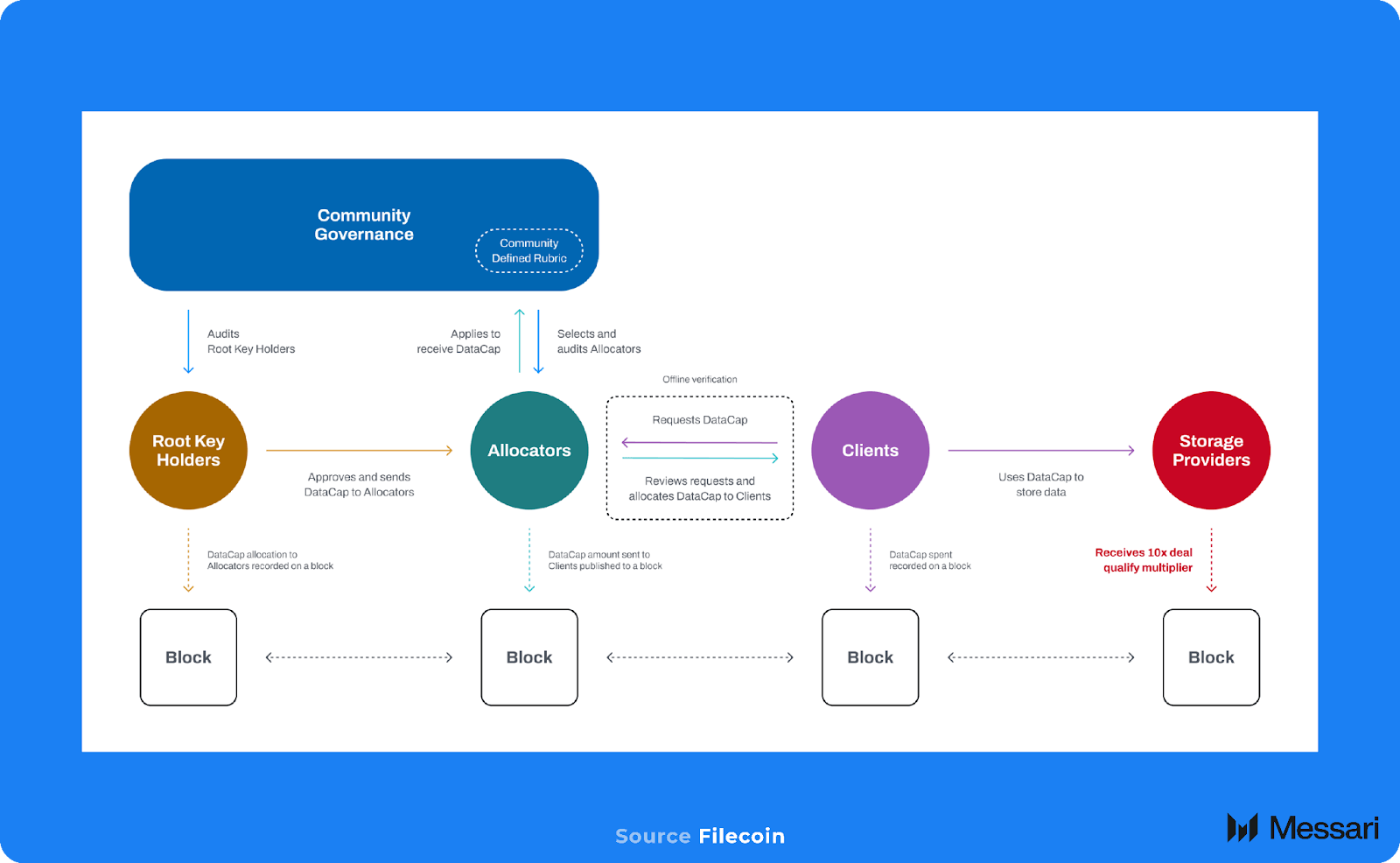
Fil+ is a program designed to incentivize high-quality, verifiable storage. It enables select clients and organizations, known as Notaries, to grant DataCap, a token-based allowance for subsidized storage, to projects that meet criteria such as public accessibility, civic utility, or long-term value.
Increased Incentives: Storage Providers that accept Fil+ deals receive 10x the block reward (quality-adjusted power), which increases their probability of producing blocks and earning FIL through Filecoin’s Expected Consensus.
Offchain Verification Process: Fil+ introduces a trust-based layer where clients must apply for DataCap allocation from Notaries. Once approved, the data is marked as "verified" and can be included in deals with enhanced rewards.
Ecosystem Integration: Fil+ is embedded into tools like Boost (to handle DataCap integration), Estuary (which facilitates Fil+ onboarding), and governance mechanisms that manage Notary roles and transparency.
Storage On-Ramps
Storage on-ramps provide abstractions and SDKs that allow developers to interact with Filecoin (and often IPFS) without needing to understand the full storage deal lifecycle. These tools serve as the primary entry points for dApps and platforms looking to store user data, metadata, media, or application assets on decentralized
Lighthouse.storage: SDK-focused platform enabling permanent storage with Filecoin via simple libraries and APIs. Supports frontend dApps, mobile apps, and metadata storage.
Akave& Storacha: In addition to being data infrastructure, both serve as programmable storage on-ramps by offering APIs, permissioned access, and caching layers for faster integration into applications.
Ramo: A decentralized data infrastructure layer focused on data pipelines, smart caching, and real-time retrieval orchestration. Acts as an integration point between Filecoin storage and compute workflows.
Singularity: A programmable storage orchestration layer designed for structured data, AI workloads, and long-term archiving. Offers developer tooling for managing decentralized datasets and automated deal management.
GhostDrive: A privacy-focused, decentralized alternative to Google Drive that uses Filecoin as a backend. While not a developer SDK or on-ramp in the traditional sense, it abstracts Filecoin storage for end-users, enabling easy file uploads and encrypted sharing without requiring protocol-level knowledge.
As of writing, the Filecoin ecosystem includes 9 active onramps supporting 30 known clients, with a total of 28,589 tebibytes (TiBs) of data uploaded across 950,436 storage deals. While this represents a small share of total network activity, it highlights the growing role of ecosystem tooling in onboarding users and streamlining data storage at scale.
Retrieval and Caching Services
Filecoin’s storage market is optimized for durability, not speed. To solve for latency and bandwidth, retrieval-specific services have emerged, functioning as decentralized content delivery networks (CDNs).
Titan Network: Incentivizes end-users to contribute bandwidth and cache content, creating a decentralized delivery mesh. Useful for video streaming and Web3 content delivery.
FilCDN(formerly Saturn): A decentralized CDN originally incubated by Protocol Labs, now operating as FilCDN to provide high-performance, incentivized retrieval. FilCDN rewards node operators for caching and serving Filecoin- and IPFS-hosted data, improving network throughput and end-user latency while reducing load on storage providers.
Swan Network: Provides multi-chain infrastructure for retrieval and compute, integrating with other ecosystems to enable smart caching and edge computing.
Hybrid Infrastructure and Cross-Layer Integration
As Filecoin evolves from a decentralized storage protocol into a full-stack data infrastructure platform, a new class of providers has emerged to bridge the gap between raw storage, programmable compute, and user-facing applications. Hybrid infrastructure providers operate across layers, integrating storage provisioning, compute orchestration, and developer tooling, to make the network more accessible and production-ready. These platforms are particularly important for builders looking to abstract away low-level complexities while tapping into Filecoin’s storage guarantees and compute integrations:
ND Labs: Offers modular infrastructure kits for deploying Filecoin-based storage and compute environments. Supports enterprise integrations and developer pipelines through middleware orchestration tools and SDKs.
Nebula Block: Provides a full-stack development platform built on Filecoin. Combines storage deal management, subnet orchestration, and offchain compute with developer-friendly interfaces for managing large data pipelines.
Twin Quasar: Specializes in infrastructure coordination for independent storage providers. Supplies open-source tooling, hardware integration, and support for building and scaling Filecoin-native services, particularly for DePIN and scientific data projects.
These hybrid players enable turnkey deployment of decentralized storage and compute applications by connecting Filecoin’s base infrastructure with accessibility capabilities, edge resources, and real-world developer needs. Their offerings often include:
Deployment automation and managed node hosting
Unified APIs for storage, retrieval, and compute pipelines
Subnet management and app-specific chain coordination
Workflow tooling for scientific datasets, AI training data, and real-time analytics
In doing so, they accelerate adoption by reducing time-to-deployment and enhance reliability for projects building atop Filecoin.
Developer Ecosystem and Tooling
Several SDKs and APIs have been built to simplify integration with the Filecoin network. These libraries abstract deal-making, token handling, and retrieval mechanics, making the protocol accessible to both frontend developers and backend engineers.
Glif SDK: Developed by the Glif team, this SDK supports wallet management, deal creation, staking interfaces, and contract interactions with the FEVM.
Analytics, Monitoring, and Reputation Services
Filecoin’s infrastructure requires robust monitoring tools to evaluate protocol health, track economic activity, and assess participant behavior. Several analytics dashboards and reputation systems serve this function:
Filfox: One of the most widely used Filecoin block explorers, offering miner rankings, deal visibility, and sector-level insight into network performance.
Filscan: A comprehensive explorer that provides transaction history, chain metrics, gas usage, and storage deal statistics.
Starboard: Offers advanced analytics, visualizations, and dashboards for tracking FVM activity, gas consumption, and protocol governance metrics. It is particularly useful for researchers and analysts monitoring FVM smart contract deployments.
DeFi Landscape
As Filecoin has evolved from a storage-centric blockchain into a general-purpose platform via the FVM, its financial layer has expanded to support DeFi use cases that align with the network’s unique storage economy. These primitives enhance capital efficiency, mitigate volatility in storage pricing, and unlock composability with broader Web3 systems.
Capital Markets and Leasing Mechanisms
Glif has emerged as the leading protocol for capital leasing in the Filecoin ecosystem, addressing a core constraint in the network’s original design, the high FIL collateral requirements for onboarding storage. Through Glif, FIL holders deposit tokens into lending contracts and receive interest-bearing iFIL, a tokenized representation of leased FIL Storage providers can borrow this FIL to collateralize deals and repay it with interest over time. This creates a mutually beneficial marketplace: SPs gain flexible access to working capital, while FIL holders earn yield on idle assets.
As of July 9, Glif holds the largest share of Filecoin’s DeFi activity, accounting for approximately 65.5% of net deposits, with nearly 23 million FIL supplied and over 13.5 million FIL actively borrowed. Its utilization rate of 59% indicates a relatively balanced supply-demand dynamic within the protocol.
The broader ecosystem includes a growing set of specialized platforms: FilFi, though no longer operational, still appears with 8.7% of historical market share in Starboard, having previously offered leasing and lending services for storage providers. Parasail (8.2%) supports undercollateralized financing for storage providers; SFT Protocol (7.2%) enables high utilization through deal-matching and liquidity routing; and HashKing (5.9%) serves SPs with pooled collateral solutions. Smaller but active participants include FILLiquid (2.0%), MineFi and Filet Finance (each 1.1%) with leasing and staking products, Secured Finance (0.35%) focused on credit markets, and HashMix (0.05%),a lending and liquid staking protocol. Together, these platforms reflect a maturing ecosystem with a mix of capital leasing, borrowing, and collateral tooling tailored to Filecoin’s storage economy.
Stablecoins and Collateral Tools
One of the most notable additions to Filecoin’s emerging financial stack is USDFC (USD for Filecoin Community), a FIL-backed stablecoin introduced by Secured Finance. USDFC is designed to mitigate pricing volatility in the storage market by offering a USD-pegged, over-collateralized asset (≥110% FIL) that can be used to denominate storage contracts more predictably.
This makes USDFC particularly valuable for enterprise clients and Fil+ partners, who require stable, long-term pricing commitments for storage deals. Built on the FVM, USDFC is integrated with DeFi platforms like SushiSwap and can be managed via EVM-compatible wallets such as Rabby, enabling stable storage payments through familiar interfaces.
Cross-Chain Bridges and Interoperability
To extend liquidity and composability beyond Filecoin, a suite of cross-chain bridges support asset transfers between Filecoin and EVM-compatible networks like Ethereum, Polygon, and BNB Chain. Solutions like Axelar, Celer Network, and SquidRouter allow users to move FIL, USDFC, and other tokens across networks, enabling Filecoin-native assets to be used in broader DeFi applications or for storage payments originating from external networks. These bridges reduce reliance on centralized exchanges, support decentralized on-ramps, and enable use cases like multi-chain storage automation and cross-chain collateralization.
Wallets and User Interfaces
Filecoin’s DeFi applications are increasingly accessible through familiar Web3 interfaces. Thanks to the FEVM, users can interact with Filecoin smart contracts through MetaMask and other EVM-compatible wallets. These integrations lower onboarding friction for developers and institutions by enabling access to the Filecoin network through commonly used tools. While lending and staking functionality is still evolving, early integrations like SushiSwap’s liquidity pools for FIL and USDFC mark initial steps toward broader DeFi utility within the ecosystem.
Sector-Specific Adoption and Integrations
NFTs and Digital Media
Filecoin supports the NFT and media sectors by providing durable, verifiable storage infrastructure. Key integrations include:
NFT.Storage: Abstracts the complexity of IPFS and Filecoin, enabling creators and developers to store NFT metadata and assets with immutability and auditability. This simplifies decentralized storage for Web3 builders without requiring them to manage storage deals directly.
Marketplace Backends (e.g., OpenSea, Rarible): Major NFT marketplaces leverage Filecoin (often through NFT.Storage or similar services) to store token-linked content. This ensures NFT assets remain accessible even if centralized servers or platforms go offline.
Numbers Protocol: Uses Filecoin to preserve the provenance and authenticity of visual content. By embedding metadata at the point of creation, Numbers builds a decentralized evidence layer that supports trusted digital media and verifiable ownership.
DeSci and Public Goods
Filecoin is increasingly used by leading cultural and academic institutions to provide durable, verifiable, and censorship-resistant storage for critical datasets. In January 2025, the Filecoin Foundation (FF) and Filecoin Foundation for the Decentralized Web (FFDW) announced the addition of over 500,000 culturally significant digital artifacts from major organizations, including the Smithsonian Institution, Flickr Foundation, Internet Archive, MIT Open Learning, and Starling Lab, to the Filecoin network.
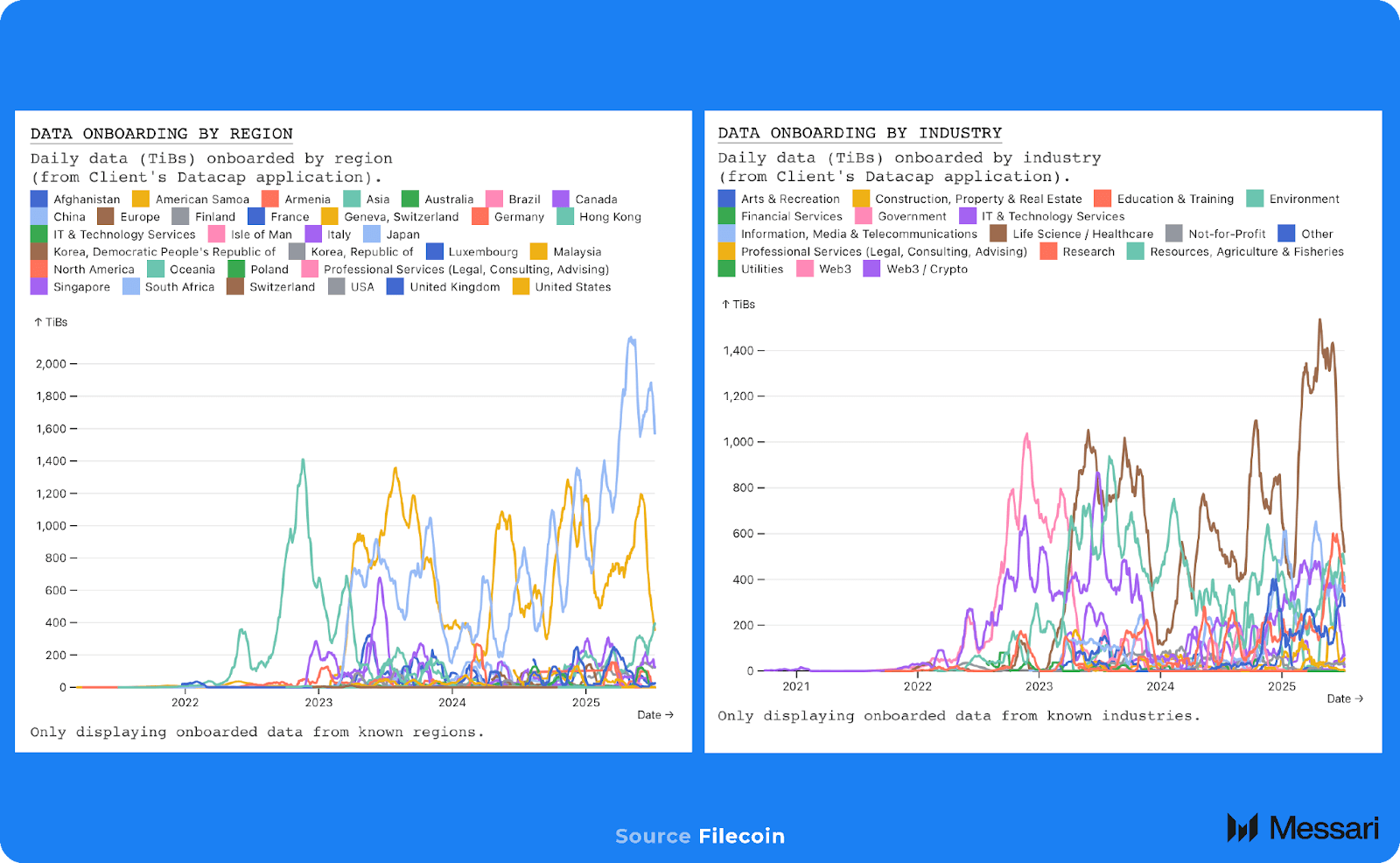
Data Onboarding by Region and Industry
Fil+ has become an important mechanism for incentivizing data onboarding across a range of use cases. Daily onboarding volumes, measured in tebibytes (TiBs), provide insight into which regions and industries are actively utilizing DataCap allocations and participating in Filecoin’s verified storage market.
Regionally, China has consistently accounted for the highest volume of Fil+ data onboarding, particularly from mid-2023 onward, with daily volumes exceeding 2,000 TiBs in 2025. This trend may reflect the activity of large clients supported by regional Notaries or coordinated data onboarding initiatives. Other regions, including the United States and Malaysia, also show periods of elevated onboarding, though with more variability over time.
Across industries, the Life Sciences and Healthcare sector has seen a notable increase in onboarding through the Fil+ program, particularly from late 2024 into 2025. This may be driven by a growing number of use cases focused on scientific research, clinical data storage, or long-term archiving. Other consistently active sectors include IT & Technology Services, Web3 / Crypto, and Education & Training, suggesting broad applicability of Fil+ incentives across both emerging and established data categories.
Overall, onboarding trends reflect how Fil+ incentives are being adopted across geographies and verticals, with activity concentrated in regions and sectors that may benefit from verifiable, long-term data storage. As the program continues to evolve, these patterns can offer a useful view into the areas where demand for Filecoin’s decentralized storage is developing most rapidly.
AI and Structured Data
Filecoin is increasingly being adopted as a decentralized backend for managing large-scale, high-value datasets in AI and structured data workflows. Key integrations include:
Bagel: A decentralized compute and data protocol that uses Filecoin for dataset storage and provenance. Bagel focuses on enabling open access to structured and unstructured data for AI training, benchmarking, and reproducibility.
Nuklai: Integrates Filecoin to store structured, collaborative datasets contributed by data providers and users. The goal is to create a shared knowledge layer for machine learning applications with decentralized incentives and governance.
Aethir: Primarily a decentralized GPU compute platform, Aethir incorporates Filecoin to persist model outputs and user-generated data, enabling persistent state management across distributed inference and compute environments.
These integrations highlight Filecoin’s evolving role not only as an archival layer, but as part of active, data-intensive systems supporting verifiability, auditability, and decentralized access within AI pipelines.
Community Growth Filecoin supports ecosystem expansion through a range of developer and community-focused programs aimed at education, collaboration, and regional outreach. Key initiatives include:
Orbit Ambassador Program: Empowers local community leaders to evangelize Filecoin, host meetups and workshops, and support onboarding across global regions.
Hacker Houses & Regional Summits: In-person events organized to deepen collaboration between builders, researchers, and ecosystem teams. These events act as hubs for experimentation, networking, and cross-project synergy.
These programs help accelerate developer engagement, foster new use cases, and expand Filecoin’s footprint in both established and emerging Web3 communities.
Governance Infrastructure Filecoin’s governance framework is designed to be transparent, participatory, and adaptable. Several tools and mechanisms support decentralized decision-making across the ecosystem:
FIP Process: A standardized, community-driven process for proposing, reviewing, and implementing protocol upgrades. It enables structured dialogue between stakeholders and core development teams.
GovHub: A centralized platform for tracking Filecoin FIPs, capturing community sentiment, and documenting proposal discussions.
Metropolis: A governance coordination tool that introduces offchain polling, delegation mechanics, and reputation tracking to improve participation transparency and reduce friction in voting workflows.
These tools ensure that Filecoin governance remains open and iterative, balancing input from developers, storage providers, tokenholders, and researchers as the network evolves.
Roadmap
Filecoin’s roadmap focuses on evolving the network into a modular, performant, and developer-friendly infrastructure for decentralized storage and compute. Progress is organized around two main vectors: technical upgrades to the protocol and strategic growth efforts to onboard users, developers, and institutions.
Technical Improvements
Retrieval Market Enhancements: FilCDN (production decentralized CDN) and Titan Network, is under active development to improve fallback routing, enable bandwidth sharing, and diversify performance across retrieval nodes. Together, these efforts aim to build a robust, multi-layered retrieval architecture to support high-availability data access at scale.
Zero-Knowledge Infrastructure and Rollups: Filecoin ecosystem contributors are actively exploring zero-knowledge proof systems and rollup-as-a-service (RaaS) solutions. These tools are expected to support scalable, trust-minimized computation and enable verifiable AI pipelines, particularly for performance-critical workloads.
Ecosystem Growth Strategy
Grants and Ecosystem Funding Filecoin Foundation, Protocol Labs and FIL-Builders continue to fund builders across the ecosystem, with targeted grants supporting infrastructure, tooling, and vertical-specific applications. Emphasis is placed on AI, DeSci, public data, and developer onboarding.
Cross-Chain Integration and L1 Partnerships Filecoin is extending its reach through integration support for external L1s such as Solana and Flow. These efforts enable onchain archival for externally originated datasets and increase Filecoin’s relevance across multi-chain ecosystems.
Developer Experience Expansion Tooling platforms such as Estuary, Powergate, Glif, and Textile are actively enhancing their documentation, APIs, and hosting pipelines to streamline developer workflows for programmable storage and compute services. These improvements are part of a wider push to reduce onboarding friction, strengthen developer experience, and support innovation across Filecoin. These efforts have been highlighted in updates like the NV25 "Teep" network upgrade, which includes enhanced developer tooling enhancements across the Filecoin ecosystem.
Closing Summary
Filecoin has evolved into a modular infrastructure stack designed for decentralized, verifiable data storage and compute. Originally focused on incentivized cold storage, the network has expanded to support smart contract programmability through the Filecoin Virtual Machine (FVM), enabling applications in DeFi, data management, and decentralized autonomous organizations.
The network operates across three primary domains: the base Layer-1 for consensus, proofs, and storage; an access and infrastructure layer that supports retrieval, compute coordination, and on-ramps such as Akave, Storacha, and Basin; and an application layer comprising developer tools and integrations. Filecoin’s verifiability guarantees are underpinned by Proof-of-Replication (PoRep), Proof-of-Spacetime (PoSt), and the recently introduced Proof-of-Data Possession (PoDP), which extends assurance to hot storage and real-time data access.
The ecosystem continues to diversify, encompassing storage and retrieval providers, hybrid infrastructure platforms, and DeFi applications such as FIL-backed stablecoins (e.g., USDFC) and capital leasing mechanisms (e.g., iFIL). Ongoing initiatives by the Filecoin Foundation and Protocol Labs, including grants, developer programs, and cross-chain integrations, have strengthened adoption and broadened the network’s reach across Web3, AI, and scientific data communities.
Looking ahead, Filecoin’s roadmap focuses on improving the retrieval market, integrating zero-knowledge infrastructure for scalable computation, and enhancing the developer experience. These efforts aim to reinforce Filecoin’s role as a core component of the decentralized data and compute ecosystem, supporting reliable, verifiable, and open infrastructure for emerging data-driven applications.
This report was commissioned by Filecoin Foundation. All content was produced independently by the author(s) and does not necessarily reflect the opinions of Messari, Inc. or the organization that requested the report. The commissioning organization may have input on the content of the report, but Messari maintains editorial control over the final report to retain data accuracy and objectivity. Author(s) may hold cryptocurrencies named in this report. This report is meant for informational purposes only. It is not meant to serve as investment advice. You should conduct your own research and consult an independent financial, tax, or legal advisor before making any investment decisions. Past performance of any asset is not indicative of future results. Please see our Terms of Service for more information.
No part of this report may be (a) copied, photocopied, duplicated in any form by any means or (b) redistributed without the prior written consent of Messari®.
Armita is a protocol researcher with a robust background in technology and blockchain. Before her role at Messari, she distinguished herself as a tech entrepreneur, executive, and advisor for various blockchain startups. Armita holds two master's degrees, one in Computer Engineering and another in Business Management, as well as a double major undergraduate degree in Physics and Pure Mathematics.
Armita is a protocol researcher with a robust background in technology and blockchain. Before her role at Messari, she distinguished herself as a tech entrepreneur, executive, and advisor for various blockchain startups. Armita holds two master's degrees, one in Computer Engineering and another in Business Management, as well as a double major undergraduate degree in Physics and Pure Mathematics.