Fei Protocol: A New Model for Stability

Set to launch on March 31, Fei Protocol is a new decentralized stablecoin protocol that will be partially collateralized by Ether. It recently made headlines as it raised $19 million from a16z, Framework Ventures, Coinbase Ventures, and Nascent, among others. At the center of the excitement around Fei are two novel ideas: protocol controlled value and direct incentives. Combined they offer the potential to create a truly governance-minimized, capital efficient, decentralized stablecoin.

Protocol Controlled Value
Protocol Controlled Value (PCV) involves the protocol of itself taking ownership of collateral it receives when users mint new FEI (the stablecoin). FEI cannot be redeemed for its underlying collateral. This stands in contrast to every other collateral based decentralized stablecoin including partially collateralized stablecoins like FRAX and ESD (in Continuous ESD), and over-collateralized stablecoins like Dai, which can be redeemed for their underlying collateral.
FEI enters circulation via sale along a bonding curve. When the price of FEI rises above $1.01 (more on this in a bit) users can buy FEI from the bonding curve. At launch the project will only support a single bonding curve denominated in ETH, meaning that users can only buy FEI with ETH; however, it eventually plans to support additional curves denominated in other ERC-20 tokens. The assets deposited into the bonding curve may not be redeemed and are permanently owned by the protocol (hence why FEI is not redeemable for its underlying collateral).
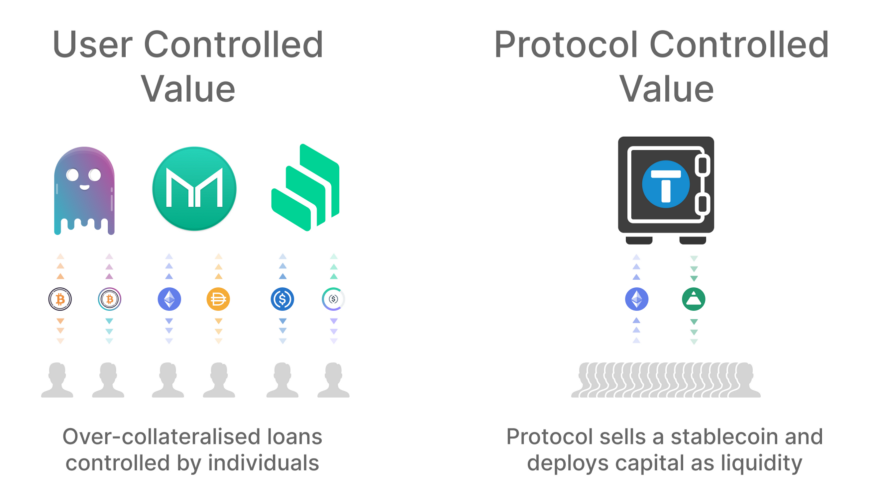
Source: Fei Protocol Blog

Ryan Watkins was a Senior Research Analyst at Messari. Previously, he worked at Moelis & Company as an Investment Banking Analyst where he worked on deals in the technology, telecom, and fintech sectors. Ryan graduated Magna Cum Laude from the Gabelli School of Business at Fordham University.