Exchanges listings' effect on prices

This post was originally published on May 07, 2019, and sent to Messari Pro subscribers.
For a while, trading the “Coinbase effect” was a well-known investment strategy amongst crypto speculators. Want to predict when a token would pump? Predict when it would get added to Coinbase. The Coinbase effect has become more muted recently with the rise of Binance and other large, liquid exchanges. It wasn’t a Coinbase listing per se, but rather “a large source of liquidity” (and often, the “first meaningful source of liquidity”) that really mattered when it came to listing effects. After the listing announcements of Zcash and XRP failed to produce any meaningful uptick in price, many jumped to the conclusion that the Coinbase effect was dead. The reality is a bit more nuanced than that.
As part of our ongoing war against two data point sample sizes, we decided to look at Coinbase listings dating all the way back to Ethereum, the first asset the company added after Bitcoin. In order to discern whether a correlation between price and listing exists, we looked at bitcoin-denominated returns 24 hours, three days, and one week after Coinbase (including GDAX/Coinbase Pro) announced support for a new asset. We used bitcoin-denominated returns to show relative returns against a crypto “benchmark.”
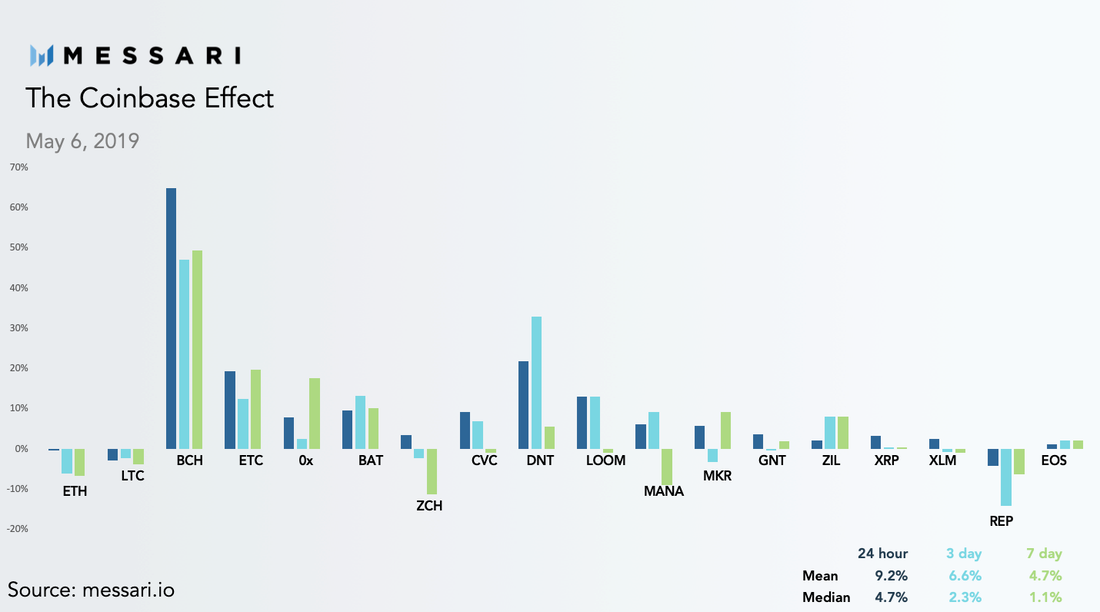
The results show that while the Coinbase effect exists, its impact has declined. Bitcoin Cash (which was a surprise announcement and simultaneous listing), Ethereum Classic, and District0x all experienced rallies in the days following their listing announcements, but most other assets saw low single-digit, or even negative, returns. Earlier listings (those to the left in the graphic) tended to see higher returns from a listing announcement. Interestingly, the first two listings, Ethereum and Litecoin, did not see any spikes due to the announcement of their imminent listing. However, once Litecoin became tradable it surged from $23 to $32 indicating that (at least in this case) it may not have been speculation others would buy upon trading availability, but rather that the actual ability to buy was a catalyst for Litecoin’s rally. This was an exception to the rule.
Analyzing subsequent listings, assets experienced larger price increases based solely on the announcements rather than the actual listings. This was evidenced by price appreciation immediately following an announcement that tapered off or decreased later that first week. Are the results statistically significant?
We ran a one-sample t-test that showed the 24-hour, 3-day, and one-week periods returned probabilities of one, seven, and nine percent, respectively. Typically a five percent threshold is the cutoff for proving significance. So, even when the Coinbase effect exists, it's only for the 24-hour period following an announcement.
