Ethereum's Future: Emerging Technologies for a Scalable and Decentralized Future

Overview
Ethereum, long heralded as the undisputed leader in the blockchain space, is starting to show signs of vulnerability. Its once unshakeable position is now being challenged by a new wave of competitors, innovative technologies, and evolving market trends. The landscape is shifting, and Ethereum's dominance is no longer a foregone conclusion. These emerging challenges are multifaceted and stem from various sources. Newer blockchains are touting faster transaction speeds, lower fees, and improved scalability, features that Ethereum has traditionally struggled with.
While initially holding 100%, Ethereum's fee revenue share has steadily decreased in favor of Alt L1s. Notably, BNB, Tron, and Solana have emerged as significant competitors, each claiming a growing percentage of the fee revenue.
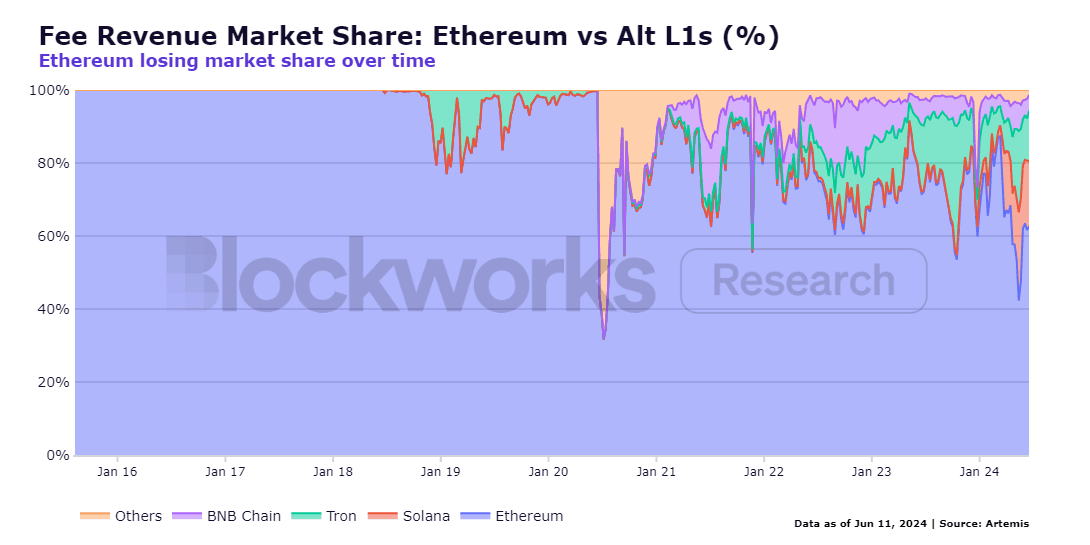
As highlighted above, Ethereum is facing increasing challenges to its once-unrivaled position. This decline vs Alt L1s is not necessarily due to the limited capabilities of the L1 but rather can be attributed to users shifting their activity to Ethereum L2s. This outcome was anticipated and agreed upon by core developers when L2s were first introduced as the solution to scaling Ethereum. Below we show the evolution of Ethereum vs L2 daily transactions.
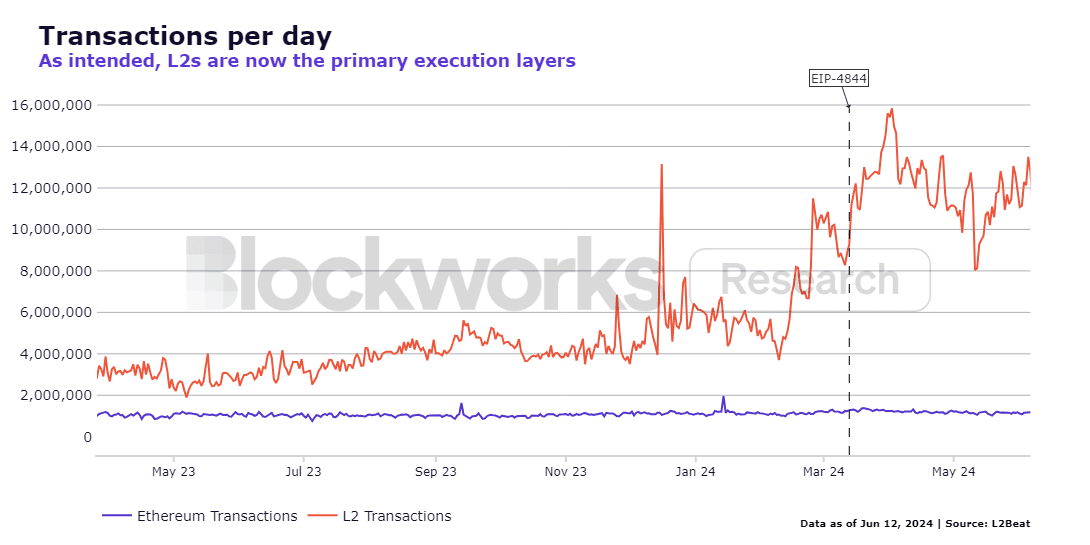
However, this rollup-centric roadmap is not without its tradeoffs. For instance, MEV is yet another metric in which Ethereum has lost its long-held first position. MEV Tips are paid from users to validators for transaction inclusion or priority access to state. Generally, this is to capture opportunities like CEX to DEX and cross-DEX arbitrage. Since April 2024, Solana has been the new king of MEV capture, largely driven by the rise in memecoin trading activity.

Marc covers Ethereum, Bitcoin and their L2s. Previously led Ethereum and DeFi research at CoinShares.