Ethereum Roadmap Part 2: The Surge and the Scourge

Prior to 2022, Ethereum’s scaling roadmap focused mostly on sharding the execution layer. However, since rollups have proven themselves to be a much better solution for scaling execution, Ethereum has opted to remove sharding from the roadmap and instead make Ethereum the best possible base layer for rollups.
The Surge refers to the goal of maximizing the scalability and throughput of rollups built on Ethereum.
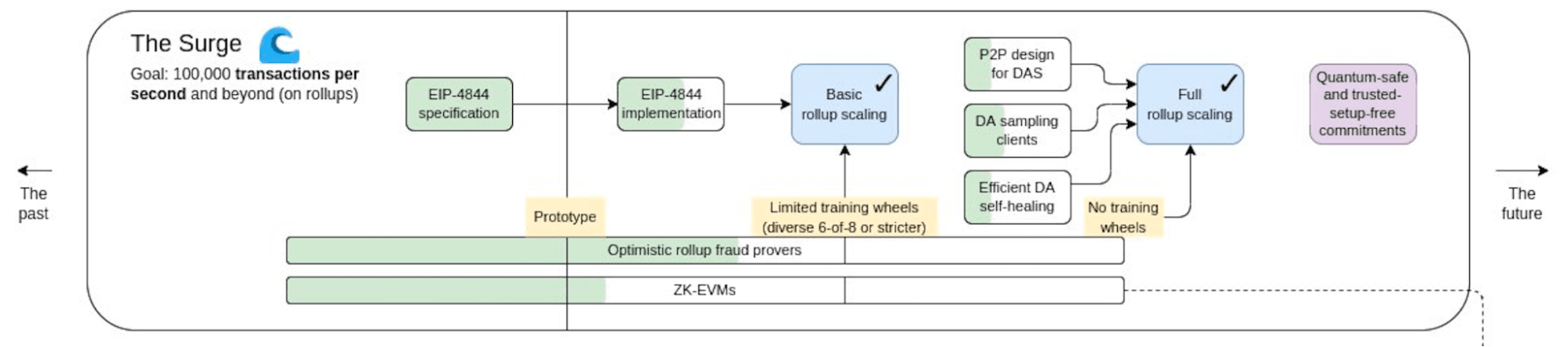
*Source: *https://twitter.com/VitalikButerin/status/1588669782471368704/photo/1
This section of Ethereum’s roadmap includes two iterations, starting with basic rollup scaling before full rollup scaling. In order to achieve basic scaling, Ethereum as a base layer will need to change how L2 data is posted to the L1 through Proto-Danksharding while rollup teams work in parallel to create rollups, including optimistic rollups and zk rollups (such as zkEVMs), under a set of training wheels. Full rollup scaling includes further improvements to calldata, improving Ethereum’s data availability capability, all alongside completely decentralized and robust rollup implementations.
In addition to rollups, another key component to Ethereum is how it chooses to handle MEV, which so far has seen its solutions built outside the core protocol through Flashbots’ MEV-Geth and MEV-Boost. This also pairs with Ethereum’s concerns around censorship and credible neutrality, as proposers can effectively choose which blocks they want to include.
The Scourge refers to the goal of MEV management and credibly neutral transaction inclusion through the role of Proposer-Builder Separation (PBS), inclusion lists, and application layer mitigation strategies.

Westie leads coverage on Ethereum, L2s, and Synthetix. Previously he worked in public sector technology Consulting at Guidehouse.