Ethereum Liquid Staking: Cash Flow in Crypto

On January 10, 2024 the SEC officially approved the launch of a spot Bitcoin ETF. With 11 different asset managers launching BTC ETFs, the event marked a milestone for broader scale institutional interest in BTC and the digital asset market. Amidst steady inflows to BTC, the market’s attention has begun turning toward Ethereum, as Blackrock filed for a spot ETH ETF in November 2023. Although it is unclear whether an ETH ETF will be approved in 2024, the potential institutional flows from such an event would mark a fundamental shift in the market. An ETH ETF would mark the first time asset managers could offer an investment product for an asset that can be staked, which greatly enhances the attractiveness of custody from an institutional perspective.
A potential ETH ETF catalyst, combined with the mainnet launch of EigenLayer in Q2 of this year, paints an optimistic picture for Ethereum and the broader liquid staking market going forward. Currently, an all-time high of 28.9M ETH (~$69.36B) is staked across 906k different validators. This is quite impressive when considering that Celsius has wound down staking operations to prepare for in-kind distribution to creditors. The bankrupt entity has unstaked 537k ETH (~$1.3B) in the past month. EigenLayer has truly become a black hole for Ethereum, with 745k ETH (~$1.8B) staked. This growth can likely be attributed to the fact that EigenLayer stakers accrue points, which will likely be redeemable for a token upon mainnet launch. Further, various protocols, such as Alt Layer, are targeting EigenLayer participants for airdrops. Once the AVS market heats up on mainnet, Pandora’s box will be opened and the amount of ETH staked will likely continue to expand at a rapid pace.
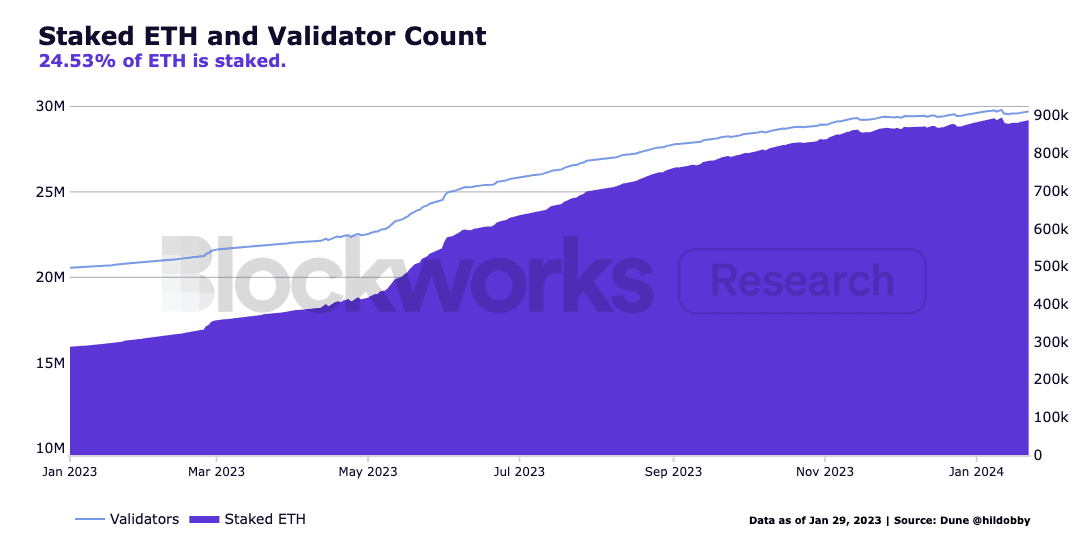
With that being said, liquid staking protocols sit at a prime intersection between DeFi, Ethereum, and cold hard cash flows. This report will provide an update on major LST providers and point to any catalysts on the horizon. As ETH staking continues to ramp up, the LST market sits primed for an unprecedented flywheel, where LST governance tokens can become cash cows and potentially outperform ETH as an investment.
Restaking
As mentioned above, the demand structure of ETH is set to evolve throughout 2024 on the back of new dynamics introduced via restaking, a process where market participants can stake their already-staked ETH (restake) to secure another protocol or service. Restaking lets a user pledge their stETH to loan security to another protocol to earn an incentive. However, if the node operator fails to comply with operator requirements, the user faces additional slashing risk, where the total deposited collateral can be drawn against to fulfill obligations.
EigenLayer will serve as the marketplace for AVS (actively validated services), where protocols can purchase security from node operators/stakers. The first AVS to market is EigenDA, which provides a high throughput and decentralized data availability service on top of Ethereum. Restakers can delegate stake to node operators that perform duties for EigenDA in exchange for service payments. The end user for EigenDA is any rollup that wants to enable low transaction costs and high throughput, as EigenDA is drastically cheaper than current DA on Ethereum.

Pibblez leads coverage on emerging L1s, infrastructure, and stablecoins. Previously worked as a Research Analyst at Kraken.