Ethereum June 2024 Update

Market Commentary:
In June, markets rose as inflation declined but still remained above the Federal Reserve’s 2% target rate. The latest Consumer Price Index (CPI) slowed for the second straight month in a row, showing overall prices increasing 3.3% YoY compared to the reported 3.4% in April. Lower gasoline prices helped drag down the overall index as the energy index fell 2% in May, while gasoline fell 3.6%. Moreover, core inflation (which strips out food and energy prices) rose 3.4% YoY compared to 3.6% in April. However, as highlighted in last month’s update, the housing sector continued as the focal point. It was the largest factor in the core CPI’s monthly increase as rent prices rose 0.4%, marking the fourth straight month of rental increases. However, the Producer Prices Index (PPI) surprised to the downside falling to 2.2% in May - its biggest decline since October 2023.
While the US economy seemingly remains sturdy, data showed retail sales were 0.1% in May (0.2% expected). This conveys that consumer spending is coming off its high point, which the Fed would like to see if it wants to decrease interest rates later this year. Furthermore, the Personal Consumption Expenditures Index, the Fed’s preferred inflation gauge, is expected to be flat for the month of May. Jerome Powell stated that the committee would need to see more “good data” before cutting rates. The odds of a rate cut have now increased to an estimated ~61% chance in September (up from ~50% last month).
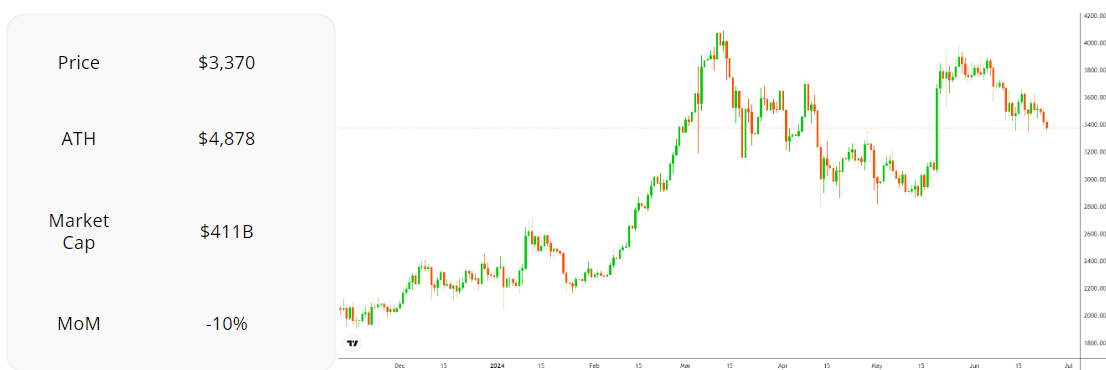
The S&P 500 hit an all-time high of 5,482, up 4% from the end of May; similarly, the NASDAQ rose 5%, continuing its upward trend for 2024. While gold did not hit a new all-time high, it ranged between $2,270 and $2,305. However, the aforementioned macro factors, while positive for stock prices, did not help ETH as its price declined 10% from $3.8k to $3.3k. This decline happened despite the upcoming US spot ETH ETF. However, we won’t see these ETFs trading until the SEC reviews S-1 registration statements filed by fund issuers, a process that could happen within the next week or two. Estimates for inflows currently range between 10% and 30% of Bitcoin inflows. With a deflationary supply and the majority of ETH not on exchanges (as discussed later), flows at the top end of the range could have a material impact on the price of ETH.
Ethereum is preparing for Pectra, its next major upgrade following the March 2024 Dencun upgrade. Pectra, scheduled for early 2025, combines two upgrades (Prague and Electra) to improve Ethereum's flexibility and optimization. It includes several Ethereum Improvement Proposals (EIPs) that enhance account abstraction, validator operations, and network performance. Some notable improvements include faster BLS signature operations, increased validator balance limits, and data availability sampling. Post-Pectra, the network will be better equipped to handle increased adoption, integrate with other networks, and introduce new features. After Pectra, the Ethereum community is considering implementing Verkle trees in the Osaka upgrade to enable stateless validator clients for improved solo staking.
TradFi Markets:

Marc covers Ethereum, Bitcoin and their L2s. Previously led Ethereum and DeFi research at CoinShares.