Ethereum Feels the Burn

Top of Mind
With improvement in market sentiment, on-chain activity has increased, and ETH has become net-deflationary since The Merge. From Sept. 16, 2022, to Jan. 22, 2023, ~219,000 new ETH were issued as protocol rewards, and 222,000 ETH were burnt through base transaction fees giving a net burn of 3,000 ETH and a net deflation rate of ~0.01%.
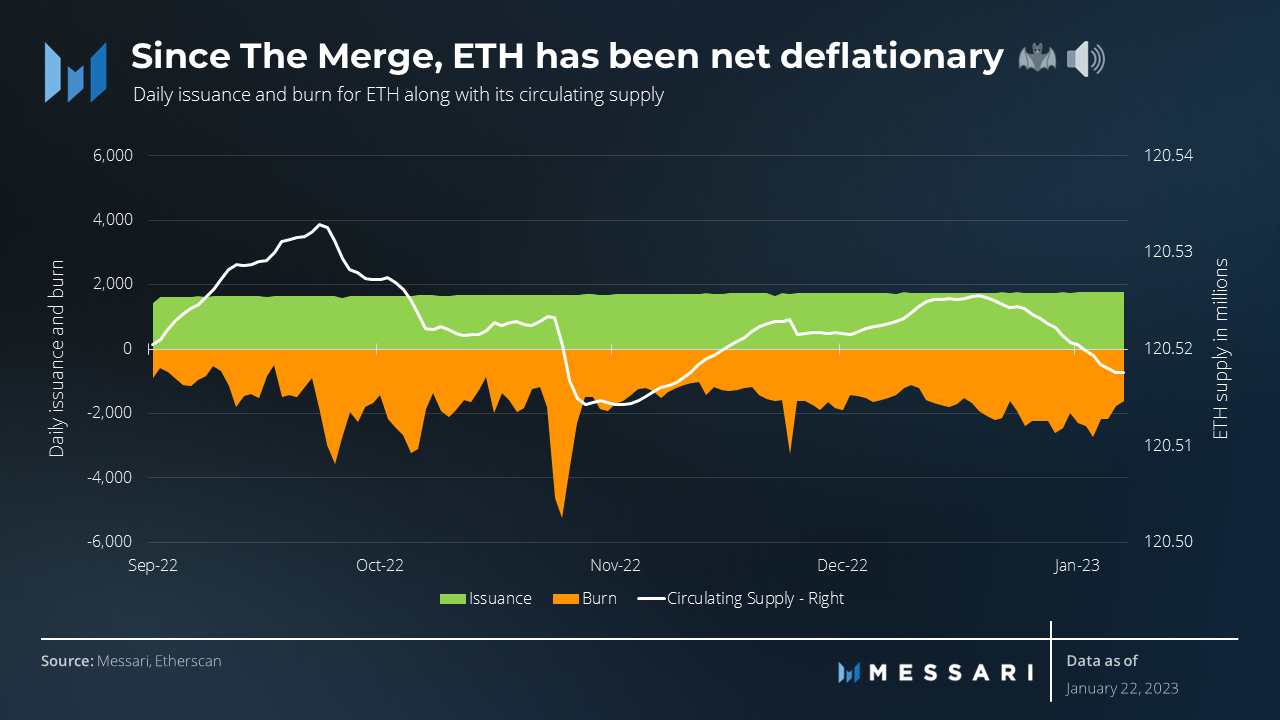
With inflation near zero, the income made by the validators may be considered “real” yield (as opposed to nominal yield, which is pre-inflation). However, the rewards are still in the base asset, ETH, which makes the yield more similar to the federal funds rate or a stock dividend rather than cash flows. “Real” yield generated in the base asset should not be used for a discounted cash flow calculation, as a change in the value of the asset changes the value of the cash flow. This creates a self-referential loop where the calculated fair value is driven by the price. “The Theory of Relativity” covers this idea in greater detail.
A recent post by Domothy, a researcher at the Ethereum Foundation, brought to light an interesting relationship between the value of ETH, inflation rate, and fee paid in USD. We can calculate a dollar value for ETH if we have a desired inflation rate and assume that the fee paid for transactions in USD is independent of the price of ETH.
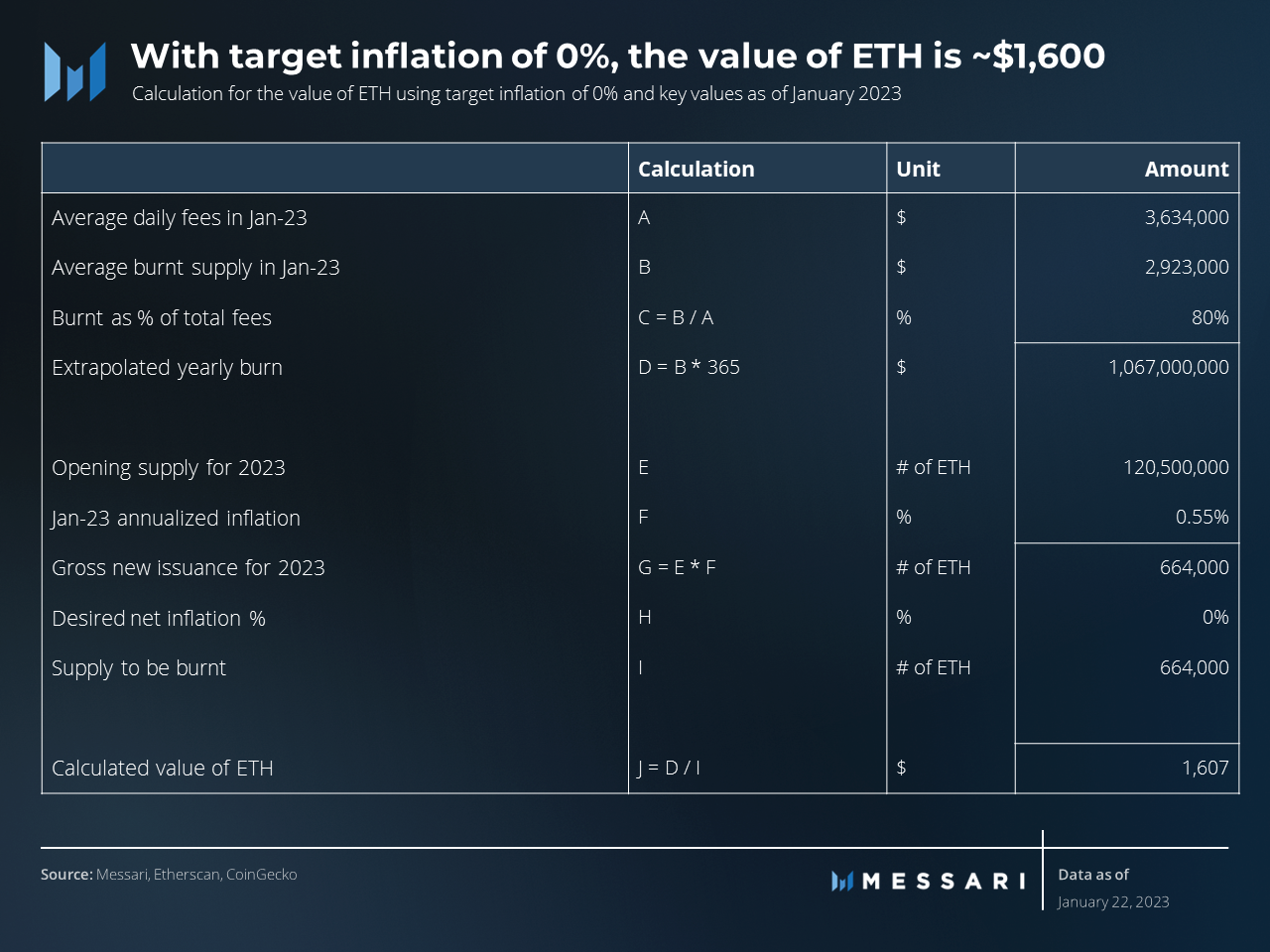
At 0% inflation, the base fees burnt on EIP-1559 transactions can be divided by the supply issued through the year. For January 2023 values, the calculated value for ETH is ~$1,600. The calculated value of ETH increases with higher gross and desired inflation. Gross inflation is a function of the amount of ETH staked and will likely increase post-Shanghai as more ETH is staked. While the meme of ultrasound money is strong, desired net inflation should likely be a small positive value to replace the ETH lost in accidental transactions and private keys lost. Both of these considerations should positively affect ETH’s calculated value than what we have currently assumed.

Kunal previously worked in equity research and now considers himself a financial analyst in crypto. He specializes in valuation and bottom-up analysis for Layer-1 and DeFi protocols because he has yet to learn of a way to value NFTs.