Ethereum August 2024 Update

Market Data
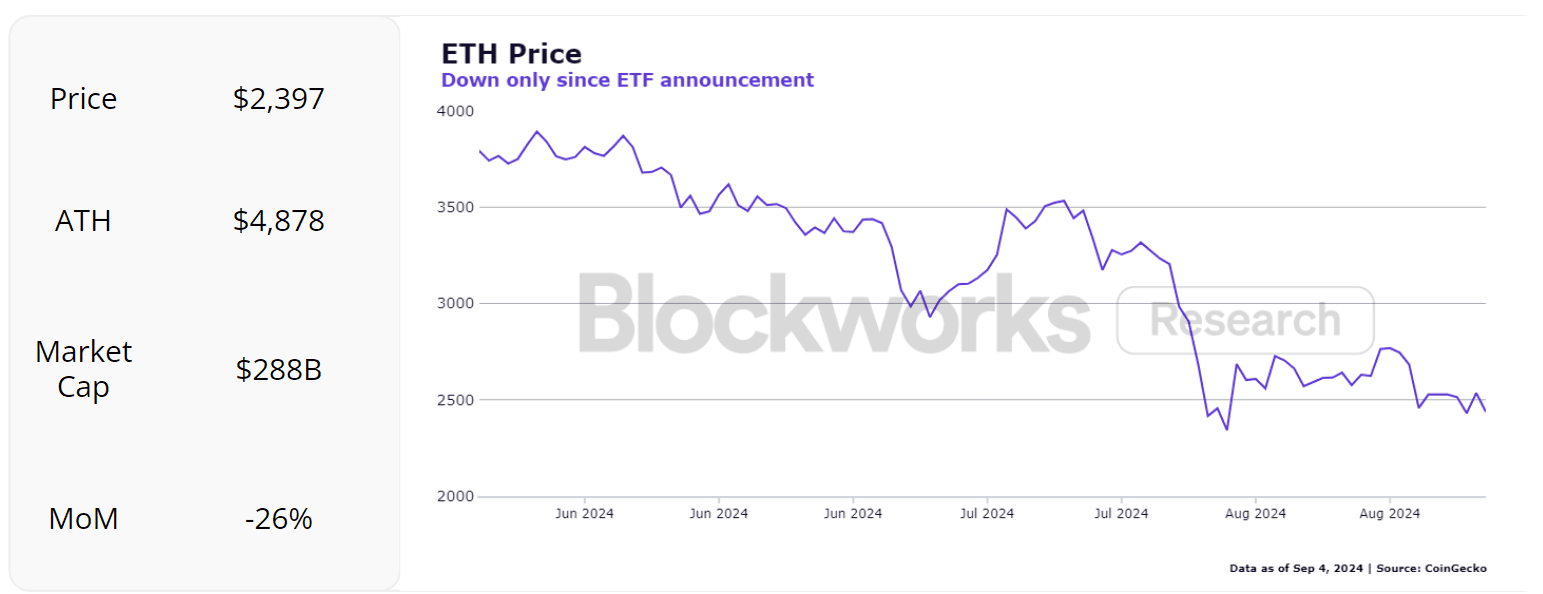
Market Commentary
In August, markets were volatile but ended higher as inflation declined but remained above the Federal Reserve’s 2% target rate. Recent economic data suggests that the period of high inflation may be coming to an end. The Personal Consumption Expenditures (PCE) Price Index, a key measure of inflation, showed a significant decline in both overall and core inflation rates. For the 12 months ending in July 2024, overall inflation stood at 2.5% while core inflation (excluding food and energy) was at 2.6%. These rates were unchanged from June.
Fed Chair Jerome Powell indicated that if economic data continues to show progress on inflation coupled with a stable labor market, a rate reduction could be considered. Recent data shows inflation nearing the Fed's target and a softening labor market. JOLTS data showed that the number of job openings fell by 237K in July, bringing the number of openings as a percentage of total employment down from 4.8% to 4.6%. This marks the lowest rate since December 2020. Similarly, the ratio of jobs per unemployed worker reached 1.1, a ratio not seen since the pre-pandemic era. However, the report also highlighted that the rate at which employers hired new workers and the rate at which workers voluntarily quit their jobs were both inching up. This highlights a faster-moving more adaptable job market vs 2019.
Moreover, the number of people filing new insurance claims fell to 227K last week (a drop of 5K). The claims data has remained steady for months, implying no sudden layoff increases despite other signs of a softening job market. This is while the US economy added 142K jobs in August, causing unemployment to creep lower to 4.2% (from 4.3% in July). It should also be noted that July and June jobs added were revised down by 25K and 61K respectively (to 89K and 118K). Regardless, the labor market has now retraced to its pre-pandemic levels albeit with some tweaks. Financial markets are now at even odds between a 25bp and 50bp rate cut this month. Given the markets’ recent historical mispricing for earlier and more frequent cut dates, and comments from Jerome Powell, a 25bp cut may be more likely.
The S&P 500 ended August at 5,648, 2% higher than the end of July. Similarly, the NASDAQ also closed higher, ending the month 0.7% higher vs July. As not to be left out, gold saw a new all-time high of $2,525 and ended the month at $2,493 (up 2.8% MoM). While a positive month for stock and gold prices, the aforementioned macro factors did not help ETH as its price declined 26% from $3.1k to $2.4k. This marked the third month in a row of declining prices for ETH.
In fact, the flash crash on August 5th led to Ethereum’s largest liquidation month since 2021. Total liquidations for lending protocols reached $450M with Aave hosting nearly two-thirds of that ($290M). Below we show the liquidations on Ethereum over the last year.

Marc covers Ethereum, Bitcoin and their L2s. Previously led Ethereum and DeFi research at CoinShares.