Ether.Fi: The Crypto Neobank

Market Context & Positioning
Ether.Fi entered the market in 2023 at a time when Ethereum staking was already consolidating around a handful of leaders. Lido controlled more than 30% of staked ETH and had become the default venue for both institutions and DeFi participants, while other competitors were left to compete in niche markets, such as Rocket Pool, which targeted a smaller base of home-staker–friendly participants. Against this backdrop, Ether.Fi differentiated itself by introducing a withdrawal-key model that gave depositors custody assurances. Its two-NFT structure, splitting capital ownership from validator operations, was a deliberate signal: Ether.Fi was positioning itself as a credible, user-first variant in a market where trust and control were central concerns.
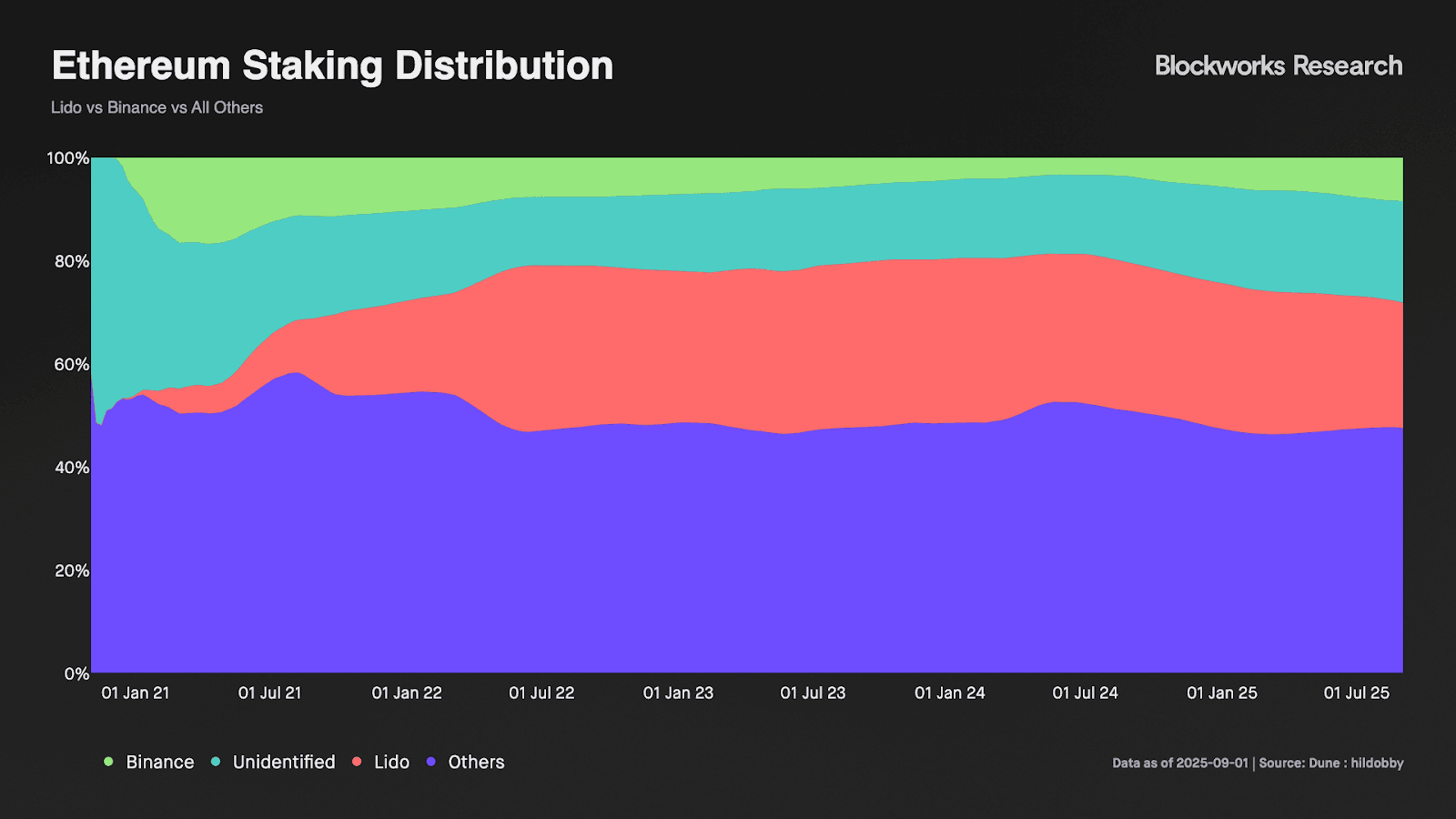
The more powerful catalyst, however, came from timing. Ether.Fi’s launch coincided with two of the most dominant staking narratives in Ethereum’s recent history: the Shanghai upgrade and the emergence of EigenLayer. While Shanghai unlocked withdrawals, catalysing new ETH inflows into staking, EigenLayer began to capture mindshare with the concept of restaking (using staked ETH to secure additional services). This narrative rapidly escalated. By early 2024, Polymarket was pricing EigenLayer’s fully diluted valuation at $20–25B, reflecting how strongly the market was valuing its potential. When EigenLayer launched its points program in late 2023, it effectively cemented the airdrop meta as the core driver of flows.
That environment opened the door for new entrants. Lido, constrained by its conservative governance and emphasis on validator security, chose not to participate in EigenLayer. Into that gap stepped a group of new and tokenless protocols such as Ether.Fi, Renzo, Karak, Mantle (through mETH), Swell, Puffer, and Kelp, all able to stack their own points programs on top of Eigen’s. The incentive structure became extremely powerful: LRTs offered base staking yield, EigenLayer points, and protocol-specific points, while still giving investors exposure to the underlying ETH. The results were immediate, and in one month of 2024 alone, these new platforms attracted 862k ETH, with Ether.Fi quickly emerging as one of the core beneficiaries.
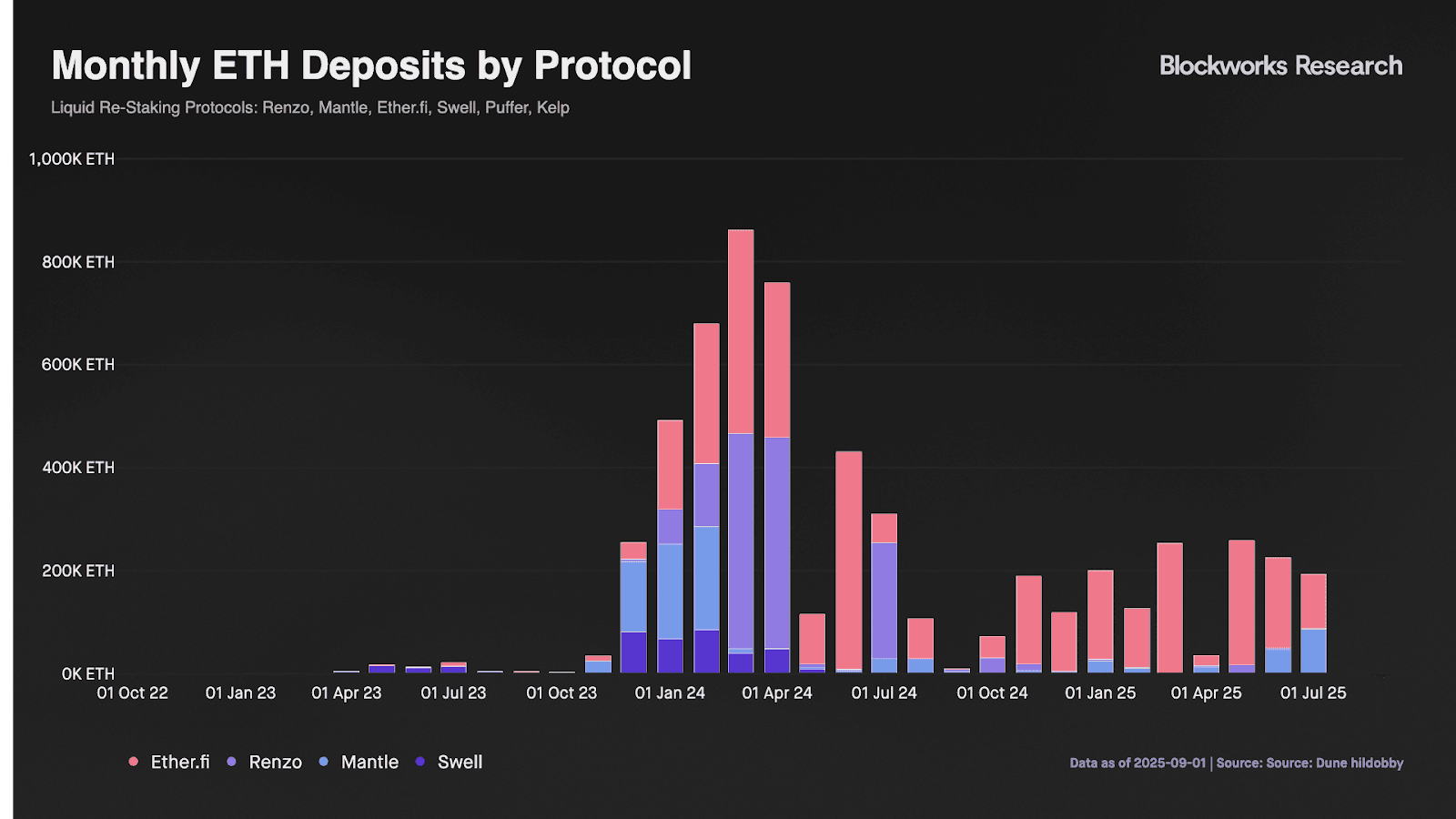
With this explosive growth, the LRT sector expanded from less than 100k ETH staked on January 1, 2024 to a peak of 3.8M ETH by June 20. Ether.Fi’s eETH accounted for 1.8M ETH, representing nearly half of the market. The driver of this penetration was not only incentive alignment but also the team’s speed of integration. eETH was rapidly adopted across leading DeFi protocols, with Pendle becoming the anchor venue. At one point, Pendle markets held 400k eETH as traders used PT/SY positions to express views on yield and points. The points meta proved to be the initial growth engine for Pendle itself, helping propel its TVL from $200M in January 2024 to $6B by June.
